




Sauna Dekor Spa Solutions engineering team, Istanbul
Last updated: 14 October 2026
Short answer: sauna lighting is chosen by heat rating first. A Finnish sauna runs at 80–100 °C, so an LED strip in it must be rated for about 125 °C, glass fibres tolerate 180 °C, and plastic fibres rated for 80 °C do not belong in a sauna at all. Sauna Dekor Spa Solutions builds hotel and villa saunas, and this guide, dated 14 October 2026, sets out which light goes where.
The ratings below come from the published sheets of Cariitti, the Finnish maker of sauna lighting and fibre optics, and from the installation manual of Harvia, the Finnish heater maker. Wiring zones and cable ratings are covered in our separate guide to sauna electrical requirements; this article is about the light itself.
Why is sauna lighting chosen by temperature rating?
Because the air under a sauna ceiling is the hottest air in the building. A Finnish sauna runs at 80–100 °C, and heat rises, so the ceiling edge where a light line looks best is also where it suffers most. Every light in the room needs a stated ambient temperature rating above that figure.
The rating is a property of the whole fitting, not only of the LED chip. Cariitti’s sauna LED strip, for example, states an ambient range up to +125 °C, a silicone casing rated to +180 °C and a silicone connection cable rated to +200 °C. Each part that sits in the hot air has its own number, and the lowest of them sets the limit for the fitting.
That is why a sauna light is specified from a datasheet rather than from a catalogue photograph. A strip sold for kitchens or bathrooms may look identical and fail in weeks. In our specifications every light inside a sauna carries a written ambient rating from its manufacturer, alongside its IP rating and its supply voltage.
Can you use LED strips in a sauna?
Yes, if the strip is made for it. Cariitti’s Sauna Ultra Ambient strip is rated for ambient temperatures from −40 to +125 °C, sealed to IP67 and supplied at 24 V. It is designed for sauna ceiling edges, where it gives about 45 °C of margin over a sauna at 80 °C.
The datasheet gives the rest of the specification. The warm white version runs at 2,700 K and 3 W per metre, with a colour rendering index above 90, and it can be cut every 50 mm. It comes in a side-emitting and a top-emitting version, so the same strip can light a ceiling edge, the back of a bench or a backrest, depending on which way the light needs to fall.
The low voltage matters for the installation. A 24 V strip is fed from a driver, and the driver does not need to sit in the hot room. We place drivers outside the cabin, behind a service panel, so that the only things inside the sauna are the sealed strip and its heat-rated cable. Running cables through the wall build-up without breaking the vapour barrier is part of the sauna insulation detail.
How does fibre optic sauna lighting work?
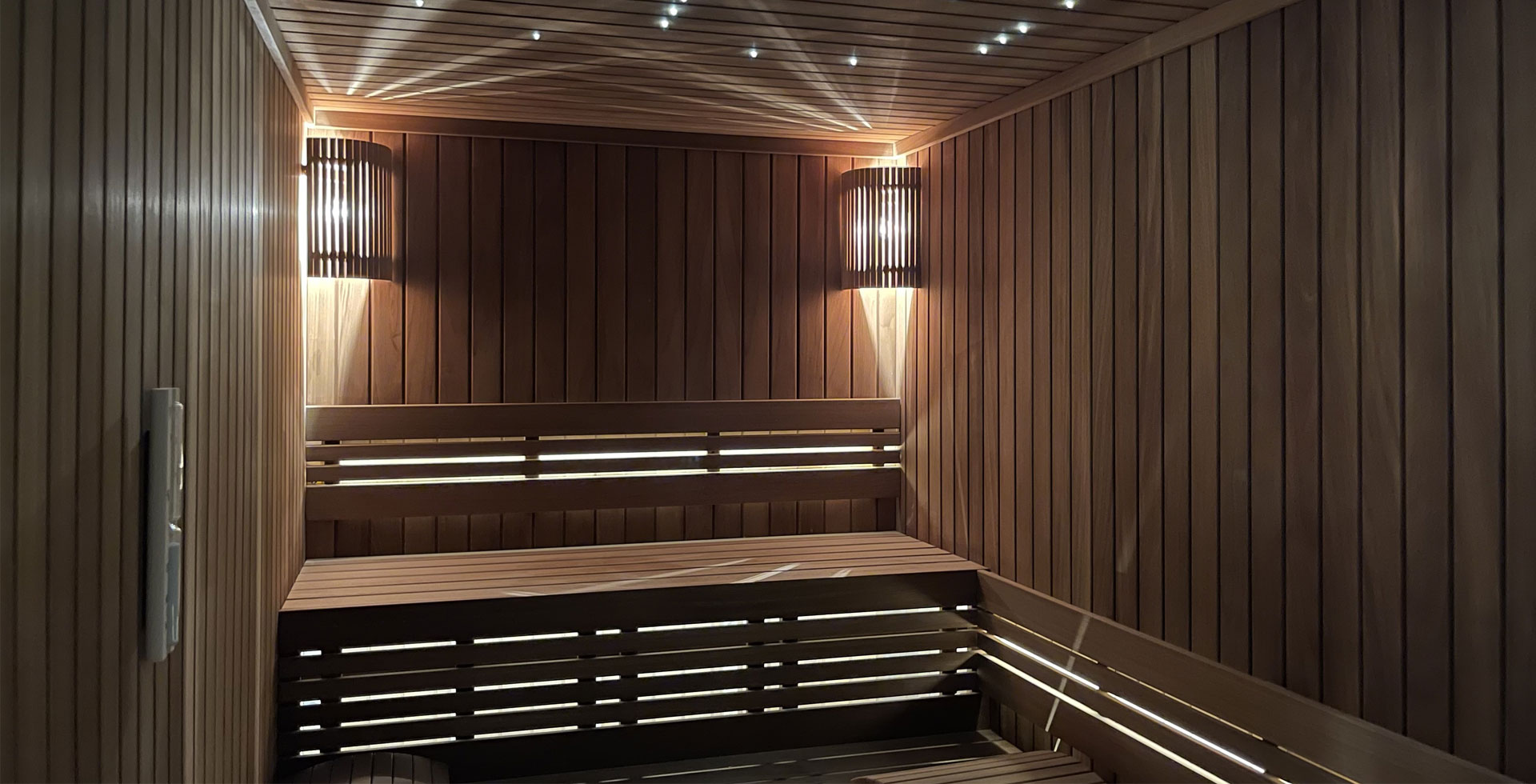
A fibre optic system keeps the light source out of the heat and carries only light into it. A projector holds the LED; glass fibres run from it to the ceiling, the benches or the backrests. Cariitti rates its glass fibres for saunas at 180 °C, so the fibre ends can sit in the hottest part of the ceiling.
The projector has its own limits. Cariitti’s VPAC27 projector is sealed to IP65 and may be installed inside the sauna, under the benches, at no more than 80 cm from the floor. Its VPL30X projector allows an ambient temperature of no more than 40 °C and, inside a sauna, an installation height of no more than 40 cm from the floor. Both figures put the projector low, where the air is coolest.
Fibre sets are sized to the room. Cariitti’s Ceiling Pro set, recommended for saunas of 3–5 m², carries fibres of 2 mm with one thicker 3 mm fibre for the heater, a 16 W LED at 2,700 K and a mains dimmable supply. Glass fibres cannot be cut on site, so the harness is ordered to the measured lengths of the room. This is the system behind most starry sauna ceilings.
Why are plastic fibres not used in a sauna?
Because they are rated for only 80 °C. Cariitti states that the plastic fibres in its starry sky sets tolerate up to 80 °C and may not be installed in a sauna. The same sets are suitable for steam rooms and infrared cabins whose temperature stays below 80 °C.
The difference matters because the two kinds of fibre look the same once installed. A starry ceiling in a steam room and one in a sauna can show the same pattern of points, but the sauna version must use glass fibres rated for heat. When a hotel spa has a sauna and a steam room side by side, the two ceilings are therefore two separate orders, even if the interior designer draws them as one effect.
The steam room has its own problem, which is water rather than heat: its fittings need sealing against condensation and spray. That side is covered in our guide to steam room lighting, which sets out IP ratings, drivers and speakers for a room close to saturation.
Which light source suits which job?
Each of the 4 common sauna light sources has one job it does well. LED strips draw lines along ceiling edges and benches, glass fibres place points in the hottest part of the ceiling, wall lights give the room its main reading light, and a lit panel gives soft, even light from above.
| Light source | Published heat rating | Typical position in a sauna | Source of the rating |
|---|---|---|---|
| Sauna LED strip, 24 V, IP67 | Ambient −40 to +125 °C | Ceiling edge, under bench edges, behind backrests | Cariitti Sauna Ultra Ambient datasheet |
| Glass fibre ends | 180 °C | Ceiling points, heater fibre, benches and backrests | Cariitti Ceiling Pro and Seat Lighting sets |
| Fibre projector | Ambient up to 40 °C (VPL30X); IP65 | Outside the room, or under benches 40–80 cm from the floor | Cariitti VPL30X and VPAC27 sheets |
| Plastic fibre ends | 80 °C | Not in a sauna; steam room or infrared cabin only | Cariitti Starry Sky sets |
| Wall light, vapour-proof | Per the light’s maker | 150 mm below the ceiling, not over the heater or upper benches | Harvia installation manual |
Most hotel saunas we build combine 2 or 3 of these. A typical scheme is a light line under each bench edge for safe footing, a soft line along the ceiling edge or a backlit panel for atmosphere, and either wall lights or fibre points for character. The wall light is the one most often left out in new designs, because indirect lines already light the room.
Where should the lights go in a sauna?
Lights go where they light surfaces, not faces. Harvia’s manual places a wall light 150 mm below the ceiling, not directly over the heater and not over the upper benches, and allows lights under the benches. Cariitti designs its strip for ceiling edges and its fibres for ceilings, benches and backrests.
The rule behind both is that a guest lying on the upper bench should not look into a light source. Light aimed at timber is reflected back softly; light aimed at the bench is seen as glare. So the lines go under the bench edges, where they light the step and the floor, and behind the backrest slats, where they light the wall. The ceiling line faces the ceiling or the wall, not the room.
Timber colour changes the result. Pale woods such as aspen and ayous reflect more light than thermo-treated timber, so a dark sauna needs more light, or more lines, for the same effect. Our guide to sauna wood compares the timbers we use; the lighting is chosen after the timber, never before.

Should the heater be lit?
A heater can be lit, but only with a fitting made for that position. Cariitti includes 1 thicker fibre and a stove lens in its sauna fibre sets for lighting the heater area. Harvia, for its part, asks that a wall light is not placed directly over the heater.
The two statements fit together. The air directly above a heater is hotter than anywhere else in the room, so an ordinary light there is out of its rating; a glass fibre end, which carries no electricity and is rated for 180 °C, can be aimed at the stones from a safe distance. The result is a soft glow on the stones without a fitting in the hottest air.
The heater guard and the clearances around the heater are set by the heater manufacturer and do not change because of lighting. Any lit detail near the heater is checked against the heater’s installation manual before it is drawn, and on our drawings the stove fibre is shown with its distance from the heater stated.
What colour temperature suits a sauna?
Warm white, around 2,700 K, is the usual choice for a Finnish sauna, and it is the colour Cariitti uses for its sauna LED strip and its Ceiling Pro projector. Both state a colour rendering index of 90 or above, which keeps the timber looking like timber rather than orange.
Colour rendering matters more in a sauna than in most rooms, because the room is almost entirely one material. A light with poor rendering flattens the grain of the wood and makes pale timber look yellow. With a CRI of 90 or more, the difference between the benches, the walls and the ceiling stays visible even at low light levels.
Coloured light is a separate choice. Cariitti offers RGBW fibre sets rated to 180 °C, so a sauna can carry colour changes if the operator wants them. In hotel saunas we usually keep the main scheme warm white and add colour only where the operator asks for it, because a sauna is used for long, quiet sessions and the light should not draw attention to itself.
What does a hotel sauna need from its lighting?
A hotel sauna needs 3 things a villa sauna can do without: dimming that the spa can control centrally, light levels set for cleaning as well as for use, and drivers and projectors that can be reached without entering the hot room. Each of these is decided on the drawings.
Dimming comes first. Cariitti’s VPL30X projector can be dimmed by DALI or a pushbutton, and its sauna LED strip by a phase-cut dimmer on the supply. In a hotel we connect the sauna’s lighting to the spa’s lighting control, so the operator can set a quiet level during opening hours and a bright level for the cleaning team, without separate switches in each room.
Access comes second. Drivers and projectors fail more often than strips and fibres, so we place them in a service void or behind an access panel outside the cabin. Switches are outside the sauna too, since sockets and plugs are not allowed in the room under Harvia’s manual. All of this belongs in the commercial sauna specification, as its own section of the submittal.
What does sauna lighting look like in our projects?
Our hotel and club saunas show 3 different schemes. At the Diplomatic Club in Doha, completed in 2022, fibre-optic points cover the ceiling above dark thermo-treated timber, with 2 slatted wall lights and lines behind the bench slats. At Yelken Hotel in Awaza, a backlit panel lights the ceiling.
The Diplomatic Club spa uses dark timber, so it carries several light sources at once: the fibre points give the ceiling depth, the wall lights give reading light, and the bench lines mark each step. The Yelken Hotel sauna uses pale timber and needs less: one large lit panel above and a row of uplights along the back wall.
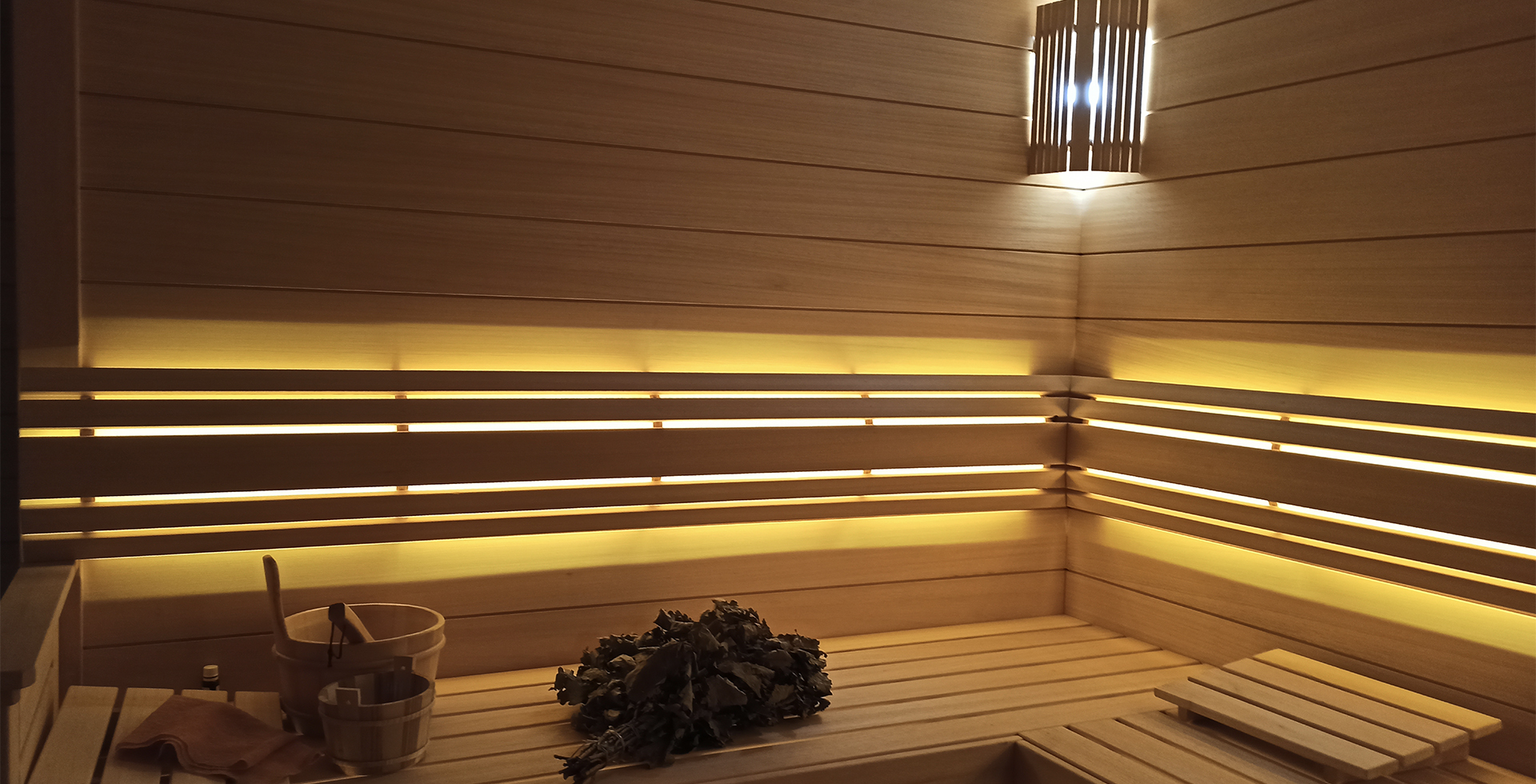
The third scheme, in the photograph above, is the one we use most in villas: warm lines under the bench edges and behind the backrest, and one slatted lantern on the wall. It lights the steps, the wall and the timber, and leaves the guest’s face in shadow, which is the aim of every sauna lighting scheme in this guide.
Who builds this
Sauna Dekor has designed, manufactured and installed saunas, steam rooms, hammams, pools and cold plunges since 1987: 40 years of manufacturing in Istanbul, in our own facility in İkitelli OSB, with a team of 19 employees and 5,000+ projects in 35+ countries. We work under TS EN ISO 9001:2015, certificate no. 202025106. Our offices are in Istanbul (İkitelli OSB), Dubai (Latifa Tower, World Trade Centre), Bodrum (Bodrum Çarşı), Germany (Monheim am Rhein) and Boston (66 Long Wharf, Unit 4B). We also have representative offices in Haarlem and Doha.
We build the sauna rooms, benches, backrests and linings in our own workshop, and we design and fit the lighting into them. We do not manufacture LED strips, fibre optic projectors, fibres, drivers or wall lights; they come from makers such as Cariitti, and any marking, rating or certification of that equipment belongs to its manufacturer. Heaters come from Harvia or EOS. The TS EN ISO 9001:2015 certificate is ours. On the work we deliver, the terms are a 24-month warranty on workmanship and manufacturing; 24-month manufacturer’s warranty on electrical and mechanical equipment; 5-year warranty on structure and waterproofing.
Frequently asked questions about sauna lighting
What temperature rating does sauna lighting need?
Higher than the room’s ceiling air. A Finnish sauna runs at 80–100 °C, and Cariitti rates its sauna LED strip for ambient temperatures up to 125 °C and its glass fibres for saunas at 180 °C. Ordinary bathroom or kitchen strips are not made for that heat.
Can LED strip lights go in a sauna?
Yes, if the strip is a sauna strip. Cariitti’s Sauna Ultra Ambient is rated from −40 to +125 °C, sealed to IP67 and supplied at 24 V from a driver that can sit outside the cabin, with a silicone cable rated to 200 °C.
Can plastic fibre optics be used in a sauna?
No. Cariitti rates the plastic fibres in its starry sky sets for 80 °C and states that they may not be installed in a sauna. They suit steam rooms and infrared cabins below 80 °C; a sauna needs glass fibres rated for 180 °C.
Where should a sauna light be placed?
Harvia’s manual places a vapour-proof wall light 150 mm below the ceiling, not directly over the heater and not over the upper benches, and allows lights under the benches. Light lines work best under bench edges, behind backrests and along the ceiling edge.
Where does the fibre optic projector go?
Low and cool. Cariitti’s VPAC27 projector, sealed to IP65, may sit under the sauna benches at no more than 80 cm from the floor; its VPL30X allows no more than 40 cm and 40 °C ambient. Outside the cabin is easier to service.
What colour light is used in a sauna?
Warm white around 2,700 K with a colour rendering index of 90 or more, which keeps the timber looking natural. Coloured RGBW fibre sets rated to 180 °C exist, but in hotel saunas we keep colour as an option the operator chooses.
Sources
- Sauna Ultra Ambient White — Cariitti, product page and technical data. Source for the −40 to +125 °C ambient rating, IP67, 24 V supply, 2,700 K, 3 W/m, CRI above 90, 50 mm cutting interval, the +180 °C silicone casing, the +200 °C silicone cable and the design for sauna ceiling edges.
- Sauna Lighting Ceiling Pro Set — Cariitti, product page. Source for glass fibres rated to 180 °C for the sauna ceiling, the IP65 VPAC27 projector under the benches, the 16 W 2,700 K LED with Ra 90, the thicker heater fibre and stove lens, and the 3–5 m² room size.
- Starry Sky Set (100 fibres) — Cariitti, product page. Source for plastic fibres rated to 80 °C that may not be installed in a sauna but suit steam rooms and infrared cabins below 80 °C.
- VPL 30X DALI projector — Cariitti, product page. Source for the IP65 projector with IP20 driver, DALI or pushbutton dimming, the 40 °C maximum ambient temperature and the 40 cm maximum installation height inside a sauna.
- VPAC LED projector — Cariitti, product page. Source for the IP65 projector that may be installed on the sauna wall under the benches at no more than 80 cm from the floor, and for mains dimming.
- Harvia Spirit — owner’s and installation manual — Harvia, dealer-hosted copy. Source for the vapour-proof wall light 150 mm below the ceiling, not over the heater or the upper benches, lights under benches, and no sockets or plugs in the sauna.


