




Sauna Dekor Spa Solutions engineering team, Istanbul
Last updated: 6 October 2026
Short answer: steam room lighting has to be sealed against water jets, not just damp air: Abu Dhabi’s wiring regulations require every luminaire in a bathroom or similar wet location to reach at least IPX5, and anything within arm’s reach of a shower to run on separated or protective extra-low voltage. In practice that means low-voltage LED fittings set flush into the tiled surface, with drivers, amplifiers and switches outside the room. Sauna Dekor Spa Solutions builds steam rooms that way, and speakers follow the same rule.
This guide explains why a steam room is harder on electrical fittings than a bathroom, what the IP code actually promises, which voltage the fittings should run on, where the lights and speakers belong in the room, and how one control can run light, sound and steam together. It ends with two rooms we built, a specification checklist, and the sources behind every figure.
Why is a steam room harder on lights than a bathroom?
Because the water reaches the fitting from every side and never stops. A steam room runs at 40–50 °C at close to 100 % relative humidity, so the air is saturated for the whole session and water condenses on every surface that is even slightly cooler than the air. A bathroom light sees splashes and a few minutes of shower vapour; steam room lighting sits inside a cloud for hours a day.
Three things follow. First, condensate forms on the lens and the bezel of every fitting, then runs along the ceiling and walls towards the lowest point. Second, the room is cleaned wet: in a hotel or a gym the tiles are rinsed and sometimes hosed, which is a jet of water, not a spray. Third, the steam room heats and cools every day, so any fitting that relies on a soft gasket is pumped in and out by the temperature cycle until the gasket lets moisture past.
This is also why steam room lighting is a different decision from sauna lighting. A sauna is hot and dry, so its fittings are chosen for heat; we covered that side, and the separate IEC rules for rooms with sauna heaters, in our guide to sauna electrical requirements. A steam room is warm and wet, so the fittings are chosen for water first. Our comparison of a sauna vs steam room sets out the two climates side by side.
What IP rating does steam room lighting need?
IPX5 is the floor in the Abu Dhabi wiring regulations, and we treat it as a minimum rather than a target. The IP code comes from IEC 60529: the first digit rates protection against solid objects and dust, the second against water. An “X” in place of the first digit means only the water figure was declared.
The water digits that matter in a steam room are these. IPX4 covers splashing from any direction. IPX5 covers water jets from a nozzle. IPX6 covers powerful jets. IPX7 covers temporary immersion, and IPX8 covers continuous immersion under conditions the manufacturer states. Each step is a separate test, so a fitting declared IPX7 has not automatically been tested against jets; good wet-area fittings often carry two declarations, such as IPX5 and IPX7 together.
The Abu Dhabi Electricity Wiring Regulations (2020) put numbers on this for wet rooms. Regulation 9.3.2 requires all appliances, luminaires and accessories in bathrooms and similar locations to have a minimum moisture-ingress protection of IPX5, and underwater lighting to be SELV at no more than 12 V AC or 30 V DC with IPX8. Regulation 9.3.1 extends the bathroom rules to other places where people are partly clothed and in contact with water, which is exactly what a steam room is.
For steam room lighting we read that as follows: IPX5 for anything on the ceiling or the upper walls, and an immersion rating for anything set low enough to sit in rinse water or be hosed at close range, such as a light under a bench or near the floor drain. The rating on the label applies to the fitting as installed with its own seal, so the fixing detail matters as much as the product.
Which voltage, and where do the drivers go?
Inside the room, extra-low voltage; outside it, everything that converts the supply. Regulation 9.3.2 of the Abu Dhabi rules requires fittings within arm’s reach of a shower or similar facility to run on SELV or PELV, separated from the mains by a safety isolating transformer. In a steam room nearly every surface is within reach, so we design as if all of it is.
In practice that means LED fittings and strips running at extra-low voltage, with the driver or transformer in a dry, ventilated, accessible space outside the steam room: a plant cupboard, a ceiling void over the changing area, or the technical room that also houses the generator. Drivers are electronics; they do not belong in a saturated room at 45 °C, and putting them outside also means they can be replaced without opening the tiled surface.
Three other rules from the same document apply directly. All final circuits in a bathroom or similar location, lighting included, are protected by a 30 mA residual current device. Switches for equipment in the room are installed outside it or replaced by a cord-pull switch. And wall-mounted switches are not installed in shower rooms at all. The international parent document, IEC 60364, has a Section 701 for locations containing a bath or shower and a Section 703 for rooms with sauna heaters, but no separate section for steam rooms, which is why the local authority’s reading of “similar locations” decides the final design. The electrician who signs the installation confirms it.
Which type of steam room lighting suits which job?
Four kinds of fitting cover almost every steam room we build: recessed downlights, bench under-lights, wall or niche lights and fibre-optic points. They differ less in brightness than in where the water meets them, what stays outside the room, and what has to be serviced later without opening the tiled surface.
| Fitting | Where it sits | What it faces | What stays outside the room | Best used for |
|---|---|---|---|---|
| Recessed ceiling downlight | Set flush into the ceiling or vault | Condensate on the lens; rising steam at the hottest point | Driver, switch | General light; reads as visible beams when the room is full of steam |
| Bench under-light (LED strip) | Concealed under the front edge of the bench | Rinse water, cleaning, pooled water at floor level | Driver, controller | Glare-free light on the floor; makes the bench appear to float |
| Wall or niche light | Recessed into a wall niche or behind a translucent panel | Direct condensate run-off down the wall | Driver, switch | Accent light on a feature wall or a shower niche |
| Fibre-optic points | Fibre ends in the ceiling; light source in a separate box | Only the fibre tips are in the room | Light source, its lamp and electronics | Star-ceiling effect with no electrical parts inside the room |
Fibre optics deserve a note. They are the only option that puts no electricity inside the room, because the light is generated in a box outside and carried in through glass or plastic fibres. The trade-off is the build-up: many fibre tails pass through the ceiling, and each one is a crossing of the waterproof layer that has to be gathered and sealed properly. A barrel-vaulted or flat ceiling with a few sealed downlights is simpler to waterproof than a ceiling with hundreds of fibre points.
Where should the lights go in the room?
Steam room lighting works best low and indirect, with the ceiling kept as plain as possible and as few flush fittings in it as the room allows; the Bodrum vault below has 2. There are 3 reasons, and all of them come from the water: the ceiling collects condensate, steam scatters light into the eye line, and low fittings get rinsed.
The ceiling collects condensate. On a flat ceiling the drops gather and fall; on a vault or a sloped ceiling they run to the walls. Any fitting on the ceiling interrupts that surface, so ceiling fittings are set flush, never surface-mounted or hanging, and kept away from the line where water is meant to run. Fewer ceiling penetrations also means fewer places where the waterproof layer above has to be opened and sealed again.
Steam scatters light. When the room is full, a downlight produces a visible cone, which can be attractive but also puts bright points in the bather’s eye line when they lean back. A light under the bench, or in a low wall niche, lights the floor and the tiles instead of the air and stays comfortable at full steam.
Low fittings must take water. A strip under the bench is close to the floor drain and gets rinsed every time the room is cleaned. That is the position where we specify an immersion-rated product and an extra-low-voltage supply, with the driver well away. The same thinking applies to the shower systems that often sit next to a steam room: anything a jet of water can reach is treated as wet.

Can you put speakers in a steam room?
Yes, if they are waterproof speakers made for wet areas, installed on the same principle as the lights: the speaker in the room, the amplifier and music source outside it. The cone and grille sit in air at close to 100 % humidity and are rinsed with the tiles, so a dry-room ceiling speaker does not belong here.
Position matters more than size. We avoid the ceiling for speakers for the same reason we keep the ceiling plain: it is where condensate gathers and drips. In the Bodrum Polimeks Erraertfarm steam room the waterproof speakers sit behind white round grilles in the vertical front of the curved bench, at intervals along its length. They are below the seat, out of the drip line, and close to the listener.
Volume is the other design point. A glass mosaic room is hard on every surface and reflects sound strongly, so a little goes a long way. Low background music, or the sound off entirely in a hotel room shared by strangers, is usually the right setting; the operator decides, but the installation should make low levels sound clear rather than forcing the volume up.

Who switches the light, the sound and the steam?
Ideally 1 control, mounted where the rules allow. Switches do not go inside a wet room, so steam room lighting and sound are switched from outside, through a relay, or from the steam generator’s own control. All the steam rooms we build use Condair generators, whose Omega range covers 2 to 20 kg of steam per hour.
Condair’s Omega brochure describes an optional integrated spa control that can switch accessories such as light, fan, fragrance and music, with a freely configurable relay, and an external touch display offered in flush-mounted or wall-mounted versions standing only 19 mm off the wall.
One control has practical value for an operator. The lights come on with the session and go off with it, the music follows the same timer, and staff do not have to reach a separate switch. Our page on the steam generator explains how the generator is sized and where it sits; the lighting and sound circuits are then planned with the same electrician. The generator, its control and its certification belong to Condair; what we design is the room, the positions of the fittings and how their supply reaches them.
Is coloured light worth it?
As a design choice, sometimes; as a treatment, we make no claim. Colour-changing LED fittings are widely sold for steam rooms and can make a room feel calmer or more theatrical. We specify them when the designer wants them and the operator will use them, on the same IPX5 and extra-low-voltage rules as white light.
Our practice is to keep white light available as well. Staff need it for cleaning and inspection, and a mosaic finish is chosen in daylight-white conditions, so a room lit only in saturated colour hides both the dirt and the finish. In multi-room thermal areas such as the Roman thermal rooms we often give each room one consistent light colour, so the sequence reads clearly as guests move through it.
What does this look like in a finished room?
The Bodrum Polimeks Erraertfarm steam room, completed in 2026, is a single room finished entirely in green-grey glass mosaic, including a barrel-vault ceiling. The vault carries only two recessed spotlights and a round vent, so nothing hangs below the curve and condensate runs down to the walls. A concealed LED strip under the curved bench lights the floor, waterproof speakers sit in the bench front, and steam comes from a Condair generator outside the room.
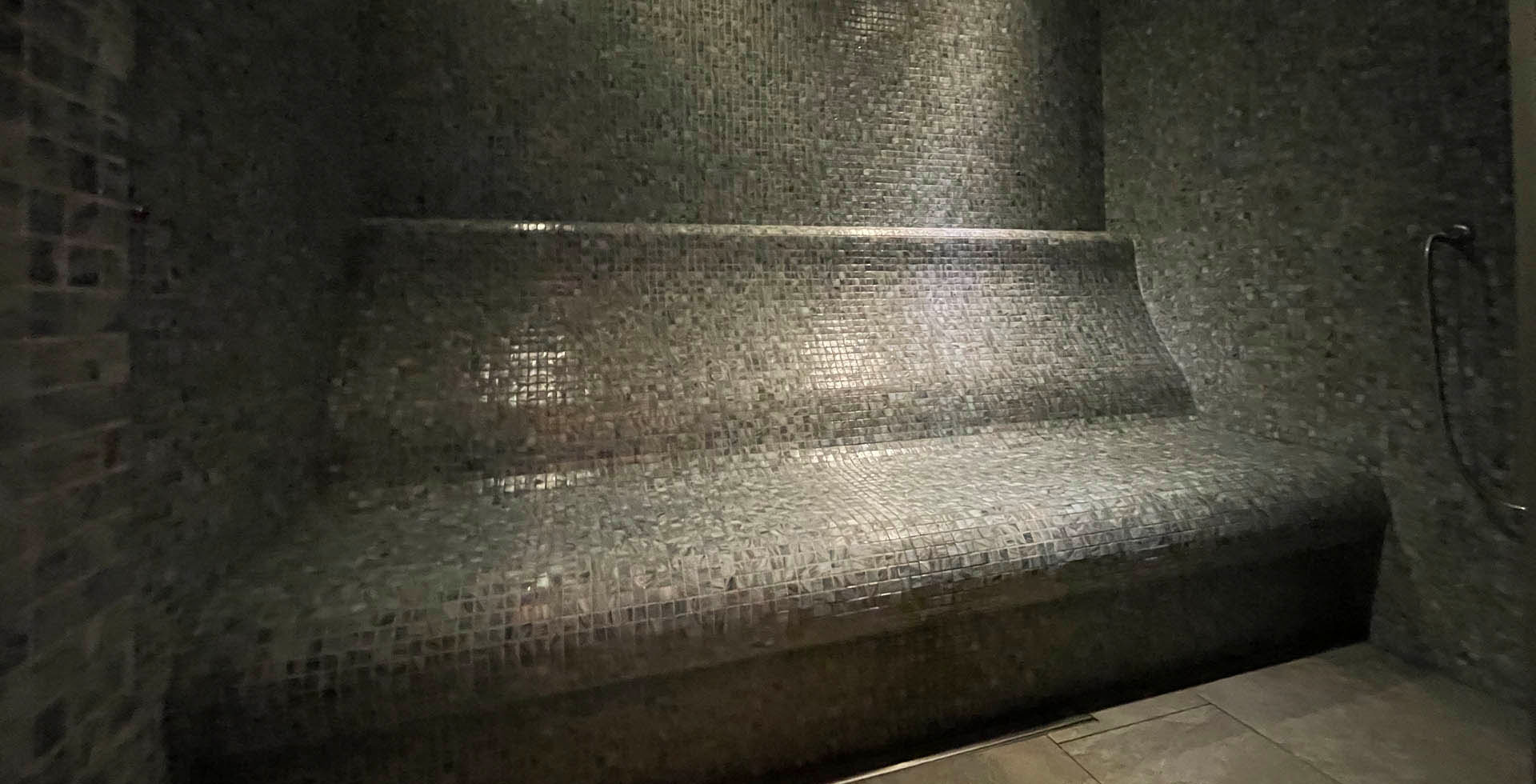
At Hilton Istanbul Maslak, where we built the spa in 2017, the steam room is clad in dark grey glass mosaic with a contoured bench and backrest and a wall-mounted hand shower. The photograph below shows how a dark mosaic room reads under low, indirect light: the bench contour and the tile surface carry the room, and no fitting draws the eye.
Lighting is a small share of a steam room budget, but it is one of the few items that cannot be changed later without opening the tiled finish. Our overview of steam room cost in the UAE covers the larger items around it.
What belongs in the specification?
A steam room lighting and sound specification that survives the site names the following, in writing, before the tiling starts:
- The declared IP rating of every fitting in the room, at least IPX5, with an immersion rating for any fitting at bench or floor level.
- The supply voltage of every fitting: SELV or PELV inside the room, with the transformer or driver named and located outside it.
- The driver, amplifier and control positions: dry, ventilated, accessible, and outside the steam room.
- The 30 mA residual current protection on every circuit serving the room, and the switching position outside it.
- Each fitting’s position on the drawings, clear of the ceiling’s water run-off line and of the steam inlet.
- How each cable or fibre crosses the waterproof layer, and who signs that the crossing was sealed before the tiles went on.
- Waterproof speakers with their amplifier outside the room, and the control that links light, sound and steam.
On the waterproofing side, Schlüter states that its KERDI-DS membrane is required for continuous-use steam rooms. Whatever system is used, every light and speaker is a hole in that layer, so the number of fittings is a waterproofing decision as well as a lighting one.
Who is writing this
Sauna Dekor has designed and built saunas, steam rooms, hammams, pools and cold plunges since 1987: 40 years of manufacturing in Istanbul, in our own facility in İkitelli OSB, with a team of 19 employees, working under TS EN ISO 9001:2015, and with 5,000+ projects in 35+ countries. On a steam room we design the room, build its structure, waterproofing and tiled finish, and set out the positions of the lighting, speakers and controls with the project electrician.
We do not manufacture steam generators, light fittings, speakers or control panels; their manufacturers make them, and any CE marking or conformity declaration on that equipment belongs to its manufacturer. The TS EN ISO 9001:2015 certificate is ours. On the work we deliver, the terms are a 24-month warranty on workmanship and manufacturing; 24-month manufacturer’s warranty on electrical and mechanical equipment; 5-year warranty on structure and waterproofing.
Frequently asked questions about steam room lighting
What IP rating do steam room lights need?
At least IPX5, which covers water jets. Abu Dhabi’s wiring regulations set IPX5 as the minimum for every luminaire in bathrooms and similar wet locations. For fittings at bench or floor level, which can sit in rinse water, choose a product that also declares an immersion rating such as IPX7.
Can you use normal LED lights in a steam room?
Not standard indoor fittings. Steam room lighting should be a sealed, extra-low-voltage LED fitting rated for wet locations, with its driver or transformer installed outside the room in a dry, ventilated and accessible space, so the electronics never sit in saturated air.
Where should the light switch for a steam room go?
Outside the room. Abu Dhabi’s regulations do not allow wall-mounted switches in shower rooms; switches go outside or are replaced by a cord-pull switch. Many projects switch the lights from the steam generator’s control, so they follow the session timer.
Can you put speakers in a steam room?
Yes, using waterproof speakers made for wet areas, with the amplifier outside the room. Keep them out of the ceiling, where condensate drips. In our Bodrum Polimeks Erraertfarm steam room the speakers sit behind round grilles in the front of the bench.
Are fibre-optic star ceilings suitable for steam rooms?
Yes, and they put no electricity in the room, because the light source sits outside. The cost is in the waterproofing: every fibre tail crosses the ceiling’s waterproof layer, so the tails must be gathered and sealed through a single, properly detailed crossing.
What temperature and humidity must steam room lighting withstand?
A steam room runs at 40–50 °C at close to 100 % relative humidity, with condensate forming on every cooler surface, including the lens and bezel of each fitting. Daily heating and cooling cycles also stress gaskets, so sealed, rated fittings matter more than brightness.
Sources
- The Electricity Wiring Regulations (2020) — Department of Energy, Abu Dhabi. Source for IPX5 on all luminaires in bathrooms and similar locations, SELV or PELV within arm’s reach, 30 mA RCD protection on all bathroom circuits and SELV at 12 V AC or 30 V DC with IPX8 for underwater lighting (9.3.1–9.3.2), switches outside wet rooms (7.2.3), and the 12 V AC / 30 V DC insulation threshold for SELV (9.1.6).
- IEC 60529:1989+AMD1:1999+AMD2:2013, Degrees of protection provided by enclosures (IP Code) — International Electrotechnical Commission. Source for the structure of the IP code and its water-protection digits.
- IEC 60364 — Wikipedia. Reference for the parts of IEC 60364, including Section 701 for bathrooms and Section 703 for rooms and cabins containing sauna heaters.
- Condair Omega — the compact steam generator with quick steam availability — Condair brochure, 03/2020. Source for the integrated spa control switching light, fan, fragrance and music, the external touch display standing 19 mm off the wall, and the 2 to 20 kg/h steam range.
- Schluter-KERDI steam shower FAQ — Schlüter-Systems. Source for KERDI-DS being required for continuous-use steam rooms and its declared vapour permeance of 0.18 perms.


