


Temperature
50–65°C
Soft heat


[ Bio sauna ]
In brief (November 2026): a bio sauna, or soft sauna, is a sauna run at 50–65 °C, milder than a Finnish sauna at 80–100 °C and drier than a steam room. Sauna Dekor builds bio saunas in the same timber cabins as its Finnish saunas.
Who it is for: hotel spas and clubs that offer a milder sauna next to the Finnish room, and home spas.
Sauna Dekor — saunas, Turkish hammams, steam rooms, salt rooms and pools, manufactured since 1987 in our own facility in İkitelli OSB, Istanbul; 5,000+ projects in 41+ countries.
The Sauna Types Menu
 Since 1987
[ What to know ]
Temperature
50–65°C
Soft heat
Finnish sauna, for comparison
80–100°C
80–100 °C
Timber
Ayous · aspen · pine
Manufacturing
Own facility, İkitelli OSB, Istanbul
01 — 110 words
A bio sauna, or soft sauna, runs at 50–65 °C with added humidity from a combined heater and water reservoir, so the heat is gentler than in a Finnish sauna at 80–100 °C.
Sauna Dekor is a bio sauna (soft sauna) manufacturer and installation contractor for hotel spas, wellness centres and private villas in the UAE, Saudi Arabia and Qatar, building in Istanbul since 1987 and installing in 41+ countries in our 40th year. A bio sauna is not a cooler Finnish sauna: the combined heater, the humidity control and the ventilation rate are a different specification, and the cabin has to be built for continuous moisture.
02 — 177 words


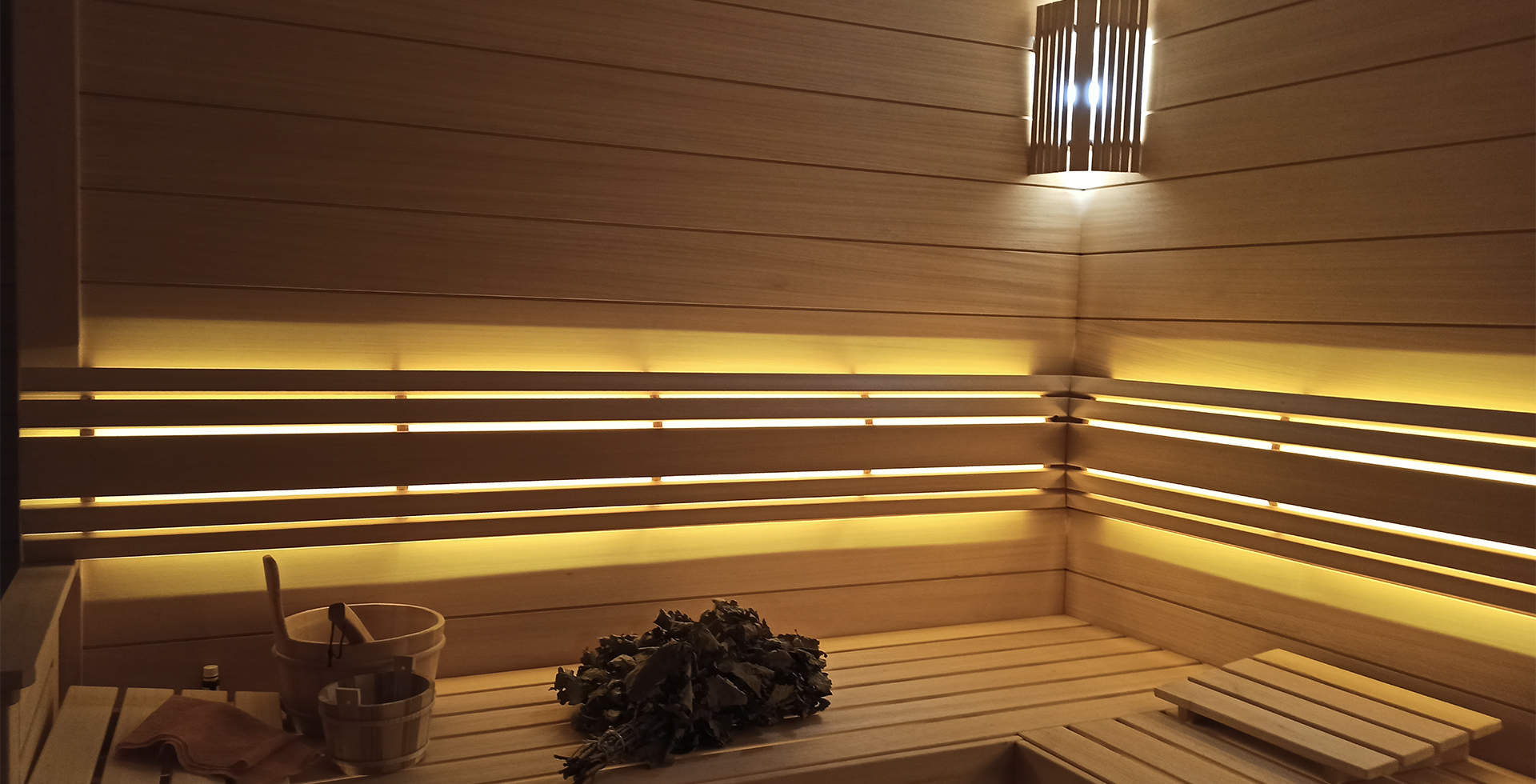
Temperature: 50–65 °C Bio sauna is a sauna with a much less heated and humid atmosphere than Finnish saunas. A Finnish sauna runs at 80–100 °C with dry air, while a bio sauna runs at 50–65 °C with noticeably more humidity. Relaxing aromas, herbs, etc., on heated rocks in traditional Finnish saunas. Steam is removed by pouring the added water. On the other hand, the sauna's interior is illuminated with different colored lights at intervals during general use. It has been revealed that the colors used in the sauna have both biological and psychological functional benefits in the human body.
Chromotherapy lighting is a common option in a bio sauna: the cabin lighting can be held on one colour or cycled slowly through a sequence, and it is chosen for atmosphere. The fittings are IP-rated and the controller sits outside the cabin. Bio saunas, which have a more humid and lower temperature indoor environment than saunas, have many users. Because they run cooler than a Finnish sauna, they suit guests who find a 90 °C cabin uncomfortable.


03 — 413 words
Sauna Dekor offers expert solutions for creating custom saunas that meet all your needs including Bio Sauna construction. They provide guidance for choosing the location of your sauna, design and installation services, and even maintenance support. Their experienced team listens to your dreams for the perfect sauna and helps make them a reality with custom wood textures and decorations. They can build saunas in any room of your house or in your garage, basement, or attic. Sauna Dekor provides high-quality service and always stands behind their products and designs. Contact them today to get started on creating your dream sauna!
The most important and primary step in constructing the bio sauna, which you will create to add the warmth, controlled humidity and lighting of a bio sauna to your living spaces, is to correctly determine the area where the sauna will be built. If it is located inside the house or project, a place where plumbing, heating, and electricity can be easily accessed should be chosen. For a sauna to be designed outdoors, the sauna's location should be determined so that the area sits on a flat surface, away from overhanging trees and running water. If the sauna is located technically and physically suitable, such as the size and distance to mechanical installations, the user's desired sauna design should be started. For example, what style the sauna room to be built should be, which tree type should be preferred, experts should be consulted for the technical details of the lighting for the use of colors, the cost of the materials to be selected, etc. all must be determined at this stage according to the imagined design. After the sauna design, the application process is carried out professionally by the Sauna Dekor Spa & Solutions installation team in your home or the appropriate area of your project.
As in traditional sauna designs, wooden timbers and paneling are used indoors. According to customers' requests, budgets, and design requirements, Cedar, Pine, Fir, Spruce, and Ayous trees are mostly preferred in Turkey for Bio Sauna construction. A sauna stove should be selected that will provide the required temperature and humidity. Panels that will adjust the temperature and heat values in the sauna should be preferred. Aromatherapy materials are among the products used in the bio sauna to be determined after the design. Aromatherapy scents and oils that will relax your body and increase your inner peace while resting will make your bio sauna experience much more enjoyable.
04
Discover our Finnish sauna and infrared sauna options. Pair with a steam room or massage room for the ultimate spa.
From our portfolio
Rooms we manufactured in Istanbul and installed with our own team. Each frame opens the project page.


05 — 158 words
A bio sauna sits between the two rooms most people already know. It runs cooler than a Finnish sauna and drier than a steam room, which is why it is the room that carries a mixed-age hotel clientele through a longer session. The engineering consequence is that it is neither: a Finnish cabin builds heat and sheds moisture, a steam room is a sealed, fully saturated wet room, and a bio sauna has to hold a moderate temperature and a controlled mid-range humidity at the same time.
| Bio sauna | Finnish sauna | Steam room | |
|---|---|---|---|
| Air temperature | 50–60 °C | 70–95 °C | 40–46 °C |
| Relative humidity | 45–65% | 5–15% | Close to saturation |
| Heat source | Combi heater: stones plus steam vessel | Stone heater | Steam generator |
| Interior | Timber, built for continuous moisture | Timber | Tile, mosaic or solid surface |
| Session length | Longer, gentler cycles | Short, hot cycles | Medium |
| Ventilation | Mechanically supported, drying cycle needed | Passive is often enough | Mechanical extract, mandatory |
06 — 123 words
The heater is a combi unit — stones plus an integrated steam vessel — and it needs a plumbed water supply, a drain, descaling access and a controller that manages both outputs. Because the cabin runs wet for hours, timber selection and detailing matter more than in a dry cabin: kiln-dried, low-resin species, no exposed metal fixings against skin, and joints that can move. A post-session drying cycle is part of the control strategy, not an optional extra. The ventilation logic behind that is set out in sauna ventilation, the comparison most clients start from in sauna vs steam room and infrared vs traditional sauna, and the usage pattern a bio sauna suits in how often to use a sauna.
Comparison
Operating ranges of the rooms we build. A Finnish sauna is the hottest and driest; a steam room and a hammam run cooler with far more moisture; cold rooms close the circuit.
| Room | Temperature | Humidity |
|---|---|---|
| Finnish sauna | 80–100 °C | 10–20 % RH (dry air) |
| Bio sauna | 50–65 °C | — |
| Infrared cabin | 45–60 °C cabin air | — |
| Steam room | 40–50 °C | Close to 100 % RH |
| Turkish hammam | Room air 40–50 °C; heated platform 40–45 °C | — |
| Cold plunge pool | Water 2–15 °C | — |
| Snow room | About −10 °C | — |
Sources: Sauna Dekor approved operating ranges (29 September 2026); Finnish sauna humidity: Hussain & Cohen, 2018; snow room: TechnoAlpin.
Cross-section
A cabin is not a box but a five-layer structure. The layer that is left out decides how many years the cabin lasts.
Ayous or aspen boards. Both stay comfortable to touch at 90 °C and do not bleed resin.
The breathing space left behind the lining. Without it, moisture is trapped behind the timber and the boards move within a few seasons.
Aluminium foil with taped joints. It stops moisture in the cabin from reaching the insulation; once it is punctured, the insulation stops working.
Stone wool. It keeps the heat inside, and it is the layer that sets the heater output and the running cost.
The cabin's own frame. It carries the bench loads and the heater weight and does not lean on the existing wall: the cabin is a separate structure.
Comparison
The five sauna cabins we manufacture, side by side. Four of them share the Finnish construction; the infrared cabin is heated by emitters instead of stones.
| Type | Temperature | Humidity | Heat source |
|---|---|---|---|
| Finnish sauna | 80–100 °C | 10–20 % (dry air) | Electric stone heater; water poured on the stones (löyly) |
| Bio sauna | 50–65 °C | More humid than a Finnish sauna | Combi heater with an integrated vaporiser |
| Infrared sauna | 45–60 °C cabin air | Not humidified | Infrared emitters that warm the body directly |
| Russian sauna (banya) | 80–100 °C, Finnish range | Run wetter than a Finnish sauna | Electric stone heater; the venik is part of the ritual |
| Portable sauna | 80–100 °C, Finnish range | 10–20 % (dry air) | Ready-built cabin with a stone heater |
Sources: Sauna Dekor approved operating ranges (October 2026); Finnish sauna humidity: Hussain & Cohen, 2018. Heater output by cabin volume: sauna heater sizing.
Short answer: a bio sauna runs at 50–65 °C, between a steam room at 40–50 °C and a Finnish sauna at 80–100 °C. In a hotel thermal suite it is usually the first or second hot room guests use, before the Finnish sauna and the cold plunge.
A common order in a thermal suite:
See the Finnish sauna and how the rooms are combined in a thermal suite.
Updated:
FAQ
Roughly 50–65 °C air temperature with relative humidity held around 45–65%. That is cooler and moister than a Finnish sauna and much drier than a steam room, which is what allows a longer, gentler session.
Yes, with a combination heater that has a built-in water evaporator. The same cabin can run dry at 80–100 °C or as a bio sauna at 50–65 °C. The heater and the control panel are chosen together so the panel can switch between the two modes.
Temperature, humidity and equipment. A Finnish sauna runs hot and dry from a stone heater; a bio sauna runs cooler with controlled humidity from a combi heater that has stones and a steam vessel. The bio cabin therefore needs a water supply, a drain, descaling access and a drying cycle that a dry cabin does not.
It depends on cabin volume, glazing area and insulation, and it is calculated per project. As an order of magnitude, a small private cabin sits in the single-digit kilowatt range on a three-phase supply, while a hotel cabin can be several times that. Combi heaters also need a plumbed water feed and a drain, which is the point most electrical designs miss.
Daily wipe-down of benches and floor, periodic descaling of the steam vessel on the schedule the heater manufacturer sets, stone replacement when the stones break down, and a drying cycle after the last session so the cabin does not stay damp overnight. Access for descaling has to be designed into the bench layout.
Hotel and resort spas with a mixed clientele, wellness and recovery centres that run longer sessions, and private villas where not everyone wants a 90 °C cabin. It is often specified as the second heat room alongside a Finnish sauna rather than instead of one.
Gallery
Send us the room size and ceiling height; we will work out the scope and the budget range with you.
Last updated: 12 November 2026
Book a consultation or speak with our team.
We’d love to cooperate
TO BUILD AMAZING POOLSAUNATURKISH BATH & HAMMAMSNOW ROOMSTEAM ROOMSALT ROOMWHIRLPOOL
Sauna Dekor Spa Solutions
Sauna Dekor Spa Solutions was established in 1987. In order to spread the use of Spa & Wellness, it introduced its products in many international fairs and followed the innovations abroad and examined the Spa & Wellness culture on-site, and made perfect applications with quality materials and correct manufacturing techniques.
Talk to our team
Dubai office · Istanbul factory
WhatsApp+90 532 215 64 78Call Dubai+971 58 558 1295Request a quoteYour privacy, your choice
We only set analytics and ad cookies if you allow them. Google Analytics helps us understand visits and Google Ads measures our adverts; nothing optional is stored until you choose.
Your browser sends a Global Privacy Control signal, so advertising cookies stay off.


