




Sauna Dekor Spa Solutions engineering team, Istanbul
Last updated: 7 October 2026
Short answer: sauna wood is settled by 3 numbers before anything else is drawn. The first is thermal conductivity, which has to sit between 0.09 and 0.13 W/mK so that a bench at 90 °C can be sat on. The second is resin content, which has to be zero on any surface skin touches, because resin in a softwood becomes mobile above roughly 70 °C. The third is moisture content at installation, which is 6 to 8% and not the 10 to 12% at which timber leaves a normal yard.
Everything else follows from those 3 figures. Species choice, board thickness, the 20 to 25 mm cavity behind the panelling, the gap between bench slats, the depth a fastener head is set below the surface and the number of times a seat can be sanded are all consequences of how wood behaves between 4 and 18% moisture at air temperatures of 80 to 100 °C. This guide works through them in that order, with the arithmetic shown.

What does sauna wood actually have to survive?
A daily cycle from about 20 °C to 100 °C, relative humidity swinging between 5 and 40%, and a surface that is wetted for seconds and then dried for hours. Sauna wood is not exposed to constant damp; it is exposed to fast, shallow, repeated cycling, and that distinction decides every choice below.
The vertical gradient inside the cabin is larger than most briefs assume. Air at the ceiling of a heated room runs 100 to 110 °C while the floor sits at 30 to 40 °C, so a single vertical board can span a 60 °C difference over its own length. The board at head height dries harder and moves more than the one at skirting level, though both are cut from the same pack.
Water arrives in pulses rather than as a soak. A ladle of water on hot stones lifts humidity from roughly 10% to 30 or 40% for 2 to 3 minutes, and the moisture that reaches the panelling penetrates only a few tenths of a millimetre before the room dries it out again. That is precisely why untreated timber survives in a cabin and fails in a commercial steam room.
Why is thermal conductivity the most important number on a bench?
Because it decides what skin reads, not what the thermometer reads. Wood at 0.12 W/mK and a carbon steel fastener at roughly 50 W/mK, sitting side by side at the same 90 °C, produce contact temperatures of about 44 °C and 85 °C. One of those is a seat and the other is a burn.
The governing quantity is thermal effusivity, the square root of conductivity multiplied by density and by specific heat. For aspen that is roughly the square root of 0.12 × 450 × 1,600, or about 290 in SI units; for carbon steel it is near 13,900, some 48 times higher. Skin sits around 1,200, between the 2.
Contact temperature is then the effusivity-weighted average of the 2 surfaces. Skin at 33 °C against wood at 90 °C settles near 44 °C, where contact time barely matters; the same skin against steel at 90 °C settles near 85 °C, where tolerable contact is under a second. EN ISO 13732-1 treats hot-surface burn thresholds as material-dependent for exactly this reason.
Which species are used for sauna wood, and how do they compare?
Seven, in practice, and they divide into wall timbers and bench timbers. The split is not aesthetic: bench timbers carry no resin canals and sit at 0.09 to 0.12 W/mK, while wall timbers may carry resin and run up to 0.13 W/mK. The table gives working figures at about 12% moisture content. The timbers we use most are ayous, thermo-ayous, aspen, thermo-aspen, pine and thermo-pine; alder, Western hemlock and Western red cedar are also supplied on request. Which of them goes on which surface in our own cabins, and what to ask a supplier about it, is in our best wood for sauna guide; this page stays with the numbers.
| Species | Density (kg/m³) | Thermal conductivity (W/mK) | Resin | Typical position |
|---|---|---|---|---|
| Nordic spruce (Picea abies) | 440–470 | 0.11–0.12 | Resin pockets present | Walls and ceiling |
| Western red cedar (Thuja plicata) | 350–390 | 0.09–0.10 | No resin canals; aromatic extractives | Walls, ceiling, backrests |
| Aspen / haapa (Populus tremula) | 420–460 | 0.11–0.12 | None | Bench slats, backrests |
| Thermally modified aspen | 380–420 | 0.10–0.11 | None | Bench slats and walls, never bearers |
| Alder (Alnus glutinosa) | 490–530 | 0.12–0.13 | None | Bench slats, headrests, handles |
| Ayous (Triplochiton scleroxylon) | 340–400 | 0.09–0.10 | None | Bench slats in continuous use |
| Western hemlock (Tsuga heterophylla) | 450–490 | 0.11–0.12 | None | Walls and ceiling |
Density does most of the work in the conductivity column. Conductivity in dry timber tracks density almost linearly, at roughly 0.0002 W/mK for every kg/m³ plus a small constant, so a 370 kg/m³ cedar board and a 520 kg/m³ alder board differ by about 0.03 W/mK, or 30%. That is enough to be felt on a bare thigh after 10 minutes and not enough to change how the cabin is built.
The resin column excludes rather than ranks. Any species with resin canals is a wall material only, and that single rule removes pine from every bench in a commercial sauna regardless of its grade or its appearance. The remaining 6 species then separate on hardness, colour behaviour and how much movement the build can absorb.
Why does resin decide where a board is allowed to go?
Because resin softens and flows at temperatures the cabin reaches every single day. Softwood oleoresin begins to move somewhere around 60 to 70 °C, and bench-height air in a sauna sits at 80 to 100 °C, so a resinous board placed under bare skin will weep within its first season of use.
The consequence is physical rather than cosmetic. Liquid resin on a seat is tacky at 80 °C, it collects dust and body oils, and it hardens into a raised dark patch as the room cools. It cannot be washed off, and sanding a profiled surface deeply enough to remove it takes 1 to 2 mm rather than the 0.3 mm a routine renewal takes.
This is why the bench list is a hardwood list with ayous added to it. Aspen, haapa in Finnish, has no resin canals at all, nor do alder and ayous, so all 3 can be placed against skin at any cabin temperature; aspen is also the one that does not raise a splinter after 10 years of wetting and drying. Cedar is the exception that proves the rule: it has no resin canals either, but it does carry aromatic extractives that can mark a pale towel in the first years.
What does thermal modification at 180 to 215 °C change?
It roughly halves the timber’s moisture movement and takes 10 to 30% off its bending strength at the same time. Heating aspen to between 180 and 215 °C in a low-oxygen kiln degrades the hemicelluloses that hold water, so equilibrium moisture content falls by about 40 to 50% at any given humidity.
The dimensional gain is real and measurable. A modified aspen slat that would have moved 0.9 mm across a 90 mm width over a 4-point moisture swing moves closer to 0.45 mm, which is why modified seats hold their slat gaps in cabins that are fired hard and then left cold for a week between bookings.
The strength loss is the reason it stays a surface material. Impact resistance falls further than bending strength does, so bench bearers, step stringers, backrest frames and anything carrying a point load remain in unmodified timber. We specify modified aspen for the slats a person sits on and untreated aspen or alder for every element underneath them.
Why is Western red cedar a wall material as often as a bench one?
Because at 350 to 390 kg/m³ and 0.09 to 0.10 W/mK it is the coolest timber to touch in the cabin and also among the softest, at roughly 1.5 N/mm² Brinell. It marks under a fingernail. That combination sends it to walls, ceilings and backrests more often than to a seat in continuous use.
Its extractives do the job resin does elsewhere, without the drawback. Thujaplicins give cedar its decay resistance and its aroma, and unlike oleoresin they do not become mobile at 70 °C, so a cedar board fixed above a heater does not weep. The aroma is pronounced for the first 2 to 3 years and then fades to almost nothing.
Colour movement is the item to declare before it happens rather than after. Cedar arrives with a spread from pale salmon to dark chocolate inside the same pack, and it darkens further in service, so a wall panelled in it will not read uniform at year 5. That is a specification decision taken at the outset, not a defect.

What moisture content should sauna wood have when it is installed?
Six to 8%, against the 10 to 12% at which most timber leaves a yard. Equilibrium moisture content is the value wood drifts towards at a given temperature and humidity, and a heated cabin at 90 °C with 10% relative humidity pulls the surface layers down towards 3 to 5% within hours of firing.
Installing at yard moisture is the most common failure we are called in to correct under our spa design and installation services. A board fitted at 12% and then driven to 5% loses about 1.8% of its width; a 90 mm board opens a 1.6 mm gap at every joint, and 8 boards in a row open more than 12 mm across the run.
The reverse failure exists as well. Wood taken to 4% in a hard-fired cabin and then left through a damp winter can climb back to 14 or 16%, and that swelling is what buckles a tightly fitted tongue-and-groove wall. Both cases are the same mistake: the board was fixed at a moisture content it does not live at.
Fibre saturation point is the ceiling over all of this arithmetic. Below roughly 28 to 30% moisture content, wood changes dimension in proportion to moisture; above it the cell walls are already full and extra water only fills cavities. Sauna wood spends its whole life in the lower half of that range, between about 4 and 12%.
How much does a 90 mm board move when the moisture changes by 1%?
About 0.23 mm across the grain if it is flat-sawn, and about 0.11 mm if it is quarter-sawn. Divide total tangential shrinkage, roughly 7.8% for spruce, by the 30% fibre saturation point to get 0.26% of width per moisture point, then multiply that by the 90 mm width.
The figure that matters on site is the accumulated one. A row of 8 boards at 90 mm covers 720 mm of wall, and a 4-point moisture swing from 8% down to 4% moves that run by about 7.5 mm in total, arriving as roughly 0.9 mm at each of the 8 joints rather than as one visible gap at the end.
Profiled panelling exists to absorb exactly that. A V-joint or shadow-gap profile already reads as a 3 to 5 mm recess, so a 0.9 mm seasonal change disappears into a line the eye has already accepted, while a square-edge butt joint shows the same movement as a fault. This is why sauna panelling is profiled and almost never flat.
Why is tangential movement roughly twice the radial figure?
Because ray cells run radially and restrain the wood in that direction. Across the species used here the ratio sits between 1.8 and 2.2 to 1: spruce at about 7.8% tangential against 3.8% radial, aspen at roughly 6.7 against 3.5, and Western red cedar at about 5.0 against 2.4.
Cutting pattern therefore settles half the movement before any species is chosen. A quarter-sawn board presents its radial direction across the face and moves at roughly half the rate of a flat-sawn board taken from the same log, which on a 90 mm width is 0.11 mm rather than 0.23 mm for each moisture point.
It also settles how the board fails when it does. Flat-sawn boards cup away from the heart as they dry, and a cupped bench slat lifts its 2 edges into contact with skin; quarter-sawn boards stay flat and check along the rays instead. For seat surfaces we take the quarter-sawn material and accept the lower yield from the log.
Does Brinell hardness matter on a sauna bench?
Less than on any other surface in the building. Brinell values across these species run from about 1.2 N/mm² for spruce and 1.4 for aspen to 2.5 for alder, against 3.4 for oak, and a seated load spread over a whole thigh never approaches the point pressure the indentation test applies to the sample.
Where it does matter is underfoot. Duckboards, the step up to an upper bench and the floor of a changing area all take point loads from heels and dropped objects, and a 1.2 N/mm² softwood step will show every one of them inside a season. We move to alder at 2.5, or to a harder species again, on those elements only.
The test itself is a flooring test, and quoting it for a bench is a category error made often. Its useful reading is comparative: alder dents at roughly twice the load aspen does, and both dent at a fraction of what a stone or tiled surface would need before it marked.
What do knots change in sauna wood?
The surface behaviour and the cracking, not the heat. A knot is denser than the wood around it and conducts marginally better, but the difference across a 15 mm panel is well under 1 °C at the face. What actually changes is that a knot shrinks differently from the board it sits in.
Knots check and loosen because their grain runs across the board’s grain. As a panel dries from 12% to 5%, the surrounding wood loses about 1.8% of its width while the knot barely moves, so a ring crack opens around it, and a dead knot can eventually drop out and leave a hole through to the cavity behind.
In a softwood the knot is also where resin is concentrated. That is the real argument for A or B grade material on a ceiling above a heater: not appearance, but the fact that every knot is a small reservoir that will weep at 100 °C. Rustic grade belongs on a lower wall, well away from the hot zone.
How thick should the panelling be, and what goes behind it?
Fifteen millimetres of panelling with a 20 to 25 mm ventilated cavity behind it, open at the bottom and at the top. The thickness is a compromise: below 12 mm the board cups and telegraphs the battens, and above 18 mm it adds mass that slows the cabin’s heat-up without improving anything a bather notices.
The cavity is what keeps the timber alive. Any vapour that gets past the panelling has to be able to leave, and it leaves by a chimney effect up a continuous 20 to 25 mm gap with an inlet at floor level and an outlet near the ceiling. A cavity closed at either end stops being a drying path and becomes a trap.
Battens set that cavity and they can only run in 1 direction. Horizontal panelling takes vertical battens at 400 to 600 mm centres and the air path stays unbroken; vertical panelling needs horizontal battens plus counter-battens, or the path is cut into 600 mm dead pockets. This is resolved alongside the thermal suite layout rather than afterwards on site.
How are the boards fixed without creating a hot metal surface?
From behind or from underneath wherever possible, and at least 5 mm below the face where it is not. A steel head sitting flush with a bench at 90 °C reaches a contact temperature near 85 °C, while 5 mm of wood over the same head keeps the touch reading at the timber’s own 44 °C.
The 5 mm figure comes from how far heat travels through wood during a touch. Thermal diffusivity for these species is about 1.7 × 10⁻⁷ m²/s, so the depth heat penetrates in 10 seconds is roughly 1.3 mm and in 60 seconds about 3.2 mm. A fastener 5 mm down is simply not felt within any realistic contact time.
In practice that means hidden clips on wall panelling and screws driven upward on benches. A clip engages the tongue of the profile and brings no metal to the face at all; a bench slat is fixed from the bearer below, so the seat carries no fastener anywhere along the 400 mm a person occupies.
Where a face fixing cannot be avoided, on a backrest end or a trim, the head is punched 5 mm down and plugged with the same species. Stainless or hot-dip galvanised fixings are used throughout, because plain steel in a cabin that cycles through condensation will stain the wood around it within 2 seasons.

What section does a sauna bench need?
Slats 28 to 40 mm thick and 90 to 120 mm wide, with 8 to 12 mm between them and a 5 to 8 mm radius on every exposed edge. Twenty-eight millimetres spans 600 mm between bearers with under 3 mm of deflection under load; 40 mm is the section for continuous commercial use.
The gap does 3 separate jobs. It drains water, it lets the void under the bench ventilate so the underside dries at the same rate as the face, and it gives each slat room to move its 0.9 mm without pushing against its neighbour, which is also why a slat is fastened along 1 line only. Below 8 mm it blocks with lint; above 12 mm it stops being comfortable.
The edge radius is a pressure question before it is a splinter question. A square arris under a thigh concentrates load along a line, and at 90 °C that line is also the hottest part of the slat because it has heated air on 2 sides of it. A 5 mm radius spreads both, and 8 mm is better again on a front edge.
Bearers follow from the slat section. At 28 mm we set bearers at 600 mm centres and at 40 mm we open out to 900 mm, and in both cases the bearer stays solid, unmodified timber, because the bearer is the element carrying the load. In a commercial spa cabin it is the part loaded hardest and seen least.
Why is sauna wood never varnished?
Because a film finish fails at the 2 things a cabin does. It softens and goes tacky above 60 to 70 °C, and it traps the moisture the wood has to shed, so a varnished panel blisters from behind within 1 to 2 heating seasons and the blister cannot be repaired without stripping the whole board.
There is a contact argument as well. A film has a different effusivity from the wood beneath it and it is not porous, so it holds sweat on the surface instead of letting the first tenths of a millimetre absorb it. A varnished seat at 85 °C feels hotter than a bare one at the same temperature, which is the opposite of the intention.
Paraffin oil is the single treatment we do use, and only in 3 places: backrests, headrests and door handles. It penetrates rather than filming, it reduces how deeply body oils soak into a contact point, and it is reapplied roughly every 12 months in continuous use. It is kept off the seat surface, which has to stay absorbent.
How is aged sauna wood renewed, and how many times?
By sanding 0.3 to 0.5 mm off the face, roughly every 3 to 5 years in continuous use. A 15 mm profiled panel tolerates about 4 cycles before the V-bead of its profile is visibly flattened; a 28 to 40 mm bench slat tolerates 8 or more, because it has no profile to lose in the first place.
What is being removed is a very thin darkened layer. Bench surfaces darken because sweat and body oils are absorbed into the first few tenths of a millimetre, not because heat has changed the wood, which is why an 80 to 120 grit pass restores the colour and repeated washing does not. Walls above head height rarely need the treatment at all.
Slats come off the frame for the work, which is the real design decision hiding in this section. A seat that lifts off its bearers can be sanded flat on a workbench in about an hour; one glued and face-fixed in position has to be sanded overhead, and it will be renewed later and less well.
Where does sauna wood stop working?
At the threshold of a wet room. Wood-decay fungi become active above roughly 20% moisture content and work fastest between 20 and 40 °C, and a steam room holds 40 to 50 °C at close to 100% relative humidity continuously, so timber there never dries below the threshold and will eventually rot.
The sauna escapes the same problem by arithmetic rather than by luck. Air at 80 to 100 °C and 5 to 15% relative humidity drives the wood to 3 to 5% moisture, and the wetting pulses that lift it are minutes long against hours of drying. Over a week the timber spends almost none of its life above 20%.
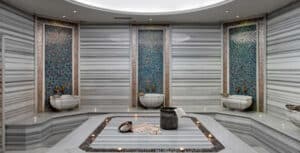
This is the boundary that separates our 2 material families. Timber lining, benches, backrests and duckboards belong on the dry side; mosaic, stone, tile and moulded acrylic belong on the wet side, and the junction between them is a threshold detail rather than a blend of materials. Both sides are set out across the Sauna Dekor product range.
The last limit is what the timber does not decide at all. Heat-up time, the vertical gradient in the cabin, the air change rate and the height of the upper bench above the heater are questions about the room and its equipment, and a correct wood specification will not rescue a wrong one. What fails first, and after how long, is set out in our notes on what wears out in a sauna and when.
Who is writing this
Sauna Dekor has designed and built thermal and wellness facilities since 1987 and is now in its 40th year, manufacturing in its own Istanbul facility with 19 employees, working under TS EN ISO 9001:2015, with projects delivered in more than 35 countries. On sauna wood that means we select, grade, profile, moisture-check and install the timber ourselves rather than ordering a finished kit, and we meter the moisture content of a pack on site before any board is fixed to a wall.
What we do not make is equally clear. Sauna heaters, control panels, extract fans and steam generators are not our products; they come from the equipment manufacturers we buy from, and any CE marking or EN 60335 conformity carried by that equipment belongs to its manufacturer rather than to us. The TS EN ISO 9001:2015 certificate is ours; the rest of the paperwork is theirs, and we pass it through unchanged.
Frequently asked questions about sauna wood
Which wood is used for sauna benches?
Resin-free species only: ayous at about 370 kg/m³, aspen at 440 or alder at 510. All of them sit between 0.09 and 0.12 W/mK, so a seat at 90 °C reads roughly 44 °C against skin rather than the air temperature.
Can pine be used in a sauna?
On walls below the hot zone, not on benches. Pine carries resin canals, and oleoresin becomes mobile around 60 to 70 °C while bench-height air runs at 80 to 100 °C, so a pine seat weeps a tacky dark residue within its first season of use.
What moisture content should sauna wood have when it is installed?
Between 6 and 8%, not the 10 to 12% at which timber normally leaves a yard. A 90 mm board fitted at 12% and then driven to 5% in service loses about 1.6 mm of width and opens a visible gap at every single joint.
How thick should sauna panelling be?
Fifteen millimetres, with a 20 to 25 mm ventilated cavity behind it that is open at floor level and again near the ceiling. Below 12 mm the board cups over the battens; above 18 mm it only adds mass that slows the cabin’s heat-up.
Is thermally modified wood worth using in a sauna?
For seat slats, yes. Modification at 180 to 215 °C cuts equilibrium moisture content by 40 to 50% and roughly halves movement, but it also costs 10 to 30% of bending strength, so bearers and stringers stay in unmodified timber.
Should sauna wood be oiled or varnished?
Never varnished. A film softens above 60 to 70 °C and blisters within 1 to 2 heating seasons. Paraffin oil goes on backrests, headrests and handles only, reapplied about every 12 months, and is kept off the seat surface itself.
Why is wood not used in a steam room?
Because decay fungi work above 20% moisture content, and a steam room holds 40 to 50 °C at close to 100% humidity all day, so the timber never dries out. Mosaic, stone and moulded acrylic are used on that side instead.
Sources
- Wood Handbook: Wood as an Engineering Material — USDA Forest Service, Forest Products Laboratory, current edition. Source for the density figures, the tangential and radial shrinkage percentages, the fibre saturation point near 30% and the equilibrium moisture content relationships used throughout this article.
- Wood Products — Puuinfo, Finnish Forest Industries, Helsinki. Reference for Nordic spruce and aspen panelling profiles, grading classes, board thicknesses and the moisture content at which interior lining is delivered and fixed.
- Wood drying — encyclopedic overview, accessed 2026. Background reference for equilibrium moisture content, fibre saturation point and the roughly 2 to 1 relationship between tangential and radial shrinkage quoted above.
- Thermal conductivity — encyclopedic overview, accessed 2026. Background reference for the conductivity range of timber against carbon steel, and for the effusivity relationship used to derive contact temperatures.
- EOS Saunatechnik — EOS Saunatechnik GmbH, Germany. Manufacturer documentation for cabin air temperatures, heater outputs and bench clearances above a heater; that equipment and any conformity marking on it belong to EOS as its manufacturer.
- DIN — Deutsches Institut für Normung, Berlin. Publisher of the hot-surface contact and wood indentation test methods referred to above; those standards belong to their issuing bodies rather than to us, and are cited here for method rather than for compliance.


