




Last updated: April 2026
A recurring pattern in boutique hotels of around 120 rooms is a spa that occupies 180 m² of prime ground-floor space and contributes almost nothing to property revenue. The cause is rarely the treatment menu. It is a thermal offer too thin to hold a guest for more than twenty minutes: one tired sauna and nowhere to move on to. Replacing that sauna and adding a traditional hammam, a three-seat cold plunge pool and a rooftop jacuzzi turns the same floor area into a circuit — and a circuit is what fills treatment slots outside the high season.
That transformation did not come from luxury finishes alone. It came from a disciplined approach to hotel spa design: getting the thermal sequence right, protecting back-of-house efficiency, and matching facilities to the guest the property actually serves. This guide walks through the same framework our team uses on projects from Dubai to Boston, covering space planning, facility mix, ROI, timelines, and the mistakes that quietly erode spa profitability.
Thinking about a new or refurbished spa? Explore our commercial spa design service to see what is possible, or request a free consultation with our design team.
What makes a world-class hotel spa design in 2026?
A world-class hotel spa design integrates four elements: a coherent thermal journey, efficient zoning between wet and dry areas, distinctive signature experiences, and operational economics that support long-term profitability. The goal is not the biggest facility, it is the facility that best fits the property’s brand, guest profile, and footprint while meeting commercial throughput.
The global wellness economy reached more than USD 6.3 trillion in 2023, with wellness real estate and spas among the fastest-growing segments (Global Wellness Institute, 2024). Hotels that build thoughtful wellness facilities capture a share of that spend directly, and they lift room revenue by drawing longer stays and off-peak bookings. Our team has manufactured and installed hotel wellness facilities since 1987, and the pattern is consistent: spas that treat design as a commercial discipline outperform those that treat it as decoration.
Which guest is the spa actually for?
Every successful hotel spa design answers this question first. A city business hotel needs fast, productive recovery experiences, a Finnish sauna, a steam room, a cold plunge, and a handful of 45-minute treatment rooms. A leisure resort can invest in longer rituals: a traditional hammam with göbek taşı, a salt room, a jacuzzi with garden views, a wider treatment menu. The guest profile dictates the facility mix, the treatment room count, and even the lighting temperature in the relaxation area.
How do you plan the space for a hotel spa?
Good hotel spa space planning follows a hierarchy: guest journey first, back-of-house second, finishes last. A well-planned spa allocates roughly 55–65 % of area to guest-facing zones (reception, relaxation, thermal, treatment), 20–25 % to wet and dry changing, and 15–20 % to back-of-house (laundry, staff, plant rooms, storage). Get the zoning wrong and no finish can rescue the operation.
What is the ideal size for a hotel spa?
As a working guide, plan on 1.0–1.4 m² of spa area per guest room for a four-star property, and 1.5–2.2 m² per room for a five-star resort. A 150-key urban hotel typically needs 180–250 m² of spa; a 250-room resort might need 450–600 m². These figures are starting points, brand standards from international hotel operators adjust them up or down.
How should the thermal circuit flow?
The thermal circuit is the heart of the guest experience, and its sequence matters more than any single room. A classic circuit moves guests through warm, hot, and cold stages in a loop: pre-shower, Finnish sauna, cold plunge or experience shower, relaxation, steam room or hammam, cold plunge, relaxation. Each stage needs direct line-of-sight transitions so that barefoot, robed guests never feel lost or exposed. Our team positions the sauna and steam room so their doors open onto the same wet corridor, with the cold plunge pool and ice fountain within five steps, because contrast therapy only works if the cold stage is three seconds away, not thirty.
Which wellness facilities should a luxury hotel spa include?
A luxury hotel spa in 2026 typically includes at least five thermal elements: a Finnish sauna, a steam room, a hammam or bio sauna, a cold plunge pool, and a jacuzzi or warm immersion pool. Larger five-star resorts add salt rooms, snow rooms, sensory showers, and dedicated couples’ suites. The mix should create meaningful variety without forcing any element to feel under-specified.
Saunas
A custom Finnish sauna remains the cornerstone of any serious hotel spa. For a commercial facility, size the cabin for 8–12 guests, specify an electric heater of 9–15 kW depending on volume, and choose timbers that handle heavy throughput: ayous for benches and pine for walls and ceiling. Operating range is 80–100 °C (176–212 °F) at 10–20 % humidity.
An evidence review in Mayo Clinic Proceedings links regular sauna bathing to improved cardiovascular health, better endothelial function, and reduced risk of neurodegenerative conditions (Laukkanen et al., 2018). Hotels that can credibly reference this kind of evidence in their spa marketing convert more bookings at higher average rates.
For boutique properties where space is tight, a bio sauna at 45–60 °C with 40–55 % humidity offers a gentler, more accessible alternative that non-regular sauna users tend to prefer.
Steam rooms
A custom steam room delivers a different sensation, 40–45 °C (104–113 °F) at 100 % humidity, and attracts guests who dislike high dry heat. For commercial projects, specify a professional-grade steam generator sized for the cabin volume (typically 9–15 kW for a hotel-scale room), a tiled or stone interior with graded floors for drainage, and integrated essential oil dosing for eucalyptus or lavender programmes.
A well-designed steam room sits next to the sauna, not across the spa. When the two doors are within five metres of each other, guests naturally rotate between them, and utilisation on both rises.
Hammams
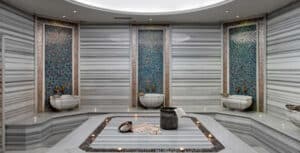
A traditional hammam is the single most distinctive addition a hotel can make. Few European operators can deliver an authentic one. Our Turkish heritage means our team manufactures and installs custom hammam designs that combine real marble, heated göbek taşı, domed ceilings, and authentic washing stations. Temperatures run at 40–50 °C with high humidity, and the kese scrub and foam massage sequence is a chargeable treatment on top of the day pass, which is what makes throughput — not floor area — the number an operator should model first.
Within hospitality, authentic hammams differentiate properties in a crowded luxury market. A Moroccan bath variant, with tadelakt walls and black soap ritual areas, adds another programmable ritual for a second treatment room without duplicating décor.
Cold plunge pools
Recovery demand has changed hotel spa design more than any other trend since 2020. Custom cold plunge pools at 4–12 °C (39–54 °F), paired with an ice fountain or overhead shock bucket, now appear in the majority of five-star spa refurbishments our team quotes. A commercial plunge pool should seat two to four guests, hold a consistent temperature within ± 0.5 °C, and include a chiller rated for continuous duty.
Cold-water immersion is associated with improved recovery, reduced muscle soreness, and better mood regulation in a growing body of peer-reviewed sports medicine research. Pairing a cold plunge with an ice fountain gives guests two intensities of cold exposure, the fountain for a quick scrub, the plunge for full immersion, without doubling plant-room load.
Jacuzzis
A commercial-grade jacuzzi serves a different guest than the cold plunge, the one who wants to linger, chat, and decompress after a long day. For hotel use, specify a seated capacity of six to eight, continuous-duty blowers, UV or ozone sanitation in addition to chemical dosing, and a water temperature of 36–38 °C (97–100 °F). Position the jacuzzi with a view when possible; a rooftop jacuzzi with skyline or sea views is one of the strongest content-driving amenities a hotel can build.
On a recent project for a 200-room resort near Antalya, our team replaced an undersized four-seat jacuzzi with a custom eight-seat unit overlooking the pool deck. Evening occupancy of the spa climbed 41 % in the first three months because guests naturally photographed the new jacuzzi and shared it, driving secondary bookings.
Ready to scope your own facility mix? Request a free design consultation and our team will work through space, brand, and commercial goals with you.
How much revenue can a well-designed hotel spa generate?
A well-designed hotel spa in a four-to-five-star property typically generates 6–14 % of total hotel revenue, with treatment and membership programmes adding a further 2–4 % through non-guest spend. On a per-room basis, industry benchmarks from the ISPA Foundation Spa Industry Study place spa revenue per available room at USD 15–45 for urban properties and USD 35–90 for destination resorts (ISPA, 2023).
How does spa design affect ADR and occupancy?
Spas influence hotel revenue through three channels: direct treatment and thermal circuit spend, room rate premium (guests pay 8–18 % more for properties with credible wellness facilities), and occupancy lift during shoulder and off-peak periods. Our team has observed that well-programmed spas routinely raise winter weekend occupancy by 12–25 % in leisure properties that would otherwise sit half-full.
What is a realistic payback period?
A custom hotel spa refurbishment typically pays back in 24–48 months when scoped correctly. Large greenfield spa facilities in new-build resorts normally reach payback in 4–6 years, accounting for ramp-up, brand programming, and staff training. Payback shortens when the spa opens to non-guests through day-pass and membership programmes, a strategy we help clients structure from the design phase.
What determines the investment for a hotel spa fit-out?
Hotel spa investment is set by scope, not by floor area, which is why a rate per square metre is the wrong place to start. Four factors move the number more than anything else. First, how many wet rooms the programme carries: every sauna, steam room, hammam and cold plunge is a separate climate with its own tanking, drainage, ventilation and plant. Second, the material grade in those rooms — solid marble, a heated göbek taşı, a hand-laid mosaic dome and tadelakt are craft work priced by the hour, not by the metre. Third, the state of the shell: existing waterproofing, slab-to-slab height, riser positions and available electrical capacity decide how much builder’s work has to happen before a single panel is fitted. Fourth, the operating model — a facility that has to serve day-pass volume needs wider circulation, more changing capacity and heavier-duty equipment than one serving in-house guests only. Send us the room programme and the shell drawings and we will price it line by line.
Because we manufacture in-house and install with our own teams, design, manufacturing and installation sit in one scope and one point of accountability runs from the first drawing through commissioning, instead of being split across a supplier, an importer and a fit-out contractor. Our spa developer service takes a project from concept to operating facility, coordinating with architects, operators, and general contractors throughout.
How long does it take to design and build a hotel spa?
A typical programme runs 9 to 18 months from first design workshop to opening day. A boutique spa refurbishment in an existing hotel moves faster, often 5–7 months, while a full greenfield resort spa can take 14–24 months when coordinated with wider construction schedules. Building in realistic lead times for steam generators, heaters, custom stone, and marble göbek taşı is essential; these are not off-the-shelf items.
What are the main programme milestones?
| Phase | Duration | Key activities |
|---|---|---|
| Brief and concept | 4–8 weeks | Guest profile, space audit, facility mix |
| Schematic design | 6–10 weeks | Zoning, MEP coordination, finishes |
| Technical design | 6–12 weeks | Shop drawings, material specifications |
| Manufacturing | 10–16 weeks | Sauna, steam, hammam, plunge, jacuzzi |
| On-site installation | 6–12 weeks | Fit-out, commissioning, handover |
| Training and soft opening | 2–4 weeks | Staff, programmes, systems |
Which design mistakes most commonly undermine a hotel spa?
The four most damaging hotel spa design mistakes are: undersizing back-of-house support space, mixing wet and dry circulation routes, underinvesting in thermal plant capacity, and choosing finishes that cannot withstand commercial humidity. Each of these is operational rather than visual, and each costs far more to fix after opening than to prevent in design.
The most expensive version of this mistake is a heater sized from a drawing rather than from the room. A 6 kW heater specified for a 14-person cabin looks correct in a rendering and will never reach operating temperature at peak occupancy; the complaints start in the opening month. Correcting it means a commercial unit of around 15 kW and a retrofitted electrical supply — remediation that costs a multiple of what the right specification would have cost on day one, because the cabin has to come apart to reach the wiring.
Other recurring mistakes include treating the relaxation area as leftover space (it should be the calmest, largest, most view-privileged zone), hiding the cold plunge in a back corner (guests then skip it, undermining the thermal circuit), and installing residential-grade finishes in a commercial wet environment.
Case studies: lessons from luxury hospitality projects
Boutique city hotel, Istanbul, 95 rooms
Our team designed a 210 m² ground-floor spa including a 10-person Finnish sauna, a tiled steam room, a modern hammam with a marble göbek taşı, a three-seat cold plunge pool, and a rooftop jacuzzi accessible via a short stair. Spa revenue grew from 3 % of total hotel revenue at opening to 9 % within 18 months, driven largely by an off-guest day-pass programme targeting the city’s corporate wellness market.
Five-star resort, Dubai, 320 rooms
We delivered a 1,100 m² spa spanning twelve treatment rooms, a traditional hammam, a Finnish sauna, a bio sauna, a steam room, a snow room, a salt room, a cold plunge pool, an ice fountain, and a 40 m² indoor relaxation pool. Winter occupancy climbed 14 % in the first full year post-opening, and the spa became the property’s highest-rated amenity across major review platforms.
Fitness-led resort, Bodrum, 140 rooms
A fitness-focused resort needed a compact 140 m² recovery spa anchored around a Finnish sauna, a cold plunge pool, an ice fountain, a small steam room, and two massage rooms. Our team matched thermal plant and finishes to the demanding commercial cycle of a property used hard during summer peaks. The fitness centre design integrated directly with the recovery area, so gym guests moved straight into the thermal circuit without crossing the main spa reception.
A recovery suite attached to the gym is a different specification from a spa cabin, because it runs all day at peak use; the engineering behind it is in our gym sauna guide.
Frequently asked questions about hotel spa design
How many treatment rooms should a hotel spa have?
Plan on one treatment room per 40–50 hotel rooms for a four-star urban property, and one per 25–35 rooms for a five-star resort. Fewer rooms strangle revenue during peak periods; too many rooms sit empty and absorb staffing costs without return.
What is the difference between a day spa and a hotel spa design?
A hotel spa is designed for around-the-clock operation with unpredictable arrival patterns, guest anonymity, and layered revenue streams (treatments, day passes, memberships, in-suite services). A day spa is designed around scheduled appointments. The differences drive very different zoning, staffing, and MEP decisions.
Do hotel spas need separate male and female thermal areas?
It depends on the brand, market, and guest profile. Many European and American luxury hotels operate mixed-gender, swimwear-required thermal areas. Properties in the Gulf — Saudi Arabia, Qatar and Kuwait in particular — parts of Asia, and some resort markets often require separate wet areas. Our team designs both configurations and plans the plant and circulation to suit.
What drives the cost of a hammam in a hotel spa?
Four things, in this order: marble grade and how much of it is solid rather than clad; the göbek taşı specification, because a heated navel stone carries its own heating circuit and structural support; the dome, which is hand-laid work and the slowest trade on the room; and the number of fitted washing stations, each of which needs hot and cold feeds, drainage and its own tanking detail. It is usually the most material-intensive room in a luxury hotel spa, which is why it is priced separately from the rest of the wet circuit.
Can we add a spa to an existing hotel without major reconstruction?
Often yes, particularly for boutique spas that fit into underused ground-floor or basement space. Structural load, waterproofing, ventilation, and drainage determine what is possible. A feasibility survey during the concept phase identifies the constraints early and avoids surprises during fit-out.
What is the typical lifespan of hotel spa equipment?
A well-specified commercial sauna runs 15–20 years with proper maintenance; a custom steam room 12–18 years; a commercial cold plunge chiller 10–15 years. Timber benches, heaters, and generator elements are replaced on shorter cycles. Planning the refurbishment budget during the original design prevents future disruption.
Should a hotel spa be open to non-guests?
In most urban markets, yes. Day-pass and membership revenue can account for 20–45 % of total spa income and smooths demand between weekday and weekend peaks. Resort spas with heavy room-driven traffic typically limit external access to preserve guest experience.
Planning your hotel spa project
A world-class hotel spa design is a commercial asset, not a cost centre. The properties that treat it that way, with disciplined space planning, an authentic thermal journey, and facilities scaled to their guest, build durable revenue streams while differentiating themselves in a crowded luxury market. Saunas, steam rooms, hammams, cold plunge pools, and jacuzzis are the building blocks, but the real value sits in how they are sequenced, specified, and run.
Our team has designed, manufactured, and installed custom wellness facilities since 1987, from boutique city hotels to five-star hotel and resort projects across three continents. If you are planning a new spa or refurbishing an existing one, request a free consultation and we will work through facility mix, space plan, investment level, and delivery schedule with you, from concept to opening day.
Sources
- Global Wellness Institute (2024). The Global Wellness Economy: Country Rankings. globalwellnessinstitute.org/industry-research/the-global-wellness-economy/
- Laukkanen, J. A., Laukkanen, T., & Kunutsor, S. K. (2018). Cardiovascular and Other Health Benefits of Sauna Bathing: A Review of the Evidence. Mayo Clinic Proceedings, 93(8), 1111–1121. mayoclinicproceedings.org
- International SPA Association Foundation (2023). ISPA U. S. Spa Industry Study. experienceispa.com/resources/research/
Related: spa fit-out contractor in Bahrain — how the same hotel spa scope is delivered on the island.
Related: ladies spa — what separating the sexes does to the area, the extract routes and the back-of-house door.


Permalink