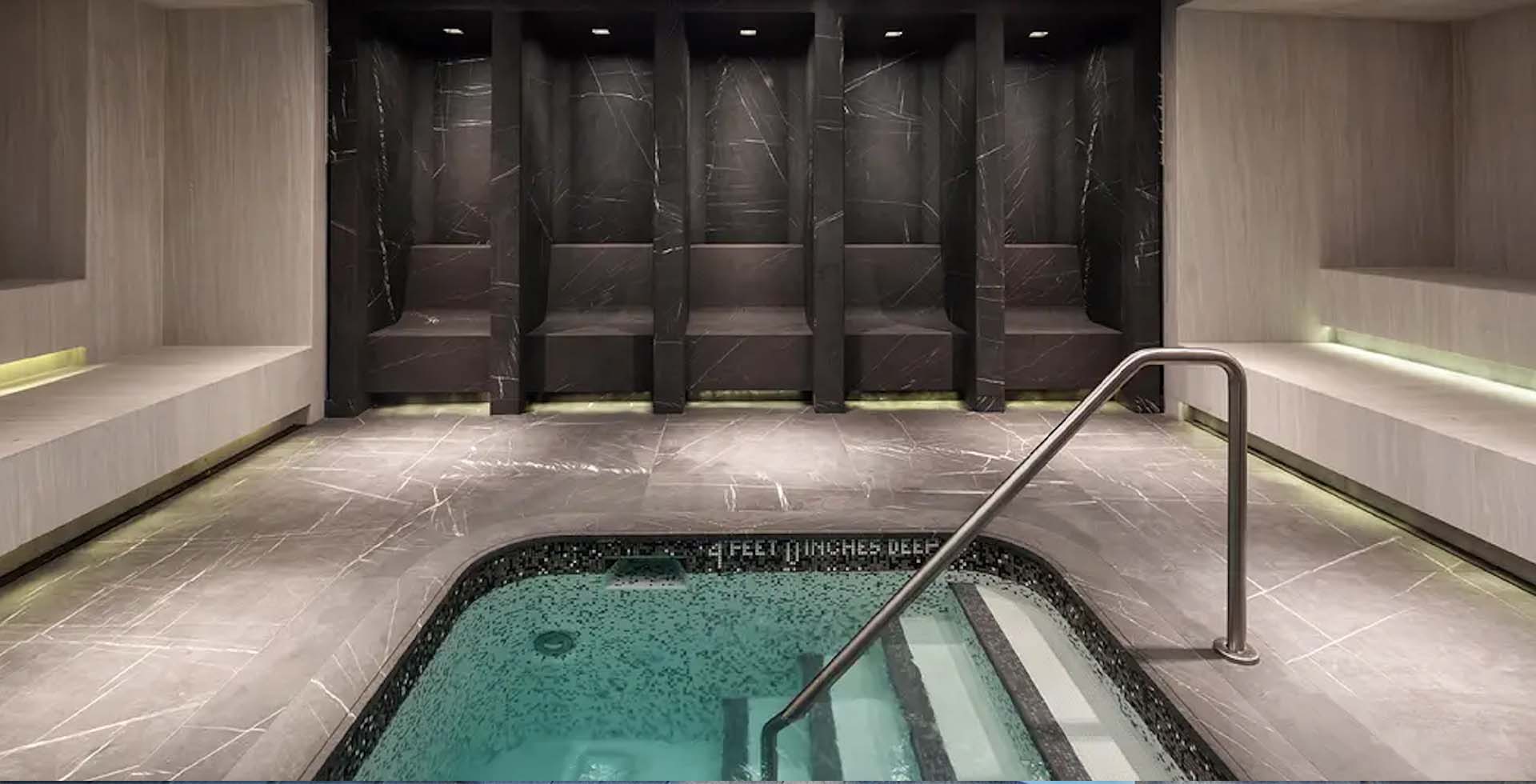
Which cold plunge is best to buy?
The answer depends on the category, not on the brand. For one household a few times a week, a plug-in chilled tub is the lowest-risk purchase. For a villa or a home spa, a drop-in shell with separate plant gives better control and a longer service life. For a hotel, gym or recovery studio, only a built-in plunge with a chiller sized for continuous duty and a proper filtration and sanitation package will hold its temperature through back-to-back users.
What size chiller does a cold plunge need?
Size it against three loads rather than one: the initial pull-down, the continuous standing heat gain through the tank walls and from the circulation pump, and the body heat each bather brings in. In a hot climate the standing loss dominates, which is why insulating the tank shell is usually cheaper than upsizing the chiller to compensate for not insulating it.
Is a chilled plunge better than adding ice?
Mechanically, yes, and the reason is behavioural rather than technical: ice logistics are the most common reason an unchilled tub stops being used. An unchilled barrel is a legitimate low-cost entry for a single user who is realistic about that. For anything with more than one user it is not a serious option.
Do cold plunges need filtration?
Yes. Cold water is not self-cleaning and plunge users enter unshowered far more often than pool users do. A workable specification has mechanical filtration, a sanitation method matched to the volume, and a turnover rate matched to the number of users. Commercial installations additionally carry testing and record-keeping obligations.
Can a cold plunge go indoors?
Yes, and it is common, but three things have to be decided early: drainage, where the chiller lives, and where the heat it rejects goes. An indoor chiller adds to the cooling load of the room it sits in. Placing the plunge next to a shower at layout stage is far cheaper than adding drainage afterwards.
How much space does a cold plunge need?
The tub is the small part. Allow for entry and exit with a handrail, a non-slip surround, a drainage route, and a plant location within a serviceable pipe run of the tank. On built-in projects the plant space and its access route are the items most often left out of an early layout and most expensive to add later.
Who builds built-in cold plunges?
Sauna Dekor manufactures and installs fixed cold plunge pools alongside saunas, steam rooms and hammams, working from Istanbul since 1987 — this is our fortieth year — most often in the UAE, Qatar and Saudi Arabia and in 41+ countries. Our quality management system is certified to TS EN ISO 9001:2015. We do not manufacture consumer plunge tubs; we supply and install Wellis swim spas.
Should the plunge or the sauna come first in a project?
Decide them together. They share a wet-area envelope, they are usually used in sequence, and the waterproofing, drainage and plant coordination are much cheaper as one scope than as two. Splitting them across two contractors is the most reliable way to produce a leak at the junction.