




Last updated: 7 October 2026
Short answer: Best wood for sauna benches, in our view: a low-density, resin-free timber that conducts heat poorly, so the surface stays comfortable to sit on. At Sauna Dekor Spa Solutions that means ayous or aspen, plain or thermally modified. For wall and ceiling linings we use ayous, aspen, pine or thermo pine. Those six timbers are our standard schedule. Hemlock, Western red cedar, alder and spruce are supplied when a client asks for them.
Whatever the species, two things decide whether a sauna survives ten years in the Gulf: the moisture content of the timber at the time of manufacture and glue-free construction on every hot surface. Neither of them shows on a sample board, so both belong in the specification.
Who is writing this, and which species does it cover?
Sauna Dekor has manufactured saunas in Istanbul since 1987 and cuts every board itself, so this guide covers the timbers in our own schedule: ayous, thermo ayous, aspen, thermo aspen, pine and thermo pine as standard, with hemlock, Western red cedar, alder and spruce on request. Abachi, a name seen on many European sauna price lists, is the same tree as ayous (Triplochiton scleroxylon); we write ayous.
We are Sauna Dekor, a sauna and thermal-room manufacturer that has been cutting timber for this purpose since 1987 — 40 years now — from our own workshop at Ziya Gökalp, Metal İş Sanayi Sitesi Yolu 20. Blok No:17-19, 34490 İkitelli OSB, Başakşehir, İstanbul, Türkiye. A team of 19 employees has delivered installations in over 35 countries, with hotel, developer and private-residence work in Dubai, Abu Dhabi, Riyadh and Doha. We select, machine and finish the timber ourselves rather than importing finished cabins, which is why this guide covers only the species we actually cut.
Our own certificate is TS EN ISO 9001:2015 quality management, certificate no. 202025106 (EKOL Belgelendirme, valid to 19.06.2027). Forestry chain-of-custody certificates such as FSC or PEFC are held by the timber supplier, not by us; CE and EN 60335 conformity for heaters is held by the heater manufacturers such as EOS and Sentiotec.
Which four properties decide the choice of sauna wood?
Sauna wood is judged on four measurable properties, and colour is not one of them. Density decides touch temperature, resin content decides whether the board weeps, stability decides whether joints stay closed over 2 cycles a day, and wet behaviour decides maintenance. Appearance comes fifth, as the last filter rather than the first.
1. Thermal conductivity. Sauna air runs hot and the surfaces run hot with it. A dense timber stores and passes heat efficiently, which is exactly what you do not want under a bare thigh. Low-density timber conducts poorly, so it sits at a touch temperature well below the air temperature. That is the reason ayous is our bench timber: it is physics, not fashion.
2. Resin and extractive content. Resinous timber can weep under heat. Pine carries resin, which is why we use it on walls and ceilings and never on benches, backrests or headrests. Resin-free ayous and aspen take every surface skin touches.
3. Dimensional stability. A sauna cycles from ambient to working temperature and back, sometimes twice a day, sometimes twelve times. Every cycle moves the wood. Correctly dried and correctly fixed, a stable board moves without cupping, splitting or opening its joints.
4. Behaviour when wet. Feet are wet, benches take water, and in a bio sauna the humidity is deliberately raised. A board that greys, raises its grain or stains under repeated wetting is a maintenance problem regardless of how it looks on delivery.

Best wood for sauna surfaces: which species goes where?
Benches, backrests and headrests are ayous or aspen, plain or thermally modified. Wall and ceiling linings are ayous, aspen, pine or thermo pine as standard, with hemlock, Western red cedar, alder or spruce on request. The table below is the schedule we quote from on every project; the sections after it explain each species and where it goes in the room. The density and conductivity figures behind it are worked through in our sauna wood guide.
| Species | Status in our schedule | Benches, backrests, headrests | Wall and ceiling lining | What the client sees |
|---|---|---|---|---|
| Ayous | Standard | Yes — our default | Yes | Pale cream to light straw, no resin |
| Thermo ayous | Standard | Yes | Yes | Even brown through the board, no resin |
| Aspen | Standard | Yes | Yes | Near-white, odourless |
| Thermo aspen | Standard | Yes — seat slats | Yes | Light to mid brown, moves less than untreated aspen |
| Pine | Standard | No — resin | Yes | Light, with visible grain and knots |
| Thermo pine | Standard | No (benches stay ayous or aspen) | Yes | Brown, knots still visible |
| Hemlock | On request | No | Yes | Pale, straight grain, few knots |
| Western red cedar | On request | No — soft, marks easily | Yes | Reddish-brown, aromatic |
| Alder | On request | No (benches stay ayous or aspen) | Yes | Warm reddish-brown, darkens with heat over the years |
| Spruce | On request | No — resin pockets | Yes | Pale, with knots |
Ayous
A West African hardwood, pale cream to light straw, very low density for a hardwood, no resin and remarkably poor at conducting heat. It is what we specify for benches, backrests and headrests unless a client asks otherwise, and it works equally well as a lining. Abachi and obeche are other trade names for the same tree. Its weaknesses are honest ones: it is soft and marks under impact, it is not a structural timber, and its light colour shows staining if the room is not cleaned. It also needs to arrive properly kiln-dried; ayous that has been shipped and stored badly will move.
Pine
Our standard lining alongside ayous, and the timber many people picture when they picture a sauna. Light in colour, with visible grain and knots, and it warms in tone as it ages. Pine carries resin, so it stays on walls and ceilings; every surface skin touches is ayous or aspen. A specification that says only “pine” has not said enough: ask for the grade (knotty or clear) and the board thickness, because both change the look and the price.
Aspen
A Nordic hardwood, near-white, resin-free, low density and essentially odourless. Aspen is the alternative to ayous for benches and suits linings where the client wants a very pale, contemporary interior. It handles moisture well, which makes it useful in rooms that run wetter, such as a bio sauna.
Thermo ayous, thermo aspen and thermo pine
Thermally modified timber has been heated in a low-oxygen kiln, which darkens it through the full thickness of the board and roughly halves its moisture movement. It also loses part of its bending strength, so we use it for seat slats and linings and keep bench bearers and frames in untreated timber. Thermo pine stays on walls and ceilings, like ordinary pine. The kiln temperatures and the strength figures are set out in the thermal modification section of our sauna wood guide.
Hemlock, Western red cedar, alder and spruce (on request)
These four are not in our standard schedule, but we supply them when a client asks. Hemlock is a pale, straight-grained lining. Western red cedar gives a reddish-brown, aromatic room; it is soft and marks easily, so we keep it off seats. Alder is the option for a client who wants warm colour in the lining; it darkens with heat over the years, which some clients like and some do not, so we say so in advance. Spruce is the classic Nordic lining and carries resin pockets, so it stays on walls and ceilings. Benches stay ayous or aspen in every case.
What we do not use
We do not build with species outside this schedule. We do not put pine or spruce on benches. We do not use oak or other dense hardwoods on benches, because density is precisely the wrong property there. We do not use timber without a clear supply chain. And, most important, we use no plywood, MDF, blockboard or glued laminate anywhere on a hot surface.

Why does glue-free construction matter more than the species?
Choosing the right bench timber and then gluing it badly wastes the choice. Benches carry the longest skin contact and, after the heater guard, the highest surface temperature in the room, so an adhesive line there sits under continuous thermal load. Our rule has 3 parts: solid timber, mechanical fixing, and fixings hidden from below so nothing metallic touches skin.
Bench tops, bench frames, backrests and headrests are solid timber. The bench should be demountable in modules for cleaning and replacement; in commercial rooms this is not a refinement, it is how the room stays serviceable for fifteen years.
The same logic applies to lining: solid tongue-and-groove profile boards, fixed to battens with a ventilated cavity behind, over insulation and a foil vapour barrier with taped laps. Not sheet material. Not a laminate. The cavity lets the back face of the lining dry, and a lining that cannot dry from behind will cup.
When you compare quotations, ask three questions and the price differences usually explain themselves:
- Are the benches solid timber, and what species and section?
- Is the lining solid profile board or sheet material?
- Is there a ventilated cavity behind the lining, and a foil vapour barrier with taped joints behind that?
Our commercial sauna specification guide contains this language in a form you can paste into a tender document.
Why is moisture content the number that decides everything?
Moisture content, not species, is what turns a good bench board into the wrong one. Timber reaches equilibrium with the humidity around it, and when that humidity changes, the timber shrinks or swells unevenly across the grain. That is why we ask 1 question before drying any Gulf order: will the building be air-conditioned all year?
The practical consequence matters more in the Gulf than almost anywhere. A lining machined to suit a damp northern European interior, then installed in a permanently air-conditioned tower where the air stays dry all year, loses moisture after installation. It shrinks. Tongue-and-groove joints open, bench slats develop gaps, and the client sees a defect that is really a moisture-content mismatch.
The reverse happens too. Timber stored in an uncooled container yard or an open site compound through a coastal summer picks up moisture, is installed swollen, and then dries and cups once the room starts operating.
This is why we control drying in-house and ask, on every Gulf project, whether the building will be permanently conditioned, seasonally conditioned or unconditioned. The answer changes the target moisture content and the joint detail. It is also why site storage is written into our method statements: timber waits in a dry, conditioned space, not in a corridor.
What does the Gulf climate do to sauna timber?
A timber schedule that works in Helsinki is not automatically right for Dubai. In the rooms we are called to inspect across the Gulf, 3 regional effects show up again and again: a steep vapour gradient, fine abrasive dust, and chlorinated air from neighbouring pool halls. Each one has a specification answer.
Coastal humidity plus air conditioning creates a steep gradient. A sauna in a beachfront hotel sits between saturated outdoor air and a dry conditioned interior. Vapour drives hard in one direction, and if the vapour barrier is discontinuous — a lap that was never taped, a duct penetration that was never sealed — moisture collects in the insulation behind the lining. The timber is blamed; the barrier is at fault. The same pattern recurs across the thermal suite and in hotel spa builds. Our note on sauna ventilation covers the airflow half of this.
Fine dust is abrasive and it stains pale timber. Ayous and aspen are chosen partly for being pale; the same paleness shows dust and body oils. This is a cleaning question, not a species question, and it belongs in the operations manual: soft brush, mild neutral cleaner, no solvents, and periodic light sanding of bench tops rather than coating them.
Chlorinated air from an adjacent pool hall attacks timber and fixings together. Where a sauna opens off a pool deck — very common in the region’s hotels and clubs — the specification should assume chlorinated air enters every time the door opens. That pushes fixings toward higher-grade stainless and shortens the maintenance interval, in hotel rooms and gym saunas alike. Heater choice interacts with this too, as set out in our guide to sauna heater types. Our fitness and sport centre work runs into this constantly.
Our delivery footprint is set out on the Dubai, Abu Dhabi, Riyadh and Doha pages, with manufacturing in Istanbul.
How does the room type change the timber schedule?
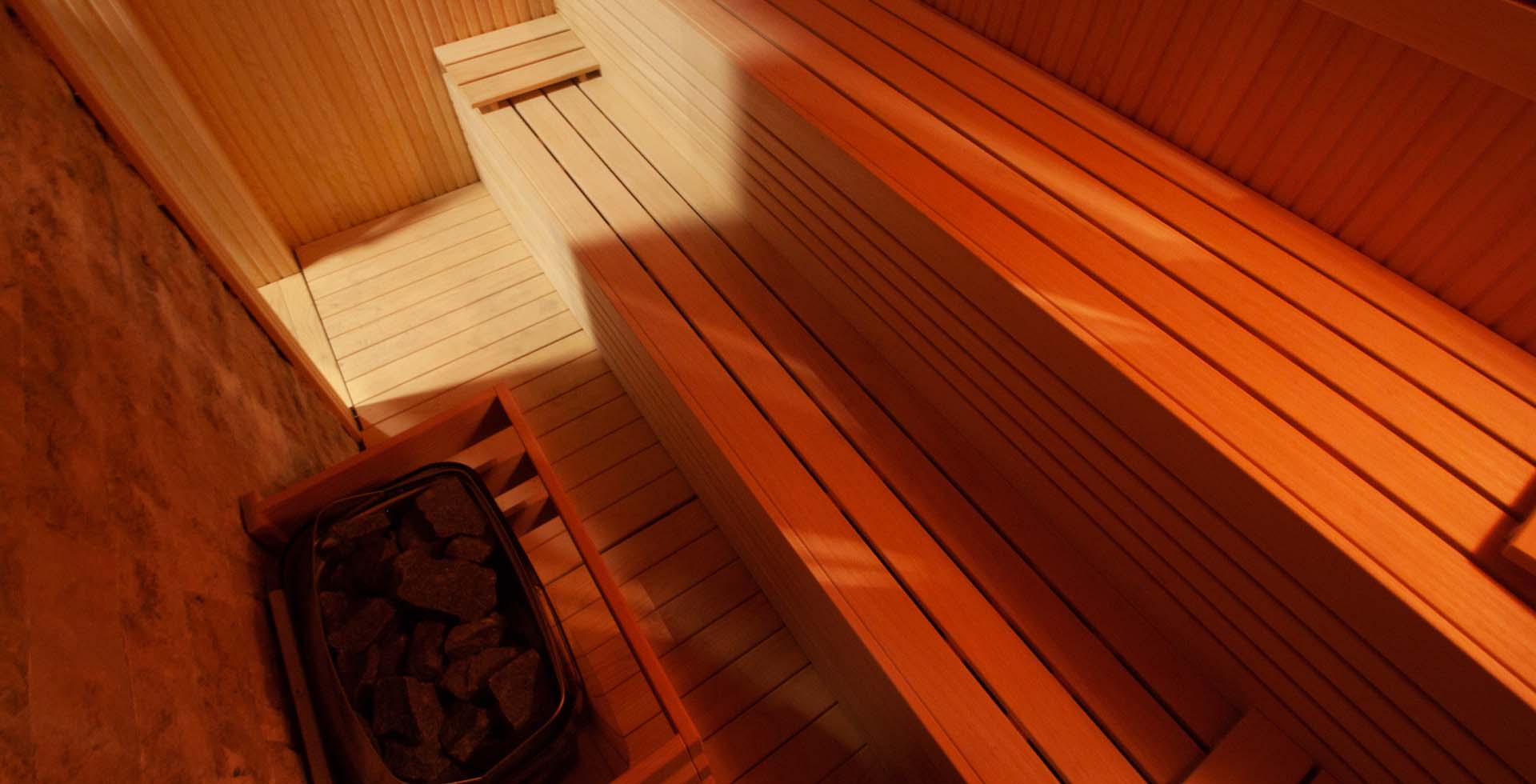
The room decides the timber more than the client’s taste does. Across the 5 room types we build — Finnish, bio, infrared, outdoor cabin, and steam room or hammam — the bench rule stays the same, ayous or aspen, while the lining and the detailing change with temperature and humidity.
- Finnish sauna — hottest and driest air, with humidity spikes from löyly. Benches ayous or aspen. Lining ayous, aspen or pine, or hemlock, Western red cedar, alder or spruce on request. The most forgiving case, and the one covered in choosing a home sauna.
- Bio / soft sauna — lower air temperature with sustained humidity, which is harder on timber than dry heat. Favour ayous or aspen lining and make sure the cavity behind the lining is genuinely ventilated.
- Infrared room — low air temperature, with radiant load concentrated around the panels. The boards immediately around the emitters see local heat, so detailing there matters more than species. See our infrared explainer and the comparison piece.
- Outdoor cabin — external cladding is a weathering problem and follows exterior joinery practice; the internal lining is a normal sauna problem. Two specifications on two sides of the same wall, covered in our outdoor sauna kits notes and the outdoor sauna guide.
- Steam room and hammam — not timber rooms at all. Saturated air means tiled, stone or microcement finishes over a tanked substrate. A timber-lined steam room is a specification error, as set out in our steam room build guide.
Should sauna timber be finished at all?
Bench timber takes no finish at all: 0 coats of varnish, lacquer or any film-forming product. A film on a hot surface softens, becomes tacky, traps dirt and eventually blisters, and it stops the timber breathing and drying. Bench tops are left bare and maintained by cleaning and occasional light sanding.
Lining can be left bare or treated with a breathable, low-emission paraffin-based sauna wax where a client wants a slightly darker tone or easier cleaning, applied to walls rather than to seating. Door frames and thresholds, which take water and hand contact, may justify a treatment that the rest of the room does not.
Anyone offering a “sealed” or “lacquered” sauna interior is selling furniture, not a sauna.
What should buyers ask when comparing timber in sauna quotations?
Most quotations describe the timber in three words and hide the differences that matter. Ask every supplier for the same 6 items in writing, compare the answers line by line, and the price gap between similar-looking offers usually explains itself before you reach the bottom of the list:
- Species and grade for benches and for lining, separately. “Pine” is not a specification; the grade and board thickness are.
- Section sizes. Bench slat thickness and lining board thickness. Thin lining boards are the most common way a low price is achieved.
- Construction method. Solid and mechanically fixed, or glued panel. Demountable bench modules, or fixed.
- Moisture content at despatch, and the target the supplier is drying to for your building’s conditioning regime.
- Chain-of-custody documentation from the timber supplier, if the project requires it — and check whose name is on the certificate.
- Fixings. Stainless grade, and confirmation that no fixing head touches a seating surface.
Those six questions separate three similar-looking quotations more effectively than any amount of showroom time. Where the timber line sits in the overall price is set out in our note on what a sauna costs in the region.
Who can prepare a timber schedule for your room?
If you are specifying a room now, send the drawing, the building’s conditioning regime and the intended duty — private residence, hotel, club — and we will come back with a timber schedule rather than a species name. We manufacture what we specify, so the schedule is a commitment rather than a preference. Talk to us through the contact page or a virtual consultation, and see the wider context on our sauna product page, project record, company background, private spa and commercial spa pages, or the spa solutions overview.
Frequently asked questions
Which woods does Sauna Dekor use for benches as standard?
Ayous and aspen, plain or thermally modified. All of them are low-density, resin-free and poor conductors of heat, which is what a seating surface needs. Pine and thermo pine stay on walls and ceilings because of their resin, and hemlock, Western red cedar, alder and spruce are lining options on request. The contact-temperature figures behind this are in our sauna wood guide.
Is abachi the same wood as ayous?
Yes. Abachi, ayous and obeche are trade names for the same West African tree, Triplochiton scleroxylon. A quotation that lists abachi benches is offering the timber we specify as ayous; compare grade, section and moisture content, not the name.
Which wood do you use for sauna walls and ceilings?
Ayous, aspen, pine or thermo pine as standard, with hemlock, Western red cedar, alder or spruce on request. The lining is always solid tongue-and-groove board fixed to battens, with a ventilated cavity and a taped foil vapour barrier behind it, never sheet material.
Can pine be used in a sauna?
Yes, as a wall and ceiling lining, which is how we use it. Pine carries resin, so it should not be used for benches, backrests or headrests. If a quotation says only “pine”, ask which surfaces it covers and which grade is meant.
Why is plywood not acceptable in a sauna?
Glued panel products put an adhesive line under sustained heat on the surfaces with the longest skin contact, and they cannot be sanded and maintained the way solid timber can. Benches, backrests and headrests should be solid timber, mechanically fixed, with fixings hidden from the seat.
Should sauna wood be sealed or varnished?
Bench surfaces should be left bare. Any film-forming coating softens at sauna temperature, turns tacky, traps dirt and eventually blisters. Lining may take a breathable, low-emission sauna wax if a client wants a darker tone, but seats are maintained by cleaning and light sanding.
How does Gulf humidity affect sauna timber?
The problem is rarely outdoor humidity itself; it is the gradient between saturated outside air and dry conditioned interiors, plus the moisture content the timber arrived at. Timber dried for a northern European interior shrinks after installation in a permanently air-conditioned building and opens its joints.
How long should sauna timber last?
Lining lasts indefinitely if the vapour barrier is continuous and the cavity behind it is ventilated. Bench tops are consumables in commercial use, which is why they should be built as demountable modules. Maintenance guidance is in our note on sauna maintenance.
Sources
- USDA Forest Products Laboratory, Wood Handbook: Wood as an Engineering Material (FPL-GTR-282) — moisture content, equilibrium moisture and thermal conductivity of wood.
- Forest Stewardship Council, FSC chain-of-custody certification — held by the timber supplier.
- Programme for the Endorsement of Forest Certification, PEFC chain of custody — held by the timber supplier.


