




Sauna Dekor Spa Solutions engineering team, Istanbul · project and press enquiries: Alican Aykaç, Managing Partner
Last updated: 26 October 2026
Short answer: swimming pool construction in Dubai runs in 8 stages: site survey, drawings and approvals, excavation, the structural shell, waterproofing, pipework and plant, finishes, then pressure testing and the first fill. Sauna Dekor Spa Solutions builds villa and hotel pools, and most problems we are asked to fix were decided in the first 3 stages, long before the tile went on.

What are the stages of swimming pool construction?
There are 8, and each one closes a decision the next cannot reopen cheaply. The order is survey, drawings and approvals, excavation, shell, waterproofing, pipework and plant, finishes, then testing and first fill. Skipping or overlapping stages is the most common reason a new pool loses water or needs tiles lifted.
- Site survey: levels, access for machines, soil and groundwater, existing services.
- Drawings and approvals: structure, hydraulics, electrical, plant room and finishes, submitted to the community and authority that apply.
- Excavation: to the structural drawing, with shoring where the plot is tight.
- Shell: reinforced concrete with every pipe sleeve and fitting cast in place.
- Waterproofing: a continuous system on the inside face, tested before finishes.
- Pipework and plant: suction, return, overflow or skimmer lines, filter, pump, dosing and heating or cooling.
- Finishes: mosaic, tile or stone, coping and the deck around the pool.
- Testing and first fill: pressure tests, a water test, commissioning and handover.
What does the site survey decide?
It decides where the pool can sit and how it can be built. A survey records 4 things: site levels, access for excavation machines, the soil and groundwater conditions, and services already in the ground. In a finished villa, access alone can change the method from machine digging to manual work.
Groundwater matters in coastal plots. A high water table can push an empty shell upward, so the structural design and the drainage of the excavation have to account for it. Buried services, irrigation lines and boundary walls set the edges of the dig.
The survey is also when we agree whether the pool is indoor or outdoor, because that changes the plant, the finishes and the air handling. Our pages on indoor swimming pools and outdoor swimming pools set out the differences.
Which drawings are needed before digging?
At least 5 sets: structure, hydraulics, electrical, plant room and finishes. The hydraulic drawing fixes every inlet, outlet, skimmer or overflow channel and the balance tank, and those positions must be cast into the shell. A pool built from an architectural sketch alone has no fixed position for any of them.
The hydraulic layout decides how water moves through the pool. Good circulation reaches every corner and returns the surface water to the filter, which is the subject of our note on better water circulation in a pool. The electrical drawing fixes equipotential bonding, lighting circuits and the plant supply.
Community and authority approvals in Dubai follow these drawings, so changing them after submission costs time. We freeze the drawings before excavation starts.

Why is the concrete shell the critical stage?
Because everything that passes through the wall is fixed when the concrete is poured. Pipe sleeves, lights, inlets, skimmer bodies and the overflow channel are set in the formwork; a missed sleeve means coring through new concrete later. We check every penetration against the hydraulic drawing in 1 walk-through before each pour.
The structural engineer sets wall and floor thickness and the reinforcement. On rooftops and basements the slab carries the full weight of water, shell and finishes, so the shell design starts with the building’s structure, not with the pool.
After the pour the shell needs curing time before waterproofing. Rushing that step to save a week is the fastest way to lose the waterproofing later.
How is a pool waterproofed?
With a continuous waterproofing system on the inside face of the shell, detailed around every pipe, light and fitting, then tested with water before any finish goes on. The 2 weak points are the penetrations and the joints between walls and floor, so they get their own detail on the drawing.
Concrete alone is not treated as watertight. The waterproofing layer is applied after the shell has set and dried, with collars or sealing details at each penetration. A water test then shows any leak while it is still cheap to fix.
We give a 5-year warranty on structure and waterproofing, which is why we do not skip the test.
What goes into the plant room?
The filter, pump, dosing system, any heating or cooling unit, the balance tank on overflow pools and the electrical panel. A plant room needs 3 things beyond space: ventilation, a floor drain and service access wide enough to replace the largest item. We place it as close to the pool as the plot allows.
In a Dubai summer, outdoor pools often need cooling rather than heating, and the cooling unit needs fresh air to reject heat. A plant room in a sealed basement can overheat its own equipment.
Indoor pools add dehumidification of the pool hall, which is a separate air-handling system and is covered in our guide to indoor pools in Dubai.
How are finishes chosen for a Gulf pool?
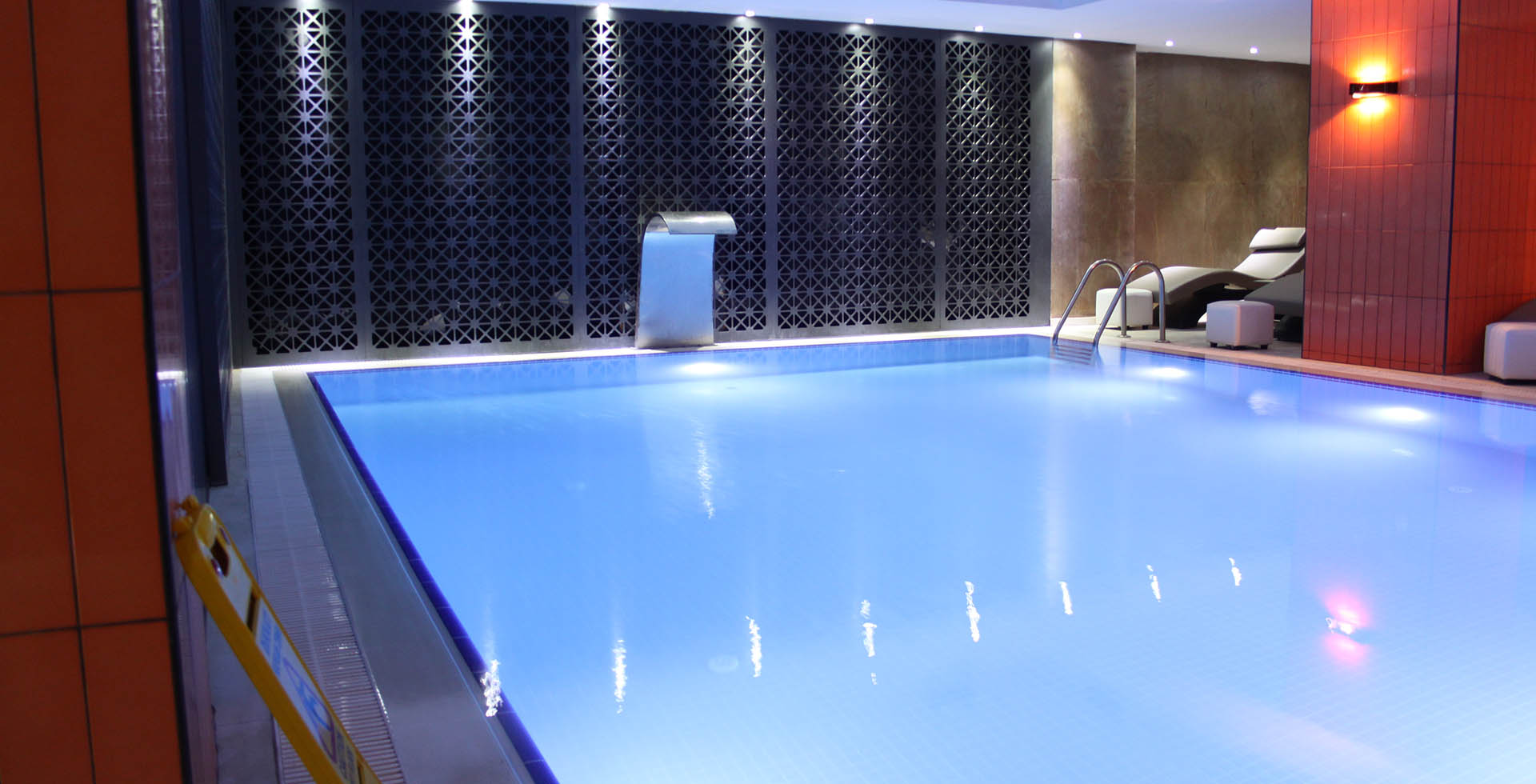
For heat, glare and water chemistry, in that order. A finish must stay bonded through 2 kinds of stress: hot sun on an outdoor deck and constant immersion inside the shell. Mosaic, porcelain tile and natural stone all work when the adhesive, grout and movement joints are specified for submerged use.
The deck matters as much as the shell. Pale, slip-resistant stone stays cooler under foot; dark polished surfaces get hot and slippery. Coping details decide whether water from the deck runs back into the pool or away from it.
For a narrow plot, a lap pool changes the finish plan too: a long, straight shell shows every tiling line.
What happens at testing and first fill?
The pipework is pressure tested, the shell is filled and watched for leaks, and the plant is commissioned with water flowing through every line. Then the owner or facility team is shown 3 routines: daily checks, water balance and backwashing. Handover should include the drawings as built and the equipment manuals.
Maintenance starts on the first day of use. Our guide on how to maintain a pool lists the routine checks.
Who builds this
Sauna Dekor Spa Solutions has designed and built pools, saunas, steam rooms and hammams since 1987: 40 years of manufacturing in Istanbul, in our own facility in İkitelli OSB, with a team of 19 and TS EN ISO 9001:2015 certification (EKOL, certificate 202025106). We have delivered 5,000+ projects in 35+ countries, 577+ of them for hotels and resorts.
We give a 24-month warranty on workmanship and manufacturing; a 24-month manufacturer’s warranty on electrical and mechanical equipment; and a 5-year warranty on structure and waterproofing. Our villa and hotel pool work in the emirate is on the swimming pool in Dubai page.
Frequently asked questions about swimming pool construction
How many stages does swimming pool construction have?
We work in 8: site survey, drawings and approvals, excavation, shell, waterproofing, pipework and plant, finishes, then testing and first fill. Each stage closes decisions that are expensive to reopen in the next one.
Can a pool be built without hydraulic drawings?
It can be poured, but not built well. Without a hydraulic drawing, inlets, skimmers, the overflow channel and the balance tank have no fixed position, and sleeves missed in the shell must be cored through new concrete later.
Is concrete watertight on its own?
We do not treat it as watertight. A continuous waterproofing system goes on the inside face of the shell once it has set, with a detail at every penetration, and a water test follows before any tile or stone is laid.
Where should the plant room go?
As close to the pool as the plot allows, with ventilation, a floor drain and access wide enough to replace the largest unit. Cooling equipment needs fresh air, so a sealed basement plant room can overheat in summer.
Which finish suits a pool in the Gulf?
Mosaic, porcelain tile and natural stone all work if the adhesive, grout and movement joints are specified for submerged use. On the deck, pale slip-resistant stone stays cooler and safer than dark polished surfaces.
What should the handover include?
Pressure and water test results, commissioning of the plant, as-built drawings, equipment manuals and a walk-through of daily checks, water balance and backwashing for whoever will run the pool.
Sources
- Swimming pool — Wikipedia. Construction types, circulation, filtration and disinfection.
- Building commissioning — Wikipedia. Testing systems before handover.
- Installation handbook — Schlüter-Systems. Sealing details at penetrations and water testing before tiling (wet-area practice that pool contractors share).
- Competition regulations and facilities rules — World Aquatics. Reference for competition pools; villa pools follow the owner’s brief.


