




Rasul and Mud Bath: The Complete Guide to Mud Therapy Rooms and How to Build One in 2026

Sauna Dekor Spa Solutions engineering team, Istanbul
Last updated: 5 October 2026
Sauna Dekor Spa Solutions is an Istanbul manufacturer of saunas, hammams and steam rooms, working since 1987 — 40 years — on projects in more than 35 countries. We have built onsen, rasul and float rooms as part of projects in Iraq and Turkmenistan.
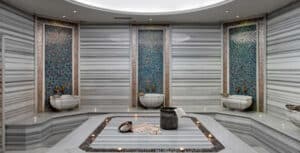
There is a moment in every spa tour we give when the group reaches the rasul chamber and someone asks, “So what exactly happens in here?” It is the most intriguing room on the floor: a domed, mosaic-tiled steam chamber with a starlit ceiling, heated seats, and small bowls of coloured clay waiting on a marble stand. What happens is one of the oldest treatments in the world — the mud bath — staged as a ritual guests never forget, and one of the highest-margin treatment rooms a spa can build.
Interest in mud is quietly climbing: “mud bath” alone now draws well over a thousand questions a month to AI assistants, with rasul and rhassoul adding a steady stream from spa-goers who met the ritual on holiday and want to understand it — or bring it home. This guide, written from 40 years of manufacturing wellness facilities at Sauna Dekor, explains what a rasul is, how the mud bath ritual works, what the evidence honestly supports, how a mud therapy room is engineered, and what it costs to build one.
Planning a rasul or mud therapy room? Explore our commercial spa services or request a free consultation.
What is a rasul?
A rasul (also spelled rhassoul) is a tiled steam chamber designed for a self-applied mud ritual: bathers coat themselves in mineral clays, relax as gentle herbal steam slowly moistens and warms the mud, and finish with a warm rain shower that rinses everything away. The name comes from rhassoul clay — a mineral-rich lava clay mined in Morocco’s Atlas Mountains and used in North African bath culture for centuries.
The rasul is the Arabian bathing tradition’s answer to a room built to our massage room design, but without a therapist: the room itself delivers the treatment. A classic rasul session runs 45–60 minutes — apply the clays, sit in rising steam as the mud softens, massage it off, and rinse under the rain shower — and is typically enjoyed by couples or small groups, which is exactly why spas love it commercially.
Where the hammam is about heat, marble and a scrub delivered by an attendant, the rasul is private, self-guided and built around the mud. The two sit beautifully side by side, which is why we so often build them as neighbours on the same spa floor.
What is a mud bath, and where does the tradition come from?
A mud bath is any therapeutic immersion or application of mineral-rich muds and clays — a practice as old as bathing itself. Cleopatra’s Dead Sea muds, the volcanic mud pools of Italy and New Zealand, Austria’s moor mud, Morocco’s rhassoul: every bathing culture found its local mud and built a ritual around it. Modern spas deliver the tradition in three formats:
- The rasul chamber — the self-applied clay ritual in a steam room, the format that dominates hotel spas.
- The mud wrap or mud treatment room — therapist-applied peloid treatments on a wet table.
- The immersion mud bath — full-body soaking pools of thermal mud, mostly found at natural spring destinations.
For homes and hotels, the rasul chamber is the buildable format — it needs no mud spring, works with packaged mineral clays, and turns the whole experience into architecture.
What are the benefits of a mud bath?
The honest picture: mud and clay treatments have genuine, well-documented effects on skin — deep cleansing, gentle exfoliation and improved skin feel — plus the same warm-steam relaxation benefits as any mild heat bathing, while many wider claims remain traditional rather than proven. Mineral muds (peloids) also have a long clinical history in European balneotherapy: a 2026 systematic review and meta-analysis of Hungarian trials found consistent benefits of balneotherapy including mud packs for musculoskeletal complaints (Bender et al., 2026), and a 2025 clinical study reported measurable anti-inflammatory effects from mud-bath therapy in older patients with osteoarthritis (Ortega-Collazos et al., 2025). Rhassoul clay’s high absorbency, meanwhile, is why it has cleaned skin and hair for a thousand years.
What we tell clients: treat the rasul as a superb skin treatment and an unforgettable shared ritual, not as medicine. The reliably real benefits — cleansed skin, deep relaxation, the social experience — are exactly the ones guests pay for repeatedly. As with every tradition we build, from the banya to the onsen, the ritual structure is what turns a one-off treatment into a habit.
Rasul vs hammam: what is the difference?
A rasul is a private, self-guided mud ritual in a steam chamber; a hammam is an attended bathing ritual on heated marble. The rasul needs no therapist (guests apply the clay themselves), seats two to four people, and centres on mud and steam; the hammam centres on heat, water and the scrub-and-foam ritual delivered by staff. Commercially this is the rasul’s superpower: it sells as a couples’ treatment with almost zero labour cost — the room does the work.
| Rasul | Hammam | |
|---|---|---|
| Ritual | Self-applied clays + steam | Attendant scrub + foam massage |
| Staffing | None during session | Therapist/attendant required |
| Format | Private, 2–4 guests, bookable | Communal or private |
| Core surface | Heated tiled seats, domed ceiling | Heated marble slab (göbektaşı) |
| Session | 45–60 min | 45–90 min |

How do you build a rasul or mud therapy room?
A rasul is engineered like a steam room with three extra disciplines: mud-proof drainage, an integrated rain shower, and a heating and steam sequence that can be programmed as a ritual. It is a fully tanked wet room — but the mud changes the engineering in ways a standard steam room build never faces.
- Waterproofing and surfaces. Full tanking, mosaic or ceramic surfaces that release dried clay easily, and heated seats and floors so guests stay warm while the mud dries.
- Steam, staged. A rasul session is a programmed sequence — gentle warmth while the clay is applied, rising herbal steam to soften it, then the rain shower. The controls matter as much as the generator.
- Mud-capable drainage. Clay-laden water clogs standard traps; the drainage runs, falls and accessible sediment traps must be designed for mud from day one. This is the detail that separates a rasul that runs for years from one that backs up in a season.
- The rain shower finale. An overhead soft-rain system rinses guests and walls; wall-wash jets or a hand shower speed the room’s turnaround between bookings.
- Atmosphere. The classic grammar: domed ceiling, fibre-optic starlight, warm earth-toned mosaics, niche lighting for the clay bowls. The theatre is not decoration — it is why the treatment commands its price.
In a home private spa, the rasul often doubles cleverly: built as a steam room with heated seats, a rain shower and a mud-rated drain, one room serves as daily steam bath and weekend mud ritual.
What determines the cost of a rasul or mud room?
What a rasul costs is decided long before the mosaic is chosen. Three layers set the budget, in that order of impact. The first is the wet-zone shell: tanking, floor falls and a drain rated for clay rather than for water. A rasul carries mineral mud down the same gully every session, so the drainage line is specified differently from a steam room, and it is the one thing that cannot be corrected once the room is tiled. The second is the plant: a steam generator sized to the room volume, and — more expensive than the generator itself — the staged control that walks temperature and humidity through the ritual instead of holding one setting. The third is the theatre: the domed ceiling, fibre-optic starlight, mosaic grade, clay niches and the rain system. That last layer is what scales furthest between a dual-use residential room and a four-guest commercial suite, and it is why two rasuls of identical floor area can sit a long way apart on a budget sheet. Guest capacity, whether the room doubles as a daily steam bath, and whether the rinse is a single overhead head or a full wall-wash set complete the picture.
| Format | What moves the budget most | Second-order drivers | Lead time |
|---|---|---|---|
| Residential mud-steam room (dual-use) | Tanking and a mud-rated drain retrofitted into an existing bathroom shell | Mosaic grade, heated seat, single rain head | 10–14 weeks |
| Compact commercial rasul (2 guests) | Staged humidity control and a drainage line sized for back-to-back bookings | Dome forming, starlight, clay niches, turnaround wall-wash | 12–16 weeks |
| Full rasul suite (4 guests, themed dome) | Room volume, generator capacity and the duty rating for continuous daily operation | Custom mosaic and stone, lighting and audio scenes, second rinse zone | 14–20 weeks |
The operator’s arithmetic is compelling for a reason that has nothing to do with the build cost: no therapist works inside a rasul session. A treatment room next door needs a paid pair of hands for every booking, so its ceiling is the rota; the rasul’s ceiling is hours in the day. That is why, on the commercial spa floors we design, the rasul is consistently among the first rooms to pay itself back, and why it is priced as an occasion rather than as therapist time. Consumables are simple: packaged rhassoul and mineral clays, ordered like any spa supply.
Where does a rasul fit in a spa or thermal suite?
The rasul slots into a thermal suite as its bookable, revenue-generating chapter — the private ritual alongside the free-flow circuit of sauna, steam and cold. In the Gulf it pairs naturally with the hammam as a two-room Arabian bathing story, and for guests it is the treatment they book for occasions: couples, celebrations, small groups. Zone it with the other wet rooms so the tanking, steam plant and drainage cluster in one engineered core.
Frequently asked questions about rasul and mud baths
What is the difference between rasul and rhassoul?
None — both spellings refer to the same ritual and the same Moroccan clay. “Rhassoul” is closer to the Arabic (from ghassala, to wash); “rasul” is the spelling most European spa menus use.
What kind of mud is used in a rasul?
Mineral clays — classically Moroccan rhassoul, often alongside white, green or red mineral clays with different textures for face and body. Spas buy them as packaged, hygienic single-session preparations.
Is a mud bath hygienic?
In a properly built rasul, yes: each session uses fresh packaged clay, and the room’s rain shower and wall-wash rinse surfaces between bookings. The engineering detail that matters is the mud-rated drainage — that is what keeps the room fresh year after year.
How long does a rasul session last?
Forty-five to sixty minutes: application, steam, massage-off, rain rinse, rest. Most spas sell it as a 60-minute private booking for two.
Can you have a rasul at home?
Yes — usually as a dual-use mud-steam room: a full steam room with heated seats, rain shower and mud-capable drainage. Daily it is your steam bath; whenever you like, it is a private mud ritual.
Rasul vs mud wrap — which should a spa offer?
They monetise differently: the mud wrap is a therapist treatment on a table; the rasul is a self-guided room that earns without labour. Spas with space build the rasul and keep wraps on the treatment menu — the rasul consistently delivers the better margin.
Sources
- Bender, T., Hodosi, K., & Tefner, I. K. (2026). Evidence-based balneotherapy in Hungary: updated systematic review and meta-analysis of the Hungarian clinical trials. Full text
- Ortega-Collazos, E. et al. (2025). Neuroimmunomodulation induced by mud-bath therapy: clinical benefits and bioregulation of innate/inflammatory responses in elderly patients with osteoarthritis. Full text
Ready to add a rasul or mud therapy room? From a dual-use residential mud-steam room to a fully themed commercial rasul suite, our team designs the ritual sequence, engineers the steam, drainage and rain systems, and delivers it as one accountable project — request a free consultation and we will scope formats and costs for your space.
Frequently asked questions
What is a rasul? A rasul is a domed steam chamber where guests apply mineral clays to their own skin, sit while herbal steam softens them, and rinse under a rain shower. It comes from North African bathing tradition and takes 45-60 minutes for two to four people.
What drives the cost of building a rasul chamber? Three layers, in order of impact: the wet-zone shell, meaning tanking, falls and a drain rated for clay rather than water; the steam plant and the staged control that moves the room through the ritual; and the theatre, meaning dome, mosaic grade, starlight and the rain system. Guest capacity and whether the room also serves as a daily steam bath move it further.
Why is a rasul profitable for a spa? No therapist works inside the session, so the revenue ceiling is hours in the day rather than staff on the rota. A well-placed chamber turns four to six bookings a day, and it is sold as an occasion rather than as therapist time.
What goes wrong when a rasul is built badly? Three things: drainage that is not rated for mud and silts up, steam control that cannot stage temperature and humidity through the ritual, and wall surfaces that hold clay instead of releasing it. All three are decided before the room is tiled.


