




Sauna Dekor Spa Solutions engineering team, Istanbul · project and press enquiries: Alican Aykaç, Managing Partner

Last updated: 5 October 2026
A hammam is a warm, humid bathhouse in which the bather warms up, is scrubbed with a kese glove and soaped on a heated marble platform, then rinsed and rested. The word comes from the Arabic hamma, “to heat”; in Turkish it is hamam. The room air of a Turkish hammam is held at 40–50 °C.
This guide is written by Sauna Dekor Spa Solutions, an Istanbul manufacturer that has designed and built hammams, saunas and steam rooms since 1987, with projects in more than 35 countries.
When Fatih Sultan Mehmed took Constantinople in 1453, one of his first acts was not tearing down the city’s Byzantine bathhouses. He kept them running. Within a decade he had commissioned new ones, grander and hotter, and the hammam became as central to Ottoman civic life as the mosque.
Five centuries later, that same building type is experiencing a global revival. The wellness industry reached $6.8 trillion in 2024, with spa revenues alone topping $157 billion worldwide (Global Wellness Institute, 2025). Hotels from Europe to Southeast Asia are installing hammams, and the word itself has entered mainstream design vocabulary. Yet most people outside the Middle East and North Africa still confuse a hammam with a steam room.
They are not the same thing. A hammam is a specific architectural form, a specific bathing ritual, and a specific cultural institution. This guide covers the full picture: what the word means, where the tradition comes from, how the ritual works, how hammams vary across the Islamic world, what the health evidence says, and how the experience compares to a sauna or a steam room.
Planning a hammam for a hotel, wellness centre, or private residence? Explore our hammam range to see what Sauna Dekor has built since 1987, or request a free consultation with our design team.
What does the word “hammam” mean?
The hammam meaning is rooted in the Arabic word hamma, “to heat”. In its broadest sense it refers to any bathhouse built for communal washing in the Islamic world. The spelling varies by language: hamam in Turkish, hammam in Arabic, hammom in Uzbek. In English, “hammam” with the double-m has become the standard international spelling, and it is the form Sauna Dekor uses across all projects and documentation.
What makes a hammam a hammam, rather than simply a hot room, is the combination of three elements. Architecture: domed ceilings, heated stone surfaces, graded temperature zones. Ritual: a structured sequence of warming, scrubbing, and resting. Social function: a communal space for cleansing, conversation, and ceremony. Remove any one of those three and you have something else: a steam room, a spa treatment, or a tiled sauna. But not a hammam.
Where does the hammam come from? A 1,400-year Turkish bath history
The hammam is the Islamic world’s adaptation of the Roman thermae, filtered through Byzantine bathhouse culture and shaped by Islamic requirements for ritual cleanliness. The tradition spans roughly 1,400 years, from the Umayyad desert palaces of the 7th century to the boutique hotel hammams being built today. Its evolution tracks closely with the expansion of Islam itself.
When Arab armies encountered Roman bathhouses across Syria, Egypt, and North Africa in the 7th and 8th centuries, they adopted and modified the form. The Quran and Hadith emphasise physical cleanliness (tahara) as inseparable from spiritual purity. The bathhouse offered a practical solution for communities that needed a place to perform thorough ablution. Early Islamic bathhouses were simpler than their Roman predecessors: smaller, less ornate, and focused on function rather than spectacle.
The Ottomans transformed the hammam into a monumental civic institution. The master architect Mimar Sinan, who designed over 300 structures for Sultan Suleiman the Magnificent in the 16th century, built hammams that rivalled mosques in craftsmanship. His Haseki Hurrem Sultan Hamami in Istanbul (1556), commissioned for the sultan’s wife, still stands as one of the finest examples of Ottoman bath architecture. Academic research on Turkish baths as cultural heritage documents how these structures served simultaneously as places of worship preparation, social gathering, and architectural innovation (Karatosun & Baz, 2017).
By the 17th century, Istanbul alone had more than 150 public hammams. Every neighbourhood had one. Weddings were celebrated there, business deals sealed, political alliances formed. The hammam was not an extra; it was infrastructure.
How did the hammam spread beyond Turkey?
The hammam tradition travelled along trade routes, military campaigns, and religious networks. It reached Morocco and Andalusia with the westward spread of Islam, Central Asia and India with Mughal expansion, and the Balkans with Ottoman conquest. Each region adapted the basic form to local climate, materials, and social customs.
The result is the distinct hammam traditions that survive today: the Ottoman hammam of Turkey, the Moroccan hammam of North Africa, the hammom of Uzbekistan, the hamam of Iran, and the Mughal baths of the Indian subcontinent.
The Andalusian hammam is the clearest illustration of why the word is plural. A brief for a hammam inside a converted 19th-century European building will sometimes call for the Andalusian tradition rather than the Ottoman one: lower ceilings, horseshoe arches, intricate zellige tilework, with the historical references drawn from the Alhambra baths in Granada rather than from an Ottoman imperial bath. A room of that kind is a different design problem from an Ottoman hammam even though both are called by the same name. “Hammam” is not one single thing; it is a family of related traditions, each with its own architectural language.
What happens during a hammam ritual?
A hammam visit follows a structured sequence of warming, scrubbing, washing, and resting that typically lasts 60 to 90 minutes. The ritual varies by region, but the underlying logic is consistent everywhere: open the pores with heat, remove dead skin mechanically, cleanse with soap, and rest. This is not a quick shower. The slowness is deliberate, and it is what distinguishes a hammam from a modern spa treatment with a timer.
The three temperature zones
Traditional hammams are built around three rooms arranged in a progression from cool to hot:
- Cool room (sogukluk / barrani) — the entrance, changing area, and resting room, kept at ordinary room temperature. Bathers undress, wrap in a cotton cloth (peshtamal in Turkish, fouta in Moroccan), and acclimatise.
- Warm room (ilikhlik / wastani) — a transitional chamber at roughly 30-35 °C (86-95 °F), designed to ease the body into heat gradually and prevent thermal shock.
- Hot room (sichakhlik / dakhilani) — the heart of the hammam, heated to 40-50 °C (104-122 °F) with humidity near 100 %. This is where the bathing ritual takes place.
Each room has its own dome, its own light wells (small star-shaped openings called “elephant eyes”), and its own acoustic character. Designing these three zones in correct proportion to one another is one of the most technically demanding aspects of hammam construction, and something our team specifies on every project, whether it is a 200 m² hotel facility or a compact private spa.
The scrub and wash
Once the bather has warmed on the heated stone for 15 to 20 minutes, an attendant performs a full-body scrub using a coarse mitt (a kese in Turkish, a kessa in Moroccan). The mitt removes dead skin in visible ribbons, a result of steam-softened skin meeting firm mechanical friction. This is followed by a soap wash: a foam massage in the Turkish tradition, a savon noir (black olive-oil soap) application in the Moroccan tradition.
The experience is physical, thorough, and surprisingly intimate. First-time visitors often describe it as the most effective skin treatment they have ever had.
What are the different types of hammam across the Islamic world?
The hammam is not a monolithic tradition. Across 1,400 years and three continents, distinct regional types have evolved, each with its own materials, proportions, rituals, and aesthetic. Understanding these differences matters when designing or specifying a hammam for a commercial or residential project.
Ottoman (Turkish) hammam
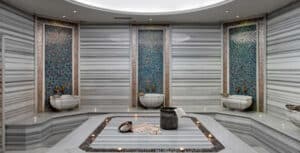
The grandest and most widely recognised form. Ottoman hammams feature a large central dome over the hot room, a monumental heated marble platform (gobek tashi) at the centre, multiple private washing alcoves (khalvet) around the perimeter, and extensive use of marble and stone. The ritual centres on the gobek tashi, where bathers lie flat to absorb radiant heat before receiving the kese scrub and the distinctive foam massage. Istanbul’s 16th-century hammams by Mimar Sinan remain the architectural benchmark.
Sauna Dekor’s Turkish bath projects draw directly on these historical references, adapted for modern building codes, waterproofing standards, and heating technology.
Moroccan hammam
Moroccan hammams are typically lower-ceilinged and more intimate than their Ottoman counterparts. The walls are finished in tadelakt, a polished lime plaster unique to Morocco that is naturally waterproof and antibacterial. There is no gobek tashi; bathers sit on low benches or the heated floor. The ritual revolves around three signature products: savon noir (black olive-oil soap), the kessa mitt, and ghassoul clay from the Atlas Mountains.
Our Moroccan bath designs use authentic tadelakt and traditional layouts adapted for hotel and residential settings. The room itself, its heat and its ritual are covered in our guide to the Moroccan bath.
Persian (Iranian) hammam
Persian hammams share the Roman-derived three-zone layout but are distinguished by their decorative tilework, painted ceilings, and elaborate entrance halls. Historically, the finest examples featured muqarnas (honeycomb vaulting) and figurative wall paintings, elements forbidden in stricter interpretations of Islamic art but celebrated in Persian culture. Many of Iran’s most important surviving hammams, such as the Vakil Bathhouse in Shiraz (1760s), are now museums.
Andalusian hammam
The hammams of Islamic Spain, built between the 8th and 15th centuries, blended Roman, Visigothic, and Islamic architectural elements. They are characterised by horseshoe arches, relatively low ceilings, and intricate zellige (geometric mosaic tilework). A well-preserved surviving example is the Banuelo in Granada (11th century). The Andalusian style has seen a revival in contemporary European spa design, particularly in Spain, Portugal, and southern France.
Central Asian hammom
In Uzbekistan and neighbouring countries, the hammom adapted to extreme continental climates. Buildings are heavier, more insulated, and often partially underground. The heating systems traditionally burned local fuels (dung, cotton stalks) rather than wood. Bukhara and Samarkand both retain historic hammoms, some dating to the 16th century.
Modern hammam
The modern hammam is a contemporary interpretation that retains the three-zone layout, the heated stone surfaces, and the scrub-and-wash ritual but uses current materials: engineered stone, underfloor electric or hydronic heating, digital steam controls, and glass or composite enclosures. This is the format most commonly specified by architects for boutique hotels and high-end residences, and it is the fastest-growing segment of our hammam business.
What does a hammam session do for the body?
A hammam session warms the body slowly in humid air at 40–50 °C, softens the outer layer of the skin and then removes it with a kese scrub and a soap wash. The 60 to 90 minutes of warming, washing and resting is the experience itself: hygiene, ritual and rest. We describe what the room does, not medical outcomes, and anyone with a heart condition, a blood pressure problem, a respiratory condition or a pregnancy should ask their own doctor before a session.
What does the scrub do for the skin?
Humid heat softens the outer layer of dead skin, and the kese or kessa mitt removes it mechanically. A soap wash follows: a foam wash in the Turkish tradition, black olive-oil soap in the Moroccan one, sometimes with ghassoul clay or argan oil. The visible result is exfoliation, and it is the step a sauna or steam room on its own does not include.
Is the humid air easier to breathe?
Warm, humid air at 40-50 °C feels easier to breathe for many people, and steam loosens mucus in the nose and throat in the same way a hot shower does. That is comfort while you are in the room, not treatment, and anyone with a diagnosed respiratory condition should ask their own doctor first. What the room does deliver is a humidity level near 100 %, against 10-20 % in a Finnish sauna.
Why does a hammam feel relaxing?
The slowness is the point: 60 to 90 minutes of warm stone, dim humid light, the attendant’s scrub and a long rest afterwards. In Ottoman and Moroccan bath culture the hammam was also a social space, and the resting room was where people talked, drank tea and cooled down before going back outside.
Want a hammam for your guests or your own home? Our team has designed and installed hammams for commercial spa projects and private residences across three continents since 1987. Request a free consultation.
How does a hammam differ from a sauna and a steam room?
Hammam vs sauna, hammam vs steam room: all three use heat for wellness, but they differ fundamentally in temperature, humidity, heating method, ritual format, and the role of the bather. Understanding these differences is essential for anyone specifying thermal wellness facilities for a hotel, gym, or home.
| Feature | Hammam | Finnish sauna | Steam room |
|---|---|---|---|
| Temperature | 40-50 °C (104-122 °F) | 80-100 °C (176-212 °F) | 40-50 °C (104-122 °F) |
| Humidity | 90-100 % | 10-20 % | 100 % |
| Primary heat source | Heated stone surfaces (radiant) | Electric or wood-burning heater (convective) | Steam generator (convective) |
| Session length | 60-90 minutes | 10-20 minutes per round | 10-20 minutes |
| Attendant | Traditional (tellak/natir) | Self-service | Self-service |
| Exfoliation | Integral (kese/kessa scrub) | Not included | Not included |
| Architecture | Domed rooms, marble/stone, multiple zones | Timber cabin, single room | Tiled room, single room |
| Social tradition | Communal, ceremonial | Communal in Finland, often private elsewhere | Typically private |
The most important practical distinction is this: a sauna (whether Finnish or infrared) and a steam room are heat-delivery systems. A hammam is a complete bathing experience that happens to involve heat. The scrub, the wash, the rest, and the social dimension are not optional extras; they are the hammam itself.
A rasul is a close neighbour: a tiled steam chamber for a self-applied mud ritual, often built next to the hammam on the same spa floor. Our rasul and mud bath guide covers how it works and how it is built.
For commercial operators, this distinction has revenue implications. A sauna or steam room is a self-service amenity; a hammam is a bookable, staffable, revenue-generating treatment. Hotels that add a hammam typically see higher per-guest spa spend than those relying on self-service thermal facilities alone.
How do you design and build an authentic hammam today?
Building a hammam that delivers the authentic experience requires expertise in three areas: thermal engineering (heated stone, steam generation, ventilation), waterproofing (hammams are the most moisture-intensive rooms in any building), and cultural accuracy (proportions, materials, and layout that feel right). Getting any one of these wrong produces a room that looks like a hammam but does not perform like one.
The build sequence itself — tanking and falls, under-slab heating, the stone schedule and steam output sized against cold marble — is set out stage by stage in our guide on how to build a hammam.
The heated marble platform at the centre of the hot room, the göbek taşı, is held at a surface temperature of 40–45 °C. The room air around it is held at 40–50 °C. Building a hammam takes 3 to 8 weeks in a private home and up to 12 weeks on a large project.

Sauna Dekor Spa Solutions has manufactured and installed hammams since 1987: 40 years, 19 employees and 5,000+ projects in more than 35 countries, from our own facility in İkitelli OSB, Istanbul, with a Gulf office at Latifa Tower, World Trade Centre, Dubai. Our quality system is TS EN ISO 9001:2015, certificate no 202025106. We bring authentic cultural knowledge alongside modern engineering. Every hammam we build, whether for a five-star hotel or a private home, is custom-built to the client’s space, design vision, and operational requirements.
Our hammam projects include traditional Turkish baths, Moroccan baths, and modern hammams for hotel and private clients. Hotel references include Hilton (Hilton Istanbul Maslak, 2017) and Ritz-Carlton (Ritz-Carlton Istanbul, 2013). Developer and contractor clients include Emirates Engineering. Start your project with a free consultation.
Frequently asked questions about hammams
Is a hammam the same as a Turkish bath?
A Turkish bath is one type of hammam. The word “hammam” refers to the broader tradition of communal bathhouses across the Islamic world, including Ottoman (Turkish), Moroccan, Persian, Andalusian, and Central Asian variations. In everyday English, the two terms are often used interchangeably.
Can you build a hammam at home?
Yes. A residential hammam requires a waterproofed, heated room with proper steam ventilation, stone or tile surfaces, and a drain. The smallest home hammams we have built fit into spaces as compact as 6 m². Custom-built residential hammams are one of the fastest-growing segments of our business.
How long does it take to build a hammam?
Building a hammam takes 3 to 8 weeks in a private home and up to 12 weeks on a large project such as a hotel spa. Most of that time goes on the waterproofed shell, the floor and bench heating and the stone work; our modern hammam page lists the stages.
How hot is a hammam compared to a sauna?
A hammam operates at 40-50 °C (104-122 °F) with near-100 % humidity. A Finnish sauna operates at 80-100 °C (176-212 °F) with 10-20 % humidity. The hammam is gentler in temperature but the high humidity makes the heat feel more enveloping.
How often do people visit a hammam?
In Turkish and Moroccan bath culture a weekly visit is the traditional norm, and many families still keep it. In a hotel or a home hammam the rhythm is a personal choice; anyone with a medical condition should ask their own doctor how often regular heat is right for them.
Is a hammam suitable for people with sensitive skin?
Generally, yes. The humid heat is gentler on skin than the dry heat of a sauna. However, the kese or kessa scrub is vigorous, and the attendant should be informed of any skin conditions beforehand. People with eczema, psoriasis, or open wounds should consult a dermatologist before their first visit.
What should you wear in a hammam?
Traditionally, bathers wrap in a cotton cloth: a peshtamal in Turkish hammams or a fouta in Moroccan ones. Most commercial hammams today provide these wraps. Swimwear is acceptable in many modern hammams, but traditional public hammams in Turkey and Morocco still follow the cloth-wrap custom.
How much does it cost to build a commercial hammam?
Costs vary widely depending on size, materials, and complexity. A 30 m² modern hammam for a boutique hotel starts at a different investment level than a 200 m² traditional marble hammam for a resort. The practical starting point is a free consultation with our team, who can provide a detailed quote based on your space and vision.


