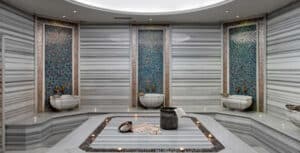
A private villa hammam and sauna at Nad Al Sheba, Dubai
Sauna Dekor manufactures and installs saunas, hammams, steam rooms and spa suites as a single turnkey package. We have been doing it since 1987, this is our 40th year, and we have delivered in more than 35 countries. This project is a private villa at Nad Al Sheba, Dubai, United Arab Emirates, where we built a Turkish hammam, a marble steam room and an ayous sauna as one thermal suite.
What was built
Three rooms. The hammam is clad in beige veined marble and travertine, with a marble massage slab, twin carved kurna basins with antique brass taps, and a backlit onyx feature panel running between them. The steam room is finished in book-matched marble with an LED-lit bench edge and a fibre-optic star ceiling over a heated bench. The sauna is an ayous cabin with tiered benches, a slatted wall lamp and a stone heater set beside a marble door reveal. A dark timber door in the travertine wall connects the dry side to the wet side.
The technical decisions behind it
Waterproofing comes before marble
On a marble hammam the visible work is stone; the work that determines its service life is underneath. Screed laid to fall, a rigid core, then a bonded waterproofing membrane carried up every wall with banded internal corners and sealed collars at each pipe penetration, then an adhesive and grout system rated for permanent wet heat. Twin kurna basins mean two sets of hot and cold feeds and two waste points — four more penetrations through the tanking than a single-basin room, each one detailed rather than drilled.
Heated stone, run in zones
The massage slab and the perimeter benches sit on separate heating circuits. A bather lies on the slab for a long period and sits on the benches for a short one, so the two surfaces are not run at the same setpoint. Heating a hammam as one zone is the most common way a beautiful room ends up uncomfortable.
The onyx panel is a lighting detail, not a wall finish
Backlit onyx works because the stone is translucent; it is also porous, so it is treated as a feature rather than as a wet working surface. The cavity behind it is a separately ventilated and drained void, the LED source and its driver are accessible from outside the room, and the panel edges are sealed so moisture cannot track into the lighting chamber.
Fibre optics instead of fittings in the steam room
A fibre-optic star ceiling puts the light source and the driver outside the wet envelope entirely and brings only the fibre ends through. In a steam room, every conventional light fitting is a hole in the waterproofing; fibre optics reduce that to a single controlled entry. Given the ceiling is also laid to a fall so condensate runs to the perimeter, keeping the penetration count down matters twice over.
Ventilation, in two different regimes
The ayous sauna takes supply low near the heater and extract low on the opposite wall, at roughly three to six air changes an hour, with a run-on drying cycle after use. The steam room and hammam are on timed extract that continues after the session ends. The two systems are kept independent — cross-connecting them would feed the dry cabin with wet air.
Timber selection
Ayous for the cabin: no resin, low conductivity, dimensionally stable at sauna temperature, and comfortable to touch on a bench. Boards are fixed from below so no metal fastening is exposed to skin, the lining floats on battens over a vapour-tight layer, and a ventilated cavity behind lets the build-up dry.
What the site required
Placing a hammam, a steam room and a sauna in one villa floor means three different environments sharing walls and one ceiling void. Each has a vapour barrier on its own warm side, and none of those barriers may connect to another. The dark timber door between the travertine wall and the dry side is a threshold in the engineering sense as well as the architectural one: it is where the wet regime stops. Working in an already-finished Dubai villa, the cabin was prefabricated and dry-assembled in Istanbul, then shipped numbered for assembly on site, which keeps the fabrication dust and noise out of a completed house.
Related capability
See hammam, steam room and sauna for the three room types delivered here, shower systems for the transition between them, and our Dubai page for how we work in the UAE.
Frequently asked questions
What is a kurna, and does a villa hammam need two?
A kurna is the carved basin a bather draws water from; it is filled from hot and cold taps and used with a bowl rather than being sat in. Two basins let two people wash without sharing, which is the normal arrangement in a family villa hammam.
Can backlit onyx be used in a wet room?
Onyx is translucent and can be backlit, but it is also porous and sensitive to prolonged moisture, so it is treated as a feature panel rather than as a working wet surface. The lighting cavity behind it is a separately drained and ventilated void, and the panel is sealed and set away from the direct splash zone.
What is a fibre-optic star ceiling and why is it used in a steam room?
The light points are the ends of fibres; the light source and its driver sit outside the room entirely. That matters in a steam room, where putting an electrical fitting inside the wet envelope means putting a penetration through the waterproofing for every point of light.
Why ayous for the sauna and marble for the hammam?
They are different climates. A Finnish cabin runs hot and dry, so it wants a low-resin, low-conductivity timber that stays comfortable to touch. A hammam runs warm and saturated, so it wants a sealed, low-porosity stone that will not absorb moisture and can be heated from behind.