

Hydrotherapy Pool: Temperature, Depth, and the Humidity Problem Nobody Budgets For

Short answer: A hydrotherapy pool is a small, warm, shallow pool built for movement rather than swimming — typically 33–35 °C, 1.2–1.4 m deep, with handrails and step or hoist access. The temperature is the defining specification: it is what lets people exercise joints that hurt on land, and it is also what makes the building services around it far harder than a normal pool.
What it is, and what it is not
The term gets applied to four different things, which is why specifications go wrong. Here is the honest separation:
| Type | Temperature | Purpose |
|---|---|---|
| Hydrotherapy pool | 33–35 °C | Supervised therapeutic exercise; standing depth, handrails, accessible entry |
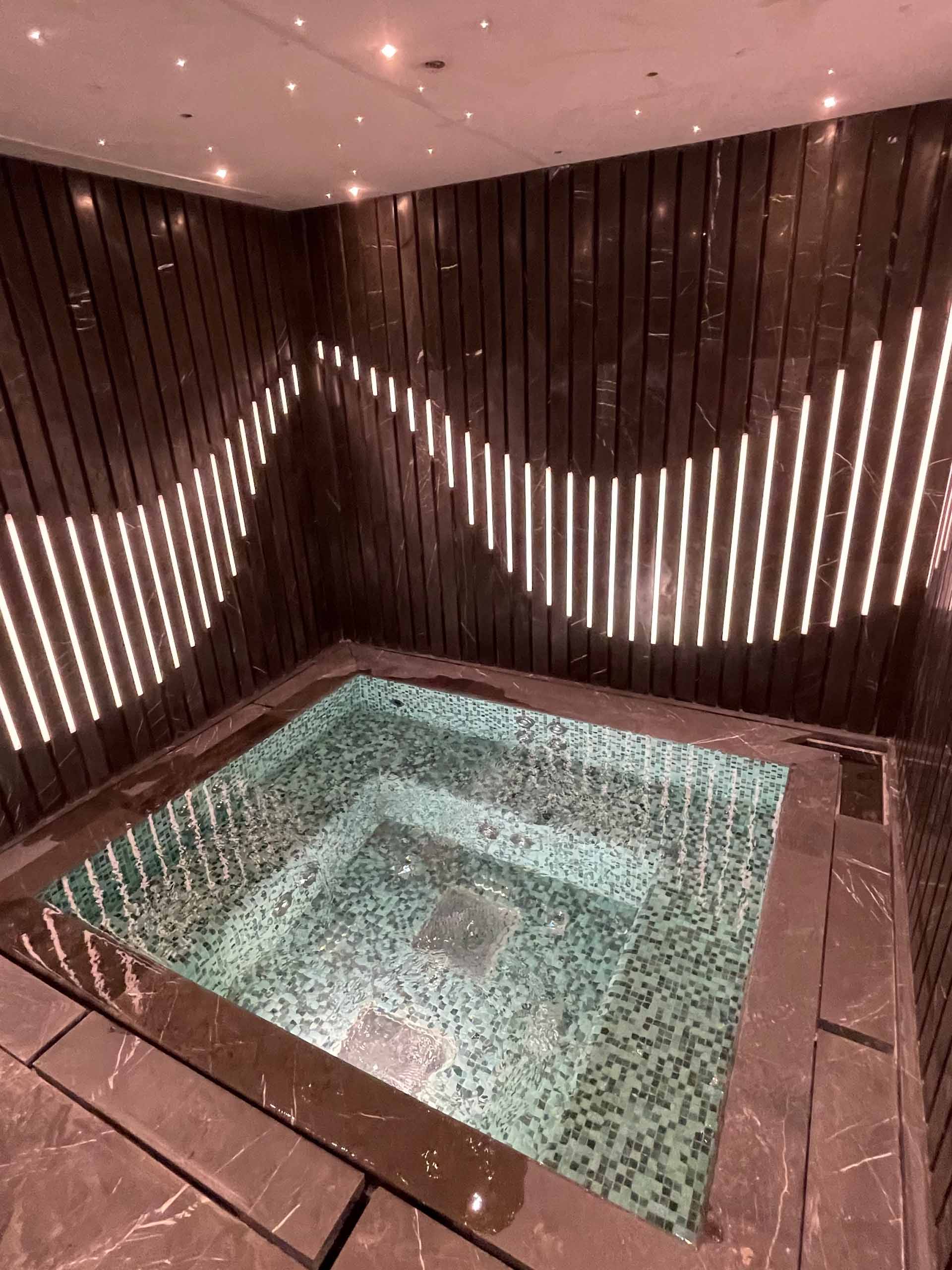
| Vitality pool | 34–36 °C | Spa feature — jets, loungers, bubble beds. Relaxation, not rehabilitation |
| Swimming pool | 27–28 °C | Laps and recreation. Too cool for therapy, too deep for standing work |
| Cold plunge | 10–15 °C | The opposite intervention entirely |
A vitality pool and a hydrotherapy pool look similar in a brochure and are different buildings underneath. If a physiotherapist is going to work in the water, the pool needs standing depth, clear floor area, non-slip gradients and accessible entry. If guests are going to sit in it with a drink, it does not.
Why warm water changes what a body can do
Three properties of water do the work, and they explain the entire clinical case.
Buoyancy removes load. Immersed to the chest, a person carries a fraction of their body weight, which is why someone who cannot walk a corridor without pain can walk the length of a pool.
Hydrostatic pressure acts on the whole immersed body, which supports circulation and reduces peripheral swelling. The same principle underlies the contrast therapy circuits we build.
Viscosity means water resists movement in every direction. Resistance scales with how fast you move, so the patient sets their own load without any equipment — and there is nothing to drop on a foot.
Warmth adds the fourth element: it reduces guarding and lets a stiff joint move through more range before it protests. It is the mirror image of what a sauna does with dry heat. This is the same family of mechanisms we cover in what is hydrotherapy, applied specifically to a pool.
What the research actually shows
The evidence here is better than for most wellness modalities, and it is worth being precise about where it is strong.
Knee osteoarthritis is the best-supported application. A 2026 systematic review of randomised controlled trials in Medicina looked specifically at functional performance and gait outcomes — the measures that matter to a patient, rather than only self-reported pain — and treats hydrotherapy as a well-tolerated rehabilitation route precisely because water supports movement while reducing joint load.
Chronic low back pain has a more interesting answer. A 2026 network meta-analysis in Frontiers in Medicine compared aquatic exercise, land-based exercise and multi-modal programmes directly. The useful framing from that literature is not “water beats land” — it is that water is a genuine alternative for people who cannot tolerate land-based exercise, which is a large share of the people who need it most.
A 2026 randomised controlled trial in Pain Management adds a dimension operators rarely think about: it compared aquatic therapy with standard care in chronic low back pain and measured psychological outcomes — anxiety, depression, pain catastrophising, kinesiophobia — alongside pain and disability. Fear of movement is often the thing keeping a patient still, and water is where movement stops feeling dangerous.
Sleep is where honesty is required. A 2026 meta-analysis of eleven trials in Healthcare found aquatic exercise improved sleep quality in patients with chronic disease, with a large effect size — but reported statistical heterogeneity of I² = 93%, which is very high. The authors flag it themselves. Treat sleep as a plausible secondary benefit, not a headline.
The part that ruins projects: humidity
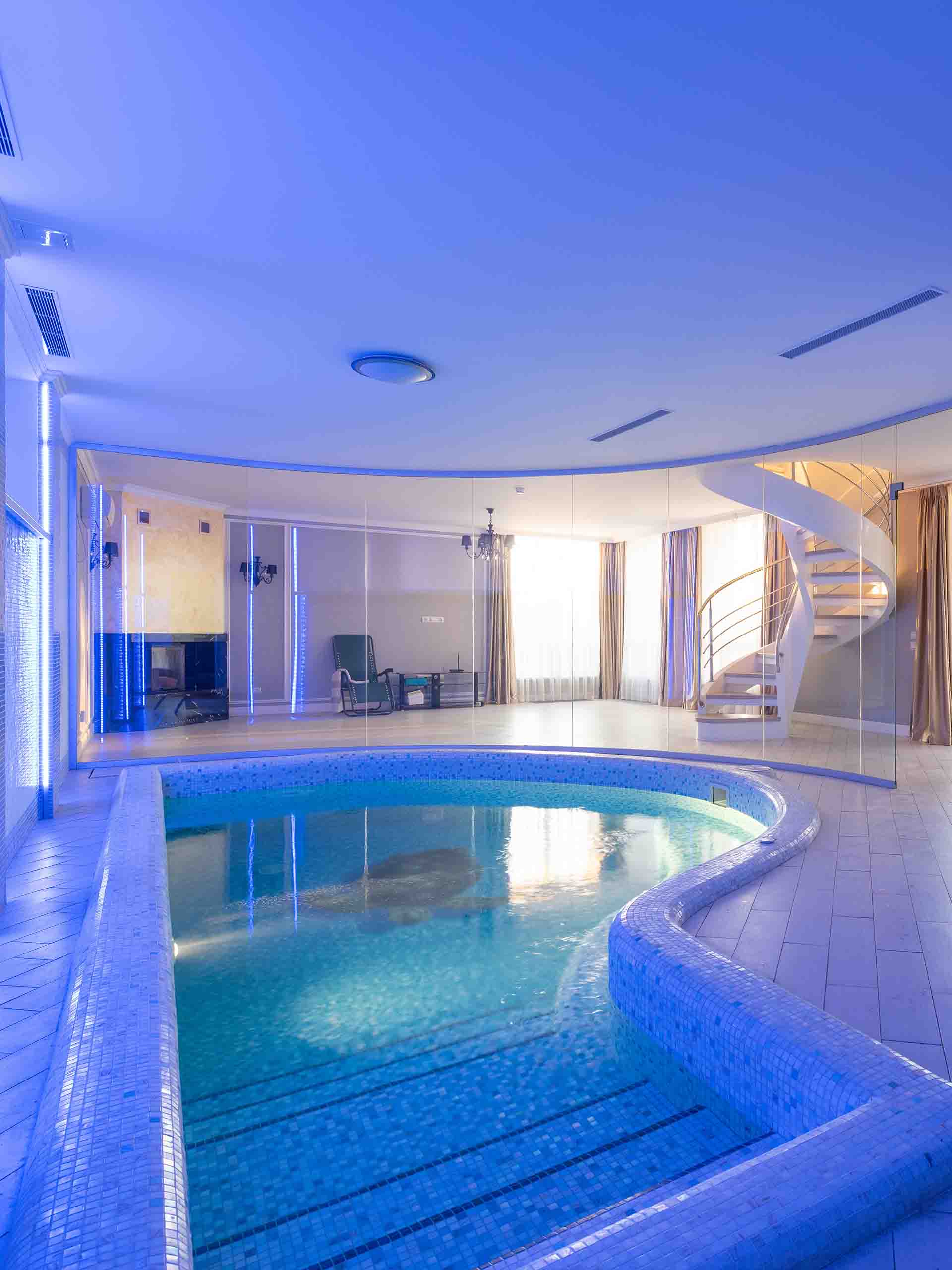
This is the single biggest difference between a hydrotherapy pool and a normal pool, and it is where budgets break.
Evaporation from a pool surface rises steeply with water temperature. A pool held at 34 °C evaporates dramatically faster than the same pool at 28 °C, and every gram of that water goes into the air of an enclosed room. If the dehumidification and air handling are sized for a normal indoor pool, the result is a hall that feels tropical, condensation on every cold surface, and — over a couple of years — corrosion and fabric damage in the structure above.
What this means in practice:
- Air temperature is normally held 1–2 °C above water temperature. That is a comfort requirement and an evaporation control.
- The dehumidification plant is sized from the water surface area and its temperature, not from the room volume.
- Every cold bridge in the enclosure becomes a condensation point. Glazing, structural steel and duct runs all need reviewing.
- A pool cover when the room is unoccupied is not an energy nicety — it is the main lever on both evaporation and running cost.
We take the same approach here as in a steam room: the enclosure and the plant are one system, and neither can be specified without the other.
The rest of the specification
Depth. 1.2–1.4 m suits standing exercise for most adults — chest-deep for buoyancy, shallow enough for a therapist to stand and assist. A graded floor gives one pool several working depths.
Access. This decides who can use it. Wide, shallow steps with rails on both sides serve most users; a hoist position serves the rest, and retrofitting one is far harder than allowing for it now. Clinical settings usually need both.
Water treatment. Warm water and low bather turnover are a harder microbiological problem than a cool busy pool. Turnover rates must be shorter than a swimming pool’s, and the treatment regime specified for the temperature it will actually run at.
Finishes and gradients. Wet barefoot circulation with users who already have mobility problems. Slip resistance is a specification, not a product choice made at the end.
Heating and running cost. Holding 34 °C year-round is the dominant operating cost. This is worth modelling before the pool size is fixed, because the honest answer is often a smaller pool used more.
Clinical versus hotel
A clinic pool is sized around therapist-to-patient ratios, needs accessible changing and a hoist, and lives or dies on infection control, in the same way a commercial spa is specified around duty cycles rather than looks. A hotel or residential pool is sized around perceived generosity and photographs, and typically runs warmer with more features.
Trying to serve both from one pool usually produces a pool that does neither well. Where a project genuinely needs both, the answer is normally a therapy pool plus a separate leisure pool, connected as part of the wider thermal suite circuit rather than merged into one basin.
For residential projects, the same logic applies at smaller scale — see home spa and indoor pool.
What a hydrotherapy pool costs to run, and where the money goes
Capital cost gets the attention; the running cost is what decides whether a hydrotherapy pool is still in use in year five. Three lines dominate, and they are all consequences of the temperature.
- Heating. Holding 33–35 °C year-round is the single largest operating cost, and it scales with surface area rather than volume. A smaller pool used more intensively almost always beats a generous pool used occasionally.
- Dehumidification. The plant that keeps the hall dry runs whenever the pool is uncovered. This is the line most often missing from an early budget, because it does not feel like part of the pool.
- Water treatment. Warm water with low bather turnover needs a shorter turnover cycle and a treatment regime specified for the temperature it actually runs at, not the temperature on the drawing.
The highest-return operational decision is a pool cover. Covered when the hall is unoccupied, a hydrotherapy pool loses dramatically less heat and puts dramatically less moisture into the air, which reduces the heating bill and the dehumidification duty at the same time. It is the cheapest item in the specification and the one most often value-engineered out.
The mistake that shows up in year three
Fabric damage. Where dehumidification was sized for a normal indoor pool, the excess moisture finds the cold surfaces: glazing frames, structural steel, duct runs. Nothing fails on day one, which is exactly why it is missed. By the time staining and corrosion appear, the fix is a building repair rather than a plant adjustment. If you inherit a hydrotherapy pool that feels tropical, treat it as a defect to investigate rather than a comfort preference.
Frequently asked questions
What temperature should a hydrotherapy pool be?
Typically 33–35 °C. Warm enough to reduce muscle guarding and let stiff joints move, cool enough that a patient can exercise for thirty to forty minutes without overheating. Above about 36 °C it becomes a relaxation pool rather than an exercise pool.
What is the difference between a hydrotherapy pool and a vitality pool?
Purpose, and everything that follows from it. A hydrotherapy pool is built for supervised therapeutic exercise: standing depth, clear floor area, handrails, accessible entry. A vitality pool is a spa feature built around jets and loungers. They overlap in temperature and in nothing else.
How deep should a hydrotherapy pool be?
1.2–1.4 m for standing exercise, often with a graded floor so one pool offers several working depths. Deeper water removes more load but stops the therapist standing alongside the patient.
Does a hydrotherapy pool need special ventilation?
Yes, and this is the most commonly underestimated part of the project. Evaporation rises steeply with water temperature, so a pool at 34 °C puts far more moisture into the air than one at 28 °C. Dehumidification sized for a normal indoor pool will not cope, and the consequences show up as condensation and fabric corrosion rather than as an obvious fault.
Where a hydrotherapy pool sits inside a broader recovery offer, it usually pairs with a wellness centre programme and a sauna and cold plunge circuit for the people who can tolerate them.
Building one
We design and build hydrotherapy and vitality pools for clinics, hotels and private residences, including the plant and enclosure design that determines whether the pool works in year five. If you are planning one, the temperature and the air handling should be agreed before the pool shape is drawn. Talk to us early.


