

Istanbul
+90 (532) 215 64 78
info@saunadekor.com
Location
Ziya Gökalp, Metal İş Sanayi Sitesi Yolu 20. Blok No:17-19,
34490 İkitelli Osb/Başakşehir/İstanbul/Turkey
Dubai
+971 58 558 1295
info@saunadekor.com
Location
Latifa Tower Dubai, World Trade Centre, Dubai UAE
Boston
+1 (617) 645 13 50
info@saunadekor.com
Location
66 Long Wharf, Unit 4B, Boston, MA 02110 USA

Interior design is the art and science of enhancing the interiors.
Ziya Gökalp, Metal İş Sanayi Sitesi Yolu 20. Blok No:17-19, 34490 İkitelli Osb/Başakşehir/İstanbul/Turkey
+90 532 215 64 78
info@saunadekor.com.tr
Temperature: between 38° C to 42° C Humidity: 50% to 80% relative humidity
Sauna Dekor builds Moroccan baths and beldi ritual rooms as a turnkey contractor for hotel spas, day spas and private villas across the UAE, Saudi Arabia and Qatar. Manufacturing in Istanbul since 1987 and now in our 40th year, we have delivered wet-area projects in more than 35 countries. A Moroccan bath is a warm, humid room built around a soap-and-scrub ritual, which makes the surface finish, the drainage and the ventilation the three decisions that carry the room.
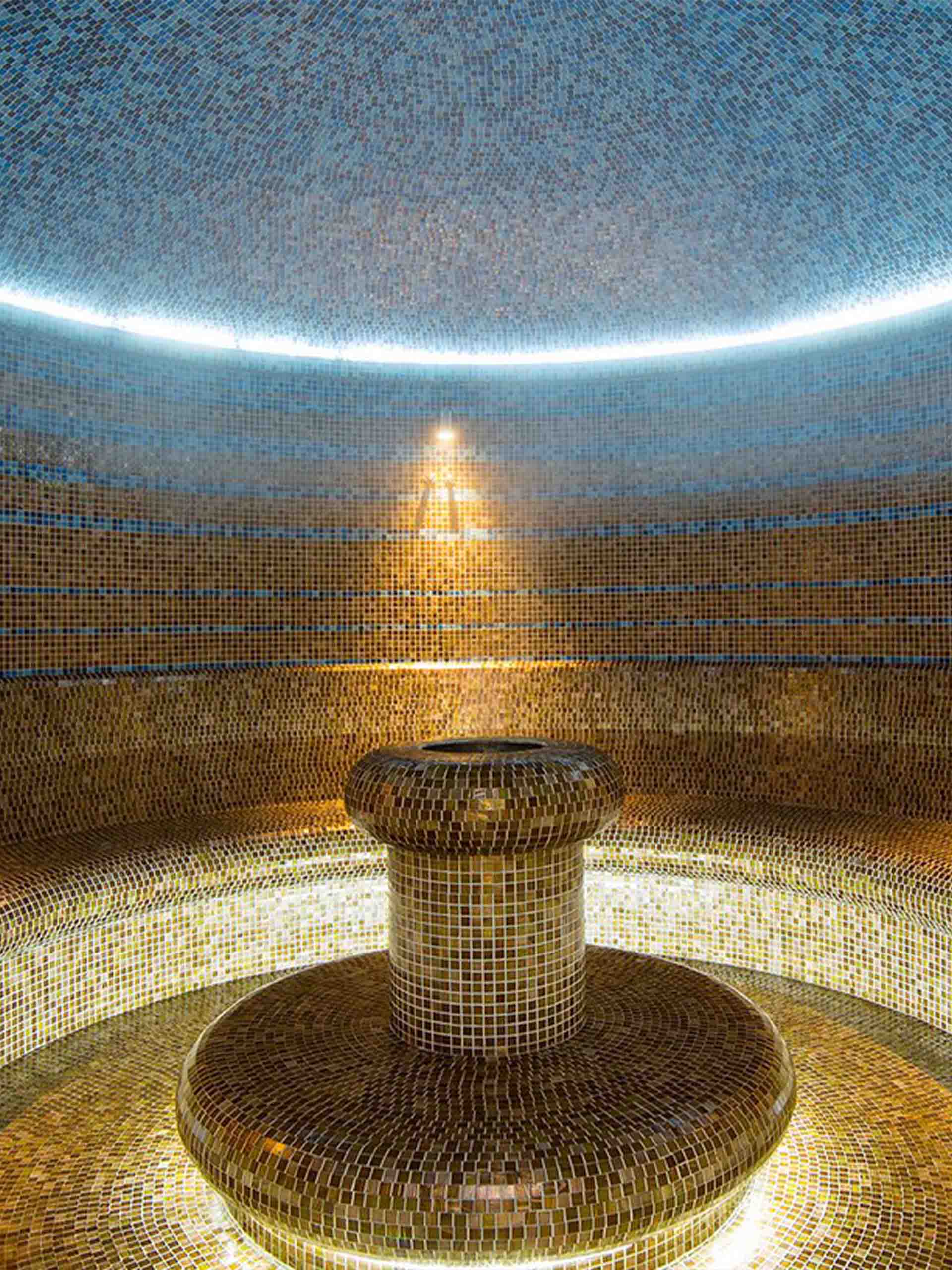
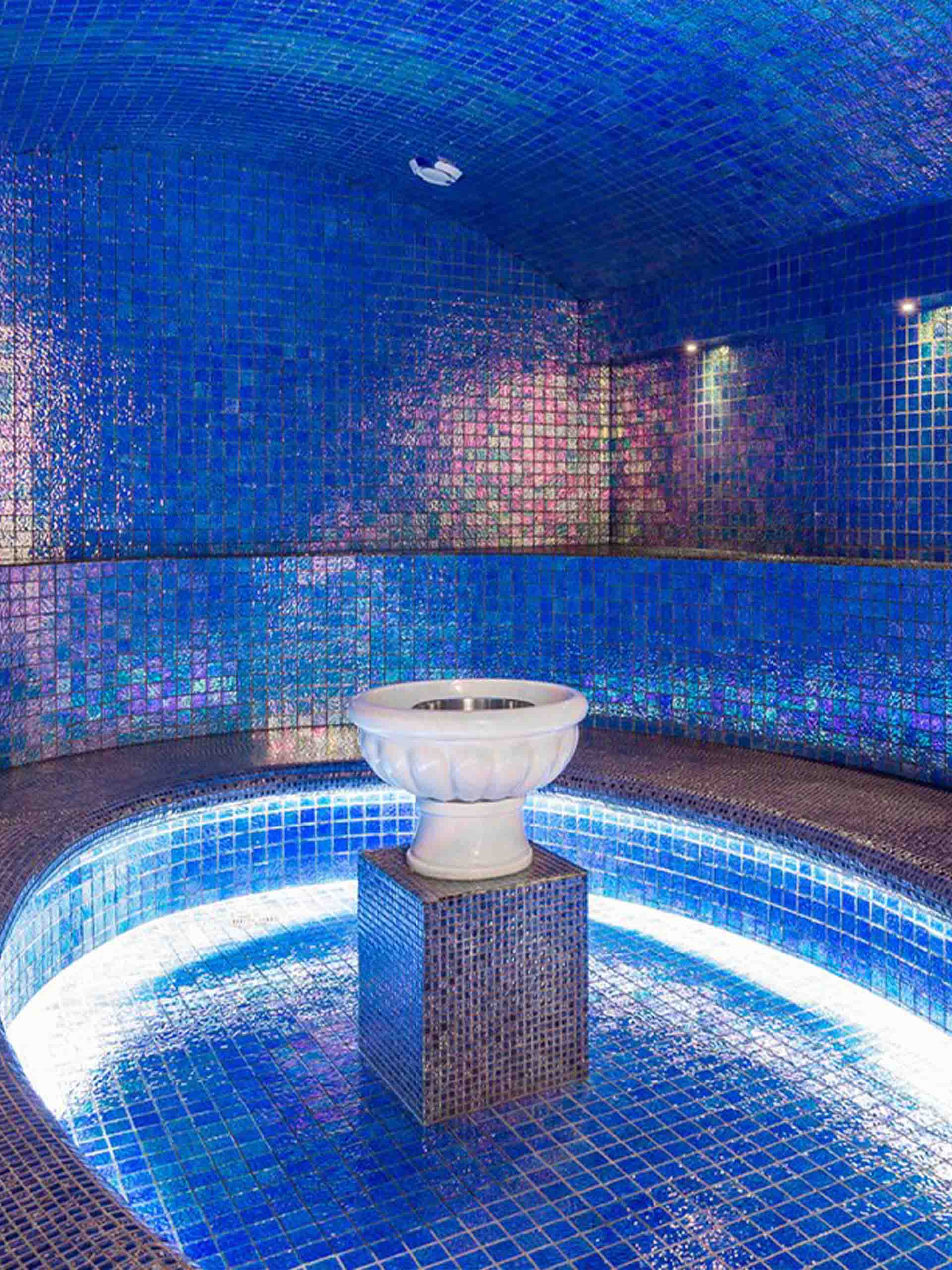
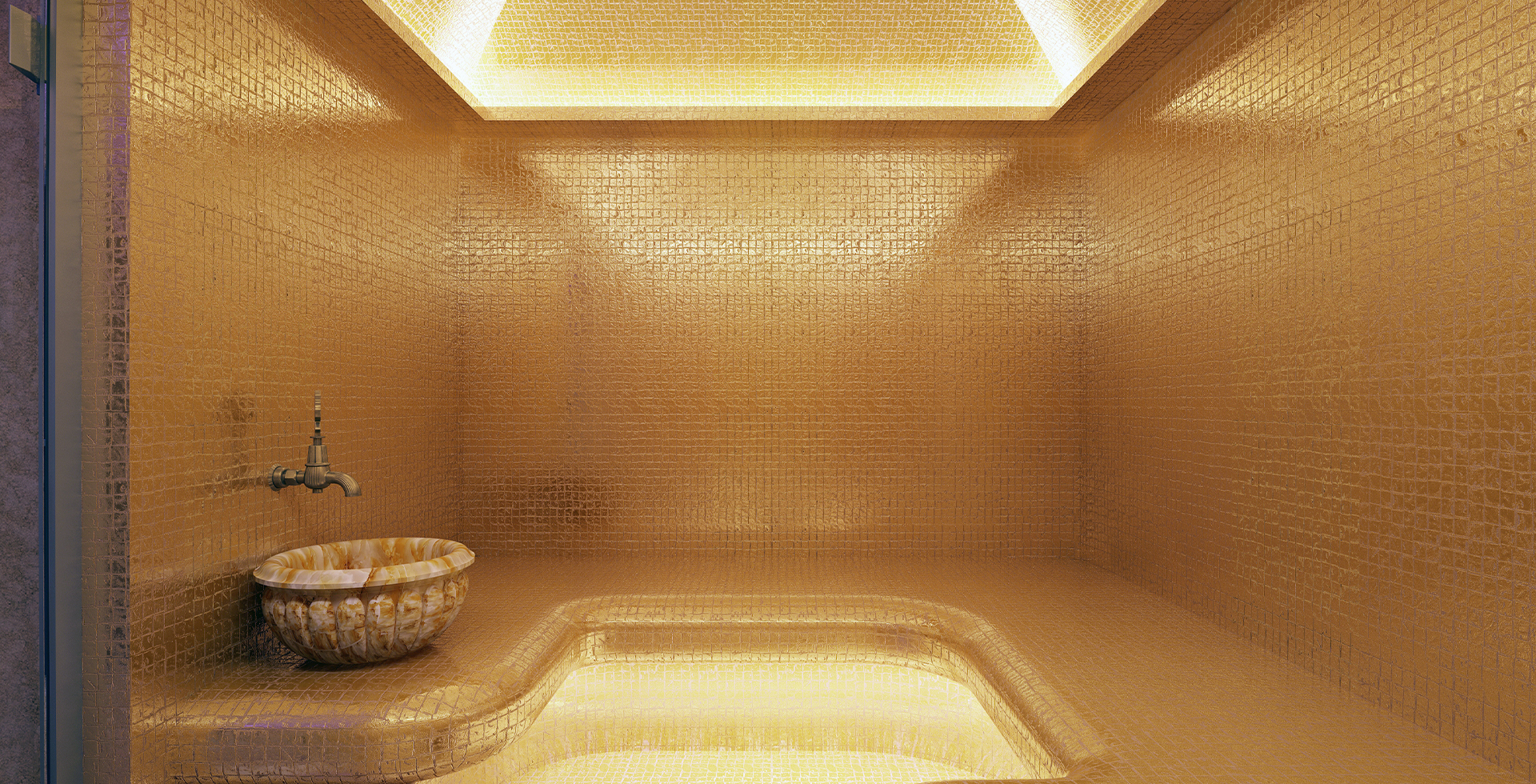
Heat/humidity, followed by a full-body, sticky, black soap massage and exfoliation with a "gome" glove; and then, frequently, a terracotta foot stone rub and rinse; and a clay/mud application to body, face, and hair (and rinse or soak). Argan oil application is often followed. In Turkish, the word "hamam" literally translates as "bathroom" and refers to the complete Turkish bathhouse. Hammams are classified into three types: Turkish bath, Moroccan bath and Modern hammam.
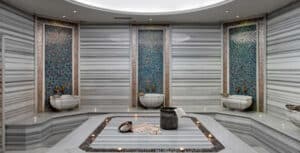
A moraccan bath is a massive domed edifice with a central room (sikaklek) that features the belly stone (göbek tasi). Traditional attendants scrub and clean bathers on the belly stone, and there are typically little chambers off the great central space for richer clients to be treated privately—these architectural elements are commonly adopted in modern hamams for private treatments. There are several basins (called kurnas) around the room that provide water for washing and rinsing, as well as lots of seat space where bathers may rest and converse while waiting for treatments. A Moroccan hammam is comparable to its Turkish counterpart, but retains more of the original Roman bathing routine, sending the bather through smaller chambers with different temperatures (akin to the Roman voyage through the laconium, caldarium, frigidarium, and tepidarium). It should be noted that the term "moroccan bath" is occasionally used interchangeably to indicate a steam bath or a steam chamber. This is especially popular in France and Switzerland's French-speaking provinces. To be clear, the Moroccan hammam is referred to be a bathing structure in this reference book (including communal and treatment areas).Moroccan Bath builders are skilled in constructing and maintaining these intricate and culturally significant bathing spaces.
The initial aim of the hamam was cleansing, and cleanliness is still important today. An exfoliating rub with a "kese" (Turkish) or "gome" (North African) mitten, a soap massage (black soap in North Africa), and a hair wash are typical treatments. Furthermore, most bathers' primary aims are socialization and relaxation, facilitated by the expertise of Moroccan Bath builders.
The hot air temperature and warmth of the treatment surface (whether a classic belly stone or a contemporary heated treatment table) reduce muscle discomfort and encourage mental relaxation, while the high humidity causes strong sweating, resulting in thorough cleaning.
Traditionally, a hypocaust offered warm under-floor heating, which was eventually superseded by hot water "hydronic" systems when piped plumbing systems became available. The floors were frequently heated above body temperature, necessitating the use of wooden sandals (which became significant fashion statements during the heyday of moroccan bath). A contemporary hamam will employ hydronic heating, which is a network of pipes that heats the floor, walls, and benches to maintain a high radiated temperature. The moroccan bath, unlike a steam room, does not function at close to 100% humidity. However, a high degree of humidity is necessary (50% to 80%), which was typically created by the vast volume of water used in the treatments and evaporating off the heated floors and seating/treatment surfaces. Because today's customers aren't always comfortable with public bathing routines, massage, exfoliation, shaving, and hair washing may be performed in private rooms. This implies that humidity levels must frequently be supplemented in other ways, such as using a steam generator or a water-misting system with proper venting and air circulation devices. These are linked to humidity and temperature sensors, which allow for precise management of the hamam environment.
Structure: Using prefabricated polystyrene panels that are cement-coated and reinforced with fiberglass on both sides is one of the most effective ways of producing "wet" thermal chambers.
These panels are resistant to moisture and mold, have good insulating qualities, and can be rapidly and simply constructed on-site.
Porcelain tile, large-area heat storage ceramics, marble, granite, or even man-made surfaces such as Avonite, Silestone, and other agglomerates can be used for walls.
Flooring: Tileable prefabricated floors with integrated gradient and assured waterproofing. Stone tiling with inbuilt drains placed into the floor to prevent water gathering and to help in cleaning and upkeep. Slip-resistant surfaces are required (the German DIN 5109-7 barefoot traffic requirements, rating B, are excellent).
Benches/Göbek Tasi: Finished with continuous stone surfaces (or comparable man-made surfaces); if employing a specific pattern or design, use water and heat resistant grout. The göbek tasi is still present, mainly as a nod to past rather than as a specialized treatment area, although maintaining this historic "amphitheatre" look is popular and gives a big surface for lying down.
Ceiling: Plastered and painted, resistant to steam and etheric oil. For aesthetic reasons, it may be tiled or incorporate decoration.
Lighting: Traditional hamams include holes in the domed ceiling, often in complicated designs, allowing sunlight to pass through these "elephant eyes," which typically have sizes of 10 cm to 15 cm.
Modern lighting technology may be utilized to reproduce similar notions, from basic, circular downlights to elaborate systems that use lighting projectors to simulate the shafts of sunlight found in traditional settings.
Size/Space considerations: The ceiling should be created with a typical domed cupola roof or vaulted ceiling. It may be necessary to construct heat recovery systems to re-circulate heat at greater levels.
Aromatherapy: A method for automatically dispensing essential oils.
Low-level audio with water/steam resistant speakers.
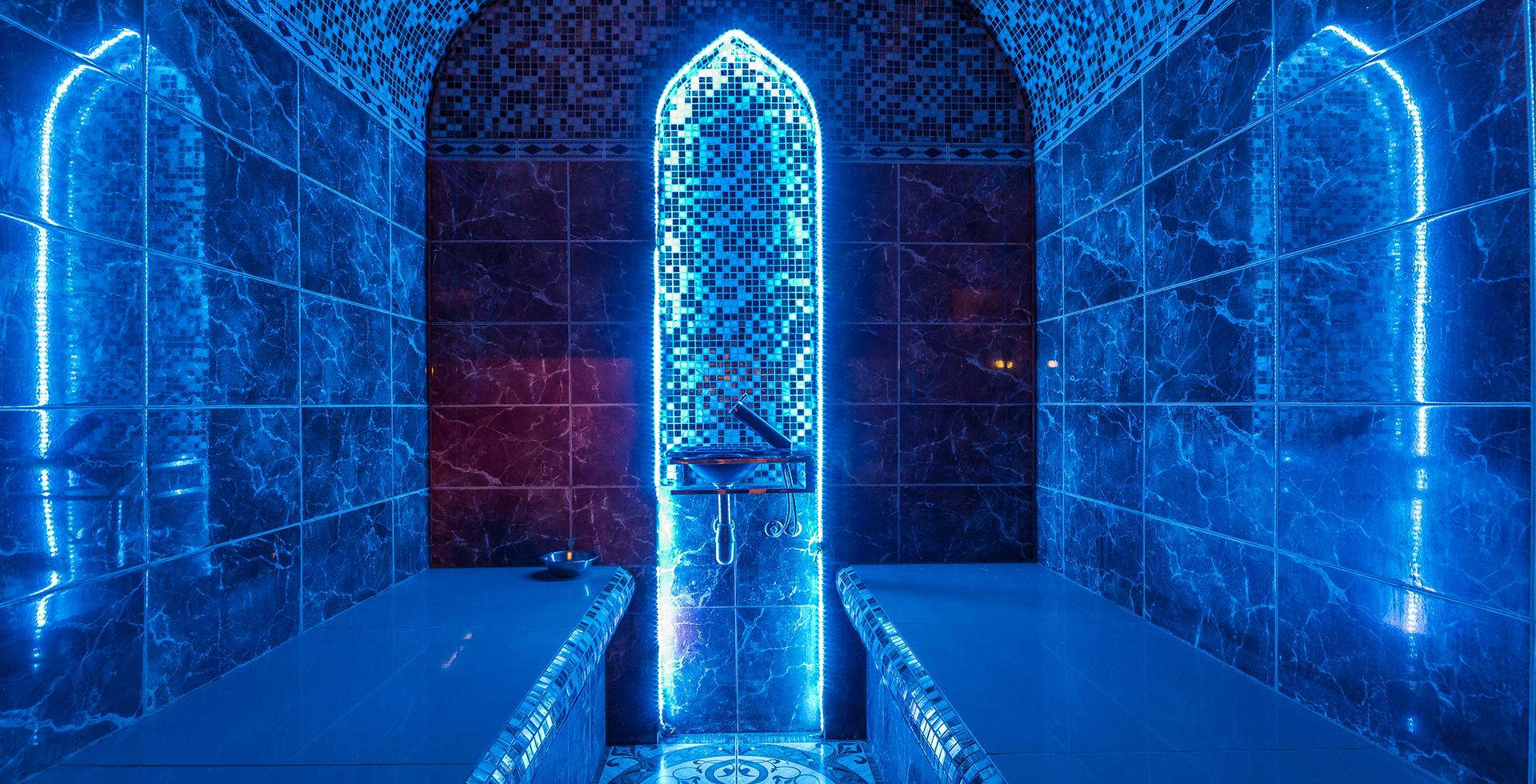
LED and fiber optic lights provide soft, indirect illumination.
Fresh air supply and air extraction will provide adequate oxygen levels. The optimum air turnover rate is 4-7 changes per hour, with incoming air temperatures ranging from 18 to 24 degrees.
Particular Considerations: Traditional Turkish "Iznik"-style tiles and Carrara Blanco marble provide a genuine ambiance, but Moroccan Bath
use a traditional plaster finish called "radelakt," which is not recommended for commercial usage.
Dramatic patterns have been developed in modern hamams employing less typical forms of natural stone and tile.
See our Turkish bath and modern hammam options. Add a salt room or experience shower.
Sauna Dekor is a Moroccan bath manufacturer and installation contractor for hotel spas, wellness centres and private villas in the UAE, Saudi Arabia and Qatar. We have manufactured wet thermal chambers in our own facility in Istanbul since 1987 — our fortieth year — and have delivered projects in more than 35 countries. A Moroccan bath is not a joinery item bought from a catalogue; it is a heated, waterproofed, drained room, and the company that draws it should be the company that builds it and the company that comes back to service it.
| Stage | Work | What it decides |
|---|---|---|
| 1. Survey and structure | Slab condition, floor build-up available, ceiling height, drainage invert, plant room location | Whether the room can hold its falls and its heating loops |
| 2. Waterproofing | Tanking to walls and floor, sealed penetrations, upstands at every threshold | Whether the structure survives the room |
| 3. Shell | Cement-coated, fibreglass-reinforced polystyrene panels forming benches, belly stone plinth and domed or vaulted ceiling | Thermal mass and geometry |
| 4. Heating | Hydronic loops in floor, walls and benches; manifolds accessible from outside the wet room | Radiant temperature and serviceability |
| 5. Humidification and control | Steam generator or misting with its venting and air movement; temperature and humidity sensors in accessible, maintainable conduits | Whether 50–80 % humidity is actually held |
| 6. Drainage | Falls to gully, bench flushing provision, hose point | Hygiene and daily cleaning time |
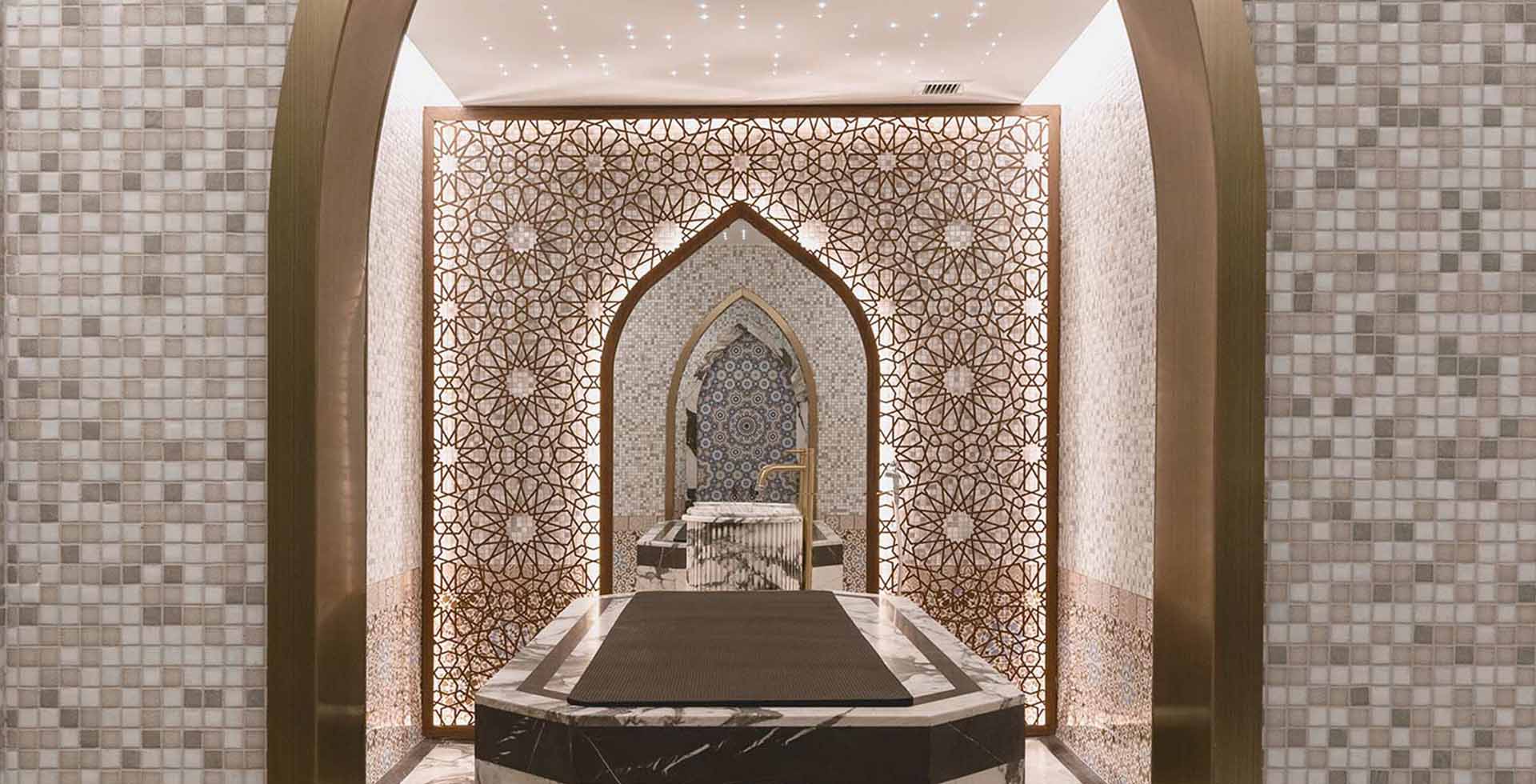
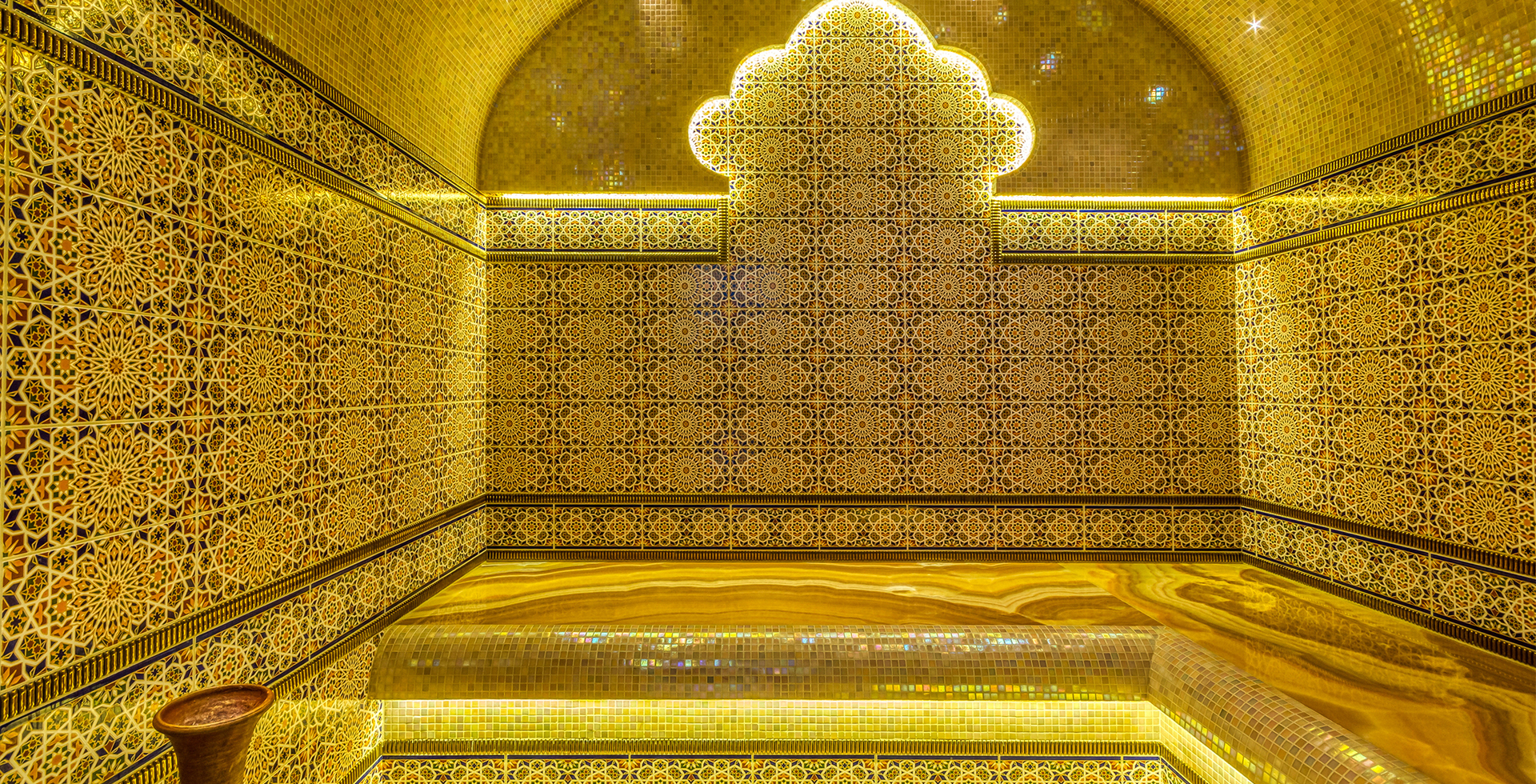
| 7. Finish | Zellige tile, marble, natural stone or mosaic; plaster only where duty allows | Authenticity and maintenance load |
| 8. Commissioning | Hold 40–50 °C and 50–80 % under load, verify sensors, hand over O&M and warranty | What the operator actually receives |
The ritual itself — black soap, the gome glove, rhassoul clay, the rinse and the argan oil — is described in our guide to what a Moroccan bath is and where the ritual comes from, and the wider family it belongs to in our history of the hammam. For how these rooms are specified and approved in the Gulf, see hammam construction in Dubai; for the sister room and its different heat regime, see what a Turkish bath is.
Three names arrive on the same brief and mean three different scopes. Getting the naming right at drawing stage is what stops a client paying for one room and expecting another.
| Name used | What is actually being asked for | Air temperature | Relative humidity | Build consequence |
|---|---|---|---|---|
| Moroccan bath / hammam maghribi | A single heated wet chamber for the savon noir and ghassoul ritual | 40–50 °C | 50–80 % | Hydronic loops in floor, walls and benches; falls to a gully; hose point |
| Moroccan steam bath / Moroccan steam room | The same chamber, described by its steam rather than its ritual — usually a client who wants visible vapour | 40–50 °C | Held at the top of the band, 70–80 % | A steam generator sized for the volume, its own venting and air movement, and sensors that can be reached without breaking tile |
| Moroccan bath house | A sequence of chambers at rising temperature with a rest room and a wash area, not one room | Cool room ambient, warm room 30–35 °C, hot chamber 40–50 °C | Rises with the sequence | Separate zoning, separate control per chamber, and a drainage strategy for the whole floor |
The distinction that matters commercially is the third one. A bath house is a floor plan, not a product: it needs the circulation, the changing provision and the plant space designed around it, in the way we set out for the wider thermal suite. A single Moroccan chamber can be dropped into an existing wet zone beside a steam room and a Turkish bath; a bath house cannot.
Searches for a “Moroccan bath bed” are usually looking for the wrong object, because the Moroccan room does not use the Ottoman heated navel stone. The Ottoman göbek taşı is a raised, heated marble platform in the centre of the chamber, and it is the defining element of a Turkish bath. A Moroccan chamber works differently: the guest is washed lying on a low tiled or marble bed set against the wall, or seated on a heated bench, while the heat comes from the surfaces and the vapour around them.
That changes what we build. The bed is specified as follows.
Where a client genuinely wants a heated central platform in a Moroccan-styled room, that is a hybrid: an Ottoman navel stone finished in zellige and tadelakt. It is buildable, and we have built it, but it should be drawn and priced as a modern hammam with Moroccan finishes rather than as a Moroccan bath, because the heating plant, the thermal mass and the room dimensions all follow the platform.
Sauna Dekor manufactures and installs Moroccan baths for hotel spas, wellness centres and private villas in the UAE, Saudi Arabia and Qatar. The rooms are manufactured in our own facility in Istanbul, where we have built wet thermal chambers since 1987, and installed by our own site teams in the Gulf. Design, manufacture, shipping, installation and after-sales sit in one contract.
Last updated: 23 September 2026
A Moroccan bath is a heated wet room: 40–50 °C air, 50–80 % relative humidity, with heat radiating from the floor, walls and benches. A steam room runs near saturation, close to 100 % humidity, and heats by condensing steam on skin. They are different rooms with different construction, different heating plant and different drainage. Building one and calling it the other is the most common mistake in the category.
Structural survey and waterproofing first, then a cement-coated, fibreglass-reinforced polystyrene shell to form the wet thermal chamber, then hydronic heating loops in floor, benches and walls, then humidification and its sensors, then drainage falls and finally the finish — natural stone, tile, zellige or plaster. The room is commissioned by holding 40–50 °C and 50–80 % humidity under load and verifying the sensors read what the room actually does.
Handcrafted zellige tile, natural stone, marble and mosaic are the durable options for commercial rooms. Tadelakt, the traditional Moroccan lime plaster, gives the most authentic surface but is maintenance-heavy under commercial duty, which is why we specify it for private rooms and use stone or tile where the room runs all day.
No. A Moroccan bath bed is a low tiled or marble washing bed, 45–55 cm high, set against the wall and laid to a shallow fall so soap, clay and rinse water drain off it. The göbek taşı is the raised heated marble platform at the centre of an Ottoman Turkish bath. A Moroccan chamber heats through its floor, walls and benches rather than through a central platform, which is why the two rooms are dimensioned differently.
In practice yes — both names describe the heated wet chamber where the savon noir and ghassoul ritual is performed, held at 40–50 °C and 50–80 % relative humidity. Clients who use the word steam usually want visible vapour, which means the humidity is held at the top of that band and the room is specified with a steam generator sized for its volume rather than relying on radiant surfaces alone.
A sequence of chambers at rising temperature with a rest room and a wash area, rather than a single room. It is a floor plan: circulation, changing provision, plant space and per-chamber control all have to be designed around it. A single Moroccan chamber can be added to an existing wet zone; a bath house is designed with the building.
A Moroccan bath in a private home takes 3–8 weeks to build; a large project takes up to 12 weeks. A hotel thermal suite with several rooms runs longer because approvals and MEP coordination sit on the critical path, not the joinery.
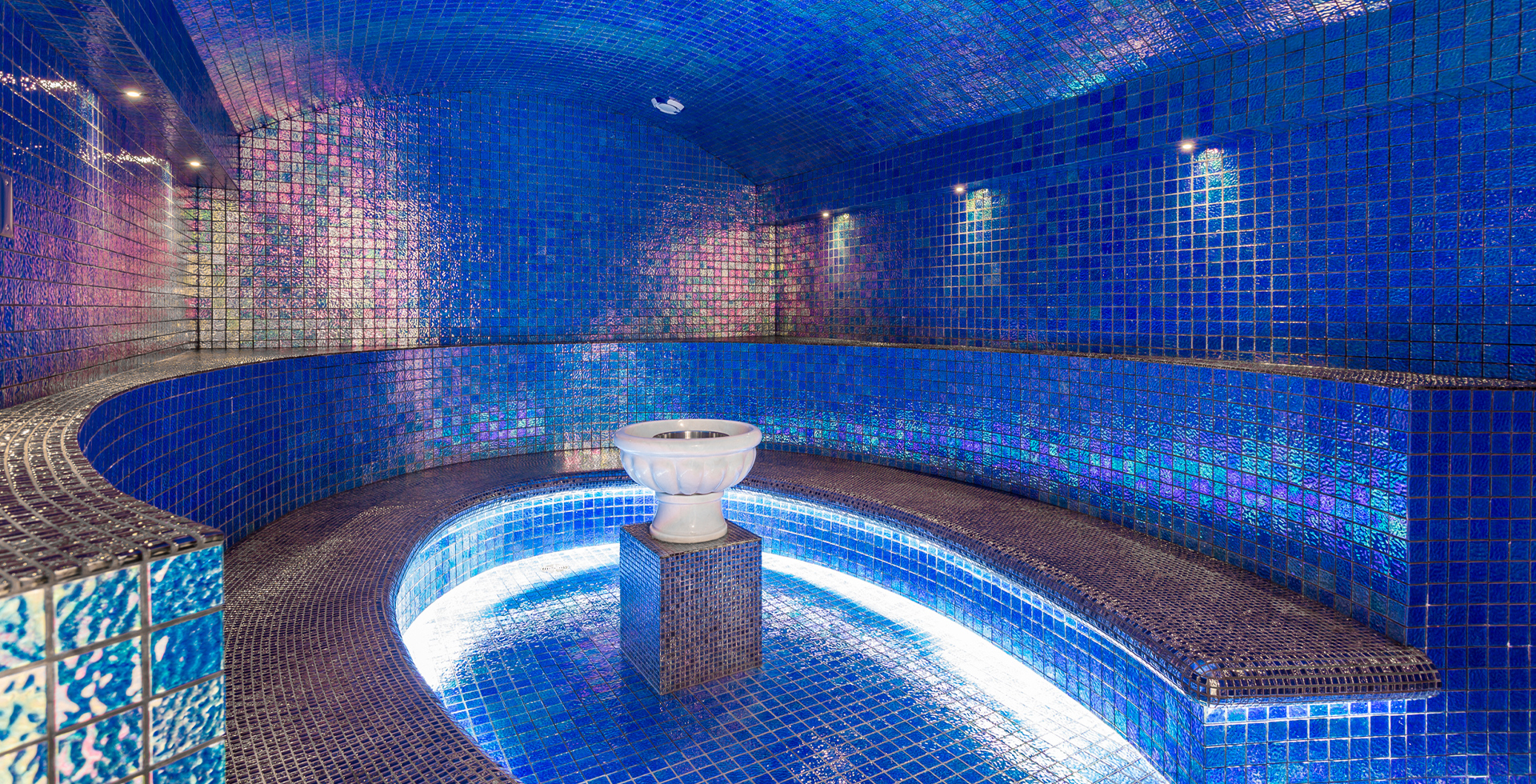
A Moroccan bath, hammam maghribi, shares its roots with the wider Islamic bathing tradition but is built around its own products and choreography — savon noir and ghassoul clay, applied and left to work before exfoliation with a kessa mitt. The tradition, the ritual and the room it implies are set out in our guide to what a Moroccan bath is.
The engineering difference from an Ottoman hammam is the centrepiece: a Moroccan room has no göbek taşı, so the heat comes from the surfaces and the steam rather than from a heated marble platform, and the room tends to be smaller and steamier. Where clay is used in a bookable treatment room, the drainage discipline is closer to that of a rasul and mud therapy room than to a steam room. Both are regularly specified together on the projects we build in the region, alongside the wider hammam work we do in Dubai.
The shell is built the same way; the room inside it is not. Both are tanked wet rooms with heated surfaces, a vaulted or sloped ceiling and floors that fall to a drain. What changes is the centrepiece, the ritual and the room plan.
| Moroccan bath | Turkish hammam | |
|---|---|---|
| Shell | Tanked room, cement-coated reinforced panels, vaulted or sloped ceiling | The same |
| Centrepiece | Treatment bed for savon noir, ghassoul and the kessa scrub | Heated marble platform (göbek taşı) |
| Heat | Heated surfaces and steam | Heated platform, surfaces and steam |
| Room plan | Usually one smaller, steamier room | Warm and hot rooms in sequence, with basins |
| Finishes | Zellige tile, tadelakt-style plaster where duty allows | Marble and natural stone |
| Drainage | Planned for clay and soap residue | Planned for basin water and floor rinsing |
A small commercial Moroccan hammam is planned from start to finish around four decisions:
A Moroccan bath in a private home takes 3–8 weeks to build; a large project takes up to 12 weeks.

Adding {{itemName}} to cart
Added {{itemName}} to cart