


Updated: 24 September 2026
Short answer: the Roman thermal rooms are four climates, and each is defined by two numbers. A caldarium is the hot, humid room at roughly 40–50 °C with humidity close to 100%. A tepidarium is the warm room at 30–40 °C, heated through its benches and floor. A laconium is the dry sweat room at 40–60 °C with humidity at or below 20%. A frigidarium is the cold step, with plunge water typically at 10–15 °C.
Those figures are published ranges, not set points, and the sources below do not agree on every one of them. What they do agree on is the order: warm, hot, dry, cold, rest. A modern thermal circuit in a hotel spa rebuilds that order in stone and mosaic, and this guide covers what each room is, what it runs at and what it takes to build.
What was a Roman bath actually made of?
A Roman thermae was a heated route rather than a single room. Bathers moved through at least 3 climates, warm, hot and cold, above a hypocaust: a floor raised on short brick pillars, with furnace gases drawn under it and up hollow wall flues. The Romans heated surfaces first and air second.
The surviving room names describe positions in that route: tepidus (warm), calidus (hot), frigidus (cold), and the laconicum, named after Laconia, the region around Sparta. Vitruvius described the laconicum with a conical roof, an opening at the top and a bronze disc on chains that was raised or lowered to regulate the temperature — a manual damper, 2,000 years before a control panel.
The exact temperatures of the ancient rooms are not recorded. What can be inferred is a ceiling on the hot room: a floor surface above about 41–42 °C is uncomfortable to stand on barefoot, so the caldarium floor could not have run much hotter than that, whatever the caldarium air temperature was. That single physical limit, heated stone that people touch, is still the governing constraint when these rooms are built today.

What is a tepidarium?
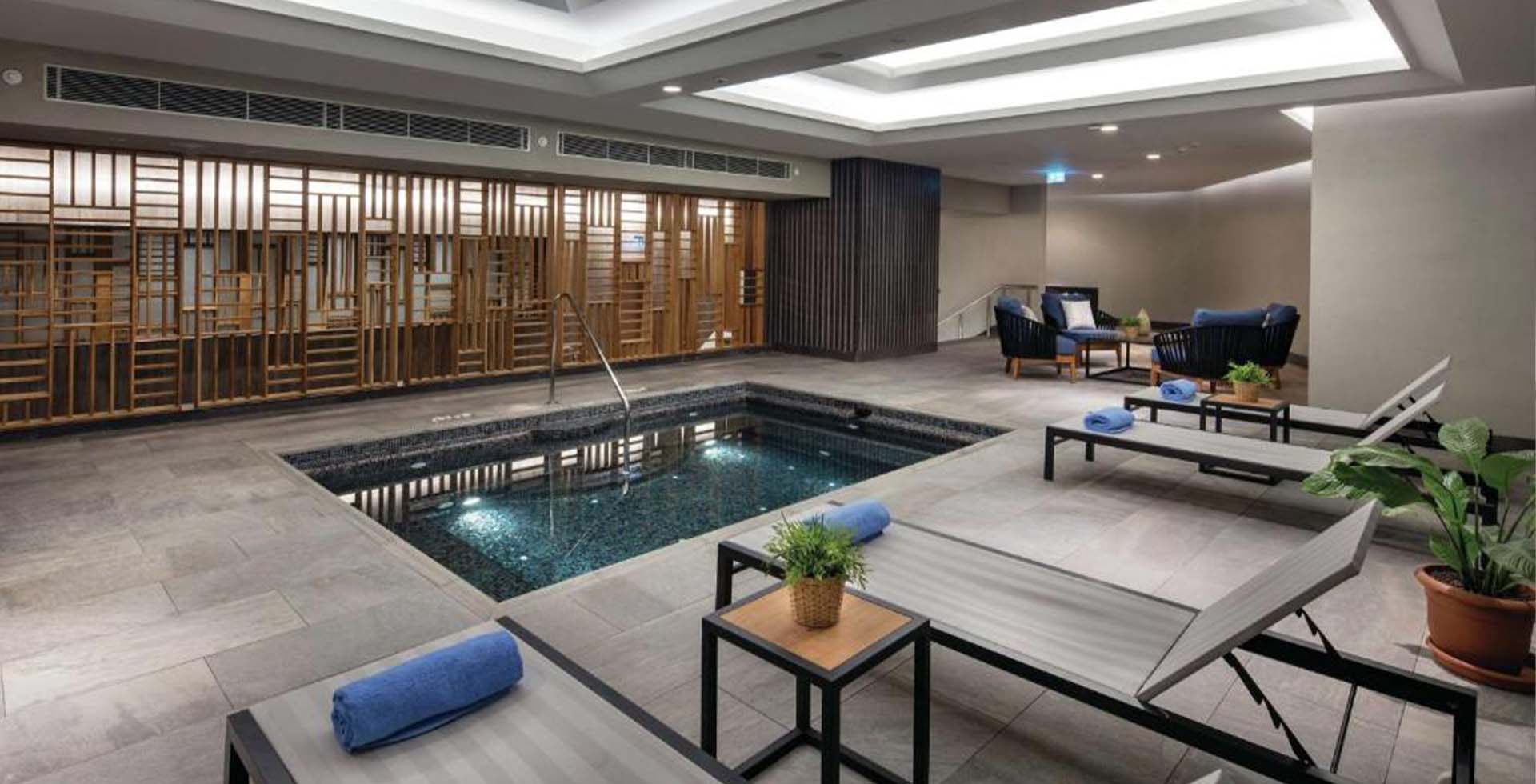
A tepidarium is the warm room of the sequence, with air at about 30–40 °C and heat delivered mainly through benches, floor and walls rather than through the air. Its surfaces sit close to body temperature, around 37 °C, which is why guests can lie on them for 20 minutes or more without discomfort.
That is the whole point of the room. A Finnish sauna asks the body to tolerate a large temperature difference for a short time; a tepidarium does the opposite, a small difference sustained for longer. In the Roman plan it was probably the hall where bathers assembled before moving on to the caldarium or the cold bath, and in a modern thermal circuit it does the same job: warm-up at the start, rest between rounds.
Building one is a floor and bench problem rather than a heater problem:
- Heating circuits under the floor and inside the benches, hydronic or electric, sized to hold a surface temperature rather than to warm the air. Benches and floor run as 2 separate zones, because one carries skin contact and the other carries footfall.
- Formed loungers in stone, mosaic or heated screed. The shape of the lounger decides whether people use the room, and forming it is joinery in a wet material.
- A tanked and drained build-up, because the room is cleaned wet even though it is not a wet room in use.
- Moderate ventilation, enough to keep the room fresh without stripping heat from the surfaces.
What is a caldarium?
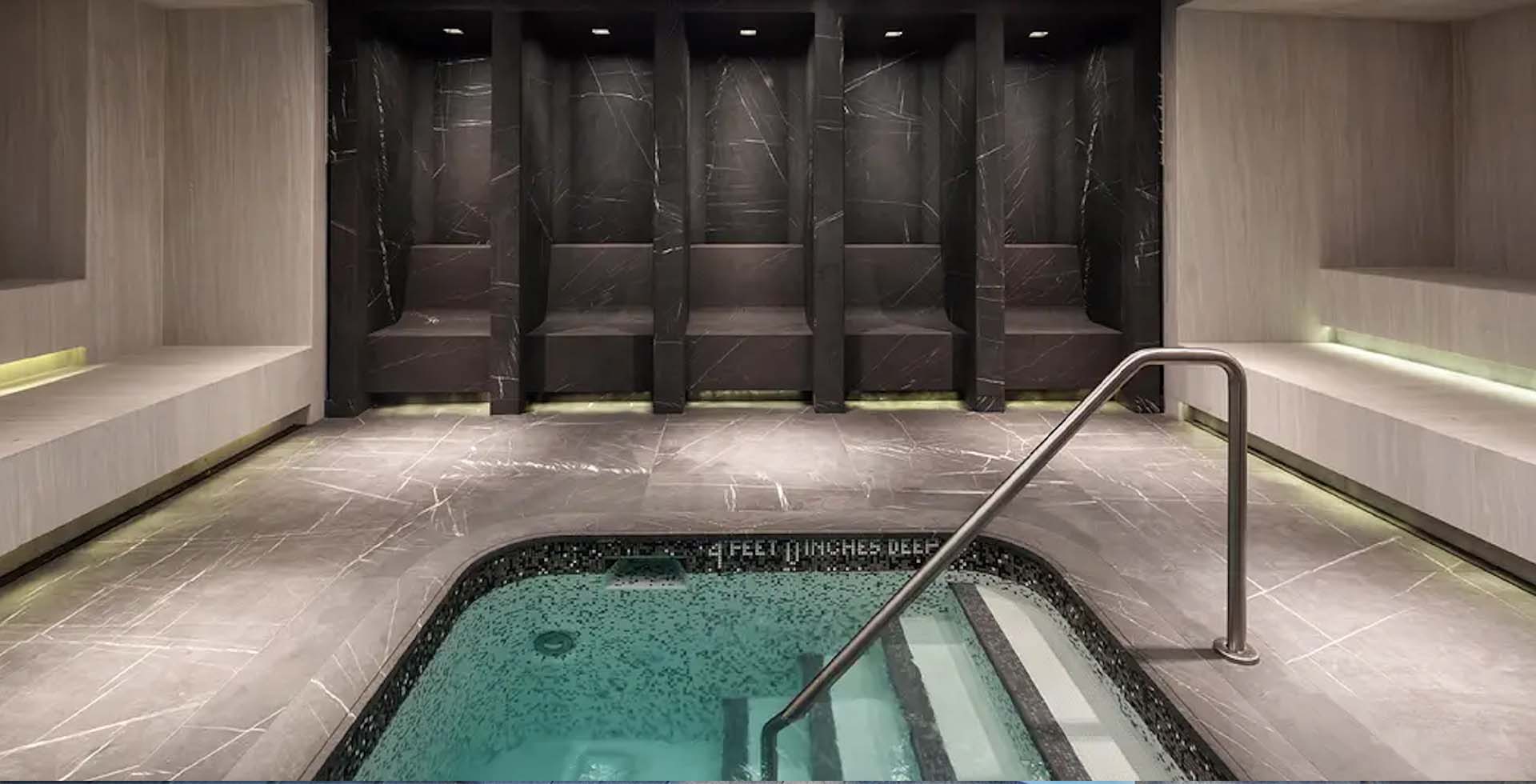
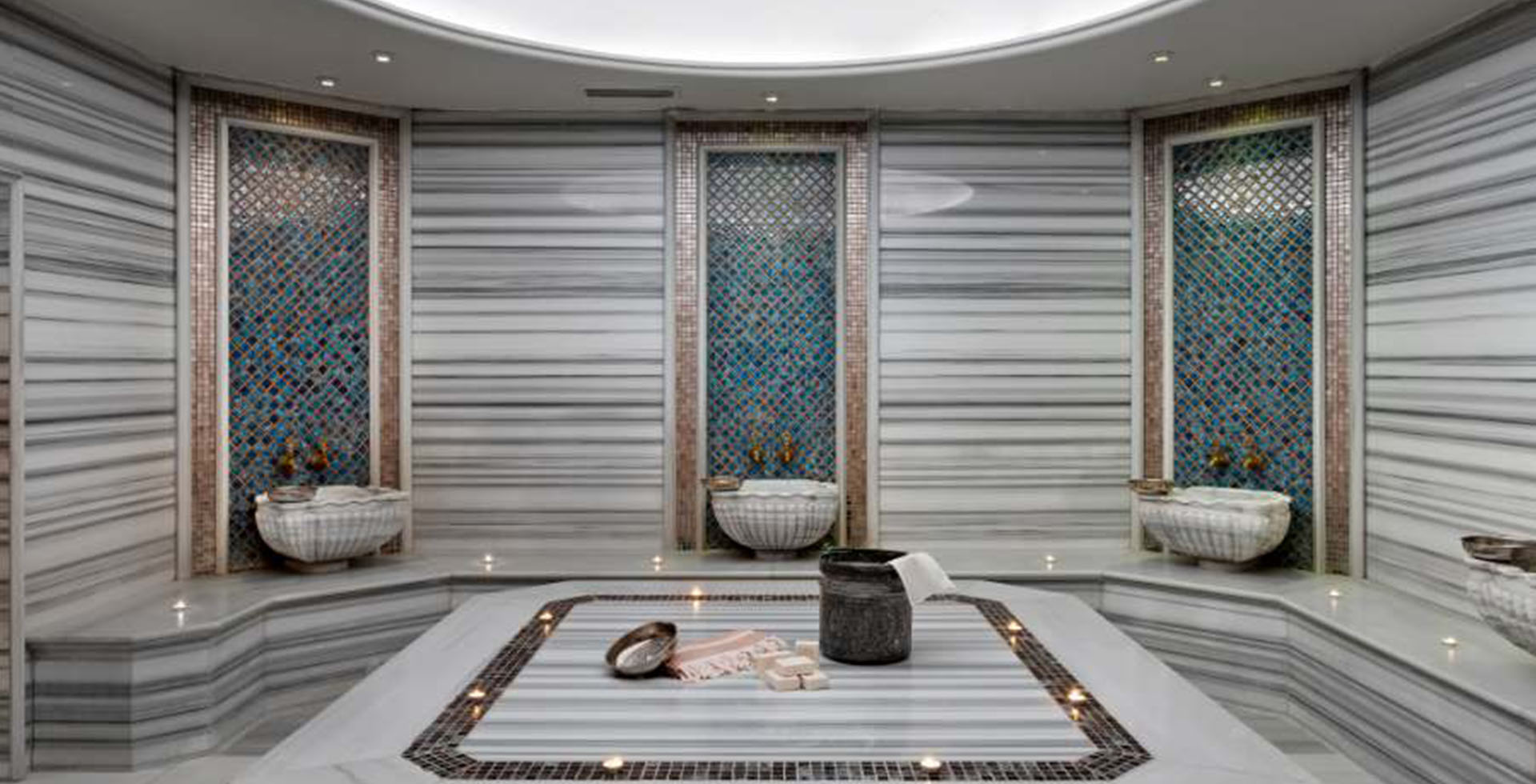
A caldarium is the hot, humid room of the Roman sequence, run today at roughly 40–50 °C with relative humidity at or near 100%. In Roman baths it held the hot plunge, the alveus. In a modern thermal circuit the water is usually gone and the climate remains: a saturated room heated through its surfaces.
In a caldarium at that combination, sweat cannot evaporate, so the skin stays wet and the room feels hotter than the thermometer suggests. It is the same climate physics as a modern commercial steam room, for which Design for Leisure gives 42–48 °C at 100% humidity. The distinction worth holding on to is architectural: a caldarium is built in stone or mosaic with heated benches and floor, as part of the Roman sequence; a steam room is often a tiled cabin heated by a generator alone.
The engineering consequences of 100% humidity in a caldarium are unforgiving, and they are the same set that governs hammam work:
- Full tanking with a continuous vapour barrier on the warm side of the insulation. There is no partial version; vapour finds any gap and condenses inside the wall.
- A domed, vaulted or sloped ceiling with a fall of about 1:10, so condensate runs to the walls instead of dripping onto bathers.
- Falls to a drain across the whole floor, with a trapped, accessible gully.
- A steam generator sized to the room volume and to the thermal mass of the stone. A generator sized for a tiled cabin will not hold a stone caldarium at temperature. We do not make generators; Condair and EOS do.
- Extract ducted to outside, with a drying run after closing.

The heated stone bench, the domed ceiling and the tanked build-up are the construction our team has used on Turkish baths since 1987; the geometry and the finish differ, the physics do not. Our hammam and Turkish bath pages cover that build-up in more detail.

What is a laconium?
A laconium is a dry sweat room heated by radiation from its walls, floor and benches. SpaDreams gives 40–60 °C with humidity of 15–20% at most; Design for Leisure gives a lower 38–45 °C. No water is thrown and no steam is injected, so the heat is even rather than layered.
The spread between those two sources is real and worth resolving on the drawing, not on site. At 38–45 °C a laconium overlaps with a tepidarium and the two rooms become one experience with two names. We treat the upper half of the published band, about 50–60 °C, as the point where a laconium becomes clearly distinct from the warm room while staying far below a Finnish sauna.
That gap to the sauna is the reason the room earns its place. Design for Leisure puts a sauna at 70–105 °C, with a strong vertical gradient between the upper bench and the floor. A laconium runs 20–50 degrees cooler with almost no gradient, because every surface is at a similar temperature. A thermal circuit with only a sauna serves guests who tolerate high heat; adding a laconium serves the ones who do not.
How is a laconium built?
Radiant heating circuits behind stone, mosaic or heated plaster on walls, benches and floor, with an air heater only as a supplementary source. The build-up is drier than a caldarium and therefore simpler than a caldarium build-up, but a vapour barrier is still required and the bench forming is the same careful work, because a laconium is a room people lie down in.
What is a frigidarium?
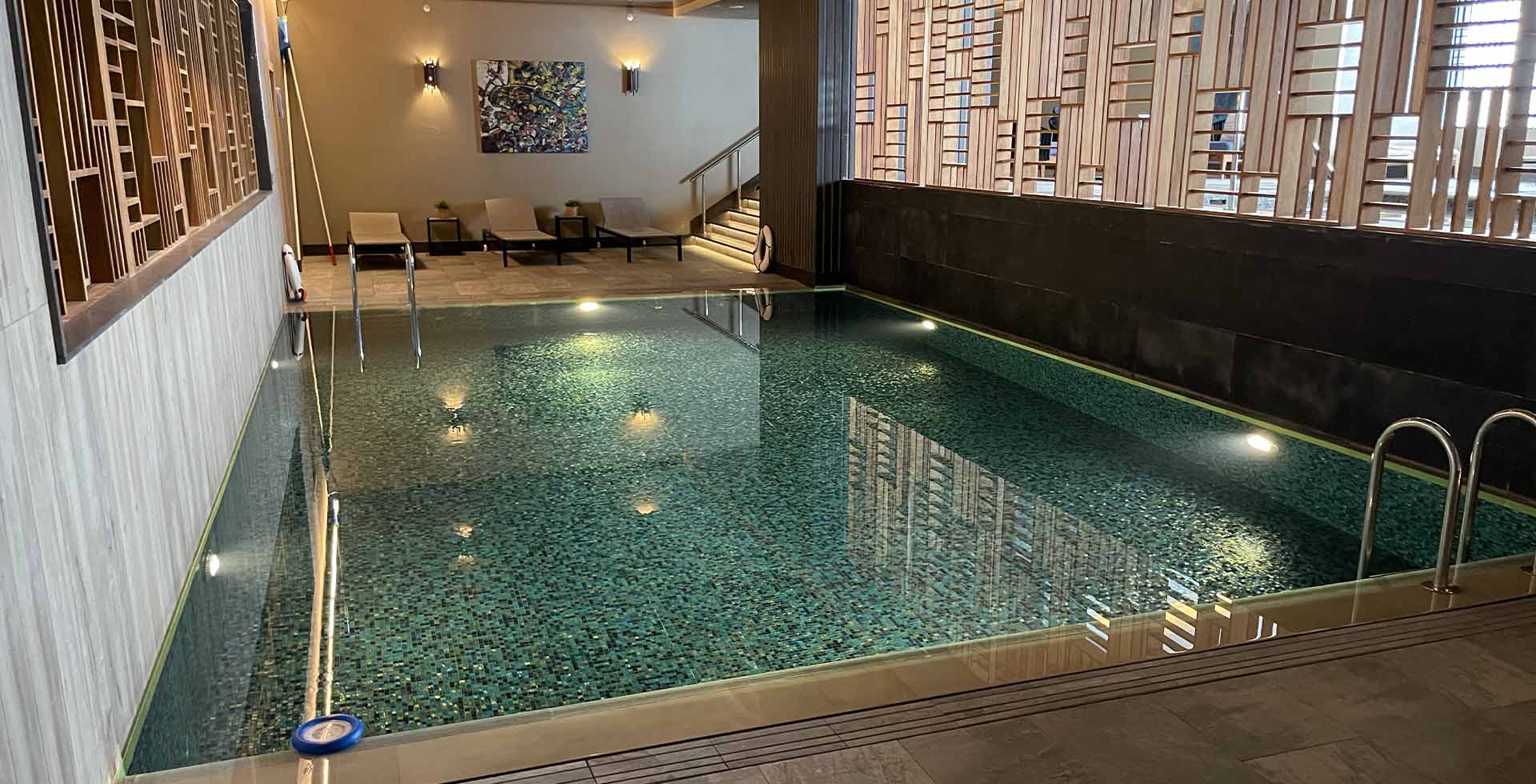
A frigidarium is the cold room that closes the Roman sequence, holding an unheated bath. Its modern form is a plunge pool: the National Collaborating Centre for Environmental Health describes cold plunge water as typically around 10–15 °C or lower. It is a short contrast step, measured in seconds, not a rest room.
It is also the step most often value-engineered out of a drawing. A cold plunge pool needs its own filtration and disinfection, a chiller sized to hold the set point against the heat that bathers carry in, and a rim people can sit on before they commit. The NCCEH review adds a point designers tend to miss: cold water lowers the effectiveness of chlorine, so the treatment plant is not a scaled-down swimming pool plant.
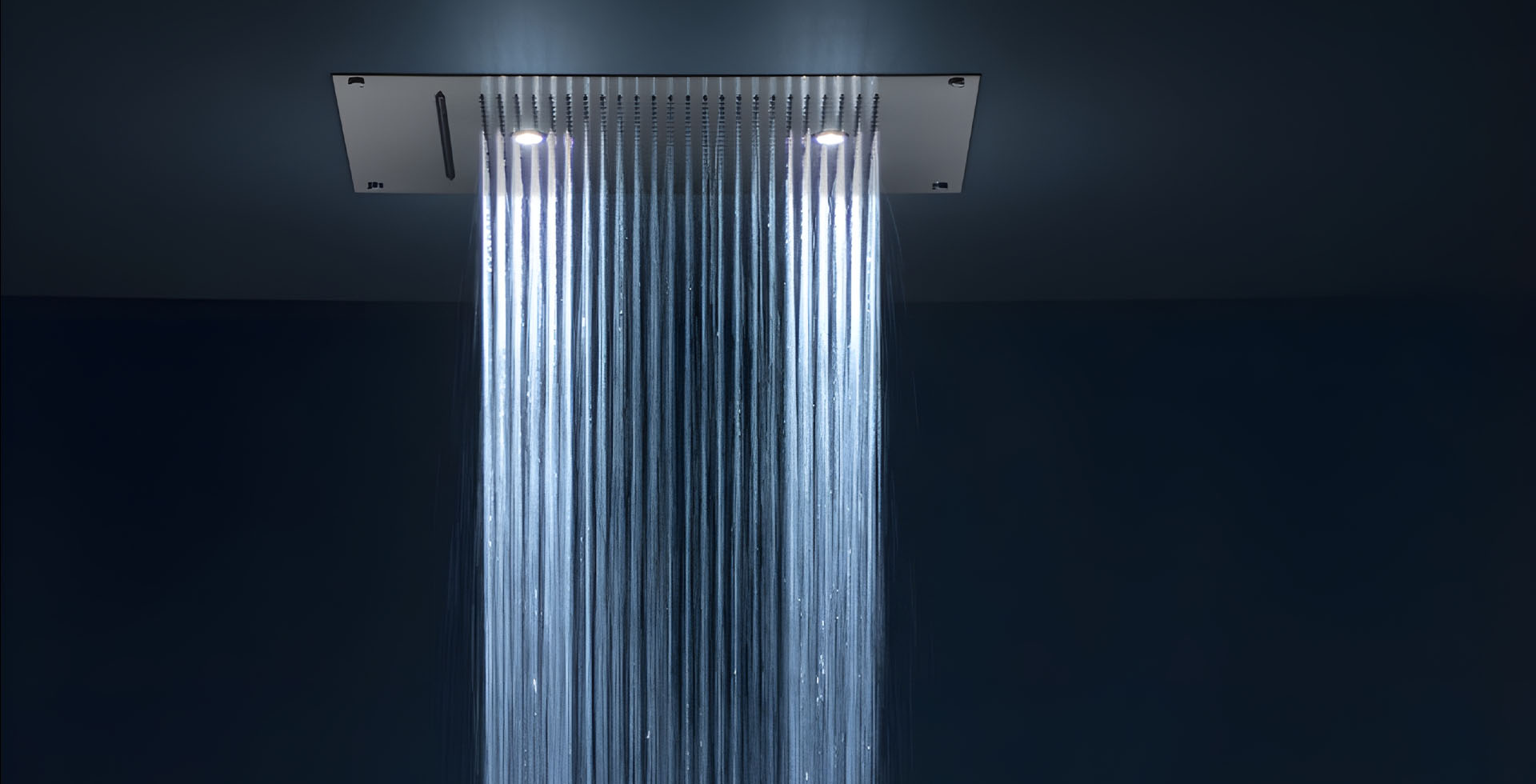
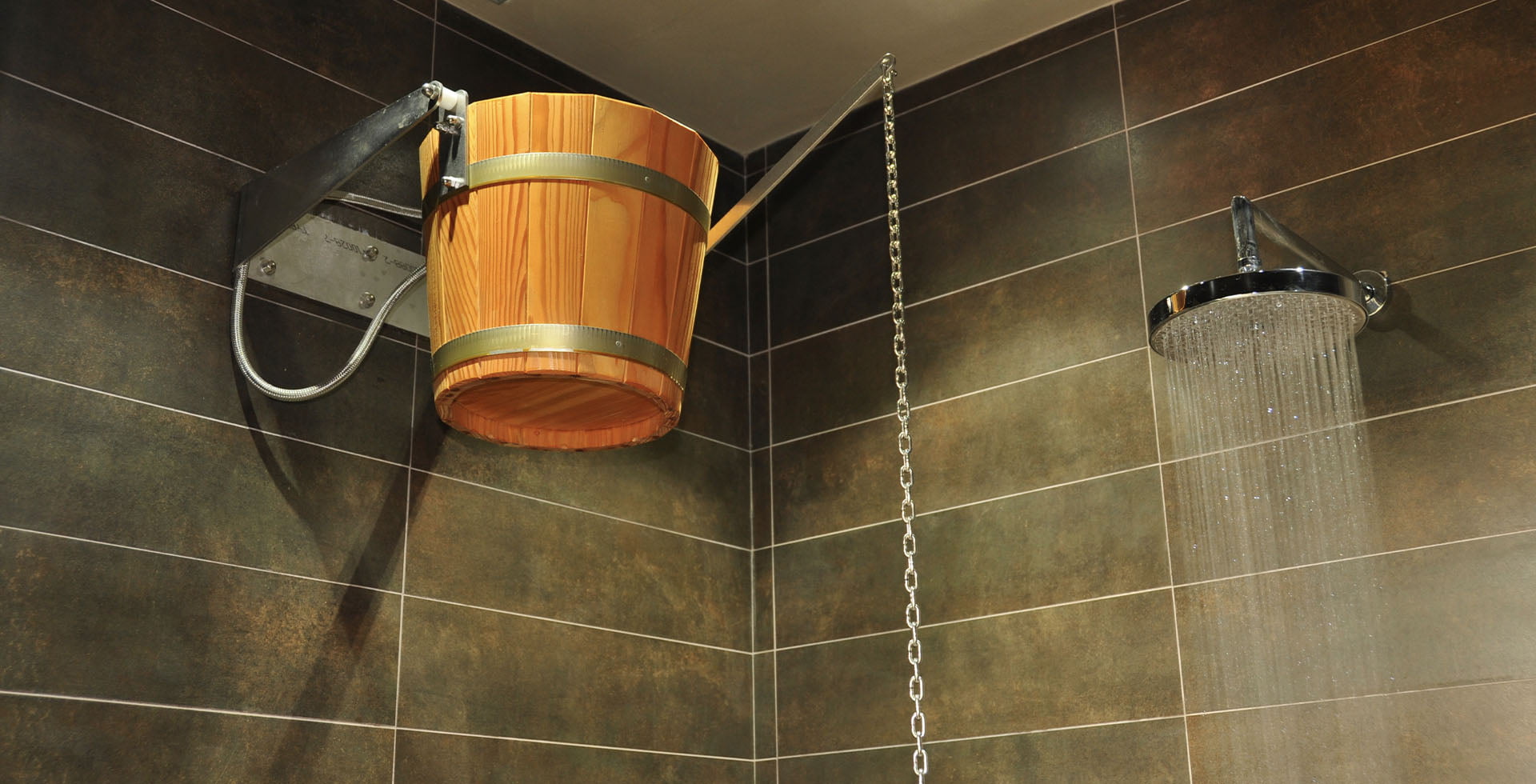
Where there is no room for a pool, a bucket shower or a cold shower on the route serves the same step in under 1 square metre, with no water treatment plant at all.
How do the four rooms compare on temperature and humidity?
Side by side, the rooms separate on two numbers. A tepidarium runs about 30–40 °C with no steam, a laconium 40–60 °C below 20% humidity, a caldarium about 40–50 °C near 100%, and a frigidarium plunge 10–15 °C. The table adds a Finnish sauna and a steam room for scale.
| Room | Air or water temperature | Relative humidity | Heat source | Published range from |
|---|---|---|---|---|
| Tepidarium | 30–40 °C air; surfaces about 37 °C | Low to moderate, no steam | Heated benches, floor and walls | Design for Leisure; Wellandia |
| Caldarium | About 40–50 °C air | 90–100% | Heated surfaces plus steam | Wikipedia (caldarium); Design for Leisure (steam room 42–48 °C) |
| Laconium | 40–60 °C air (38–45 °C in one source) | 15–20% or less | Radiant stone surfaces, dry | SpaDreams; Design for Leisure |
| Frigidarium | 10–15 °C water, or lower | Ambient | Chilled water, no heat input | NCCEH (2024) |
| Finnish sauna | 70–105 °C air | Low, rising briefly with water on the stones | Stone heater, convected air | Design for Leisure |
| Steam room | 42–48 °C air | 100% | Steam generator | Design for Leisure |
Read down the humidity column and the logic of the Roman sequence appears. The rooms are not a ladder of rising heat; they are a set of different climates. The caldarium and the tepidarium can share almost the same air temperature and still feel nothing alike, because the caldarium is saturated and the tepidarium is not. A facility that offers all four serves a much wider range of tolerances than one with a sauna and a steam room alone.

What is a thermal circuit, and in what order are the rooms used?
A thermal circuit is the Roman sequence rebuilt for a modern spa: 4 to 7 climates on one route, with a cold step after each heat step and a rest after each cold step. The Roman rooms supply the 30–60 °C middle of that range, which a sauna-and-steam pairing leaves empty.
A workable order for a hotel or a club, in the sequence guests should be encouraged to follow:
- Warm-up: tepidarium or heated loungers at about 37 °C surface temperature, to raise core temperature gently.
- Dry heat: laconium at 50–60 °C first, then a Finnish sauna at 70–105 °C for guests who want the full intensity.
- Cold contrast: a frigidarium plunge at 10–15 °C or a cold shower, for seconds rather than minutes.
- Wet heat: caldarium, or a steam room where there is no caldarium, at 40–50 °C, where humidity rather than temperature does the work.
- Rest: back to the tepidarium or to a relaxation area. The circuit is meant to be repeated 2 or 3 times, which only works if there is somewhere to sit between rounds.

Three planning points decide whether the suite works as a circuit or as a corridor of rooms. Rooms should be visible from one another, because a door people cannot see through is a door they do not open. The cold step belongs on the route, within about 5 m of the heat room it serves. And ventilation and drainage are designed for the whole zone at once, because 5 rooms solved one by one produce pressure problems between them. Our thermal suite guide covers the layout work, and the argument is set out at length in why a thermal suite is not a row of rooms.
The rasul fits the same circuit as a wet-heat station: a small domed room where guests apply mud and then sit in rising steam at caldarium-like humidity before a rain shower rinses it off. Its drainage and filtration differ from a caldarium’s because mud goes down the drain, and our rasul mud bath guide covers that separately.
What does a Roman room need that a sauna does not?
Three things a timber sauna never needs: a tanked, drained build-up under every surface; heating circuits sized to hold stone at 30–60 °C rather than air at 70–105 °C; and a ceiling geometry that moves condensate. A sauna is a cabin. A Roman room is part of the building from the slab up.
That is why a Roman room is a wet-trades package and a sauna is a joinery package. A sauna arrives as panels and goes up in 1 or 2 days; a caldarium or a tepidarium starts at the slab, with the tanking membrane, the heating circuits and the falls to drain all set before any stone is laid. Moving a bench after the screed is down is a demolition job, not an adjustment.
The heating side also changes the coordination. A sauna needs one electrical supply to one heater. A tepidarium or laconium needs heating circuits in several zones, each with its own sensor and controller, and those zones have to be agreed with the mechanical engineer before the floor build-up is fixed. The control panels and generators are the equipment manufacturers’ products, and any CE marking or EN 60335 conformity on them belongs to those manufacturers, not to us.
How do Roman rooms work in a Gulf hotel spa?
In Dubai, Doha and Riyadh the Roman rooms run against 45 °C summer ambient, so the engineering inverts. The plant fights cooling load rather than heat loss, the frigidarium chiller works hardest, and the hammam, already standard on most Gulf briefs, is the natural place to add a caldarium.
Three points come up on almost every Gulf project:
- The cold step is the expensive one. A plunge chiller rejecting heat into 45 °C outdoor air loses capacity exactly when the spa is busiest. The condenser position, ideally a shaded, ventilated plant area rather than a roof in full sun, is fixed at concept stage.
- Humidity control across the zone. A saturated caldarium at close to 100% humidity beside an air-conditioned lounge at 22–24 °C creates a strong vapour drive through every shared wall. The vapour barrier and the door seals are designed for that difference, not for a European 20 °C corridor.
- Separate circuits. Many Gulf hotel and club briefs ask for separate men’s and women’s thermal areas, which doubles the number of rooms. A tepidarium and a laconium are the easiest rooms to duplicate compactly, because neither needs a generator.

Sauna Dekor designed, manufactured and installed the sauna, steam rooms, spa hot tub and pool areas at the Diplomatic Club in Doha. Those are the wet-heat and cold-water trades that a Roman circuit is built from; the same build-ups, in stone rather than mosaic, make a caldarium, and a caldarium is where a Gulf circuit usually starts.
What should a specifier put on the drawing?
Four things make a Roman room buildable: the target air temperature, the target relative humidity, a separate surface temperature for benches and floor, and the full build-up drawn as a section. Without those 4 numbers and 1 section, a tender comes back priced for different rooms.
- The two numbers per room: air temperature and relative humidity. Everything else follows from them, and the published ranges above differ enough that the drawing must choose.
- Surface temperature targets for benches and floor, separately from air. This is what distinguishes a Roman room from a heated box.
- The build-up: tanking, insulation, vapour barrier position, screed, heating circuit and finish, drawn as a section rather than described in a sentence.
- Ventilation rate and the pressure relationship to the adjacent rooms, especially where a saturated caldarium sits next to a dry laconium.
If you have a thermal circuit at drawing stage, send the plans to our project team. The room build-ups are much cheaper to change before the screed is down than after.
Who is writing this
Sauna Dekor has designed and built thermal and wellness facilities since 1987 and is now in its 40th year, manufacturing in its own facility in Istanbul (İkitelli OSB) with a team of 19 employees, working under TS EN ISO 9001:2015, with projects delivered in more than 35 countries. On Roman rooms we form the benches, tank the substrate and lay the finish under one contract.
What we do not make is equally clear. Steam generators, heaters, control panels and chillers are not our products; Condair, EOS and Harvia make them, and any CE marking or EN 60335 conformity on that equipment belongs to its manufacturer rather than to us. The TS EN ISO 9001:2015 certificate is ours. We have no Roman-room project of our own on record to cite by name, so this guide cites the hammam, steam room and cold-water work we have delivered instead.
Frequently asked questions about Roman thermal rooms
Is a caldarium the same as a hammam?
Close relatives, not the same room. A caldarium and a hammam both run hot and humid over heated stone, around 40–50 °C, and the hammam descends partly from the Roman bath. The difference is the plan: a hammam is organised around a central heated marble platform, the göbek taşı.
What temperature is a tepidarium?
Published ranges put the air at about 30–40 °C, with benches and loungers heated close to body temperature, around 37 °C. The heat comes from the surfaces guests lie on rather than from hot air, which is why a session can last 20 minutes or more.
How hot is a laconium compared with a sauna?
Published ranges run from 38–45 °C to 40–60 °C at 20% humidity or less, against 70–105 °C for a Finnish sauna. The laconium also has almost no vertical gradient, because the heat radiates evenly from its walls, benches and floor.
Which Roman room should a small spa build first?
A tepidarium, if a sauna and steam room already exist: it gives guests somewhere warm to rest between rounds and makes the circuit repeatable. It needs no generator, only heated floor and bench circuits, a tanked build-up and 1 floor drain.
Can these rooms go in a private house?
Yes, with limits. A tepidarium scales down well because it needs no generator. A caldarium is harder at home: full tanking and a ceiling fall of about 1:10 are difficult to retrofit into an existing room with a flat 2.4 m ceiling.
Why is the ceiling in a caldarium curved?
Because at close to 100% humidity the caldarium ceiling is continuously wet with condensate. A domed, vaulted or sloped ceiling with a fall of about 1:10 runs that water down to the walls and the drain, instead of letting it drip onto the bathers below.
How cold should the frigidarium plunge be?
NCCEH describes cold plunge water as typically around 10–15 °C or lower. After a caldarium the step lasts seconds, not minutes. The chiller must be sized against the heat bathers bring in, and in the Gulf against 45 °C outdoor air at the condenser.
Sources
- Caldarium — encyclopedic overview, accessed September 2026. Source for the hypocaust heating of the hot room and for the note that a floor surface above about 41–42 °C is uncomfortable barefoot.
- Laconicum — encyclopedic overview, accessed September 2026. Source for the dry sweat room, its hypocaust and wall flues, and Vitruvius’s description of the adjustable bronze disc in the roof.
- Tepidarium — encyclopedic overview, accessed September 2026. Source for the warm room’s hypocaust heating and its place before the hot and cold baths.
- Laconium — origin, characteristics and effect — SpaDreams glossary. Source for the 40–60 °C and 15–20% maximum humidity figures.
- Popular Thermal Bathing Cabins — Design for Leisure, 2019. Source for the tepidarium (30–40 °C), laconium (38–45 °C), steam room (42–48 °C at 100%) and sauna (70–105 °C) ranges.
- Caldarium, tepidarium, laconium, relaxarium — Wellandia, 2023. Source for heated loungers at 37 °C and a tepidarium air temperature that does not exceed body temperature.
- Cold plunge tanks: Considerations for environmental public health — National Collaborating Centre for Environmental Health (Canada), April 2024. Source for typical plunge water at 10–15 °C and for reduced chlorine effectiveness in cold water.


