


Short answer: The best sauna for home is a traditional electric sauna with a heater sized to the room, proper insulation and a real vapour barrier. Infrared costs less and installs easier but delivers a far weaker thermal stimulus. Choose the heat type first, then the location, then the brand — in that order.
What “best sauna for home” actually means
“What is the best sauna for home” almost never has one answer, because the people asking it want four incompatible things: the strongest heat, the lowest running cost, the smallest footprint and the simplest installation. Every real sauna is a trade between those, so the best sauna for home use is whichever one resolves that trade in favour of the constraint you cannot move.
We manufacture and install saunas — we have done since 1987 — so we have a commercial interest in you buying one. What we do not have an interest in is you buying the wrong one, because the wrong one gets used for four months and then stores towels. This page is the decision framework we use with clients, in the order the decisions actually have to be made. It is the residential companion to our comparison of the best sauna brands.
Decision one: heat type
This decides everything downstream — electrical supply, ventilation, construction, running cost and what the room will actually do for you. There are three real options.
| Traditional electric | Infrared | Wood-fired | |
|---|---|---|---|
| Air temperature | 80–100 °C | 45–65 °C | 80–110 °C |
| Humidity control | Yes — water on stones | No | Yes |
| Heat-up time | 30–45 min | 10–15 min | 40–60 min |
| Electrical load | 4.5–9 kW, usually 3-phase | 1.5–3 kW, single phase | None |
| Indoor viability | Excellent | Excellent | Outdoor / flue required |
| Best for | Anyone with the supply for it | Apartments, heat-intolerant users | Gardens, lakes, off-grid |
The trade is not subtle, and there is now direct measurement of it. A controlled study put twenty healthy adults through hot water immersion, traditional sauna and far infrared sauna. Core temperature rose 1.1 °C with immersion, 0.4 °C with traditional sauna, and 0.0 °C with far infrared — no measurable change (Atencio et al., AJP-Regulatory, Integrative and Comparative Physiology, 2025).
A second study went further and put temperature probes directly into the quadriceps of ten adults during a 45-minute far infrared session. Muscle temperature rose 3.0 °C at 1.4 cm below the skin, 1.9 °C at 2.4 cm, and 1.1 °C at 3.4 cm. Core temperature did not change. The authors concluded that commercially available far infrared saunas provide only superficial heating, with the thermal effect down 63% by 2.4 cm depth (Reed et al., Journal of Applied Physiology, 2025).
That is a direct test of the “penetrates 3–4 cm” marketing claim, and it does not survive it. If you want a genuine systemic heat stimulus, buy traditional. If you want a comfortable warm room you can use in an apartment on a 13-amp socket, infrared is an honest choice — just buy it for what it is. More detail in what is an infrared sauna and traditional vs infrared vs steam room.
Decision two: where it goes
Location constrains the build more than most buyers expect.
Indoors, in an existing room. The most common residential outcome. You need a floor that tolerates occasional water, a nearby drain if you want a plunge or shower alongside, ventilation to outside, and enough electrical capacity. A garage, a basement or a large bathroom usually works. A carpeted spare bedroom on a first floor usually does not.
Outdoors, freestanding. Removes ventilation and moisture problems from the house entirely, adds foundation, weather envelope and a power run. Cold climates need serious insulation; hot ones need shade and a heat-tolerant envelope. Covered in our outdoor sauna guide and outdoor sauna kits.
Built into a wet room. The best long-term result and the most planning. If a sauna, a shower and ideally a cold option share one tanked, drained, ventilated wet area, the room gets used far more — because the circuit is three steps rather than a walk through the house. This is how we approach a home spa.
Decision three: size and heater
The most common specification error in residential saunas is a cabin sized generously and a heater sized to the price list.
The working rule is roughly 1 kW of heater output per cubic metre of cabin volume for a well-insulated room, with additions for uninsulated wall area — glass in particular. A glass front wall can add the equivalent of 1–2 m³ to the heating load. A 2 × 2 × 2.1 m cabin is 8.4 m³, which means a 9 kW heater, which in most homes means three-phase power.
Undersizing shows up as a cabin that reaches 70 °C and stalls, or one that holds temperature empty and collapses when three people and a door opening are added. Heat shock protein induction, cardiovascular loading and every other reason to own a sauna scale with the temperature you actually achieve — so the heater is not the place to economise. See types of sauna heaters and our page on heat shock proteins.
On sizing for people: allow roughly 0.6 m of bench length per seated person and 2 m for anyone who wants to lie down. Two-tier benches are worth the height — the temperature difference between upper and lower bench is 20–30 °C and gives one cabin two usable intensities.
Decision four: construction
This is where cheap saunas and good ones diverge invisibly, and where failures appear in year three rather than year one.
Vapour barrier. Non-negotiable in an indoor sauna. Foil-faced barrier on the warm side of the insulation, fully sealed at every joint and penetration. Without it, moisture drives into the wall build-up, condenses in the insulation, and rots the structure from inside. This failure is silent until it is expensive.
Insulation. Typically 50–100 mm mineral wool. It is not only about running cost — an uninsulated cabin cannot hold high temperature at all, so insulation is what makes the heater’s rating meaningful.
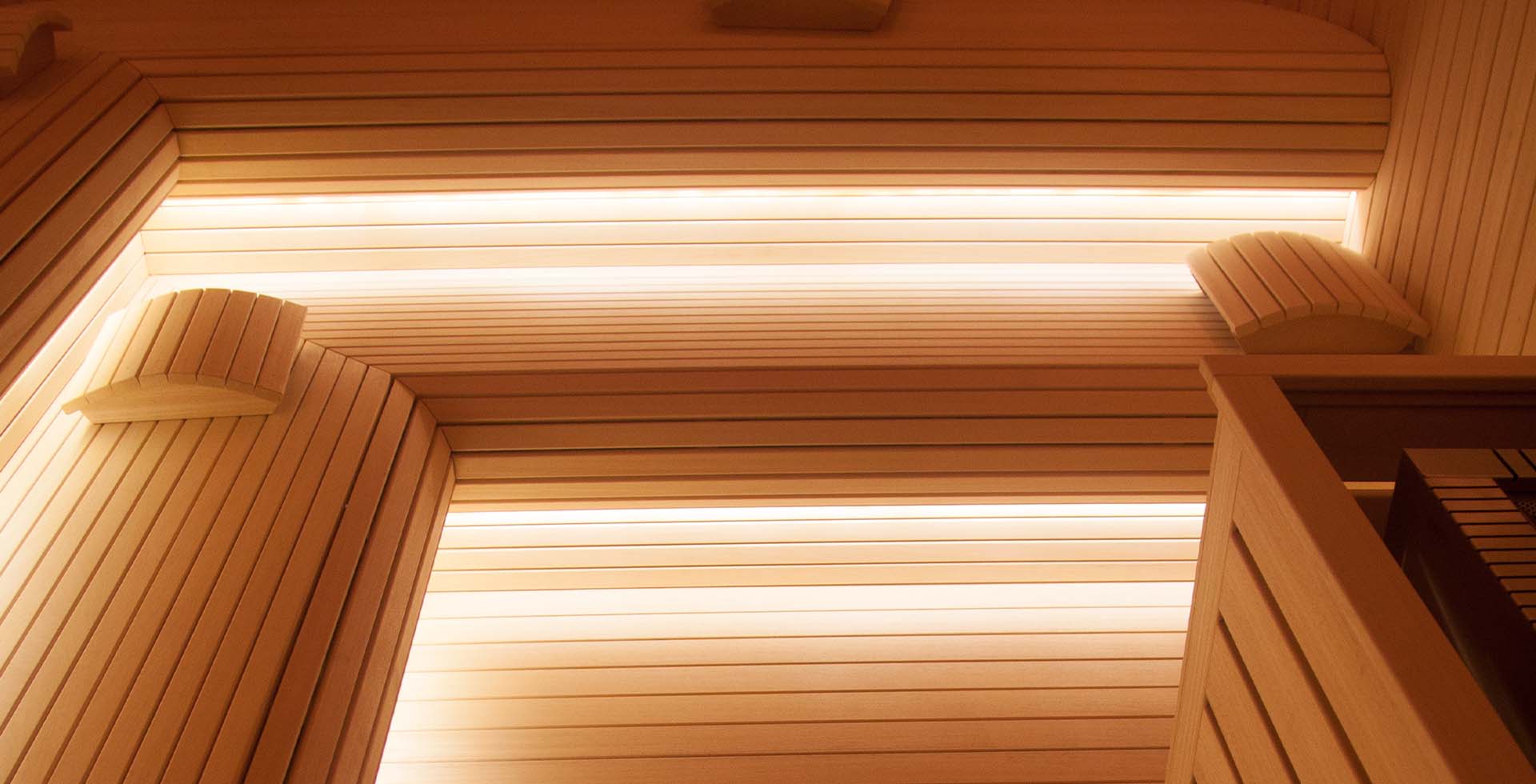
Timber. Nordic spruce, aspen, alder, thermally modified aspen, cedar and hemlock all work. What matters more than species: low resin content, no knots where skin touches, and no metal fixings on any contact surface. Thermally modified timber is more dimensionally stable and darker in colour; cedar is aromatic and expensive. Bench material should differ from wall material — aspen or thermo-aspen benches stay cooler to sit on than pine.
Ventilation. Inlet low near the heater, outlet high on the opposite wall, both adjustable. Most cheap cabins get this wrong or omit it, which is why they feel stale and dry out unevenly.
Door. Outward-opening, no lock, glass or with a glass panel. This is a safety requirement, not a style choice.
Decision five: kit or custom
A prefabricated cabin is the right answer for most standard rooms. Predictable cost, factory-controlled build quality, days rather than weeks on site. Choose one if your space is roughly rectangular and you can live with standard dimensions.
A custom build earns its cost when the space is awkward, when the sauna has to match an interior scheme, when you want a large glazed elevation, or when it is part of a wider wet area. It is also the only route to a genuinely integrated luxury home sauna. Our guidance on picking a supplier for either route is in how to choose a sauna manufacturer.
What the evidence supports, honestly
Regular sauna use has a substantial observational evidence base, mostly from Finnish prospective cohorts, associating it with lower risk of hypertension, cardiovascular disease, thromboembolism, dementia and respiratory conditions (Laukkanen and Kunutsor, Temperature, 2024). A randomised controlled trial in 47 sedentary adults with cardiovascular risk factors found that adding 15 minutes of post-exercise sauna to a guideline exercise programme lowered systolic blood pressure by 8.0 mmHg (95% CI −14.6 to −1.4) versus exercise alone over eight weeks (Lee et al., 2022).
Where it does not deliver: a randomised crossover trial in twelve older adults with type 2 diabetes found a single infrared sauna session at 60 °C produced no improvement in postprandial blood glucose handling versus a thermoneutral control (Schenaarts et al., Experimental and Clinical Endocrinology & Diabetes, 2024). Single sessions do not fix metabolic problems, and infrared is the weakest stimulus of the three.
The defensible position: the best sauna for home use is the one you will actually get into several times a week for years, and the long-term association data is genuinely encouraging. Do not buy one expecting a measurable clinical effect from any individual session.
Budget, and where it goes
Roughly, and excluding local labour rates: an infrared cabin sits at the bottom, a good prefabricated traditional sauna in the middle, and a custom build with glazing and integrated wet area at the top. The costs that surprise people are rarely the cabin — they are the electrical upgrade for a 9 kW heater, the ventilation route to outside, and the wet-area works if a shower or plunge is included. Regional figures are in infrared sauna cost and what a sauna costs in Dubai.
Running cost is modest and consistently overestimated. A 9 kW heater does not draw 9 kW continuously — it cycles on the thermostat once at temperature, typically averaging well under half its rated draw across a session.
Living with it
Maintenance is light but not zero: ventilate after each session, wipe benches, replace heater stones every one to two years as they fracture and restrict airflow, and check the vapour barrier is intact wherever it is accessible. See how to maintain a sauna and infrared sauna maintenance.
If you want the room to actually get used, put a cold option next to it. A shower is the minimum, a cold plunge is better, and the reasoning is in sauna and cold plunge. Practical use guidance is in how to use a sauna and sauna rules. If you are still weighing formats, read sauna vs steam room and steam shower vs sauna. And for the full sizing and specification walk-through, how to choose a home sauna.
Frequently asked questions
What is the best type of sauna for a home?
A traditional electric sauna, if your electrical supply and ventilation allow it. It reaches 80–100 °C, lets you control humidity by pouring water on the stones, and produces the systemic heat stimulus the research is based on. Infrared is the right answer only where the supply, the space or heat tolerance rules out traditional — it is a genuinely different and much milder stimulus, not a modern replacement.
What size heater does a home sauna need?
Roughly 1 kW per cubic metre of cabin volume in a well-insulated room, with additions for glazed or uninsulated surfaces. A 2 × 2 × 2.1 m cabin is 8.4 m³ and wants a 9 kW heater, which usually requires three-phase power. Undersizing is the most common specification mistake and cannot be fixed later without replacing the heater.
Is an infrared sauna worth it?
For the right buyer, yes. It installs on a single-phase socket, heats in ten minutes, fits an apartment, and is tolerable for people who cannot cope with 90 °C air. But direct measurement shows it produces essentially no core temperature rise and only superficial tissue heating, with the thermal effect down 63% by 2.4 cm below the skin. Buy it as a comfortable warm room, not as an equivalent to a traditional sauna.
Can I install a sauna myself?
Assembly of a prefabricated cabin is within reach of a competent DIY builder. The two parts that are not are the electrical connection for a 4.5–9 kW heater, which needs a qualified electrician and often a supply upgrade, and the vapour barrier on a built-in sauna, which has to be continuous and fully sealed. A vapour barrier failure is invisible for years and then structural.
Getting it specified properly
We design, manufacture and install saunas for private homes, villas and hotels, from single prefabricated cabins to custom wet areas. If you tell us the room, the electrical supply and how many people will use it, we can tell you within a call whether the sauna you have in mind will actually work there. Get in touch.


