


Last updated: May 2026
In February 2025, an Emirati family in a Palm Jumeirah Signature Villa asked our Dubai team a question we hear several times a week: “Can we install a sauna without rebuilding our bathroom?” The villa had a 14 m² guest suite with a sea-facing terrace and a tiled wet room that was rarely used. Eight weeks later, we delivered a 4-person custom Finnish sauna in thermowood with a glass front facing the terrace. The family now uses the sauna five evenings a week.
That project sums up the Dubai sauna market in 2026. Demand is strong across the city, and the buyers are increasingly specific: high-net-worth villa owners, Downtown apartment residents, boutique hoteliers in Business Bay, and architects fitting out new towers along the Marina. What unites them is the realisation that Dubai’s climate, far from making saunas unnecessary, makes a properly designed sauna an essential element of any serious home or hotel wellness suite.
This guide covers everything you need before commissioning a sauna in Dubai: choosing between Finnish and infrared for the UAE climate, navigating DEWA electrical approval, optimal placement in different property types, climate-matched material selection, ventilation in coastal humidity, costs in AED, and case studies from recent installations. Drawing on manufacturing experience at Sauna Dekor since 1987 and a Dubai office that has delivered hundreds of projects across the Emirates, our team has compiled the practical detail that catalogues skip.
Thinking about a sauna for your villa, apartment, or hotel in Dubai? Explore our custom sauna range or request a free consultation with our Dubai team.
Why is sauna installation booming in Dubai’s luxury property market?
Sauna demand in Dubai has grown sharply since 2022, driven by three factors: the post-pandemic wellness shift toward at-home spa amenities, the rapid expansion of luxury hospitality across Downtown, Business Bay, and the Palm, and the recognition that air-conditioned indoor living creates a thermal monotony that a sauna directly counteracts. New-build villa specifications increasingly include a sauna as standard. For existing property owners, a sauna is one of the additions most often specified during a villa refurbishment, usually inside a wider guest-suite or wellness-wing scope.
The clinical case for sauna use is independent of climate. A 2018 evidence review in Mayo Clinic Proceedings documented cardiovascular, recovery, and immune benefits across more than 40 published studies (Laukkanen et al., 2018). For Dubai residents who spend most of the day in controlled 22 to 24 °C air-conditioned environments, the deliberate heat exposure of a sauna provides a thermal stimulus that the climate alone does not deliver.
Should you choose a Finnish sauna or infrared sauna for the UAE climate?
For most Dubai residences, a custom Finnish sauna at 80 to 90 °C remains the gold standard, with an infrared sauna at 50 to 65 °C as a strong secondary option for compact spaces or daily-recovery use. Apartment dwellers and homeowners with strict DEWA load limits often choose infrared because of its lower electrical draw (typically 1.6 to 2.5 kW versus 6 to 9 kW for Finnish). Villa owners and hoteliers with adequate electrical capacity usually choose Finnish for authentic hot-stone löyly and traditional ritual.
When a Finnish sauna is the right choice
A Finnish sauna delivers the most-studied health and wellness profile and is the preferred choice for clients who want an authentic Nordic experience. It requires a 30 to 60 amp dedicated circuit, weather-sealed venting, and a footprint of 2 to 6 m² depending on capacity. For villa owners in Emirates Hills, Jumeirah Golf Estates, and Palm Jumeirah, where DEWA load is rarely a constraint, Finnish is the default.
When an infrared sauna is the right choice
An infrared sauna heats the body directly through radiant panels at lower ambient temperatures. It pre-heats in 12 to 18 minutes (versus 30 to 45 for Finnish), draws less electricity, and fits comfortably into a 1.5 to 4 m² footprint. For Dubai Marina apartments, Downtown high-rises, and JBR residences with single-meter DEWA supply, infrared is often the only practical option without an upgrade to the apartment’s electrical service.
When both are the right choice
In larger villas and luxury penthouses, the most-installed configuration is now a Finnish sauna in the main wellness suite and a smaller infrared cabin in a dressing area or master bathroom for daily recovery use. Pairing the two captures the cardiovascular adaptation of high-temperature Finnish bathing with the convenience of a brief daily infrared session.
A practical comparison:
| Feature | Finnish sauna | Infrared sauna |
|---|---|---|
| Operating temperature | 80–100 °C | 50–65 °C |
| Pre-heat time | 30–45 min | 12–18 min |
| Electrical draw | 6–12 kW | 1.6–2.5 kW |
| Footprint | 2–6 m² | 1.5–4 m² |
| DEWA approval | Required (heavy load) | Often within standard load |
| Typical scope driver | Heater rating, glazing area and DEWA load | Emitter type, control and existing circuit |
| Best for | Villas, hotels, full wellness suites | Apartments, daily-use cabins |
How does the DEWA approval process work for sauna dubai?
Sauna installations in Dubai require Dubai Electricity and Water Authority (DEWA) electrical approval whenever a dedicated circuit, load upgrade, or new connection is needed. The process involves submitting drawings via a DEWA-registered electrical contractor, paying connection or modification fees, and passing a final inspection before energisation. For a typical residential Finnish sauna, the full DEWA process takes 3 to 6 weeks; for an infrared sauna on an existing circuit, no DEWA submission is usually required.
Step-by-step DEWA approval
- Load assessment: A DEWA-registered electrical consultant reviews your property’s existing load and confirms spare capacity. Most villa supplies (200 to 400 amp) easily accommodate a 9 kW sauna; apartments often need a load review.
- Application submission: The consultant submits a connection or modification application via the DEWA portal at dewa.gov.ae, including single-line diagrams and load calculations.
- Approval and fee payment: DEWA reviews and issues a NOC (No Objection Certificate) along with the relevant fee structure. Fees are modest for existing supply modifications and higher for new circuits.
- Installation and final inspection: Once the sauna and electrical work are installed, DEWA inspects and energises the new circuit. The sauna can be commissioned the same day.
What can delay DEWA approval
The two most common delays are incomplete drawings (missing earthing details, no IP rating on the heater) and unauthorised electrical work performed before approval. Always engage a DEWA-registered consultant from the start. Our Dubai team handles DEWA coordination for every project as part of the standard installation package.
Strata and developer approvals
In addition to DEWA, apartment and villa owners in master-planned communities (Emaar, Nakheel, Damac, Meraas) typically need community management approval for any structural or electrical modification. This is usually a one-week process with as-built drawings and the DEWA NOC.
Considering a sauna in a Dubai apartment or villa? Our Dubai team manages DEWA approval, community NOC, and installation as a single-source package. Request a free consultation to get started.
Where is the best place to install a sauna in Palm Jumeirah villas and Dubai Marina apartments?
The optimal sauna location is a space with existing waterproofing, a nearby cold-water source, adequate electrical capacity, and external ventilation. In Palm Jumeirah villas, the strongest options are the ground-floor wellness wing, a converted guest suite, or a dedicated annex by the pool. In Dubai Marina and Downtown apartments, the master bathroom (replacing or augmenting a tub), a former laundry room, or a glassed-in section of the balcony are the three most-used locations.

Palm Jumeirah and Emirates Hills villas
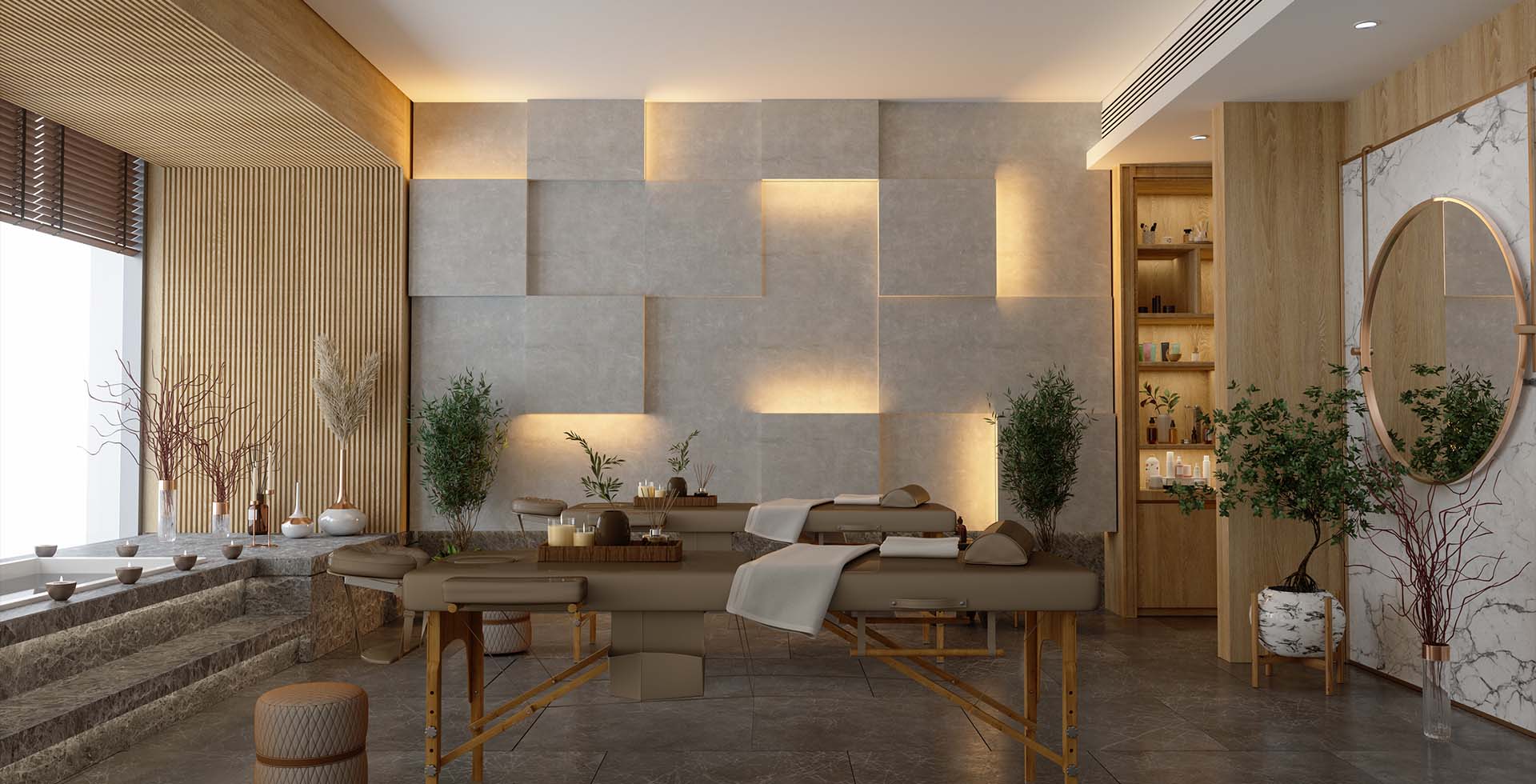
The villa profile across Palm Jumeirah, Emirates Hills, Al Barari, and Jumeirah Golf Estates supports the broadest set of options. The most common installation is a dedicated wellness suite incorporating the sauna, a steam room or hammam, a cold plunge or shock shower, and a relaxation area. The scope of a wellness suite is set by the number of rooms, the plant they share, and the waterproofing and drainage already built into the floor.
Dubai Marina and JBR apartments
Apartments typically have a 5 to 12 m² master bathroom and limited room for new freestanding builds. The most successful installations replace a corner bathtub with a 1.5 to 2 m² infrared cabin, finished in matching timber and glass to integrate with the existing aesthetic. DEWA usually approves without load modification.
Downtown Dubai and Business Bay residences
Penthouses and large units in Downtown Dubai and Business Bay often have a study or media room that can be converted. A 3 to 4 m² Finnish sauna with a glass front facing the city view is a striking installation. For hoteliers, we have completed several Business Bay boutique projects (4 to 12 rooms) where a small spa with a single sauna and steam room is what separates the property from the block around it.
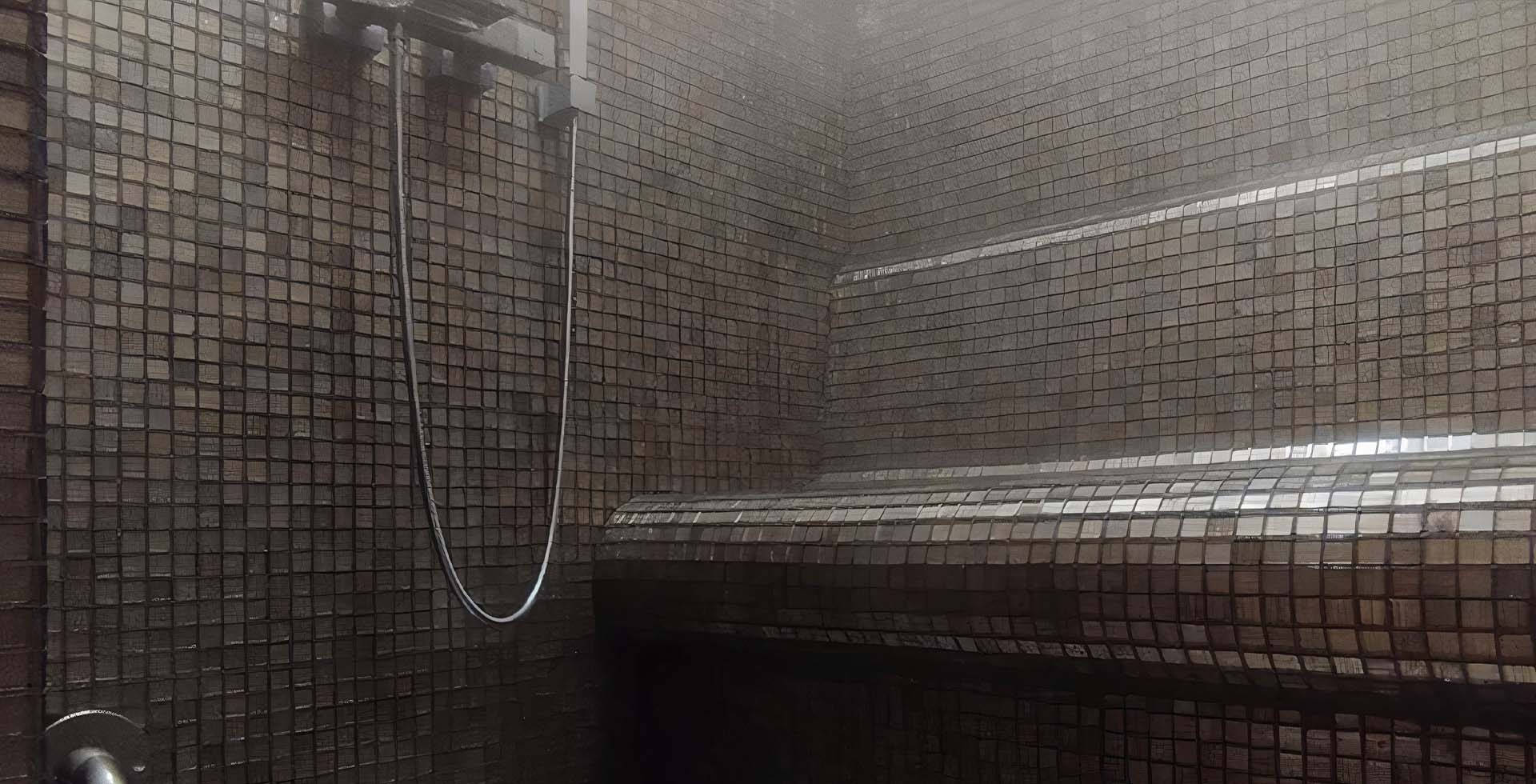
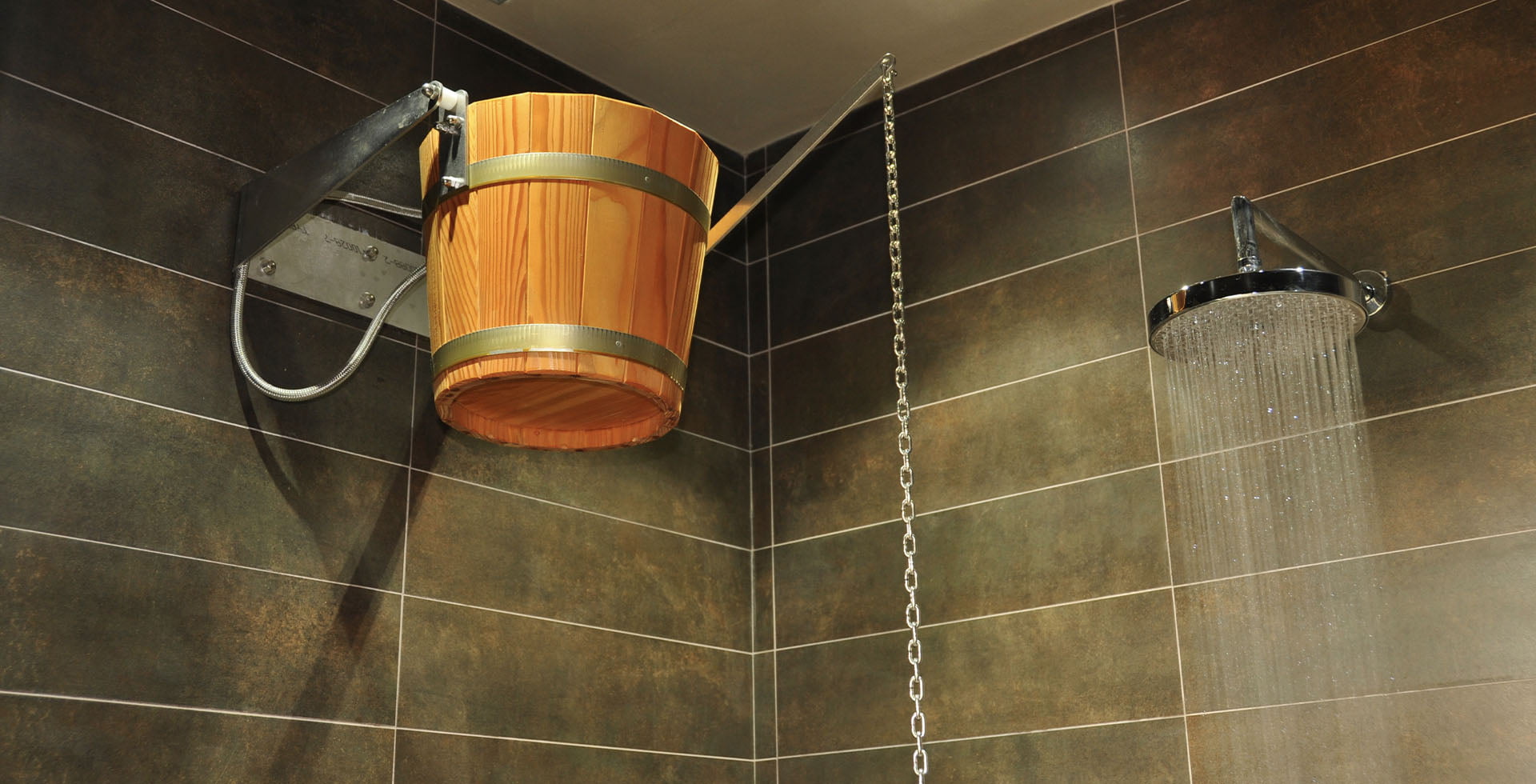
A six-room boutique hotel in an area such as Business Bay typically has around 18 m² of basement reception area to work with, and that is enough. The specification that fits is a two-person Finnish sauna in Canadian Hemlock, a small steam room with a mosaic finish, and a cold plunge alcove with a shock bucket — three experiences in a footprint most operators assume will hold one.
What timber and materials work best for Dubai’s climate?
For Dubai’s arid heat and high coastal humidity, the most reliable sauna timbers are thermowood, Canadian Hemlock, and Western Red Cedar. Thermowood is the strongest performer because heat-treatment reduces moisture absorption and prevents the warping that affects untreated softwoods when the building cycles between dry indoor air-conditioning and humid sea air. Canadian Hemlock is the most common choice for interior cabins in apartments. Western Red Cedar is favoured for premium villa installations because of its aroma and durability.
Why timber selection matters more in Dubai than in cooler climates
A sauna in London or Helsinki sees moderate humidity year-round. A sauna in Dubai sees 5 to 15 % relative humidity inside an air-conditioned villa and 60 to 90 % humidity outside, sometimes within the same hour. This continuous swing stresses any timber that is not stabilised for it. Thermowood and properly treated cedar handle the cycling; untreated spruce and softwood paneling typically warp or crack within two to four years in Dubai conditions.
Timber comparison for Dubai installations
| Timber | Suitability for Dubai | Typical use | Cost level |
|---|---|---|---|
| Thermowood | Excellent (best for villa and outdoor) | Cladding, benches, full builds | High |
| Canadian Hemlock | Good (best for interior cabins) | Apartment cabins, indoor wellness suites | Mid |
| Western Red Cedar | Very good (low resin, dimensionally stable) | Luxury villa and penthouse builds | High |
| Nordic Spruce | Acceptable (interior only, treated) | Interior cabins, budget builds | Mid |
| Abachi | Excellent for benches (low conductivity) | Bench tops in any cabin | Very high |
Non-timber materials
Glass, marble, and tile components are common in Dubai installations because they suit the local aesthetic. Heat-resistant laminated glass for front panels, locally-sourced Arabescato or Statuario marble for hammam göbek taşı platforms, and large-format porcelain tiles for steam-room finishes are routinely specified in our projects.
How do you manage ventilation in Dubai’s high-humidity coastal areas?
Dubai’s coastal humidity demands a more deliberate ventilation strategy than standard pre-fab cabins provide. The principle is the same as anywhere (passive or mechanical airflow with inlet near the heater and outlet at the opposite high corner), but the execution must account for outdoor air at 35 to 45 °C and 70 to 90 % relative humidity in the summer months. The right setup uses mechanical extraction for villas and active dehumidification for apartment cabins in dense buildings.
Passive ventilation for villas and stand-alone cabins
Stand-alone villa saunas with an external wall use a 100mm passive vent at low level (near the heater) and a 150mm outlet at high level. In Dubai, both vents should include insect mesh and a moisture-trapping baffle. Total fresh-air exchange should achieve 6 to 8 air changes per hour during a session, which keeps oxygen levels comfortable and prevents stagnant humidity build-up.

Mechanical ventilation for apartments and interior cabins
For interior cabins with no exterior wall (a common Dubai apartment scenario), passive ventilation is not enough. Specify a quiet inline extractor fan rated for 80 to 120 m³/h on the outlet, with a humidistat-triggered run-on cycle that removes residual moisture after each session. This prevents the long-term moisture damage that destroys poorly-designed cabins in 18 to 36 months.
Dehumidification considerations
In coastal apartments where the surrounding rooms maintain heavy air-conditioning, the temperature differential at the sauna door can cause condensation on glass panels. A small dehumidifier in the adjacent space, or the central air-conditioning set to a slightly higher humidity target, eliminates this. Our Dubai team specifies the precise dehumidification and HVAC interface for every installation.
What decides the scope of a sauna project in Dubai?
We do not publish price lists for Dubai, because a sauna is quoted as a scope rather than bought as a product. Two cabins of the same footprint can sit a long way apart, and the distance between them is made of decisions taken before anything is manufactured: prefabricated shell or custom joinery, timber grade, how much of the cabin is glass, the heater rating and control, whether a steam room or a cold circuit joins it, and what the building already offers in electrical load, drainage and waterproofing.
What sets the scope, by project type:
| Project type | What sets the scope | Lead time |
|---|---|---|
| Prefab infrared cabin (apartment) | Cabin size, emitter type and control; usually within the existing electrical load | 4–6 weeks |
| Prefab Finnish sauna (villa) | Heater rating, bench layout and glazing; DEWA load check | 4–8 weeks |
| Custom Finnish sauna (villa) | Timber grade, full-glass fronts, joinery made to measured room dimensions, integrated lighting and audio | 10–16 weeks |
| Bio sauna or steam room add-on | Generator sizing, tanked build-up, mosaic finish and drainage | 8–14 weeks |
| Full wellness suite | Number of rooms, shared plant, waterproofing and MEP coordination | 14–24 weeks |
Scope items that sit outside the cabin
- DEWA approval and electrical work — the extent depends on whether the incoming load has to be modified
- Community NOC and as-built drawings — required by most developers and strata boards
- Foundation or floor reinforcement — penthouses and roof terraces, where the slab has to carry the cabin and the stones
- Cold plunge or shock shower — where the contrast circuit is part of the brief; adds chiller, filtration and drainage
- Delivery, crane lift and white-glove installation — set by the access route rather than by the cabin
The cabin is rarely the whole project. Approval, electrical work, floor build-up, delivery access and commissioning all sit outside it, and a budget built on the cabin alone will fall short. We quote position by position in AED against your drawings, so the whole scope is visible before anything is ordered.
What sauna sizes are most popular for different Dubai property segments?
Sauna sizing in Dubai tracks closely to property segment. Apartments typically install 1 to 2-person cabins of 1.5 to 2.5 m². Townhouses and Marina villas typically install 2 to 4-person cabins of 3 to 5 m². Palm Jumeirah and Emirates Hills villas typically install 4 to 6-person saunas of 5 to 9 m². Boutique hotels typically install 4 to 8-person commercial saunas of 6 to 12 m². For large villa wellness suites, 6 to 12-person installations of 10 to 20 m² are common.
The right size depends on three factors: typical household or guest count, frequency of use, and adjacent spaces (relaxation lounges, cold plunge, treatment rooms). For a couple in a Marina apartment, a 1.5 m² infrared cabin is correct. For a family of five in a Palm villa, a 5 m² Finnish sauna with two-tier benches is the natural fit. For a 30-room hotel in Downtown, an 8-person commercial cabin with reinforced commercial-grade heater is the standard specification.
A two-floor penthouse in Downtown Dubai shows how that sizing decision plays out. The brief in this segment is usually the same: a cabin large enough for the household to use together with up to four guests, and a glass wall facing the city view. The specification that answers it is a 6-person cabin of roughly 12 m² in Western Red Cedar with a full glass front, integrated chromotherapy lighting, and an audio system. A cabin at that size absorbs four to five sessions across a weekend day without needing to cool down between them.
For homeowners planning a private spa and hoteliers planning a commercial spa, the sauna almost always sits within a wider wellness specification. We routinely design saunas alongside custom hammams, bio saunas, and infrared cabins for a complete heat-and-cold therapy experience tailored to Dubai’s climate and lifestyle.
What do Dubai clients build alongside the sauna?
A sauna is rarely the whole brief. In the villas and hotel spas we deliver across the UAE, it is one station in a sequence, and the rooms specified with it fall into a fairly consistent set. Each of the following has its own engineering, cost band and approval path, so it is worth knowing what you are choosing between before the layout is fixed.
- Thermal suite – the full free-flow circuit of heat, steam and cold rooms in one engineered core. This is the specification to start from if you are building more than two wet rooms.
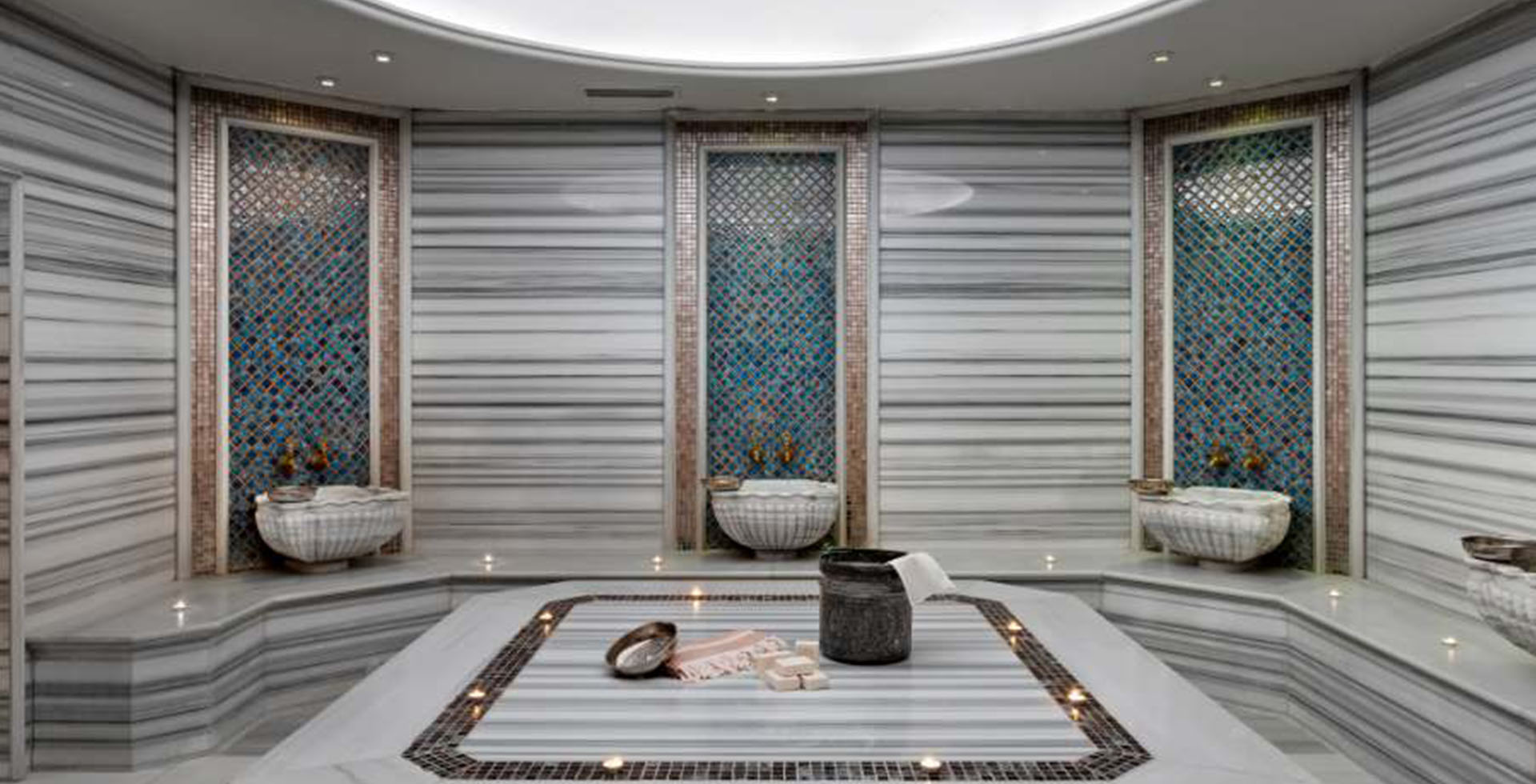
- Hammam – the attendant-led marble bathing ritual, and the room most often requested next to a sauna in Gulf projects.
- Russian banya – higher humidity and a harder heat than a Finnish cabin, with the venik ritual; a distinct build, not a hotter sauna.
- Onsen – Japanese hot bathing, increasingly specified in Dubai villas as a mineral soaking pool with its own filtration and heating plant.
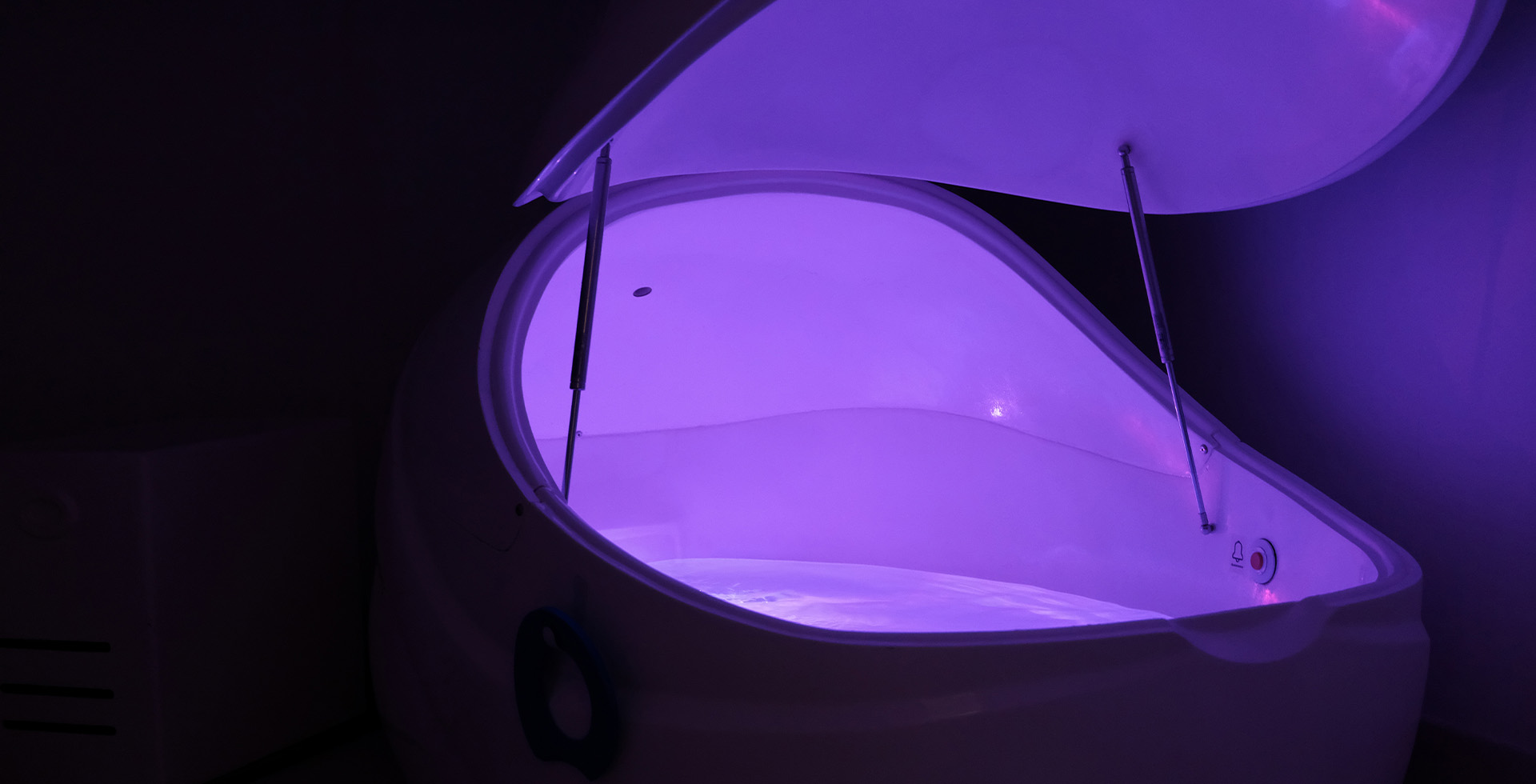
- Float room – sensory deprivation in a high-density Epsom solution; the acoustic and salt-corrosion detailing is what separates a working installation from a failed one.
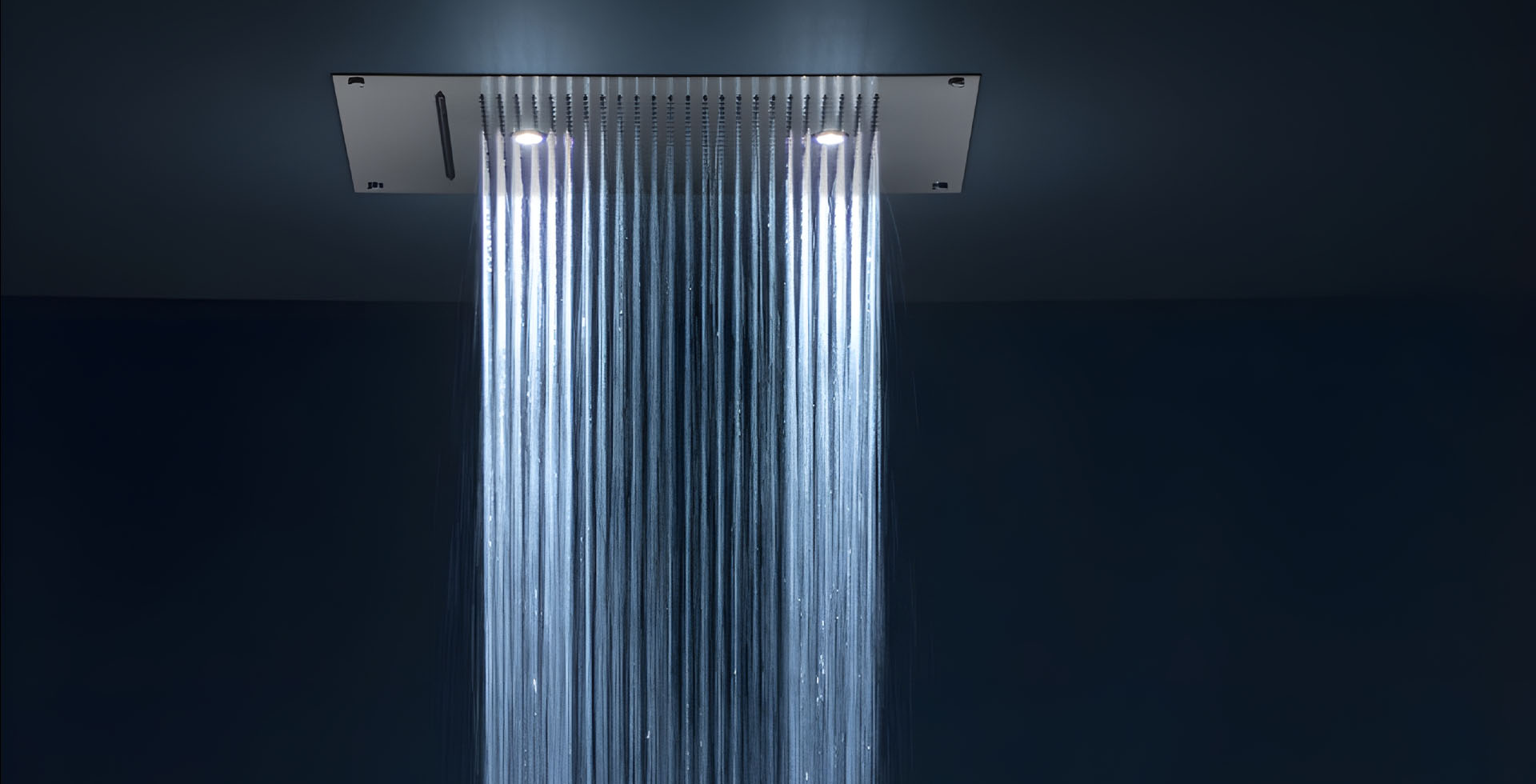
- Cryotherapy and cold plunge – the cold half of contrast bathing, which is where most of the measurable recovery benefit of a sauna session is actually realised.
- Rasul mud chamber – the self-guided mineral clay ritual; it needs mud-rated drainage from day one, which is the detail most contractors miss.
- Hydrotherapy pool – warm jetted water at 35–37 °C. This is the room that serves guests who will never step into a sauna, which is usually what widens the case for the whole wellness area.
- Longevity centre – for operators, the commercial format these rooms are increasingly assembled into rather than sold as separate spa treatments.
If the sauna is phase one of a larger wellness area, specify the drainage, tanking, ventilation and plant space for the whole sequence now, even if the other rooms are built later. Retrofitting a wet room into a completed villa costs several times what it costs to allow for it at first fix.
Which heater and which timber, by name
Two specification lines decide how a Dubai cabin ages, and both are named parts rather than preferences. The heater families we specify are EOS and Harvia: a stone heater for a Finnish sauna, a combi heater with an integrated evaporator for a bio sauna, and carbon or full-spectrum quartz emitters where the room is an infrared sauna. On a villa cabin with a full-glass façade — a cabin whose front wall is glass rather than timber — the glazed area is corrected for in the heater sizing before anything else is fixed, and a hybrid sauna running both Finnish and infrared modes needs that correction and a single control strategy agreed at the same time.
Timber is specified by species and grade: thermally modified aspen, alder and abachi (ayous) for benches and backrests, western red cedar where a client wants the aroma. Coastal humidity in Dubai and on the Palm is the reason the species is named in the document rather than left to the fit-out contractor. Sauna Dekor manufactures these cabins in its own Istanbul factory, in business since 1987 and now in its fortieth year, with installations in more than 35 countries, and coordinates UAE delivery through its authorised representative in Dubai. Commercial rooms follow the tender language in our commercial sauna specification.
Frequently asked questions about saunas in Dubai
Can you install a sauna in a Dubai apartment?
Yes. Most Dubai apartments can accommodate an infrared sauna of 1.5 to 3 m² without electrical upgrades, and many can accommodate a small Finnish sauna with a DEWA-approved load modification. Community NOC and waterproofing details should be confirmed before commissioning.
How long does sauna installation take in Dubai?
Prefab cabins are typically delivered and installed in 4 to 8 weeks from order. Custom-built saunas take 10 to 20 weeks, including 4 to 6 weeks for DEWA approval. Full wellness suites with multiple rooms run 14 to 24 weeks end-to-end.
Is DEWA approval mandatory for all sauna installations?
DEWA approval is required when a dedicated circuit, load increase, or new connection is needed. For most Finnish saunas this is mandatory; for many infrared cabins that fit within existing apartment load, no DEWA submission is required.
What is the best sauna for a Dubai villa with a pool?
A custom Finnish sauna near the pool, paired with a cold plunge in the pool deck, replicates the traditional Nordic contrast ritual that the climate otherwise lacks. Thermowood cladding handles the humidity. The scope of this configuration is driven by the cabin size, the cold-water plant and the terrace build-up.
Do you need a sauna in Dubai if the weather is already hot?
Yes. Dubai’s outdoor heat is humid and uncontrolled; sauna heat is dry (or controlled-humidity), brief, and intense. The cardiovascular and recovery benefits documented in clinical studies are not replicated by hot weather. Most Dubai residents spend their days in air-conditioned environments at 22 to 24 °C, which makes a deliberate sauna session physiologically valuable.
Where in Dubai is a sauna most often specified?
In villa segments and in penthouse units with dedicated wellness floors, where the floor area and the electrical supply are both available. We do not publish a figure for what a sauna adds to resale value: it cannot be separated from the rest of a refurbishment, and any number we gave would not be ours to verify.
Are infrared saunas safe in high-humidity coastal areas?
Yes, with proper ventilation. Infrared cabins generate less ambient humidity than Finnish saunas, but the cabin still needs an extraction fan to manage post-session moisture in coastal locations. Always specify EMF-shielded panels rated for hot-climate operation.
Can your team service my sauna after installation?
Yes. Our Dubai team provides after-sales support for every Sauna Dekor installation in the UAE, including annual servicing, heater replacement, timber maintenance, and electrical inspection.
Sources
- Hannuksela, M.L., & Ellahham, S. (2001). Benefits and risks of sauna bathing. American Journal of Medicine, 110(2), 118-126. PubMed
- Laukkanen, J. A., Laukkanen, T., & Kunutsor, S. K. (2018). Cardiovascular and Other Health Benefits of Sauna Bathing: A Review of the Evidence. Mayo Clinic Proceedings, 93(8), 1111-1121. Full text
- Dubai Electricity and Water Authority (DEWA). Connection services and electrical approval portal. dewa.gov.ae
Ready to design your sauna in Dubai? Whether you are planning a Marina apartment infrared cabin, a Palm Jumeirah Finnish sauna, or a full hotel wellness suite in Business Bay, our Dubai team draws on manufacturing that has run since 1987 and builds the cabin, the ventilation and the heater circuit as one scope — manufactured in Istanbul, installed and commissioned in Dubai. Request a free consultation and we will provide detailed project costs in AED, timber samples, DEWA coordination, and design options for your specific space.
Two practical companions to this page: what a sauna actually costs in Dubai, in real AED ranges from recent quotations, and which sauna brands are worth specifying here given the local service and spare-parts picture.
Frequently asked questions
How much does a sauna cost in Dubai? There is no list price for a Dubai sauna: the cabin is quoted against the drawings. The heater rating, the amount of glazing, the timber grade and the level of joinery account for most of the difference between two cabins of the same size, and DEWA approval, floor build-up and installation access sit outside the cabin again. We quote position by position in AED.
What sauna suits Dubai’s climate? Indoor cabins are the norm. Outdoor saunas are possible but need shading, ventilation and materials chosen for heat and humidity swings, and the plant needs to work against ambient temperatures far above European design assumptions.
Do I need approval to install a sauna in Dubai? For apartments and villas within managed communities you usually need building or community approval, and electrical work has to be signed off by an approved contractor. Commercial installations additionally require MEP coordination and civil defence review.
How long does a sauna installation take in Dubai? For a standard residential cabin, allow three to four weeks for design and approvals, six to ten weeks for manufacture and delivery, and one to two weeks on site. Custom rooms and hotel projects run longer.


