


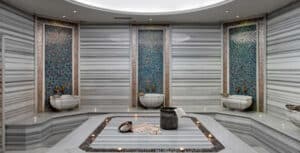


Sauna Dekor Spa Solutions engineering team, Istanbul
Last updated: 7 October 2026
Short answer: a snow room draws about 5 kW in operation and uses roughly 200 litres of water a week, according to TechnoAlpin, whose indoor snow rooms run at about −10 °C (TechnoAlpin). The manufacturer puts the daily running cost at 20–25 euros at European electricity prices, and says up to 90 % of the electricity can be recovered as heat. Sauna Dekor Spa Solutions builds the room around the snow unit, so this guide sets out snow room running costs line by line: power, water, waste heat, maintenance and what a Gulf plant room changes.
The figures below come from the snow unit’s manufacturer and are labelled as such. Where we add a worked calculation, it is shown as arithmetic, not as a measured bill. Design, sizing and capital cost are covered in our guide to snow rooms in Dubai; this page is about what the room costs once it is open.
What are the real snow room running costs?
Electricity is the main running cost, water is a minor one, and staff time is about 10 minutes a day. TechnoAlpin gives about 5 kW for operation and 20–25 euros a day at European tariffs, which it compares with running a sauna for 10 people. Weekly water use is about 200 litres, and the cooling circuit needs periodic statutory checks.
That makes a snow room comparable to a large sauna, not to a cold store. The reason is the build: TechnoAlpin specifies high-density materials such as triple glazing and PUR foam insulation panels so that the room holds its temperature with little heat loss. A room built with a weak shell, a poor door seal or a broken vapour barrier will not match those figures, because the refrigeration has to replace whatever leaks in.
The running cost has four parts, and each is treated separately below:
- Refrigeration — keeping the room at about −10 °C (TechnoAlpin) against the air around it.
- Snow production — the nightly cycle that turns water and cold air into fresh snow.
- Water — the feed for the snow unit and the meltwater when the room is defrosted.
- Maintenance — daily checks, weekly defrosting and cleaning, and periodic servicing of the cooling circuit.
Where does the energy in a snow room go?
Most of it goes into holding the room cold, not into making snow. A shell at about −10 °C (TechnoAlpin) gains heat through the walls, ceiling, door and glazing all day, and from every guest who enters. Snow is made in one overnight cycle, so its extra load falls in a few night hours, of the 24, rather than across the trading day.
The heat that enters the room comes from four places. Conduction through the insulated panels is constant and is set by the panel thickness and the temperature on the other side. Glazing is the weakest part of the envelope, which is why TechnoAlpin limits glass to three walls at most; the fourth carries the heat exchanger. The door is opened by every guest, so traffic adds load. And people themselves are a heat source: TechnoAlpin notes that the room temperature rises a little with visitor frequency.
The snow unit then adds its own load during the snow cycle, because water has to be cooled and frozen. TechnoAlpin’s EcoSnow 2.0 unit runs this on a scheduler, normally overnight, and the manufacturer recommends not making snow during visiting hours because it blocks the view inside the room.
How much electricity does a snow room use in a day?
Use TechnoAlpin’s 5 kW operating figure as the planning number. If the plant drew 5 kW for all 24 hours, that would be 120 kWh a day, an upper bound rather than a metered value. The manufacturer’s 20–25 euros a day is consistent with that order of magnitude at European prices.
To estimate your own figure, multiply the daily kWh by your tariff and then by the opening days in the year. The calculation is deliberately simple, because the honest uncertainty is not in the arithmetic but in the inputs: how good the envelope is, how many guests use the room, how hot the plant room is and whether the waste heat is recovered.
Two points keep the estimate realistic. First, the 5 kW figure belongs to the manufacturer’s own room build and conditions; a room with a thinner shell or extra glazing will draw more. Second, the electrical supply is sized for peak demand, not for the average, so the circuit rating for the room is a separate question from its running cost. Our guide to sauna electrical requirements explains how dedicated circuits for thermal rooms are planned.
How much water does a snow room use?
Very little. TechnoAlpin states that one litre of water makes five litres of snow, that the unit uses 10–15 litres an hour while it is snowing, and that a snow room uses about 200 litres a week. By its own comparison, a shower runs 10–15 litres a minute.
The water cost is therefore negligible against the electricity. What matters is the quality of the water, not the quantity. Snow is made through fine nozzles, and hard, mineral-rich water scales them, which degrades the snow and makes the unit work harder. We therefore specify the treatment the snow unit’s manufacturer requires before the room is commissioned, not after the first service visit finds scale.
Water also leaves the room. Snow that settles overnight is pushed aside before opening, and the room is defrosted for hygiene, after which the meltwater has to drain. That drain is a building item, covered below, and it needs to be planned with the same care as the water feed.
How does a snow room compare with the rest of the circuit?
A snow room is the coldest room in a thermal circuit and the only one that holds sub-zero air. It runs at about −10 °C (TechnoAlpin). By contrast, we build cold plunge pools for water temperatures from 2 to 15 °C. A steam room runs at 40–50 °C, and a Finnish sauna at 80–100 °C. Each room spends its energy in a different place.
| Room | Operating temperature | Where the energy goes | Water pattern | Daily attention |
|---|---|---|---|---|
| Snow room | about −10 °C (TechnoAlpin) | Refrigeration against heat gain through the envelope and door, plus an overnight snow cycle; about 5 kW in operation per TechnoAlpin | About 200 L a week for snow; meltwater on defrost | About 10 minutes: check indicators, keep return-air vents clear of snow |
| Cold plunge pool | We build for 2–15 °C water | A chiller removing heat from the water and from each bather | Pool volume, topped up; filtration and treatment | Water quality checks and filter care |
| Steam room | 40–50 °C at close to 100 % relative humidity | A steam generator boiling water for the whole session | Continuous feed while steaming; condensate to drain | Drain and descale the generator to its maker’s schedule |
| Finnish sauna | 80–100 °C | An electric heater warming the air and the stones | Small amounts thrown on the stones | Bench cleaning and airing |
The cold plunge is the closest relative in cost terms, because both rooms pay to remove heat. How a plunge chiller is sized is explained in our guide to the cold plunge chiller, and the water range used in studies is set out in our page on cold plunge temperature. That page draws on a meta-analysis by Machado and colleagues on how water temperature and immersion time change the effect of immersion; it is a research reference for water, not a claim about snow rooms.
Can the waste heat from a snow room be reused?
Yes, and it is the largest lever on snow room running costs. TechnoAlpin says up to 90 % of the electrical energy can be recovered through a heat exchanger in its FAQ, and up to 80 % on its product page, depending on site conditions. The recovered heat can warm water elsewhere in the building.
Every refrigeration plant rejects the heat it removes, plus the energy it uses. Without recovery, that heat goes to a condenser and into the air outside. With recovery, it goes into a water circuit. TechnoAlpin’s own example is a hotel that uses the waste heat to warm swimming pool water, and the company says it reviews the options with each client case by case.
In the Gulf, choosing where that heat goes needs more thought than in the Alps. An outdoor pool there often needs chilling rather than heating through the summer, so it is a poor year-round heat sink. Stronger candidates run all 12 months: domestic hot water for the spa showers and changing rooms, or an indoor pool. We decide the heat sink at concept stage, because a heat exchanger needs pipework, space and controls that are hard to add once the plant room is built.
What does a Gulf plant room change?
It makes the condenser work harder. A refrigeration plant rejects heat more easily into cool air than into hot air, and a Gulf plant room in summer is far hotter than an Alpine basement. The 5 kW figure should therefore be treated as a starting point, with the plant selected for the site’s own summer conditions.
Three decisions keep the cost under control. The condenser goes where it can reject heat freely, normally on a service roof or in a ventilated plant area, never in a closed cupboard next to the spa. The rejected heat must not return into the conditioned wellness area, where the building’s air conditioning would then have to remove it a second time. And the envelope is built to the standard the manufacturer assumes, because in a hot climate every gap in the vapour barrier lets moist air reach the cold structure, where it condenses and freezes.
The full engineering for a hot-climate installation, from insulation to approvals, is in our Dubai snow room guide linked at the top of this page. On this page the point is simply that the same room costs more to run in a hotter plant room, and that recovery and condenser placement claw much of that back.
What must the building supply for low running costs?
Five things: a dedicated electrical circuit, a treated water feed, a drain for meltwater, a location for the condenser, and space for heat recovery pipework. TechnoAlpin’s 5 kW and 200 L a week figures assume all five are in place and designed together with the room.
- Power: a dedicated circuit sized for the plant’s peak demand, with the rating taken from the snow unit’s documentation.
- Water: a cold feed with the treatment the snow unit requires, and an isolation valve outside the room.
- Drainage: a floor drain or channel that takes the meltwater from the weekly defrost, laid so that no water ponds where it can refreeze.
- Condenser position: a ventilated location with a short, accessible refrigerant route, chosen for heat rejection and noise.
- Heat recovery: pipe routes and a plant-room position for the heat exchanger, if the waste heat is to be reused.
Inside the room, TechnoAlpin specifies a rubber floor, so that guests do not stand on ice, and seating that can withstand the cold. The floor is cleared of snow before the room opens, which keeps a snow-free walking zone and avoids ice forming underfoot.
How much daily work does a snow room need?
About 10 minutes a day, according to TechnoAlpin, and a member of the spa team can do it. The daily task is a visual check of the function indicators and making sure the return-air vents are free of snow. Once a week the room is defrosted for hygiene, cleaned with a commercial disinfectant and restarted.
TechnoAlpin describes the service effort as comparable to a swimming pool, and the cooling circuit has to be checked periodically as the law requires. The manufacturer also offers service contracts and remote access to the unit’s settings. The snow itself is renewed every night, and TechnoAlpin reports that a 2021 microbiological analysis found the surfaces, snow and air in its rooms safe.
For an operator, the practical cost is not the 10 minutes but the weekly defrost window. A room that defrosts and makes new snow overnight once a week loses no trading hours. A room whose defrost is scheduled carelessly can be closed on a busy day. We set the defrost and snow schedule with the spa manager at handover, against the spa’s own opening hours.
Does room size change the running cost?
Yes. A bigger room has more envelope to lose cold through and more air to chill. TechnoAlpin builds snow rooms up to 25 m² and plans about 1 m² per person, so the room should be sized to the number of guests who will use it at the same time, not to the largest group imaginable.
Sessions in a snow room are short, so a room sized for six guests at once serves far more than six guests an hour. Oversizing adds envelope area, glazing and plant capacity that the spa pays for every day. Our sizing table for villas and hotel spas is in the guide to snow room supply and installation.
Placement matters as much as size. A snow room next to the sauna and the shower area is used as part of the hot and cold sequence; one at the end of a corridor is used less, which raises the cost per visit. How heat and cold are sequenced is set out in our guide to sauna and cold plunge.
What does this look like on built projects?
In October 2025 we handed over a 6 m² snow grotto in a private villa in Emirates Hills, Dubai, 14 weeks from order to handover. The condenser sits on the service roof, away from the room, so its heat never returns into the wellness wing. The client’s name is withheld by agreement.
The room opens off the villa’s existing sauna and cold plunge, which is how the cold end of a circuit is meant to be planned. It is finished in backlit natural stone, and a snow lance produces fresh powder snow on demand. The photograph below shows the sauna next to it; the snow room itself is not shown.

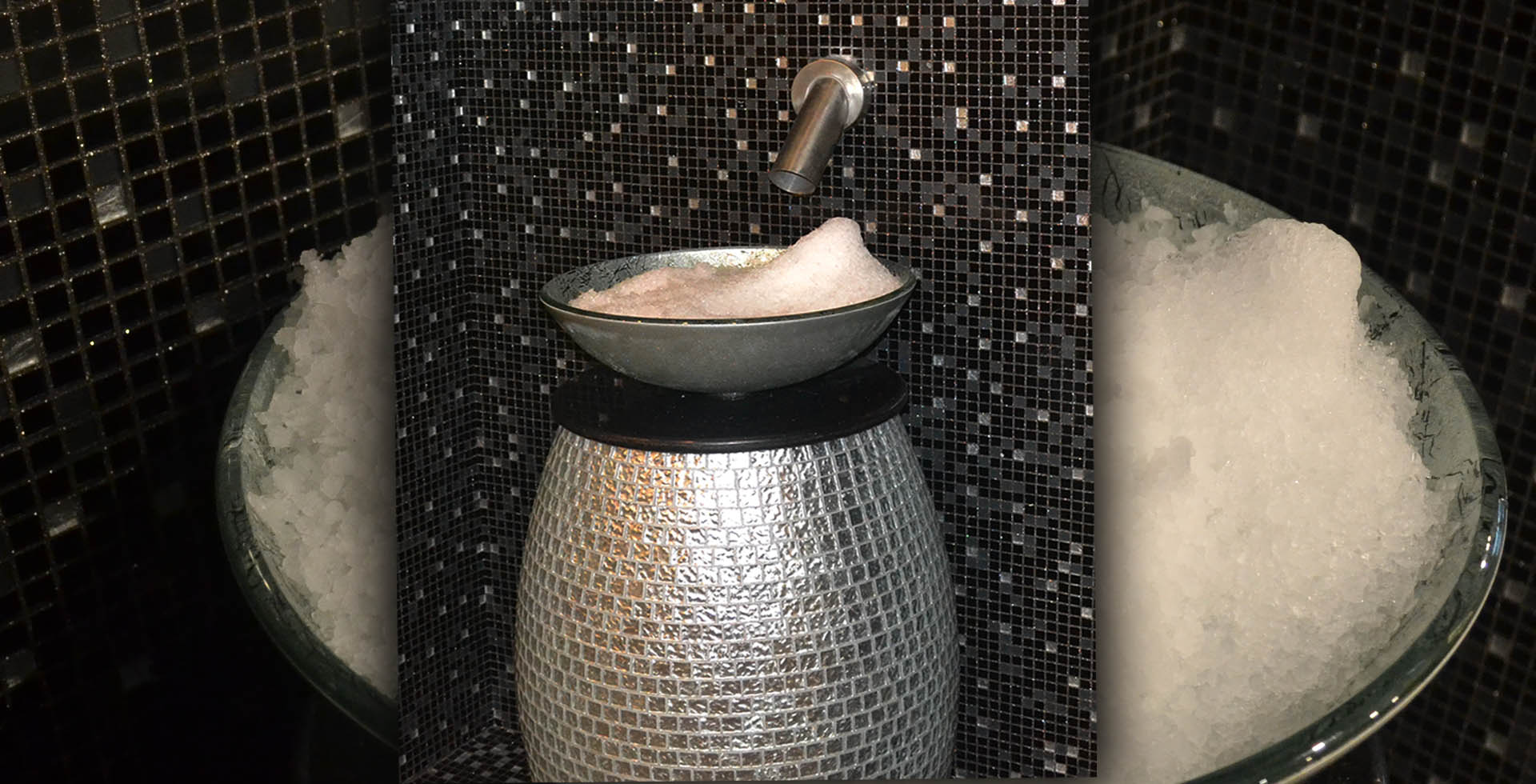
Not every project has the space or the budget for sub-zero air. At Gumush Residence Spa in Baku, the residents’ spa we fitted out has its cold side next to the hammam and steam rooms: a mosaic-clad ice fountain and a shock bucket. Each cold appliance has its own drainage rather than a shared floor gully, because an ice machine produces meltwater and condensate continuously and a shock bucket releases its whole volume at once.

What belongs in the specification?
A snow room specification that controls running costs names the following items in writing before the shell is ordered. Each one changes the daily bill or the trading hours, and each is cheaper to fix on the drawings than after handover.
- The snow unit’s declared operating power and the circuit rating, taken from the manufacturer’s documentation.
- The envelope build-up: panel type and thickness, glazing (at most three glass walls on TechnoAlpin rooms), door and seal.
- The condenser position, its ventilation, and the route of the rejected heat away from conditioned space.
- Whether the waste heat is recovered, and into which circuit it goes all year round.
- The water feed, its treatment, and the drain for meltwater from the weekly defrost.
- The room size against simultaneous users, with about 1 m² per person as TechnoAlpin’s planning figure.
- The snow and defrost schedule, the daily check, and who holds the service contract for the cooling circuit.
Who is writing this
Sauna Dekor has designed and built saunas, steam rooms, hammams, pools and cold plunges since 1987: 40 years of manufacturing in Istanbul, in our own facility in İkitelli OSB, with a team of 19 employees, working under TS EN ISO 9001:2015, and with 5,000+ projects in 35+ countries. On a snow room we build the insulated shell, the vapour barrier, the interior finish, the drainage and the interface with the sauna and plunge next to it, and we plan the condenser position and heat recovery with the project’s MEP engineer.
We do not manufacture snow units, refrigeration plant or ice machines; their manufacturers make them, and any CE or CSA marking or conformity declaration on that equipment belongs to its manufacturer. The TS EN ISO 9001:2015 certificate is ours. On the work we deliver, the terms are a 24-month warranty on workmanship and manufacturing; 24-month manufacturer’s warranty on electrical and mechanical equipment; 5-year warranty on structure and waterproofing.
Frequently asked questions about snow room running costs
How much does it cost to run a snow room per day?
TechnoAlpin puts it at 20–25 euros a day at European electricity prices, about the same as running a sauna for 10 people. Your own figure depends on your tariff, the envelope, guest numbers, the plant-room temperature and whether waste heat is recovered.
How much electricity does a snow room use?
TechnoAlpin gives about 5 kW for operation. If that ran for 24 hours it would be 120 kWh a day, which is a planning upper bound, not a metered value. A weaker shell, extra glazing or a hot plant room pushes the real figure up.
How much water does a snow room use?
About 200 litres a week, according to TechnoAlpin. The unit uses 10–15 litres an hour while snowing, and one litre of water makes five litres of snow. Water quality matters more than volume, because hard water scales the snow nozzles.
Can a snow room’s waste heat heat a pool?
Yes. TechnoAlpin says up to 90 % of the electrical energy can be recovered through a heat exchanger, for example to heat pool water. In the Gulf, domestic hot water or an indoor pool is usually a better year-round heat sink than an outdoor pool.
What temperature does a snow room run at?
About −10 °C (TechnoAlpin). TechnoAlpin notes that the temperature rises a little with the number of visitors. Sessions are short, so the room is sized to the guests who use it at the same time, at about 1 m² per person.
How much maintenance does a snow room need?
About 10 minutes a day: check the function indicators and keep the return-air vents clear of snow. The room is defrosted and cleaned once a week, and the cooling circuit is checked periodically as the law requires, usually under a service contract.
Sources
- Frequently asked questions about TechnoAlpin and indoor snowmaking — TechnoAlpin Indoor. Source for the 5 kW operating power, 20–25 euros a day at European prices, up to 90 % heat recovery, 10–15 litres an hour while snowing, about 200 litres a week, the 1:5 water-to-snow ratio, up to 25 m² and about 1 m² per person, at most three glass walls, the rubber floor, weekly defrosting, about 10 minutes of daily maintenance and periodic statutory checks of the cooling circuit.
- SNOWROOM: a room at −10 °C and real snow — TechnoAlpin Indoor. Source for the −10 °C room, the EcoSnow 2.0 unit and its scheduler, up to 80 % energy recovery, the 2021 microbiological analysis and CE and CSA certification.
- The architecture of contrast in spa design — TechnoAlpin Indoor, with comments from Cassandra Cavanah, editor of the Global Wellness Institute’s Guide to Hydrothermal Spa & Wellness Development Standards. Background on snow as the cold element of a hydrothermal journey.
- Clinical Effects of Regular Dry Sauna Bathing: A Systematic Review — Hussain J, Cohen M. Evidence-Based Complementary and Alternative Medicine, 2018. Source for the 80–100 °C Finnish sauna range.
- Can Water Temperature and Immersion Time Influence the Effect of Cold Water Immersion on Muscle Soreness? A Systematic Review and Meta-Analysis — Machado AF et al. Sports Medicine, 2016;46(4):503–514. Reference for the water temperatures and immersion times used in studies.


