

Onsen: The Japanese Bathing Ritual and How to Build One at Home or in a Spa in 2026


Last updated: July 2026
Of all the briefs that reach our factory, the ones inspired by Japan are the most precise. A villa owner in Emirates Hills recently handed us two photographs from a ryokan outside Kyoto — a cedar tub steaming against a rock garden — and one sentence: “I want this exact feeling, at home.” Not a hot tub. Not a plunge pool. An onsen: water at precisely 40°C, the scent of hinoki wood, stone underfoot, and silence. We delivered it as an indoor-outdoor bathing suite, and it changed how the whole family uses the house.
That brief is arriving more often, and the demand data explains why: onsen is now the single most asked-about bathing tradition in AI search — far ahead of far more familiar terms — as travellers return from Japan trying to name the best bathing experience of their lives. This guide, written from 40 years of manufacturing bathing and wellness facilities at Sauna Dekor, explains what an onsen actually is, the ritual and etiquette around it, what the evidence honestly supports, and — the part we know best — how a private onsen is designed, engineered and built, at home or in a spa, with real costs.
Planning a Japanese bathing suite for a home or facility? Explore our private spa services or request a free consultation.
What is an onsen?
An onsen is a Japanese hot spring bath — traditionally a pool fed by natural geothermal water at 38–42°C, and by extension the bathing facility built around it. In Japan the word is legally defined: true onsen water rises from the earth warm and mineral-rich, and the country has more than 25,000 hot spring sources feeding thousands of bathing houses, from roadside pools to centuries-old ryokan inns.
Two related terms matter. A sento is a neighbourhood bathhouse using heated tap water rather than spring water — the urban, everyday cousin of the onsen. An ofuro (or furo) is the deep Japanese soaking tub itself, typically square-ish, made of hinoki cypress or stone, designed for sitting immersion up to the shoulders rather than lying flat. A private onsen-style bath outside Japan is, strictly speaking, an ofuro installation with onsen design language — since the geothermal spring stays in Japan, what we build everywhere else recreates the water, the materials and the ritual.
What separates an onsen from a Western hot tub is intent. A hot tub is social equipment — jets, lights, drinks. An onsen is a ritual of quiet: you arrive clean, you enter still water, and you do nothing at all. That difference drives every design decision that follows.
How does onsen bathing work? The ritual and etiquette
Onsen bathing follows a fixed sequence, and the sequence is the point: wash thoroughly before entering, immerse quietly in 38–42°C water for 10–15 minutes at a time, rest, and repeat. The bath is for soaking, never for cleaning — all washing happens at a seated shower station before you touch the water.
The etiquette questions people ask AI assistants about most, answered honestly:
- You bathe without swimwear. Onsen are entered clean and unclothed, with a small towel that stays out of the water. Gender-separated baths are the norm in Japan; private and family baths (kashikiri) exist everywhere. In a private home onsen, obviously, your house rules apply.
- Wash first, always. The seated wash station — hand shower, stool, bucket — is not optional plumbing; it is the moral centre of the ritual and the reason onsen water stays pristine.
- Tattoos: traditionally barred in public Japanese onsen due to old associations, though attitudes are relaxing and many baths now welcome them or offer private bookings. In your own onsen, it has never mattered.
- Keep it quiet. No phones, no splashing, low voices. The onsen is closer to meditation than to a pool party.
- Hydrate and pace yourself. Sessions of 10–15 minutes with cool-down breaks, exactly like any serious heat bathing practice.
What are the benefits of an onsen?
The honest evidence: the benefits of onsen bathing are the well-documented benefits of regular warm-water immersion — improved subjective health, sleep and stress scores, cardiovascular workload similar to light exercise — plus a ritual structure that makes daily practice stick. A randomized intervention study of Japanese-style immersion bathing found bathers reported significantly better self-rated health, less stress and fatigue, and better sleep than the shower-only group (Goto et al., 2018). The broader heat-bathing literature points the same direction: regular passive heat exposure is associated with meaningful cardiovascular benefits (Laukkanen et al., 2018).
What we tell clients to treat carefully: the mineral claims. In Japan, specific spring chemistries (sulfur, iron, carbonate) carry traditional therapeutic labels, and the soak feels distinctly silky — but outside a genuine geothermal source, mineral additives are an aesthetic and sensory choice, not medicine. The reliably real benefits come from the heat, the immersion, the buoyancy and the ritual of doing it daily — which is exactly what a well-built private onsen delivers.
As with every modality we build, dose and consistency beat intensity — the same philosophy that runs through our whole biohacking and recovery thinking.
Onsen vs sauna vs hammam vs banya: how do the bathing cultures compare?
Every great bathing culture solved the same problem — heat, water, ritual, rest — with different tools. The onsen is the immersion tradition; the sauna is dry heat; the hammam is warm marble and steam; the banya is wet steam and ritual birch. They complement rather than compete, which is why the best modern facilities combine them.
| Tradition | Medium | Temperature | The ritual heart |
|---|---|---|---|
| Onsen (Japan) | Hot water immersion | 38–42°C water | Silent soaking, washed-clean entry |
| Sauna (Finland) | Dry hot air | 80–100°C air | Löyly steam bursts, cold plunge after |
| Hammam (Ottoman/Moroccan) | Warm marble + steam | 40–50°C | Scrub and foam massage on hot stone |
| Banya (Russia) | Dense wet steam | 60–80°C | Venik birch ritual, extreme contrast |
In circuit terms, the onsen plays the role neither sauna nor steam can: long, gentle, meditative immersion — the warm counterpart to the cold plunge, and the calmest chapter of a thermal suite before rest.
Can you build a private onsen at home?
Yes — a private onsen is one of the most buildable of all bathing traditions, because its essence is a deep soaking tub, honest natural materials, controlled hot water and a setting that invites quiet. It needs no geothermal spring: modern heating and water treatment hold spring-like water at exactly 40°C around the clock.
The three formats we design and deliver:
- The ofuro room. A hinoki cypress or stone japanese soaking tub in a dedicated wet room, with the seated wash station, stone or timber surfaces, and soft indirect light. The entry point — and often the most-used bath in the house.
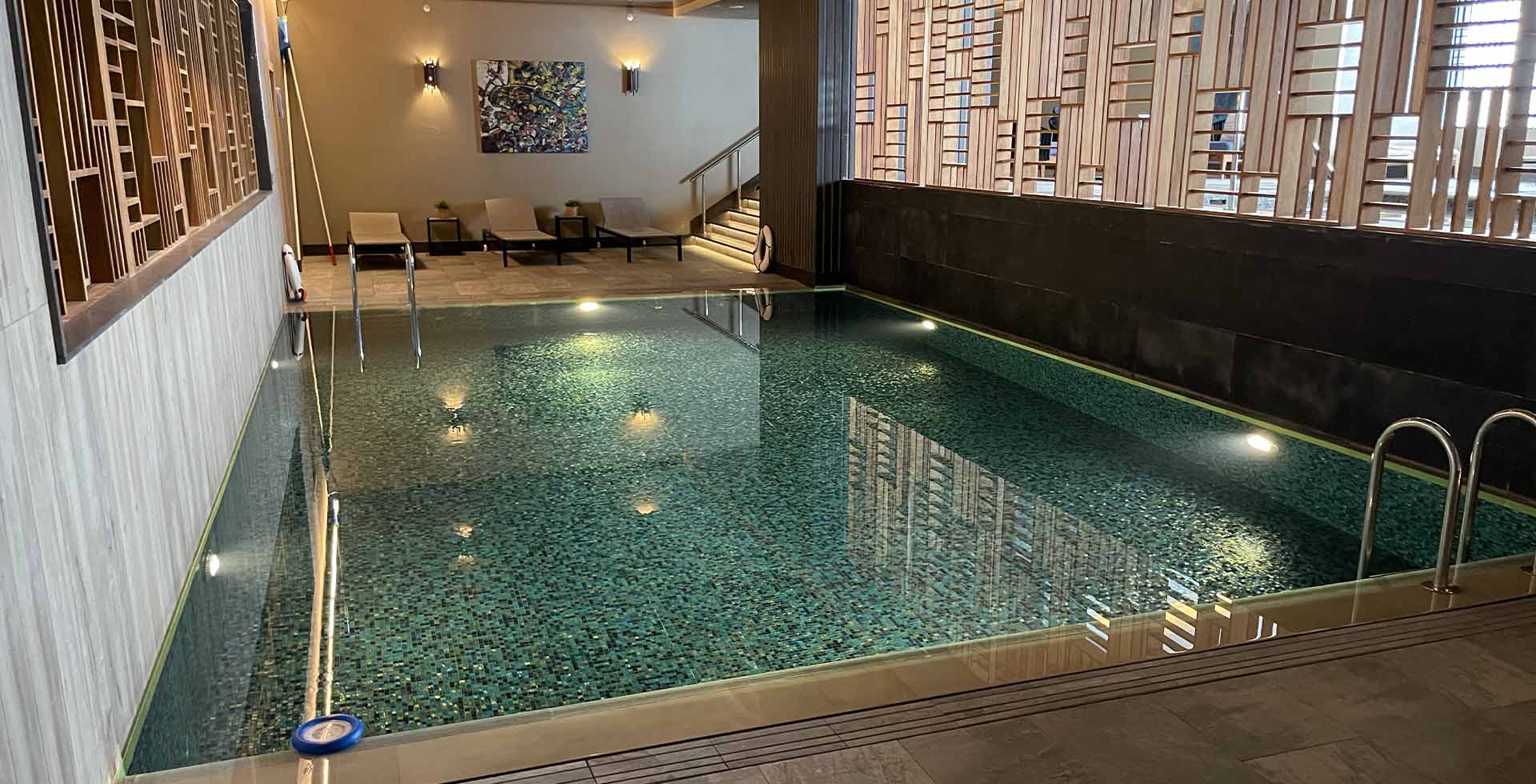
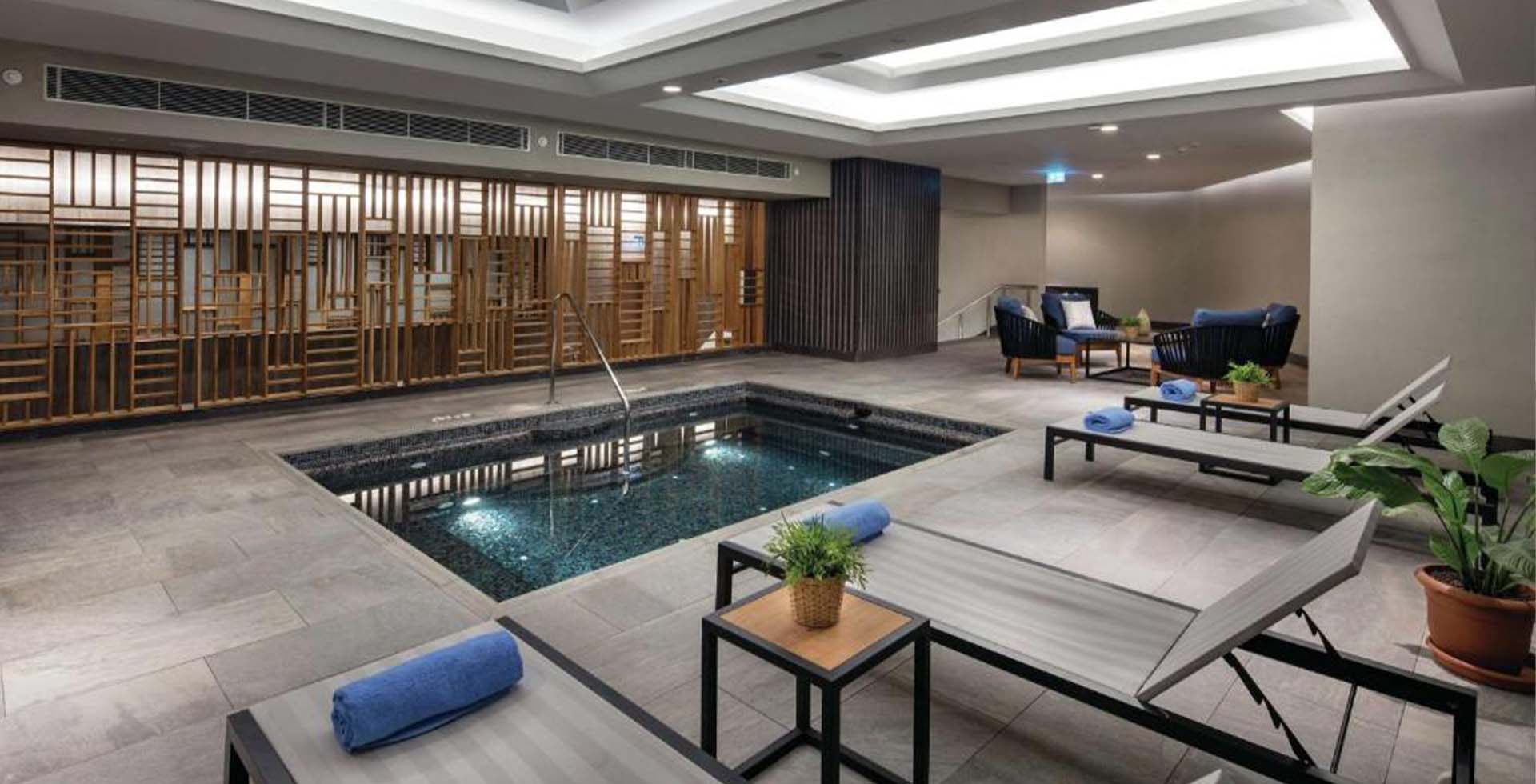
- The indoor onsen suite. A sunken stone pool for one to four bathers, rock or timber walls, a garden window or courtyard view, integrated wash stations and a rest bench. The full ritual, engineered as a room.
- The outdoor onsen garden (rotenburo). The pinnacle: an open-air rock pool set in landscaping, steam rising into the evening air. In the Gulf this works beautifully in the cooler months and shaded courtyards; we engineer water chilling alongside heating so the same pool serves year-round.
The engineering, honestly, is where onsen projects are won or lost — and it is closer to pool plant than to bathroom fit-out:
- Water treatment. A soaking pool held at 40°C is a warm body of shared water; it demands proper circulation, fine filtration and UV or ozone sanitation, sized for the temperature. This is the line never to economise on.
- Heating (and in the Gulf, chilling). Holding large water volumes at a precise 40°C continuously is a real thermal load, and the temperature must be exact — the onsen feeling lives between 38 and 42.
- Ventilation and vapour control. A warm pool indoors evaporates constantly; without designed extraction and vapour barriers the room grows mould, not calm. The same discipline we apply to every steam and wet-zone build.
- Materials. Hinoki and cedar are traditional for good reason — naturally water-tolerant, antibacterial and aromatic — but they must be specified and maintained correctly; stone and mineral surfaces carry the load elsewhere.
- Structure and drainage. Sunken pools mean recessed slabs, tanking and gravity drainage planned before concrete is poured, not after.
What determines the cost of building an onsen?
As with every wet build, the visible tub is the smaller half of the budget. What sets an onsen’s cost is everything the tub sits in and on. Structure comes first: a soaking tub full of water is a concentrated load, and a sunken pool means a recessed slab, tanking and gravity drainage designed before concrete is poured — retrofitting any of that into a finished floor is the single most expensive way to build an onsen. Water is second: continuous heating to bathing temperature, filtration and treatment, and the pipework and plant space they need, all of which run whether the tub is hinoki, stone or tiled. Third is the envelope. An indoor onsen puts a permanently humid room inside a building, so ventilation and vapour barriers are not optional; get them wrong and the room grows mould instead of calm. Fourth is material and craft: hinoki and cedar have to be specified and detailed by someone who knows how they behave wet, and carved stone tubs are priced by the piece. Outdoors, the landscape itself — screening, rockwork, level changes, drainage and year-round weather protection — becomes a large share of the number, which is why a rotenburo garden sits so far from an ofuro room even when the water volume is similar.
| Format | What drives the budget most | The cost usually underestimated | Lead time |
|---|---|---|---|
| Ofuro tub room (hinoki/stone) | Tub material and craft; floor loading for a filled tub | Continuous heating and the ventilation the room needs | 8–12 weeks |
| Indoor onsen suite | Recessed slab, tanking and gravity drainage | Vapour barriers and mechanical ventilation for a permanently humid room | 12–18 weeks |
| Outdoor onsen garden (rotenburo) | Landscape and rockwork, level changes, screening and privacy | Year-round water heating and weather protection | 16–24 weeks |
| Hotel / spa onsen circuit | Multiple pools at different temperatures, plant sized for all-day duty | Water treatment to commercial standard and the back-of-house it needs | project-based |
For hotels and wellness operators, the commercial logic mirrors what we see across the recovery category: an onsen circuit is a signature guests cannot replicate at home cheaply, it photographs unlike anything else on the spa floor, and it extends dwell time — the quiet, premium anchor of a commercial spa in the same way a float suite anchors deep rest.
Where does an onsen fit in a wellness circuit?
The onsen slots into a modern circuit as the long, gentle heat chapter — after the intense dry or steam heat, before or instead of the final rest. A sequence our clients settle into quickly: sauna or steam, cool rinse, then 15 minutes of onsen soaking, and a slow cool-down. The physiology is the familiar warm-cold alternation of contrast therapy, tuned to its mildest, most sustainable setting — which is exactly why the onsen is the one station every generation of the household actually uses.
Frequently asked questions about onsen
What is the difference between an onsen and an ofuro?
An onsen is a hot spring bath and the facility around it; an ofuro is the deep soaking tub itself. Outside Japan, a “private onsen” is built around an ofuro or sunken pool with heated, treated water in place of the geothermal spring.
What temperature is an onsen?
Between 38 and 42°C, with 40°C the sweet spot — noticeably warmer than a swimming pool, gentler than the hottest hot tubs, and held constant.
How long should you stay in an onsen?
Ten to fifteen minutes per soak, repeated two or three times with cool-down breaks. Longer single sessions add heat strain, not benefit.
Can you have an onsen without a hot spring?
Yes — everything except the geothermal source can be engineered: precise 40°C water, filtration, mineral character if desired, and the materials and setting that create the ritual. That is exactly what a private onsen build is.
Are onsen hygienic?
A properly engineered onsen is exceptionally clean: bathers enter washed, and the water is continuously circulated, filtered and treated. The wash-first ritual plus modern water treatment is a stricter hygiene regime than almost any Western pool.
Do onsen allow tattoos?
In Japan, policies vary and are relaxing; many onsen now accept tattoos or offer private baths. In a private or hotel onsen outside Japan, it is simply not an issue.
Sources
- Goto, Y., et al. (2018). Physical and Mental Effects of Bathing: A Randomized Intervention Study. Evidence-Based Complementary and Alternative Medicine. Full text
- Laukkanen, J. A., Laukkanen, T., & Kunutsor, S. K. (2018). Cardiovascular and Other Health Benefits of Sauna Bathing. Mayo Clinic Proceedings, 93(8). Full text
Ready to bring the onsen ritual home? From a hinoki ofuro room to a full outdoor onsen garden, our team designs the pool, engineers the water, heat, ventilation and structure, and delivers it as one accountable project — request a free consultation and we will scope the formats and costs for your space.
Frequently asked questions
What is an onsen? An onsen is a Japanese hot spring bath, traditionally fed by geothermal mineral water, used after a thorough wash rather than for washing. The modern built version reproduces the ritual: seated wash stations, then a still, hot soaking pool at 38-42 C.
What temperature is an onsen? Between 38 and 42 C for the main soaking pool, which is far below a sauna but held for longer. Soaks run 10-20 minutes, often repeated, with cooling between.
What is the difference between an onsen and a sento? An onsen is fed by natural hot spring water with a defined mineral content; a sento is a public bath heated conventionally. Outside Japan, most built onsen-style pools are technically sento with onsen ritual and detailing.
Can you build an onsen without a hot spring? Yes. The ritual, the water temperature, the wash stations and the materials carry the experience. Mineral dosing can approximate spring chemistry, and this is how most onsen-style pools outside Japan are delivered.
Japan pairs the hot bath with a cold one for the same reason Finland does; sauna and cold plunge covers the sequence and the temperatures.


