

Last updated: July 2026

Room, cabin or device? This page covers how red light therapy works and which devices deliver it. If you are specifying the room itself — its size, surfaces, ventilation and electrical provision — that is set out on our red light room specification page. A cabin with the panels built into it is covered under red light sauna.
In March 2026, a Dubai clinic owner walked into our showroom with a shopping bag. Inside were three red light devices she had bought online over two years: a face mask, a handheld wand, and a small panel, each bought on price. Her question was the right one: “These feel like toys. What does the real thing look like?” Four months later her clinic runs two professional red light beds we integrated into a recovery suite, booked at over 70 percent capacity.
That gap, between consumer gadgets and professional photobiomodulation, is what this guide explains. Red light therapy has moved from biohacker niche to mainstream wellness in under five years, and the search data shows it: interest in red light masks has more than doubled year over year, and red light therapy is now a standard line in every longevity center brief we receive. Drawing on 40 years of manufacturing experience at Sauna Dekor and our current work fitting red light suites into spas and clinics across the Gulf, here is what the light actually does, what the evidence supports, and which device class fits which need.
Planning to add red light therapy to a home spa, clinic, or wellness facility? Explore our commercial spa services or request a free consultation.
What is red light therapy?
Red light therapy, known clinically as photobiomodulation (PBM), is the use of specific wavelengths of red and near-infrared light, typically 630 to 850 nanometers, to stimulate cellular processes in skin and deeper tissue. Unlike ultraviolet light, it does not damage or tan the skin, and unlike infrared heat, its primary mechanism is light absorption rather than warmth.
The therapy goes by many names: red light phototherapy, red lamp therapy, LED light therapy, low-level laser therapy (LLLT), and photobiomodulation. They all describe the same principle delivered at different intensities and scales, from a handheld wand or red light therapy lamp to a full-body bed.
How does red light therapy work?
Red and near-infrared light works by being absorbed in the mitochondria, the energy factories of the cell, where it stimulates an enzyme called cytochrome c oxidase and increases production of ATP, the cell’s fuel. That, in turn, is associated with improved cellular repair, reduced inflammation, and increased local circulation (Hamblin, 2017).
Wavelength determines depth. Red light around 630 to 660 nm is absorbed mostly in the skin, which is why it is the band used for complexion, collagen, and surface healing. Near-infrared light around 810 to 850 nm penetrates deeper into muscle and connective tissue; this near infrared light therapy band is the recovery workhorse, which is why beds and panels combine both. Dose matters as much as wavelength: professional devices specify irradiance (light power at the skin, in mW/cm²) and session times, usually 10 to 20 minutes.
What are the proven benefits of red light therapy?
The strongest evidence for red light therapy covers skin quality, wound healing, and musculoskeletal recovery, with promising but earlier-stage research on sleep, hair growth, and joint pain. A widely cited review of low-level light therapy in dermatology found benefits for collagen production, wrinkle reduction, and wound repair (Avci et al., 2013), and sports-medicine research consistently reports reduced muscle soreness when PBM is applied around training.
In practical terms, the advantages of red light therapy that members book sessions for fall into four groups:
- Skin: complexion, fine lines, post-treatment recovery. The driver behind the boom in red light masks.
- Recovery: muscle soreness and training recovery, the core use in gyms and sports clubs.
- Wellbeing and sleep: evening sessions, where users adopt red light for sleep and wind-down routines.
- Longevity protocols: red light as one pillar of the Longevity Stack alongside sauna, cold, and hyperbaric oxygen.
Honest caveat from a builder rather than a device brand: red light therapy is supportive, not miraculous. The research base is real but dose-dependent, and results come from consistent use over weeks, which is exactly why it works best built into a routine, and a facility, rather than used once.
Red light vs infrared sauna: what is the difference?
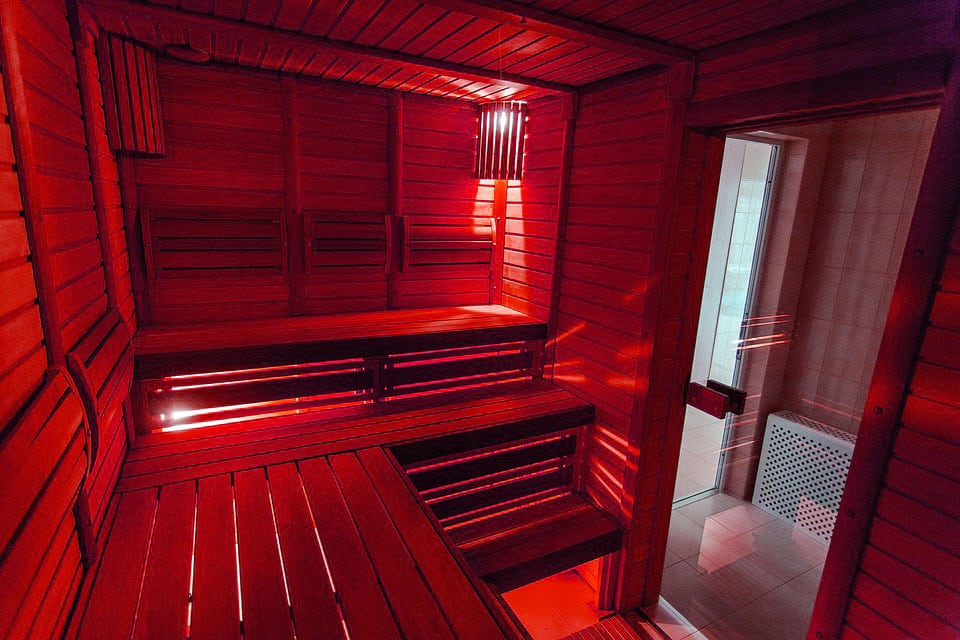
Red light therapy delivers light with minimal heat; an infrared sauna delivers heat using infrared wavelengths. A red light session leaves you at normal body temperature, while an infrared sauna session raises core temperature and heart rate like moderate exercise. They are complementary rather than interchangeable, which is why modern wellness floors install both and why combined red light sauna cabins are one of the fastest-growing requests we receive.
| Red light therapy | Infrared sauna | |
|---|---|---|
| Wavelengths | 630–850 nm (red + near-infrared) | Mid and far infrared, heat-focused |
| Primary mechanism | Light absorption in cells | Core temperature rise, sweating |
| Session feel | No heat, no sweat, 10–20 min | 45–65°C cabin, sweating, 20–40 min |
| Main benefits | Skin, recovery, inflammation | Cardiovascular conditioning, relaxation |
| Best used | Daily or near-daily | 3–5 times per week |
What red light therapy devices exist, and what separates them?
Red light devices span an enormous range, from a handheld wand to a walk-in cabin, and the honest differences between them are only three: how much of the body they treat at once, how much usable light they deliver at a real working distance, and whether they are built to run all day without losing output. Everything else is marketing. The device classes, in ascending order:
| Device class | What sets it apart | Coverage | Best for |
|---|---|---|---|
| Wands and handhelds | A few diodes held against the skin; no coverage, but the distance is zero | Spot | Targeted facial use |
| LED face masks | Diodes centimetres from the skin, which compensates for modest power | Face | Skin routines at home |
| Panels | Verified irradiance at a stated distance, proper drivers and cooling — the first tier where specification really matters | Partial body | Home gyms, small studios |
| Red light beds | Both sides at clinical irradiance in one 10–15 minute session, with canopy engineering and a commercial duty rating | Full body, both sides | Spas, clinics, longevity centers |
| Walk-in cabins | Wrap-around arrays around a standing body, often combined with heat, and the enclosure and controls that carry both | Full body, standing | Wellness floors, premium clubs |
The step change happens between panels and beds. A professional bed or cabin treats the entire body at clinically specified irradiance in a single 10-to-15-minute session, which is what makes it a bookable, revenue-generating unit rather than a personal gadget. For a detailed comparison of the home options, see our guide to red light therapy at home; for beds and cabins, see the red light sauna and bed guide.
How often should you use red light therapy?
Most protocols use red light therapy three to seven times per week, 10 to 20 minutes per session, with visible skin results typically reported after four to eight weeks of consistent use and recovery benefits felt sooner. More is not better beyond the recommended dose; photobiomodulation follows a biphasic dose response, meaning excessive exposure can blunt the benefit.
Is red light therapy safe?
Red light therapy is considered low-risk for healthy adults: it is non-invasive, non-UV, and produces little heat, and consumer devices in this category are typically FDA-cleared as low-risk wellness devices. Eye protection is recommended with high-power panels and beds, and anyone who is pregnant, photosensitive, on photosensitizing medication, or being treated for cancer should consult a physician first. In the facilities we deliver, operator training and posted session protocols are part of the handover.
Where does red light therapy fit in a spa or longevity center?
Red light is one of the four pillars of the Longevity Stack, alongside sauna, cold therapy, and hyperbaric oxygen, and it has become the single most requested new modality in our commercial projects. It earns its floor space for a structural reason: sessions are short, self-serve, and technology-delivered, so a single bed can serve 20 or more bookings a day with minimal staffing.
In a typical layout we place red light beds or cabins on the dry side of the wellness floor, sequenced after heat and cold. The popular stack, sauna, then cold plunge, then red light, gives members a complete 60-minute protocol. For how the full facility comes together, see our guides to the longevity center and the wellness center in Dubai.
Frequently asked questions about red light therapy
Does red light therapy actually work?
For skin quality, wound healing, and muscle recovery, peer-reviewed evidence supports meaningful benefits with consistent use at proper doses. For weight loss and many viral claims, evidence is thin. Buy the mechanism, not the marketing.
Is red light therapy the same as infrared therapy?
They overlap. Red light therapy uses visible red and near-infrared light for cellular effects with minimal heat. Infrared therapy usually refers to infrared heat, as in an infrared sauna. Near-infrared sits in both worlds, which causes the confusion.
Can red light therapy damage your eyes or skin?
It contains no UV, so it does not burn or tan skin. High-power devices are bright, so goggles are standard with beds and panels. Follow device session limits.
How long until I see results?
Recovery effects are often felt within the first sessions; skin changes typically take four to eight weeks of three or more sessions per week. Honest red light therapy before and after comparisons show their difference at the eight-week mark, not after one session.
What should I look for when buying a red light device?
Stated wavelengths (look for 630–660 nm plus 810–850 nm), measured irradiance at a stated distance, third-party testing, coverage area, and realistic session guidance. Vague specs are the reliable warning sign.
Can red light therapy be combined with a sauna?
Yes, and it is one of the fastest-growing configurations we build: either sequenced sessions on a wellness floor or a combined red light sauna cabin. See our red light sauna guide.
Sources
- Hamblin, M. R. (2017). Mechanisms and applications of the anti-inflammatory effects of photobiomodulation. AIMS Biophysics, 4(3), 337-361. Full text
- Avci, P., et al. (2013). Low-level laser (light) therapy (LLLT) in skin: stimulating, healing, restoring. Seminars in Cutaneous Medicine and Surgery, 32(1), 41-52. Full text
Ready to bring red light therapy into your project? Whether it is a red light corner in a private home spa or a bank of professional beds in a longevity center, our team brings 40 years of manufacturing experience and single-source design, supply, and installation. Request a free consultation and we will specify wavelengths, irradiance, room requirements, and costs in AED for your space.
Frequently asked questions
What is red light therapy? Red light therapy exposes skin to red and near-infrared light, typically 630-660 nm and 810-850 nm, at low power. It is not heat therapy: the mechanism is photobiomodulation, light absorbed by mitochondria, not a rise in tissue temperature.
How long is a red light therapy session? Ten to twenty minutes per area, three to five times a week. Longer sessions do not scale the effect, and the dose depends on the irradiance of the panel and the distance from it.
Is red light therapy the same as an infrared sauna? No. An infrared sauna heats the body with far-infrared radiation at 45-60 C; red light therapy uses specific visible and near-infrared wavelengths at low power and does not meaningfully raise body temperature.
What does a red light room need? Panel irradiance and mounting distance specified together, no reflective clutter, eye protection available, and enough ventilation to keep the room comfortable. In a spa circuit it belongs beside the relaxation zone rather than inside the wet area.
Sauna Dekor has manufactured in Istanbul since 1987 — our 40th year — with a team of 19 people, has delivered work in more than 35 countries, and holds TS EN ISO 9001:2015 for the manufacture of sauna and spa products and after-sales service.


