




Sauna Dekor Spa Solutions engineering team, Istanbul · project and press enquiries: Alican Aykaç, Managing Partner

Last updated: June 2026
In February 2026, a Dubai developer handed our team the shell of a 620 m² floor in a new Business Bay tower and a one-line brief: “Make this the wellness center that sells the building.” There was no spa, no pool, no plant room, only a concrete slab, a service riser, and a view. Four months later that floor held a sauna and steam suite, a hammam, a cold plunge, a hydrotherapy pool, a salt room, treatment rooms, and a relaxation lounge, all engineered around a single guest journey. The developer now leads every sales tour with the wellness floor, and the residences above it carry a measurable price uplift.
That is the kind of brief Sauna Dekor takes on. We manufacture saunas, steam rooms, hammams and cold therapy rooms in Istanbul and install them turnkey in Dubai and across the Gulf — work we have been doing since 1987, in more than 35 countries.
That brief captures where Dubai sits in 2026. Wellness is no longer an amenity bolted on at the end of a project; it is the differentiator that sells residences, lifts hotel rates, and defines a brand. The numbers explain why. The global wellness economy reached a record $6.8 trillion in 2024, and wellness real estate, at $584 billion, was the fastest-growing sector of all, forecast to nearly double by 2029 (Global Wellness Institute, 2025). In a city built on high-end hospitality and prime property, a well-designed wellness center is now a commercial instrument, not a nicety.
This guide is a complete, practical reference for anyone planning a wellness center in Dubai: what facilities one includes, how to design the guest journey, what it takes to engineer and build in Dubai’s climate and regulatory framework, real costs in AED, who designs and builds these facilities, and how to make one profitable. It is written from 40 years of manufacturing experience at Sauna Dekor and our Dubai office at Latifa Tower, World Trade Centre.
Planning a wellness center for a hotel, development, or private residence in Dubai? Explore our commercial spa development or request a free consultation with our Dubai team.
Why is Dubai investing so heavily in wellness centers?
Dubai is investing in wellness centers because they now drive real estate value, hotel revenue, and brand differentiation in a market where a high-end finish is the baseline. Wellness real estate grew 18 percent globally from 2023 to 2024 to reach $584 billion, the fastest growth of any wellness sector, and Dubai’s prime developments are among the most active adopters (Global Wellness Institute, 2025). A serious wellness center has shifted from a marketing line to a measurable asset.
The drivers are specific to the city. Developers use wellness floors to command higher prices and accelerate sales in a crowded prime market. Hoteliers use them to lift average daily rate, occupancy, and guest review scores. High-net-worth homeowners build private wellness suites as the centrepiece of a villa. And a growing longevity and medical-wellness sector, from anti-aging clinics to recovery centers, treats the facility itself as the product. What unites them is a demand for properly engineered, beautifully finished facilities rather than a row of prefab cabins.
What is a wellness center, and what facilities does it include?
A wellness center is a purpose-designed facility that brings heat, water, cold, and rest therapies together into a single guest journey. A complete Dubai wellness center typically includes a sauna, a steam room, a hammam, a cold plunge or ice experience, a hydrotherapy or swimming pool, treatment and treatment rooms, and a relaxation lounge, with specialist rooms added according to the brief. Where the brief adds hyperbaric, red light or a clinic zone, it is moving towards a longevity center; our longevity center vs wellness center comparison shows what that changes in the building.
The exact mix depends on the audience and the space. A hotel spa prioritises treatment rooms and a thermal circuit; a residential wellness floor prioritises a private sauna, steam, and cold sequence; a longevity or recovery facility adds salt rooms, floatation tanks, and mild hyperbaric oxygen cabins. The discipline is in selecting the right modalities and engineering them to work together rather than installing every room available.
| Zone | Typical rooms | Purpose |
|---|---|---|
| Dry heat | Finnish, infrared, combi saunas | Cardiovascular and recovery heat |
| Wet heat | Steam room, hammam, laconium | Humid heat, cleansing, ritual |
| Cold therapy | Cold plunge, snow room, ice fountain | Contrast, recovery, invigoration |
| Water | Hydrotherapy and swimming pools | Immersion, exercise, relaxation |
| Specialist | Salt room, floatation, mild HBOT | Halotherapy, recovery, longevity |
| Rest & treatment | Relaxation lounge, treatment rooms | Recovery, therapies, the journey’s pause |
How do you design the guest journey and zoning of a wellness center?
The guest journey is the single most important design decision in a wellness center, because the sequence of rooms determines both the experience and the engineering. The proven flow moves the guest from warm-up, through intense heat, to a cold contrast, then to rest, repeating the cycle. Rooms must be zoned so that hot, wet, cold, and quiet areas sit logically next to one another, with circulation, drainage, and acoustic separation planned around that path.
This sequencing is rooted in the physiology of contrast bathing. Alternating heat and cold drives the vascular response that delivers the recovery and wellbeing benefits documented across decades of thermal-bathing research (Laukkanen et al., 2018). A wellness center that scatters its sauna, plunge, and relaxation rooms across a floor breaks the cycle that makes the facility work.
Why does zoning matter more in Dubai?
Grouping the wet, high-humidity rooms into one tanked, well-drained zone is doubly important in Dubai, where the contrast between a 45 °C exterior and a heavily air-conditioned interior stresses any poorly-managed moisture. Concentrating the steam room, hammam, showers, and pool in one engineered wet zone contains the waterproofing and ventilation challenge to a single area, rather than spreading risk across the whole floor.
How do you plan circulation and capacity?
Circulation should let guests move barefoot and wet between thermal rooms without crossing dry, shod areas, with the relaxation lounge positioned as the natural pause between cycles. Capacity is set by the slowest, most space-intensive experience, usually the treatment rooms and the pool, and the thermal cabins are sized to match expected throughput at peak.
Designing the guest journey for a Dubai project? Our team plans the zoning, engineering, and modality mix as one integrated design. Request a free consultation.
What does it take to build a wellness center in Dubai?
Building a wellness center in Dubai means engineering a cluster of high-humidity, high-load, climate-sensitive rooms to survive a desert climate and meet UAE authority requirements. The essentials are full tanking and waterproofing of every wet room, controlled ventilation and dehumidification, correctly sized electrical supply with DEWA approval, fire and life-safety compliance with Dubai Civil Defence, and structural and drainage provisions signed off by Dubai Municipality.
The most common failure is treating a wellness center as ordinary interior fit-out. It is not. Steam rooms, hammams, and pools are engineered wet systems; saunas, snow rooms, and hyperbaric cabins carry significant electrical and life-safety requirements. Each room has its own temperature, humidity, ventilation, and compliance profile, and they must be coordinated as one services strategy from the first drawing, not retrofitted room by room.
What approvals does a Dubai wellness center need?
A Dubai wellness center typically needs DEWA electrical approval for the cumulative load and dedicated circuits, Dubai Civil Defence approval for fire and oxygen safety, and Dubai Municipality approval for wet-area, structural, and aquatic-facility provisions, with Trakhees and DHA involved for free-zone and clinical scopes. A registered consultant submits load and drawing packages via dewa.gov.ae, and the approvals run in parallel with construction when coordinated correctly.
Why does Dubai’s climate change the engineering?
Dubai’s climate forces heavier insulation, larger refrigeration and dehumidification capacity, and far more rigorous vapour control than a temperate market. A wellness center holding a 90 °C sauna and a snow room at about minus 10 °C within metres of 45 °C outdoor air and 90 percent coastal humidity demands engineering that European prefab specifications simply do not provide. Hard local water also requires treatment to protect steam generators, pools, and snow plant.
What determines the cost of a wellness center in Dubai?
A wellness center is a facility rather than a single room, so it is priced by its scope and never by a rate per square metre. We do not publish a range because the same floor area can be a quiet residential circuit or a full commercial facility with pool plant, and those are not the same project. What sets the budget changes as the facility grows, which is why the table below describes drivers rather than figures.
| Project type | What sets the budget at this scale |
|---|---|
| Residential wellness floor (villa / penthouse) | Room count and finish grade dominate. Every square metre is guest-facing, there is no back-of-house to absorb cost, and access for delivery and plant is usually the constraint that decides what is possible at all. |
| Boutique hotel / club wellness center | Wet-area engineering catches up with finishes: tanking, drainage and dehumidification across several rooms at once, plus the circulation that makes a thermal circuit work rather than a corridor of rooms. |
| Five-star hotel wellness center | Pool and refrigeration plant lead. A hydrotherapy pool, cold plunge or snow room brings plant that needs space, power, heat rejection and access for servicing, and that plant is frequently the largest single line. |
| Resort / destination wellness center | Structure, MEP and approvals decide feasibility before finishes are chosen: slab capacity for pools and heavy stone, three-phase supplies, BMS integration, and DEWA, Civil Defence, Municipality and DHA sign-off. |
Turnkey time depends on scope: about two weeks for a single sauna, and up to six months for large projects.
What additional costs should you budget for?
- Pool and refrigeration plant: a major share of any center with a pool, cold plunge, or snow room
- Tanking, waterproofing, and drainage across all wet rooms
- DEWA, Civil Defence, Municipality, and DHA approvals
- Structural reinforcement for pools and heavy stone on upper floors
- MEP coordination and BMS integration across the facility
The budget that goes wrong is the one built from the equipment and room list alone. Facility-wide services, waterproofing and compliance are not a percentage added at the end of a Dubai build; they are a substantial part of it, and they are decided early, by the building, rather than late, by the client.
Which commercial sauna should a spa or wellness centre choose?
Choose a commercial sauna by its duty, not by its brand: how many hours a day it runs, how many people use it at once, the heater kW the room volume calls for, the timber, the control and how it is serviced. In the saunas we build, the heaters are EOS and Harvia units, selected from each maker’s own sizing tables.
| Criterion | What to ask for |
|---|---|
| Duty rating | A heater rated for continuous commercial use, with the operating hours per day stated |
| Heater output | kW from the room volume using the heater maker’s table, corrected for glass and stone |
| Capacity | Bench length per person and the number of sessions an hour |
| Timber | Species and grade for linings and benches: ayous, aspen or pine, plain or thermo-treated; others on request |
| Control | Mounted outside the cabin, with scheduling and a BMS interface where the building has one |
| Ventilation | Fresh-air inlet and exhaust sized to the room |
| Service | Access to the heater and the control, and spare parts handed over at completion |
| Warranty | 24-month warranty on workmanship and manufacturing; 24-month manufacturer’s warranty on electrical and mechanical equipment; 5-year warranty on structure and waterproofing |
Our commercial sauna specification guide sets out how each of these lines is written into a tender.
Who designs and builds wellness centers in Dubai?
Wellness centers in Dubai are most reliably delivered by a single specialist that designs, manufactures, and installs the entire wellness scope, rather than a chain of separate suppliers coordinated by a general contractor. The wellness package, saunas, steam rooms, hammams, pools, and cold therapy, is a set of engineered systems, and splitting it across vendors is where quality gaps, programme delays, and warranty disputes begin.
Sauna Dekor delivers this scope in two roles, depending on how your project is structured. As a subconsultant, we provide the specialist wellness design, 3D visualisation, performance specifications, and BoQ within your design team. As a subcontractor, we design, manufacture, supply, and install the complete wellness package under your main contract, with a single point of accountability and a warranty. For full turnkey delivery, our spa developer service takes a project from concept to commissioning.
What does a specialist wellness subcontract look like in Dubai?
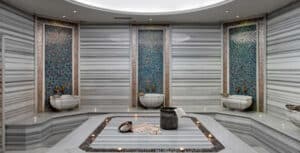
In late 2025, a five-star operator in Downtown Dubai appointed our team as the specialist wellness subcontractor for a new spa floor. The main contractor handled the base build; we delivered the saunas, a marble hammam, a steam room, a cold plunge, and a hydrotherapy pool as a single coordinated package. The saunas, the hammam stonework and the pool plant carried the scope. The spa opened on programme and now anchors the hotel’s wellness positioning, with the thermal circuit among its most-reviewed features.
How do you make a wellness center profitable in Dubai?
A wellness center becomes profitable through a combination of direct revenue, property and rate premiums, and guest retention, and the most successful Dubai facilities are designed for that return from the outset. Hotels monetise treatments, memberships, and day passes while lifting average daily rate and review scores; developers capture higher sales and resale values; and operators of medical and longevity centers price specialist services higher. The design choices that drive experience, the guest journey, the finishes, the photographable signature room, are the same choices that drive return.
The signature room matters commercially. A snow room, a domed marble hammam, or a glass-fronted sauna with a Burj Khalifa view becomes the image that sells the facility across listings and social channels, justifying higher pricing in a way a generic spa cannot. Our private spa and commercial spa projects are designed with that commercial logic built in, alongside the thermal and recovery substance that keeps guests returning.
In early 2026, a boutique hotel in Business Bay reopened its basement as a compact wellness center with a sauna, hammam, cold plunge, and two treatment rooms, designed and delivered by our Dubai team as a single package. The constraint that shaped the design was the one every basement conversion has: ceiling height and drainage falls. Each wet room had to be planned around the existing slab, the riser positions and the ventilation route out of the building, which is what decides whether a compact wellness center fits into a basement at all.
For developers and operators planning a facility, a wellness center is best approached as a coordinated system of saunas, steam rooms, hammams, cold therapy, and a fitness and recovery offer, designed together for both experience and return.
The recovery side of that mix has its own brief: heater duty, ventilation and bench material for a gym sauna are not the same as for the spa cabins next door.
Frequently asked questions about wellness centers in Dubai
What is the difference between a spa and a wellness center?
A spa typically focuses on treatments and a thermal circuit, while a wellness center is a broader facility combining heat, water, cold, fitness, and often medical or longevity services into one integrated guest journey. A wellness center is usually larger and more comprehensive than a traditional spa.
How much does it cost to build a wellness center in Dubai?
We scope and cost each wellness center individually rather than publish a range, because the spread between a compact residential floor and a resort facility is not a matter of degree but of kind. Size, the number and type of rooms, the finish grade, the pool and refrigeration plant, and the structural and waterproofing work the building needs are what set the figure, and the last two are decided by the building rather than by the brief.
How long does it take to build a wellness center in Dubai?
Turnkey time depends on scope: about two weeks for a single sauna, and up to six months for large projects. The programme covers design, manufacturing, authority approvals, installation and commissioning.
What facilities should a wellness center include?
A complete wellness center usually includes a sauna, steam room, hammam, cold plunge, hydrotherapy or swimming pool, treatment rooms, and a relaxation lounge, with salt rooms, snow rooms, floatation tanks, and mild hyperbaric cabins added for longevity and recovery positioning.
What approvals are needed for a wellness center in Dubai?
A Dubai wellness center needs DEWA electrical approval, Dubai Civil Defence fire and safety approval, and Dubai Municipality wet-area and structural approval, with Trakhees and DHA involved for free-zone and clinical scopes. These are coordinated with the design team and main contract.
Can a wellness center increase property or hotel value in Dubai?
Yes. Wellness real estate is the fastest-growing wellness sector globally, and in Dubai a well-designed wellness center supports higher sales and resale values for developments and a measurable lift in average daily rate, occupancy, and review scores for hotels.
Who builds wellness centers in Dubai?
Wellness centers are best delivered by a specialist that designs, manufactures, and installs the full wellness scope as a single package, as a design subconsultant, a works subcontractor, or a turnkey developer, rather than a general fit-out contractor coordinating multiple suppliers.
Sources
- Global Wellness Institute. Wellness Economy and Wellness Real Estate Statistics & Facts (2025). globalwellnessinstitute.org
- Laukkanen, J. A., Laukkanen, T., & Kunutsor, S. K. (2018). Cardiovascular and Other Health Benefits of Sauna Bathing: A Review of the Evidence. Mayo Clinic Proceedings, 93(8), 1111-1121. Full text
- Dubai Electricity and Water Authority (DEWA). Connection services and electrical approval portal. dewa.gov.ae
Ready to design a wellness center in Dubai? Whether you are a developer adding a wellness floor to a tower, a hotelier building a flagship spa, or a homeowner creating a private wellness suite, our Dubai team draws on manufacturing that has run since 1987 and on delivered Gulf work: a hammam and wellness suite at an Emirates Hills villa in Dubai, and a 6 m² snow grotto commissioned there in October 2025, fourteen weeks from order to handover. We can act as your specialist subconsultant at design stage or your subcontractor on site. Request a free consultation and we will provide concept design, AED project costs, DEWA and authority coordination, and a delivery plan for your space.
Frequently asked questions
What is included in a wellness centre? Usually a thermal circuit of sauna, steam and cold, a hydrotherapy or vitality pool, treatment rooms, a relaxation area, and increasingly recovery technology such as hyperbaric oxygen, red light and compression. The circulation between them is what makes it a centre rather than a room list.
How much does a wellness centre cost to build in Dubai? We cost boutique facilities against the actual floor rather than publish a figure. What drives them is the equipment specification and the extent of wet-area engineering rather than the finishes, which is the opposite of what most first budgets assume.
What is the biggest planning mistake in a wellness centre? Undersizing the plant room and deciding drainage late. Both are invisible on a concept plan and both are expensive to correct once the slab is poured.
Do wellness centres in Dubai need special approvals? Yes. Wet areas, mechanical ventilation and pool plant all require MEP coordination and authority approval, and any medical or medical-adjacent device brings its own registration route. That review should happen before the layout is frozen.


