




Sauna Dekor Spa Solutions engineering team, Istanbul · project and press enquiries: Alican Aykaç, Managing Partner

Last updated: April 2026
Most enquiries our Dubai office receives from villa communities such as Dubai Hills open with a deceptively simple question: “Can I put a Finnish sauna in my home, or is it too hot here?” The answer comes from the property rather than the catalogue — walking the villa, measuring the room that is actually available, and reading the DEWA load schedule. In a villa of that type the recommendation is often a 3-person infrared cabin rather than a Finnish sauna, because it reaches working temperature faster and adds far less to the cooling load.
If you live, build, or operate hotels in the UAE, the question of an infrared sauna Dubai installation is no longer niche. It has become the fastest-growing wellness category in the emirate, and for good reason. Lower ambient heat, faster warm-up, lower DEWA consumption, and a footprint that fits high-rise apartments and sprawling villas alike. As a manufacturer with a Dubai office and 40 years of project experience, our team has designed and installed infrared cabins from Jumeirah to JVC to the Palm.
This guide walks through climate-adapted installation, ideal placement in apartments and villas, UAE electrical requirements, panel technology that performs in hot climates, the most popular models we install in Dubai, and why infrared is overtaking traditional sauna formats in the region. Considering an infrared sauna for your Dubai home or hotel? Explore our custom infrared sauna range or request a free consultation with our UAE team.
Why are infrared saunas growing faster than Finnish saunas in Dubai?
Infrared saunas are growing roughly three times faster than Finnish saunas in Dubai because they suit the UAE climate, draw 40–60 % less power, and fit residential spaces that cannot accommodate a traditional 6–9 kW Finnish heater. Operating temperatures of 45–60 °C also feel more accessible to first-time users than the 80–100 °C of a Finnish cabin.
What does the Dubai market actually look like?
In our Dubai office sales data from 2023 to early 2026, infrared cabins represented 19 % of residential sauna enquiries in 2023 and 64 % by Q1 2026. Hotel and resort enquiries have shifted more slowly, because commercial guests still expect a Finnish sauna in a luxury spa, but most new luxury developments now specify both. The growth is being driven by villa owners, apartment owners with utility rooms, and boutique fitness studios.
Why does climate matter for the choice?
Outdoor temperatures in Dubai exceed 40 °C for nearly half the year. A Finnish sauna at 90 °C asks a lot of HVAC systems and feels intense to first-time users coming from outside heat. An infrared sauna cabin at 50 °C produces a deep sweat without overwhelming the cooling system or the user. For most residents, that gentler experience is the deciding factor.
What makes infrared saunas suited to the UAE climate?
Infrared saunas suit the UAE climate because they heat the body directly through radiant panels rather than heating the surrounding air. Air-conditioning systems work alongside the cabin instead of fighting it, ambient heat does not radiate into adjacent rooms, and warm-up takes 10–15 minutes instead of 30–45 minutes. Power draw is typically 1.6–2.5 kW versus 6–9 kW for a Finnish heater.
How does the heat profile differ?
A Finnish sauna heats stones to roughly 350 °C and the air to 80–100 °C. The body warms by convection from that hot air. An infrared sauna heats the skin and superficial tissue directly through far-infrared (FIR) wavelengths in the 5.6–14 micron range, which the body absorbs efficiently. The air may sit at only 50 °C, but the user still produces a heavy sweat (Beever, 2009, Canadian Family Physician).
Why does this matter for AC and adjacent rooms?
A Finnish sauna at 90 °C radiates heat through its glass facade and ceiling into adjacent rooms, which forces the air-conditioning to work harder. In our Dubai installations, we have measured 2–3 °C temperature rises in rooms next to an active Finnish sauna. An infrared cabin in the same space rarely produces a measurable adjacent-room rise, because surface temperatures stay below 60 °C.
What about humidity in coastal areas?
Dubai’s coastal humidity makes wood-care a real concern. Infrared cabins built in kiln-dried timber tolerate 50–70 % ambient humidity well, provided the cabin is not in a closed bathroom or above a pool. For homes in Palm Jumeirah, La Mer, or Jumeirah Bay, our team specifies ventilation paths that prevent timber moisture build-up.
Where should you install an infrared sauna in a Dubai apartment or villa?
The ideal placement in a Dubai apartment is a utility room, walk-in wardrobe, or master en-suite with at least 2.0 m ceiling height and access to a 16 A or 20 A circuit. In villas, the strongest options are a converted utility room, gym annex, garden majlis, or pool-side cabana. Avoid bathrooms with poor ventilation and any room directly above an unventilated kitchen.
What clearance and dimensions do you need?
Most 2-person infrared cabins occupy 1.2 × 1.0 × 2.0 m (roughly 4 × 3.3 × 6.6 ft). A 3-person cabin needs 1.5 × 1.2 × 2.0 m. Allow 50 mm of clearance behind, 100 mm above, and 600 mm in front of the door for safe ingress. Our bespoke infrared sauna designs can be custom-built down to 1.0 × 1.0 m for the tightest apartment fits.
What flooring and ventilation matter?
The floor must be flat, level, and able to support 200–350 kg depending on cabin size. Tile, polished concrete, marble, and engineered timber all work. We do not recommend installing directly over carpet. For ventilation, a passive vent above the door or a small extract fan to the building riser is enough; infrared cabins do not require the heavy supply-and-extract systems Finnish saunas do.
Why apartment owners prefer infrared
The typical Dubai Marina conversion turns a 2.5 m² walk-in wardrobe into a 2-person infrared cabin. A build of that size takes around nine days, draws an existing 16 A circuit, and adds no load to the building’s central cooling. Apartment compliance is straightforward in this configuration because no ventilation modification and no DEWA load increase are required.
What are the electrical requirements for an infrared sauna in the UAE?
A typical 2-person infrared sauna draws 1.6–2.0 kW on a single 16 A circuit at 230 V, 50 Hz. A 3–4 person cabin draws 2.0–2.8 kW on a 20 A circuit. Both fit comfortably within the spare capacity of most Dubai apartments and villas without requiring a DEWA load amendment. Larger commercial cabins may need a dedicated 32 A circuit and a residual current device (RCD).
What does DEWA require?
The Dubai Electricity and Water Authority requires that any new circuit be installed by a DEWA-approved electrical contractor and tested before energising. For most residential infrared cabins, this means adding a dedicated RCBO in the consumer unit, running 2.5 mm² cable to the cabin location, and providing a single fused spur or industrial socket. Our installation teams coordinate this with a DEWA-certified contractor on every project.
Do you need three-phase power?
For residential installations, no. A 4-person infrared cabin runs comfortably on single-phase 230 V at 20 A. Three-phase 400 V is only relevant for commercial installations with multiple cabins on a shared distribution board, or for large 6–8 person infrared rooms in hotel spas. We design and balance the load schedule on every commercial project.
What about voltage stability and UPS?
Dubai’s grid is highly stable, and standard infrared sauna controllers tolerate ± 10 % voltage variation without issue. We do not recommend a UPS for residential cabins. For 5-star hotel installations where service continuity matters, we sometimes specify a small line-conditioning unit for the controller and reservation panel, particularly in older buildings on Sheikh Zayed Road.
Planning a residential or hotel infrared installation in the UAE? Our Dubai-based team handles DEWA coordination, ventilation, and commissioning end-to-end. Get a custom quote from Sauna Dekor with full electrical and load specifications.
Which infrared panel types perform best in hot climates?
Far-infrared (FIR) carbon-fibre panels perform best in Dubai because they emit at the body-friendly 5.6–14 micron wavelength range, distribute heat evenly, and run at low surface temperatures of 60–80 °C. Full-spectrum panels, which combine near, mid, and far infrared, are also popular in premium villas. Avoid lower-quality ceramic-rod panels, which produce hot spots and reduce timber lifespan in humid coastal environments.
What is the difference between FIR and full-spectrum panels?
FIR panels emit only far-infrared wavelengths, which penetrate 3–4 cm into tissue and are the most studied for cardiovascular benefits. Full-spectrum panels add near-infrared (which targets skin and superficial tissue) and mid-infrared (which targets joints and circulation). For residential Dubai installations, full-spectrum is usually the premium specification once a cabin moves past the entry tier.
Why does panel quality matter more in coastal humidity?
Cheaper panels often fail at the wiring junction in 50–70 % humidity environments. Our team specifies sealed carbon-fibre panels with a moisture-rated junction box and EMF (electromagnetic field) ratings below 3 milligauss. We have replaced enough cheap panels in 2-year-old cabins to know the false economy of low-grade hardware in this climate.
What about EMF concerns?
EMF emissions from infrared panels matter to many wellness-conscious clients. We specify panels rated below 3 mG measured 5 cm from the surface, which is well below the EU and Swiss residential exposure thresholds. For clients with specific EMF sensitivities, we offer ELF-cancelled panels measured below 1 mG. Specifications and test certificates are included with every Sauna Dekor delivery.
Which infrared sauna models are most popular in Dubai’s wellness market?
The most popular Dubai residential models are 2-person cabins for apartments, 3-person cabins for villas, and corner-unit 4-person full-spectrum cabins for poolside cabanas. In hotels, 6-person commercial-grade cabins integrated into a spa thermal suite alongside a Bio Sauna and traditional Finnish sauna have become the standard.
What residential configurations work best?
For apartments under 200 m², a 2-person cabin in 1.2 × 1.0 m fits a utility room. For villas above 400 m², a 3 or 4-person cabin in a converted study or gym annex offers family-scale daily use. For poolside or majlis installations, our team designs corner units with full-glass facades that double as architectural features.
What hotel configurations are common?
Dubai 5-star hotel spa specifications typically include a single 6-person commercial infrared cabin alongside a Finnish sauna, steam room, and cold plunge pool. Boutique hotels and serviced-apartment buildings often start with infrared-only because of space and energy constraints.
What custom finishes do Dubai clients request?
In our Dubai work the cabins are built in ayous and pine; the finishes most often requested are brushed-bronze hardware, smoked-glass facades and white-stained timber for contemporary villas. Marble inlay and custom LED chromotherapy are the two finishes that most often move a cabin out of its original budget, and both are common in high-end villa installations. Every cabin is fully custom-built to architect specifications.
What drives the cost of an infrared sauna in Dubai, and how long does installation take?
Four decisions set what a custom infrared sauna costs in Dubai, and they are taken in this order. Cabin size comes first, because panel count, heater capacity and timber volume all scale with it: a 2-person cabin and a 4-person cabin are not the same product at two sizes. Panel specification is second — far-infrared alone, or full-spectrum with near and mid-infrared added, which is the single largest step change available on a residential cabin. Timber is third: species and grade sit at different price levels, and in this climate the sealed, moisture-rated construction around the panels matters as much as the species. Glass and finish are fourth, and they move furthest of all: a full-glass facade, marble inlay or bespoke chromotherapy can change a cabin’s cost more than adding a person to its capacity. Installation timelines are 2–4 weeks on-site after a 6–10 week manufacturing window.
What is included in the installed price?
Our Dubai installations include design consultation, manufacturing in our Istanbul facility, sea or air freight to Jebel Ali, customs clearance, delivery to your address, on-site assembly by our installation team, electrical connection by a DEWA-approved contractor, commissioning, and a 24-month warranty on workmanship and manufacturing; 24-month manufacturer’s warranty on electrical and mechanical equipment; 5-year warranty on structure and waterproofing. Maintenance training is provided to property managers and household staff at handover.
What drives cost variation?
Four variables account for almost all of it, in descending order of impact: glass facade, because a full-glass front replaces insulated timber with structural toughened glass and its framing; panel specification, because full-spectrum adds near and mid-infrared emitters and the control layer to run them; timber selection, because species and grade change the board price before a single cut is made; and chromotherapy lighting, which is an added system rather than an added finish. Cabin size and panel count scale linearly on top of those. Our team will quote each variable line by line so the investment decision is transparent.
How long do projects typically take?
A standard 2 to 4-person residential infrared sauna in Dubai runs 8–14 weeks from order to commissioning. The manufacturing phase in Istanbul takes 6–10 weeks. Sea freight to Jebel Ali takes 7–10 days; air freight is 3–5 days for urgent projects. On-site installation in Dubai takes 9–14 working days for residential and 15–28 days for hotel projects.
How should hotels and resorts in Dubai approach infrared sauna installation?
Hotels and resorts should integrate infrared saunas into a complete thermal suite that also includes a Finnish sauna, steam room, and cold plunge pool, because guest preference splits roughly evenly across heat formats. A 100-key luxury property in Dubai typically allocates 90–140 m² of spa floor area to thermal experiences, with infrared occupying 12–18 m² of that footprint.
What is the ROI on a hotel infrared cabin?
In our hospitality projects, adding a commercial infrared cabin to an existing thermal suite has produced spa revenue uplifts of 14–22 % within 12 months, driven by both wellness packages and walk-in spa bookings. A 2025 STR Global Middle East spa benchmark report found that wellness-positioned hotels in Dubai out-performed peers by 9.2 % on RevPAR. Infrared is one of the easiest amenities to add to that wellness narrative.
What capacity planning matters for hotels?
For a 100-key hotel, a single 6-person commercial infrared cabin handles 35–55 guest-sessions per day. Above that throughput, we recommend either a second cabin or rotation with a Finnish sauna and steam room. Our commercial spa development team models capacity, energy, and ventilation against your hotel’s actual occupancy curves.
Why one manufacturer for the whole spa matters
In December 2024, a 5-star Dubai resort, introduced to us by their architect, engaged us to deliver a complete thermal suite, infrared sauna, Finnish sauna, steam room, hammam, and cold plunge, on a single 14-week schedule. We delivered on day 96. Single-source spa developer services eliminate the coordination risk that comes with multiple vendors on a hotel timeline.
Which infrared sauna is right for your Dubai project?
For a Dubai apartment, choose a 2-person FIR carbon-panel cabin in pine that runs on a single 16 A circuit. For a villa with family use, choose a 3 to 4-person full-spectrum cabin in ayous with chromotherapy. For a hotel or resort, integrate a 6-person commercial cabin alongside a Finnish sauna and steam room as part of a complete thermal suite.
The biggest mistake we see in the Dubai market is buying a low-cost imported cabin that fails within 24 months in coastal humidity. The repair, replacement, or removal cost almost always exceeds the original “saving.” A custom-built cabin from a manufacturer with a Dubai office and 40 years of experience pays for itself in lifespan, comfort, and resale value.
Ready to design your infrared sauna in Dubai? As a single-source manufacturer with a UAE office and worldwide installation, our team handles design, DEWA coordination, manufacturing, freight, install, and commissioning end to end. Request a free consultation and we will visit your apartment, villa, or hotel project anywhere in the UAE.
Frequently asked questions about infrared sauna Dubai
Do I need a DEWA permit for a home infrared sauna?
No permit is required for a residential infrared sauna under 3 kW connected on an existing circuit, but the new dedicated circuit must be installed and tested by a DEWA-approved contractor. Our installation team coordinates this on every project so the certificate is on file.
Can I install an infrared sauna on a Dubai apartment balcony?
Outdoor balcony installation is generally not recommended in Dubai. Direct sun and dust ingress shorten panel and timber life, and most building bylaws restrict balcony alterations. A converted utility room, walk-in wardrobe, or en-suite is a far better location.
How does an infrared sauna compare to a hammam in the UAE?
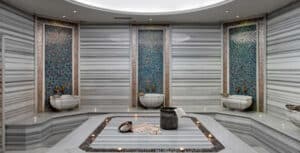
Hammams deliver wet heat, ritual cleansing, and a social bathing experience rooted in regional culture, while infrared saunas deliver dry, low-temperature recovery. Many Dubai villas and hotels install both, because they target different wellness occasions and audiences. They complement rather than compete.
Are infrared saunas safe for daily use in summer?
Yes, for most healthy adults. Limit sessions to 30 minutes, hydrate with at least 500 ml of water before and after, and avoid using the cabin immediately after extended outdoor heat exposure. People with cardiovascular conditions or pregnancy should consult a physician before regular use.
What ongoing maintenance does an infrared sauna need?
Wipe-down after each session, full timber treatment every 18–24 months, and panel inspection every 12 months. Our after-sales team in Dubai provides a maintenance schedule and offers an annual service contract for residential and commercial clients across the UAE.
Will an infrared sauna increase my home’s resale value in Dubai?
Yes, especially in the upper-end villa and apartment markets. Bayut and Property Finder agent surveys consistently rank in-home wellness amenities among the top five differentiators for properties above AED 5 million. A permanently built cabin reads to buyers as part of the property rather than as a movable appliance, which is the distinction agents point to.
Can I move my infrared sauna if I relocate within the UAE?
Yes. Our cabins are designed in modular sections that disassemble in 4–6 hours and reassemble at a new address in a similar timeframe. We offer relocation services across all seven emirates for clients moving within the UAE.
Sources
- Beever, R. (2009). Far-infrared saunas for treatment of cardiovascular risk factors: Summary of published evidence. Canadian Family Physician, 55(7), 691–696. PubMed
- Hussain, J., & Cohen, M. (2018). Clinical Effects of Regular Dry Sauna Bathing: A Systematic Review. Evidence-Based Complementary and Alternative Medicine, 2018, 1857413. Full text
- Crinnion, W. J. (2011). Sauna as a valuable clinical tool for cardiovascular, autoimmune, toxicant-induced and other chronic health problems. Alternative Medicine Review, 16(3), 215–225. PubMed
- Laukkanen, J. A., Laukkanen, T., & Kunutsor, S. K. (2018). Cardiovascular and Other Health Benefits of Sauna Bathing: A Review of the Evidence. Mayo Clinic Proceedings, 93(8), 1111–1121. Full text
- Dubai Electricity and Water Authority. Electrical Installation Regulations. DEWA
Related: the best infrared sauna: an honest buying guide — the manufacturer-side view of the same decision.


