




Sauna Dekor Spa Solutions engineering team, Istanbul
Updated: 5 October 2026
Short answer: a cold plunge chiller for a hotel or gym is sized by heat load, not by litres. A 3,000-litre plunge held at 8 °C with 20 users an hour carries about 6.5 kW of load, and in a hot Gulf plant room that points to a unit delivering around 8.2 kW at its real air temperature, usually a nominal 9 to 10 kW chiller.
In this guide, Sauna Dekor Spa Solutions sets out that sizing as arithmetic you can repeat with your own numbers: the first pull-down, the heat each user brings, the water surface, the tank, the pipework and the pump, and then the part most specifications miss, which is the air around the chiller itself. It is written for built-in commercial plunges in hotels, gyms and clubs in Dubai, Abu Dhabi, Doha and Riyadh, not for portable all-in-one ice bath tubs.
Why is a cold plunge chiller sized in kilowatts, not litres?
Because volume only sets how fast the water drifts; heat input decides whether it comes back. One litre of water needs 4.186 kJ to change by 1 K, so a 3,000-litre plunge stores 12,558 kJ, or 3.49 kWh, per kelvin. The chiller has to remove every kilowatt that arrives, continuously.
The common mistake is to read a chart that pairs tub size with chiller size. Those charts assume a domestic pattern: a covered tub, a few users a day, a shaded garden or a garage. A hotel or gym plunge is the opposite case on every point, with an open surface, users arriving every few minutes and a plant room that can be the warmest space in the building.
So the first question is not how big the tank is. It is how many kilowatts reach the water in the worst hour of a July afternoon, from which sources, and how many of them the design can remove before the chiller is chosen. On the tank side, we build cold plunge pools for water temperatures from 2 to 15 °C; the example in this guide holds 8 °C.
How long does the first pull-down take?
Many hours in the Gulf, because the water starts warm. Mains water in Dubai or Riyadh in August can arrive above 30 °C. Taking 3,000 litres from 35 °C to 8 °C removes 27 K × 3.49 kWh = 94.2 kWh: about 9.4 hours at 10 kW of net cooling and nearly 19 hours at 5 kW.
That figure matters for commissioning and for any drain-and-refill routine, not for daily running. Once the water is at temperature, the cold plunge chiller only has to hold it there against the loads described below.
It does set one practical rule. A plunge drained for cleaning is out of service for most of a working day, so the refill is scheduled overnight, and the operator should know the number before opening day rather than after the first weekly drain.
How much heat does each user bring into the water?
About 926 kJ, or 0.26 kWh, per plunge as a design allowance. A skin and fat layer of roughly 10 kg at about 3.5 kJ/kg·K, cooled by around 20 K, gives 700 kJ. Two litres of warm make-up water replacing what leaves on the body add 2 × 4.186 × 27 = 226 kJ.
This is an engineering allowance, not a physiological measurement, and it is deliberately generous. A user who arrives straight from a sauna brings a warmer skin layer; a user who stays for thirty seconds brings less. The allowance exists so that the plant is not sized on the gentlest case.
What matters is that the figure multiplies. Twenty users an hour at 926 kJ each is 18,520 kJ an hour, which is 5.1 kW of continuous load before the tank, the air or the pipework have added anything. In a gym sauna circuit, where the plunge follows every sauna round, twenty an hour is a normal evening.

How fast does the water recover after each user?
About two minutes with a well-sized plant. Recovery is the user’s heat divided by the chiller’s spare capacity, and it does not depend on volume. With 9 kW of cooling and 1.4 kW of standing loss, 7.6 kW is spare, so one user’s 926 kJ is removed in 926 ÷ 7.6 = 122 seconds.
Volume changes how the step feels, not how long it lasts. The same 926 kJ raises 3,000 litres by 0.074 K, which nobody notices; in a 400-litre ice bath tub it raises the water by 0.55 K, and ten users in quick succession add 5.5 K. That is why small tubs feel fine in a showroom and fail in a busy gym.
The same arithmetic gives the ceiling on throughput: 7.6 kW of spare capacity divided by 0.26 kWh per user is about 29 users an hour. Above that the water warms through the session and only recovers when the room empties. Every watt that leaks in elsewhere comes straight out of that users-per-hour figure.
What do the surface, the tank and the pipes add?
Between 1.4 kW and 4.4 kW, depending on how the plunge is built. An open water surface in a spa at 24 °C and 60 % relative humidity gains about 220 W per m², or 660 W for 3.0 m². An insulated tank adds 90 W; a bare one adds 2,160 W. Insulated pipework adds 250 W; bare pipework 1.2 kW.
The surface figure combines convection of about 80 W/m², radiation from the room of about 85 W/m², and condensation of about 55 W/m², because 8 °C water is below that air’s 15.8 °C dew point. Condensation is the Gulf-specific part: humid air meeting cold water releases its latent heat into the plunge. A cover out of hours, and a spa air system that holds the dew point down, remove most of it, the same logic as in an indoor swimming pool hall.
The tank is where a factor of 24 hides. A tank filled to 1.0 m has about 10 m² of wetted wall and floor; with 50 mm of polyurethane it gains 10 × 0.5 × 18 = 90 W, but bare stainless in a 35 °C void gains 10 × 8 × 27 = 2,160 W. The insulation needs a sealed vapour barrier on the warm side, exactly as a sauna wall needs its foil, which our guide to sauna insulation explains the other way round.
Pipework is the third leak. A 60 mm pipe carrying 8 °C water through a 40 °C plant room gains about 60 W per metre bare and 12.5 W per metre with 19 mm of closed-cell insulation, so 20 m of flow and return costs 1.2 kW or 0.25 kW. The circulation pump adds its own heat: a 0.55 kW motor running around the clock puts about 0.4 kW into the water.

What is the total load for a typical hotel plunge?
About 6.5 kW for the reference case: a 3,000-litre plunge at 8 °C, 20 users an hour, open surface, insulated tank and pipework. The same plunge built with a bare tank and bare pipes carries 4.4 kW of standing loss before the first user arrives, almost a compact unit’s whole output.
| Load | Insulated build | Bare build | What changes it |
|---|---|---|---|
| Users, 20 per hour at 926 kJ each | 5.1 kW | 5.1 kW | The only load that scales with the business |
| Open water surface, 3.0 m² | 0.66 kW | 0.66 kW | A cover out of hours and a lower spa dew point |
| Tank walls and floor, 10 m² | 0.09 kW | 2.16 kW | 50 mm insulation with a sealed vapour barrier |
| Pipework, 20 m flow and return | 0.25 kW | 1.2 kW | 19 mm closed-cell insulation, short runs |
| Circulation pump, 0.55 kW motor | 0.4 kW | 0.4 kW | Pump size and running hours |
| Total | 6.5 kW | 9.5 kW |
The table is the part of the specification that should travel with the chiller order. A supplier who quotes a unit without seeing these five lines is sizing from litres, and the difference between the two columns is decided by whoever builds the enclosure, not by whoever sells the chiller.
Why does the plant room air decide the real output?
Because an air-cooled chiller rejects heat into the air around it and loses capacity as that air warms. Data sheets state capacity at a named ambient, often 25 to 35 °C, while a Gulf plant room in July can reach 45 °C. Allowing about 25 % for that gap, the 6.5 kW load needs about 8.2 kW delivered at the real condition.
Every unit carries two figures that must be read together: its capacity table against ambient temperature, and its maximum operating ambient. A unit whose limit is below the plant room’s summer peak trips on high pressure on exactly the afternoons when the spa is busiest.
The room also needs air. A chiller removing 9 kW with about 3.6 kW of compressor input rejects 12.6 kW. Holding that room to a 10 K rise needs 12,600 ÷ (1.2 × 1,005 × 10) = 1.04 m³/s, about 3,760 m³/h; a 5 K rise doubles it to about 7,500 m³/h. If the make-up air comes from outside at 45 °C, a 10 K rise means the condenser breathes 55 °C air, beyond most units’ limits.

In practice there are three layouts: the condenser discharge is ducted directly outdoors, the condenser is remote and sits outside in shade, or the unit is water-cooled from the building’s condenser water. The rule we work to is simple: a chiller goes in a ventilated plant space, not a cupboard, and the layout is agreed with the MEP engineer at concept stage.
What does HP mean on an ice bath chiller?
It describes the compressor, not the cooling output. One mechanical horsepower is 0.746 kW, but a refrigeration unit moves more heat than it consumes. One 2.0 HP compact unit we have specified lists 5.0 kW of cooling for 1.95 kW of electrical input, a coefficient of performance of about 2.6, at its rating ambient.
So a 2.0 HP label says little until the capacity table is read. That same 5.0 kW falls in a 40 °C plant room, and against the 4.4 kW standing loss of a badly built plunge it would have almost nothing left for users. Compact ice bath chillers are designed for the domestic pattern described at the start, and there they work well.
This is why we ask for cooling capacity in kW at a named ambient temperature on every chiller submittal, and treat the HP figure as a description of the compressor. A comparison between two units is only fair when both are read at the same condition. Our comparison of cold plunge options covers the tub side of the same question.
Can the building’s chilled water replace the chiller?
Sometimes, depending on the target temperature. Building chilled water in the Gulf typically leaves the central plant at around 5 to 7 °C, and a plate heat exchanger needs 2 to 3 K of difference to work. That can hold a plunge at 10 to 12 °C; it cannot hold 6 °C.
When it fits, it removes the plant room ventilation problem entirely, because the heat goes to the building’s central plant instead of into a small room, and it removes a compressor from the spa level. Many towers and hotels in Doha and Dubai run on district cooling, which makes the question worth asking early.
The questions for the MEP engineer are whether chilled water runs through the spa in winter as well as summer, what its supply temperature is at part load, and whether the spa’s small, constant demand is acceptable on that circuit. The answers decide whether 8 °C is achievable or whether 10 to 12 °C is the honest target.
What filtration and hygiene does a busy plunge need?
Much tighter turnover than a swimming pool, because the bather load per litre is far higher. Twenty users an hour in 3 m³ is 6.7 users per cubic metre per hour; a 437 m³ hotel pool with 100 users an hour is 0.23, about 29 times less. Turning 3,000 litres over in 20 to 30 minutes means 6 to 9 m³/h.
The US Model Aquatic Health Code defines a spa as a structure for warm or cold water where prolonged exposure is not intended, which covers a cold plunge. Its spa turnover table, however, is written for warm water, so the turnover for a cold plunge is set by the authority having jurisdiction on the project. The chiller’s own flow must also be met: at 9 kW and a 2 K rise it needs 9 ÷ (4.186 × 2) = 1.08 kg/s, about 3.9 m³/h, which a 6 to 9 m³/h filtration circuit covers.
The water itself sits in a safe band; the pipework may not. The World Health Organization advises keeping cold water below 25 °C and ideally below 20 °C to limit Legionella. A stagnant branch in a 40 °C plant room is outside that band, so circulation runs day and night, dead legs are designed out, and UV-C, which leaves no residual, is used alongside a residual disinfectant rather than instead of it.
The tank material follows the water. Chlorinated, chloride-bearing water attacks stainless steel by pitting, and grade 316, with about 2 to 3 % molybdenum and a pitting resistance number of about 24 to 25, resists it better than 304 at about 19. Welds are pickled and passivated after fabrication, and the outer face is insulated with a sealed vapour barrier so it does not run wet in a humid Gulf spa.
What have we built on the cold side?
Cold plunges and cold pools on our record include a cold plunge at a beach club in Kilyos, Istanbul in 2025, a stainless cold pool at a resort residence project in Muğla in 2025, and a cold plunge, sauna and jacuzzi for a private villa in Dubai, delivered through a design studio in 2026.
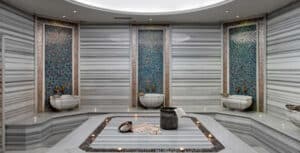
In Qatar, our work at the Diplomatic Club spa in Doha covered the sauna, steam rooms, spa hot tub and pool areas, which is where the recessed tank in the photograph above comes from. None of these projects is quoted here for a performance figure; the numbers in this guide are arithmetic set out in the text, and they repeat on any project.
For hotel and gym projects in Saudi Arabia, our Riyadh team works the same load list with the MEP engineer before the chiller is ordered.
Who is writing this
Sauna Dekor has designed and built saunas, steam rooms, hammams, pools and cold plunges since 1987: 40 years of manufacturing in Istanbul, in our own facility in İkitelli OSB, with a team of 19 employees, working under TS EN ISO 9001:2015, and with 5,000+ projects in 35+ countries. On a cold plunge we build the tank, its insulation and its enclosure, and issue the heat-load calculation.
We do not manufacture chillers, pumps, UV units or control panels; their manufacturers make them, and any CE marking or EN 60335 conformity on that equipment belongs to its manufacturer. The TS EN ISO 9001:2015 certificate is ours. On the work we deliver, the terms are a 24-month warranty on workmanship and manufacturing; 24-month manufacturer’s warranty on electrical and mechanical equipment; 5-year warranty on structure and waterproofing.
Frequently asked questions about cold plunge chillers
What size cold plunge chiller does a 3,000-litre hotel plunge need?
For 20 users an hour at 8 °C, the load is about 6.5 kW with an insulated tank and pipework. Allowing for a hot plant room, choose a unit delivering around 8.2 kW at the real ambient, typically a nominal 9 to 10 kW chiller.
Is a 2 HP ice bath chiller enough for a commercial plunge?
Usually not. One 2.0 HP compact unit we have specified lists 5.0 kW of cooling at its rating ambient. A busy commercial plunge carries 5.1 kW from users alone, before the surface, tank, pipework and pump add their losses.
How long does a cold plunge take to cool after filling?
From 35 °C mains water to 8 °C, a 3,000-litre plunge needs 94.2 kWh removed. At 10 kW of net cooling that is 9.4 hours, so drain-and-refill routines are scheduled overnight rather than during opening hours.
How quickly does the water recover after each user?
Recovery equals the user’s heat divided by the chiller’s spare capacity. With 926 kJ per user and 7.6 kW spare, it takes about 122 seconds, and the steady-state limit for that plant is roughly 29 users an hour.
Why does the plant room temperature matter so much?
An air-cooled chiller rejects heat into its room and loses capacity as that air warms. A 9 kW unit rejects about 12.6 kW, which needs around 3,760 m³/h of ventilation just to hold the room to a 10 K rise.
What water temperatures can a cold plunge be built for?
We build cold plunge pools for water temperatures from 2 to 15 °C. The chiller, the insulation and the plant room layout are then sized for the chosen setpoint, the user count and the plant room’s real summer air temperature.
Sources
- Model Aquatic Health Code, 5th edition (2024) — US Centers for Disease Control and Prevention, code posted 16 December 2024. Source for the definition of a spa as a structure for warm or cold water, and for its spa turnover table, written for warm water.
- Legionellosis fact sheet — World Health Organization. Source for keeping cold water below 25 °C and ideally below 20 °C, and for maintaining a biocide in spa pools.
- Guidelines for safe recreational water environments, Volume 2: Swimming pools and similar environments — World Health Organization, 2006. Source for bather load, circulation, turnover and disinfection as the controls on water quality.
- Specific heat capacity — Wikipedia. Reference for the 4.186 kJ/kg·K of water used in every pull-down, per-user and recovery calculation.
- Coefficient of performance — Wikipedia. Reference for the ratio of cooling output to electrical input used to read a horsepower label.
- Horsepower — Wikipedia. Reference for 1 mechanical horsepower = 0.746 kW.
- Pitting resistance equivalent number — Wikipedia. Reference for the PREN formula and the approximate values for grades 304 and 316.


