


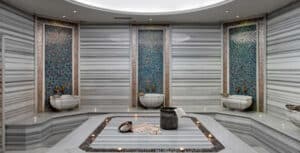


Hammam Dubai: The Complete Guide to Moroccan Bath, Turkish Bath, and Custom Hammam Design for 2026


Last updated: June 2026
In April 2026, the owner of a Palm Jumeirah villa told our Dubai team she wanted “the hammam she grew up visiting in Marrakech, but in her own home.” She had experienced hotel hammams across Dubai and found them beautiful but impersonal. What she wanted was a private Moroccan bath with a heated marble platform, tadelakt walls, and space for a kese scrub and a black-soap ritual whenever she chose. Sixteen weeks later we delivered a 9 m² custom hammam in Marmara marble with a domed ceiling, a heated gobek tasi, and a hand-finished tadelakt steam room. The marble schedule, the heated platform and the tanking, not the floor area, set what that room cost to build. The family now hosts a weekly hammam ritual at home.
Sauna Dekor has been manufacturing hammams since 1987 — this is our fortieth year — and installing them turnkey in more than 35 countries. In Dubai that means private villas on the Palm and in Emirates Hills as much as hotel spas.
That project sits at the heart of a quiet shift in Dubai. The hammam is one of the most searched and most loved wellness experiences in the city, from the Moroccan bath at a Downtown spa to the Turkish bath at Jumeirah’s Zabeel Saray. But a growing number of villa owners and hoteliers no longer want only to visit a hammam. They want to commission their own, custom built and engineered for their property, and that is a very different undertaking from booking a treatment.
This guide covers both sides. It explains what a hammam is and what happens during the ritual, the real difference between a Moroccan bath, a Turkish bath, and a modern hammam, the benefits, and then the part most articles skip: how a custom hammam is actually designed and built in a Dubai villa or hotel, including gobek tasi, marble, waterproofing, DEWA, and real costs in AED. It is written from 40 years of manufacturing experience at Sauna Dekor and a Dubai entity that designs and builds bespoke hammams across the Emirates.
Thinking about a custom hammam for your Dubai home or hotel? Explore our hammam range or request a free consultation with our Dubai team.
Why is the hammam dubai such an established part of Dubai’s wellness and hospitality scene?
The hammam is deeply embedded in Dubai because the city blends a regional bathing heritage with a world-leading luxury hospitality sector. Demand spans two distinct groups: residents and visitors seeking the Moroccan or Turkish bath experience at spas and hotels, and villa owners and hoteliers commissioning their own custom hammams. Dubai already hosts landmark installations, from the Ottoman-style hammam at Jumeirah’s Zabeel Saray to hammams in many five-star properties.
For the hospitality sector, a beautifully built hammam is a signature amenity that supports premium spa pricing and strong guest reviews. For private clients, a custom hammam brings a cherished cultural ritual into the home, on their own schedule and to their own design. What unites both is a rising expectation of authenticity and craftsmanship, which is exactly what separates a genuine custom hammam from a tiled room with a steam outlet.
What is a hammam, and what happens during a traditional bath ritual?
A hammam is a steam-based communal bathing house, built in marble around a central heated platform, where bathers warm up, are exfoliated, and are washed in a sequence of rooms at rising temperatures. The ritual heart is the gobek tasi, a large heated marble slab on which bathers recline to sweat and soften the skin before a vigorous kese-glove scrub and a foam wash. The tradition blends Roman and Islamic bathing culture and was refined into its classic form during the Ottoman era (Hammam, Wikipedia).
A traditional hammam visit follows clear stages. The bather first relaxes in a warm room to acclimatise, then moves to the hot steam room and lies on the gobek tasi until the body is warmed through and the pores open. An attendant then performs the kese exfoliation, followed by a rich soap-foam massage, before a cool-down and rest. The architecture supports this: domed ceilings pierced with small skylights let excess steam escape while marble walls and floors hold and radiate heat. For a deeper history, see our guide to what a Turkish bath is.
What is the difference between a Moroccan bath, a Turkish bath, and a modern hammam?
The core difference is ritual and finish. A Moroccan bath centres on black soap (savon beldi), a kessa-glove scrub, and rhassoul clay, often in a warm, humid, tadelakt-finished room. A Turkish bath (hammam) centres on the heated gobek tasi, kese exfoliation, and a foam massage in a domed marble room. A modern hammam keeps the heated platform and steam but uses contemporary design, materials, and lighting for hotels and homes. All three are forms of hammam.
For Dubai buyers, the Moroccan bath is the most searched experience, which is why so many spas lead with it, while the Turkish bath remains the architectural archetype most clients picture when they commission a custom build. The choice usually comes down to the ritual you want to recreate and the aesthetic that suits your property.
| Feature | Moroccan bath | Turkish bath (hammam) | Modern hammam |
|---|---|---|---|
| Signature ritual | Black soap + kessa scrub + rhassoul clay | gobek tasi + kese + foam massage | Adapted heat and scrub ritual |
| Typical finish | Tadelakt plaster, warm humid room | Marble, domed ceiling, gobek tasi | Contemporary marble, porcelain, lighting |
| Atmosphere | Earthy, intimate, North African | Grand, classical, Ottoman | Sleek, design-led |
| Best for | Skin ritual lovers, intimate spas | Authentic heritage installations | Boutique hotels, modern villas |
| Sauna Dekor page | Moroccan bath | Turkish bath | Modern hammam |
Which hammam style is most popular in Dubai?
The Moroccan bath is the most requested experience among Dubai spa-goers, while custom Turkish baths and modern hammams dominate among villa owners and hoteliers commissioning a permanent installation. Many of our Dubai projects blend the two: a classical göbek taşı and domed marble room delivering both Turkish and Moroccan rituals, since the architecture supports either treatment once the heat, steam, and scrub platform are in place.
What are the benefits of a hammam?
The benefits of a hammam combine deep cleansing, relaxation, and the wellness effects of warm, humid heat. The kese scrub removes dead skin and leaves the skin noticeably smoother, while the warm steam environment promotes relaxation and a feeling of renewal. The thermal side of bathing has documented wellness associations, with a 2018 review in Mayo Clinic Proceedings summarising cardiovascular and recovery benefits of regular heat exposure across more than 40 studies (Laukkanen et al., 2018).
It is worth being precise about what a hammam does and does not do. Its genuine, defensible benefits are exfoliation and skin cleansing, muscular relaxation, and the calm that follows warm steam bathing. Broader medical claims sometimes attached to hammams should be treated with caution. For most clients, the value is a combination of authentic ritual, social or personal relaxation, and the simple pleasure of warmth, which in an air-conditioned city like Dubai is a deliberate and welcome contrast.
Considering a private hammam to bring this ritual home? Our Dubai team designs custom hammams around the exact ritual and aesthetic you want. Request a free consultation.

How do you design and build a custom hammam in a Dubai villa or hotel?
Building a custom hammam in Dubai means engineering a fully waterproofed, marble-clad steam room around a heated gobek tasi, with a steam generator, underfloor and platform heating, controlled ventilation, and DEWA-approved electrical supply. It is closer to building a steam room than installing a sauna, because it combines high humidity, heated stone, and heavy marble, all of which demand precise waterproofing and structural support.
The gobek tasi is the centrepiece and the most technically demanding element. It is a large marble platform heated from below, usually by a hydronic or electric system, that must reach a comfortable, even surface temperature and hold it through a session. Around it, the room is tanked exactly like a steam room, clad in marble or tadelakt, and topped with a domed or sloped ceiling to manage condensation. The result only looks simple; beneath the marble sit waterproofing membranes, heating circuits, steam pipework, and drainage.
What materials and features define a quality Dubai hammam?
A quality hammam uses natural marble such as Marmara, Afyon, or Carrara for the walls, benches, and gobek tasi, tadelakt plaster for Moroccan-style rooms, a domed ceiling in marble or glass mosaic, and a correctly sized steam generator. In Dubai, every surface sits over a continuous waterproof membrane, and the heated platform is engineered for even warmth. Hard local water also makes water treatment important to protect the steam system from scaling.
What does a Dubai hammam need from DEWA and building approvals?
A custom hammam needs DEWA electrical approval for the steam generator and platform heating, owners’ association approval for the wet-area modification, and, in larger builds, a Dubai Municipality submission for structural and drainage work. A registered consultant submits the load calculations via dewa.gov.ae, and our team coordinates the full approval and installation as a single package, exactly as we do for steam rooms and saunas.
In early 2026, a boutique hotel in Business Bay asked us to add a Moroccan-style hammam to differentiate its spa. The available space was 16 m² beside the existing wet zone. We built a tadelakt-finished hammam with a heated gobek tasi, a domed mosaic ceiling, and a dedicated scrub and foam-massage area. Almost all of the cost sat in the stonework, the heated platform and the wet-room engineering rather than in the room’s footprint. Within months the hammam had become the spa’s signature treatment room and a recurring feature in guest reviews. The treatment rooms beside it follow our massage room design.
What determines the cost of a custom hammam in Dubai?
We do not publish a hammam price list, and the reason is structural rather than commercial: a hammam is a stone building inside a building, so the same brief lands at very different totals depending on what the room already is. A hammam does cost more than a comparable steam room of the same size, every time, because of the heated marble platform and the sheer volume of natural stone the room carries. Below that headline, six things decide the figure.
- Room size and ceiling height. Not just floor area: a domed ceiling changes the stone quantity, the steam volume the generator has to serve and the scaffolding the mosaic work needs. Two rooms with the same footprint and different ceilings are not the same project.
- Stone grade and quantity. The single largest line in most hammams. Marmara, Afyon or a coloured marble, slab thickness, book-matching, the amount of hand-carving in the kurna basins and the wall panels, and the wastage a strong vein pattern forces on the fabricator.
- The heated gobek tasi. The belly stone is a heated structure, not a slab laid on a floor: platform build-up, embedded heating, the control zone, the load it puts on the slab beneath it and the thermal break that keeps that heat inside the platform.
- Tanking, waterproofing and drainage. A hammam is a continuously wet, continuously warm room. Falls, the sediment trap, the membrane and the way it turns up behind the stone are all set before the screed is poured, and they are the most expensive thing on the page to correct afterwards.
- Steam generation, controls and water treatment. Generator sizing follows room volume and the stone mass it has to heat through; water hardness decides whether treatment is optional or mandatory; and the control system decides whether the room is ready when the household wants it.
- Approvals and services. DEWA-compliant electrical supply, the owners’ association NOC for a wet-area modification, and bringing power, water supply, drainage and ventilation to a room that may never have had them.

What additional costs should you budget for?
- Marble fabrication beyond the wall lining: kurna basins, the platform edge profile, thresholds and any carved detail, each priced per piece rather than per square metre
- Structural check on the slab: a stone room with a heated platform is heavy, and older villas occasionally need the floor verified before the design is fixed
- Extraction and dehumidification for the adjoining dry areas: the hammam is sealed, but the lobby and changing area next to it still have to shed the moisture that leaves with the bather
- Lighting and hardware rated for a wet, warm, mineral-loaded room: fittings, door gear and fixings that survive years of steam rather than months
- Commissioning and handover: balancing the steam, setting the platform temperature, proving the drainage and training whoever will run the room
All of this describes building a hammam, which is a different question from what a single hammam treatment costs at a spa. The trap in budgeting one is to price the visible stone and treat everything behind it as a rounding error. In a compliant Dubai build the heating, the tanking and the finishes are not the extras on top of the room, they are a large part of the room, and a budget that only counts marble is short before the first drawing is issued.
Where should you install a hammam in a Dubai home or hotel?
The best location for a hammam is within the wet, high-humidity zone of a wellness suite, adjacent to showers and ideally near a sauna and steam room, so the whole area shares tanking, drainage, and services. In villas, the ground-floor or basement wellness wing is ideal. In hotels, the hammam sits within the spa’s treatment and thermal zone, where it functions as both a ritual space and a visual centrepiece.
Grouping the hammam with the other wet rooms is not only better for the experience, it contains Dubai’s waterproofing challenge to a single engineered zone rather than spreading moisture risk across the building. This is why our villa wellness suites place the hammam, steam room, and shower area together, designed and tanked as one system from the first drawing.
In late 2025, our Dubai team designed a full wellness floor for an Emirates Hills villa whose owner wanted an authentic Turkish bath at its centre. We built a domed marble hammam with a heated gobek tasi, an adjoining steam room, a cold shower, and a relaxation lounge finished in warm stone. As on every hammam, the stone grade and the heated platform carried the budget. The family uses the hammam several times a week, and it has become the social heart of the home, exactly as hammams have been for centuries.
For homeowners planning a private spa and hoteliers planning a commercial spa, the hammam almost always anchors a wider wellness specification that may also include a steam room, sauna, and cold therapy. Designed together, these spaces create a complete bathing journey that a single room cannot match.
Looking for a Moroccan bath in Dubai — or looking to build one?
Almost everyone searching for a Moroccan bath in Dubai wants the same thing: a good place to go and have one. It is one of the highest-volume wellness searches in the emirate, and it is overwhelmingly visit intent. We should be honest that we are not that — we do not operate a spa you can book.
What we do is build the rooms. If you have had a Moroccan bath at a Dubai hotel or a Jumeirah spa in the last few years, there is a reasonable chance the hammam was manufactured by someone in our part of the industry, and quite possibly by us.
So this page is useful to you in one of two ways. If you are going for a treatment, the sections above explain what actually happens, what distinguishes a Moroccan bath from a Turkish bath, and what a well-built room should feel like — which is the best defence against paying for a tiled shower room with a plastic stool in it. If you are specifying or building one, the design, cost and installation sections are written for you.
For the wider build picture, we publish real AED price ranges across sauna, steam and plunge, a commercial specification guide for hotel projects, and a buyer’s checklist for choosing between suppliers.
Frequently asked questions about hammams in Dubai
What is the difference between a Moroccan bath and a Turkish bath in Dubai?
A Moroccan bath centres on black soap, a kessa-glove scrub, and rhassoul clay in a warm, humid room, while a Turkish bath centres on the heated gobek tasi, kese exfoliation, and a foam massage in a domed marble room. Both are types of hammam, and many Dubai spas offer both.
Can you build a private hammam in a Dubai villa?
Yes. A custom hammam can be built in most Dubai villas, provided there is space for a fully waterproofed marble room, a heated göbek taşı, and a steam system, plus DEWA-approved electrical supply. Owners’ association approval is usually required for the wet-area modification.
How much does it cost to build a hammam in Dubai?
We price each hammam against the actual room rather than publish a range, because the spread between two hammams of the same size is genuine: ceiling form, stone grade and quantity, the heated gobek tasi build-up, the tanking and drainage already in place, steam generator sizing, and the DEWA and owners’ association approvals a wet-area modification needs. Send the room dimensions, the ceiling height and what services reach the space, and we return an itemised cost. This is the construction cost, distinct from the price of a single hammam treatment at a spa.
What is a Gobek Tasi?
The gobek tasi is the large heated marble platform at the centre of a hammam, on which bathers recline to warm the body and open the pores before exfoliation. It is heated from below and is the ritual and architectural heart of a traditional Turkish bath.
How long does it take to build a custom hammam in Dubai?
A residential hammam typically takes 10 to 20 weeks, and a large commercial hammam 20 to 30 weeks, including marble fabrication, the heated platform, waterproofing, DEWA approval, and finishes. The heated gobek tasi and stonework are usually the longest parts of the timeline.
Is a hammam the same as a steam room?
No. A steam room is a humid heated room without a heated marble platform or scrub ritual, while a hammam combines a steam environment with a heated gobek tasi± and a structured exfoliation and washing ritual. A hammam is more complex to build because of the heated stone and marble.
Can a hammam be combined with a sauna and steam room?
Yes, and this is the most popular configuration for luxury Dubai wellness suites. Grouping the hammam, steam room, and sauna into one thermal zone creates a complete heat-and-cleansing journey and is more efficient to engineer, waterproof, and service.
Does Sauna Dekor build custom hammams in Dubai?
Yes. We design and build bespoke Moroccan baths, Turkish baths, and modern hammams for Dubai villas and hotels, including göbek taşı, marble work, steam systems, waterproofing, and DEWA coordination, with 40 years of manufacturing experience and after-sales support across the UAE.
Sources
- Hammam. Wikipedia (history, architecture, and gobek tasi of the Turkish bath). en.wikipedia.org/wiki/Hammam
- Laukkanen, J. A., Laukkanen, T., & Kunutsor, S. K. (2018). Cardiovascular and Other Health Benefits of Sauna Bathing: A Review of the Evidence. Mayo Clinic Proceedings, 93(8), 1111-1121. Full text
- Dubai Electricity and Water Authority (DEWA). Connection services and electrical approval portal. dewa.gov.ae
Ready to design your own hammam in Dubai? Whether you want a private Moroccan bath in a Palm Jumeirah villa, an authentic Turkish bath with a heated göbek taşı, or a modern hammam as the centrepiece of a five-star spa, our Dubai team brings 40 years of manufacturing experience and a track record with Hilton, Ritz-Carlton, and Emirates. Request a free consultation and we will provide marble samples, göbek taşı and steam engineering, DEWA coordination, AED project costs, and a design tailored to your space and ritual.
Frequently asked questions
How much does a hammam cost to build in Dubai? We quote per room rather than publish a figure. The cost is driven by three layers, and they do not move together: the shell with its tanking, insulation and heating; the stonework, which is usually the largest line and is priced on grade and quantity rather than area; and the steam and control system, sized to the room volume and the stone mass it has to heat.
What is the difference between a hammam and a Moroccan bath? In the Gulf market the terms are used interchangeably for the same room. Strictly, hammam describes the Ottoman-Turkish bath with a heated central belly stone, while the Moroccan version emphasises black soap, rhassoul clay and a scrub.
How long does a hammam project take? Design typically takes three to four weeks, manufacture eight to twelve weeks and installation three to six weeks, so a straightforward project runs about four to six months from brief to commissioning.
What is the most expensive mistake in a hammam build? Deciding drainage after the slab is poured. Falls, the sediment trap and the heated floor build-up have to be set before the screed goes down; correcting it afterwards routinely doubles the budget for that room.


