


Last updated: June 2026
Hyperbaric Oxygen Chamber: a hard-shell chamber is one of the heaviest single objects that goes into a wellness floor, and the questions it raises are structural and mechanical long before they are cosmetic. Where does a rigid vessel of well over a tonne sit, and what carries it? Where is the oxygen stored, and how is that store rated and routed? How is the room ventilated and cooled with a compressor and an occupant both adding heat to it? And how is a pressure vessel detailed so the finished room reads as a treatment suite rather than a plant room? Those questions, not the chamber itself, are what a designer is engaged to answer, and they are the same questions that govern the plant behind an infrared sauna cabin or a cold-therapy pool in the same circuit.
That project reflects a clear shift in the Dubai wellness market. Hyperbaric oxygen therapy (HBOT), once confined to hospitals and dive-medicine units, is now one of the fastest-growing additions to anti-aging clinics, biohacking centers, elite-athlete recovery facilities, and high-net-worth private wellness rooms across the Emirates. The interest is driven by genuine peer-reviewed research and, in equal measure, by marketing hype, which is exactly why anyone commissioning a chamber needs to separate what is proven from what is promotional before spending a dirham.
This guide is written from Sauna Dekor’s perspective as a luxury wellness facility designer with 40 years of spa engineering experience and a Dubai entity that designs and integrates complete wellness suites. We do not manufacture hyperbaric chambers; we design the rooms that house them, engineer the services they need, and integrate them into wider contrast-therapy circuits. Below: how HBOT works, what the evidence does and does not support, chamber types, Dubai installation requirements, space planning, what drives cost, safety, and how a chamber fits into a luxury wellness facility.
Planning a hyperbaric suite for a Dubai home, clinic, or wellness center? See what we take responsibility for on our hyperbaric chamber suite and mHBOT installation page, explore our private spa design, or request a free consultation with our Dubai team.
Why are Dubai’s wellness facilities and biohacking centers adopting hyperbaric oxygen chambers?
Three buyer groups drive it: anti-aging clinics, sports-recovery centers and private villa owners, with adoption accelerating since 2023. The concentration is in Jumeirah, Downtown, Business Bay and on the Palm. For clinics the chamber is a service line; for private clients it is a fitted amenity inside a wider wellness room.
HBOT adoption in Dubai has accelerated since 2023 because the city sits at the intersection of three forces: a concentration of high-net-worth individuals investing in longevity, a competitive luxury-clinic and hospitality sector seeking differentiation, and a culture of early technology adoption. Anti-aging clinics, sports-recovery centers, and private villa owners are the three largest buyer groups, and demand is strongest in Jumeirah, Downtown, Business Bay, and on the Palm.
For clinics and biohacking centers, a hyperbaric chamber is both a service line and a marketing asset, often photographed for the facility’s listings and social channels. For private clients, it is a discreet at-home amenity that fits within a wider wellness investment alongside a sauna, cold plunge, and treatment room. What unites both is the expectation of a properly engineered, beautifully finished installation rather than a chamber dropped into a spare room, which is where a specialist facility designer becomes essential.
How does a hyperbaric oxygen chamber actually work?
The chamber raises air pressure around the body above the 1.0 ATA of sea level while the user breathes oxygen-enriched or pure oxygen, which increases the oxygen dissolved in blood plasma. Medical chambers run at 2.0 to 3.0 ATA with 100 percent oxygen; mild wellness units run at 1.3 to 1.5 ATA.
A hyperbaric oxygen chamber works by raising the air pressure around the body above normal atmospheric pressure while the user breathes oxygen-enriched or pure oxygen air. This dramatically increases the amount of oxygen dissolved in the blood plasma and delivered to tissues. Medical chambers operate at 2.0 to 3.0 ATA (atmospheres absolute) with 100 percent oxygen, while mild “soft-shell” wellness chambers operate at 1.3 to 1.5 ATA, typically with an oxygen concentrator. Sessions usually run 60 to 90 minutes.
At sea level you breathe air at 1.0 ATA. Inside a chamber pressurised to 2.0 ATA, the dissolved-oxygen content of the blood rises far beyond what is possible by breathing oxygen at normal pressure. That is the physiological mechanism the established medical uses rest on, and it is why the regulator-recognised indications listed in the next section are dominated by wounds and tissue where the blood supply is compromised. The claim belongs to the regulators and the published trials cited below, not to us. The key variables are pressure (measured in ATA), oxygen concentration, and session duration, and they differ sharply between medical and wellness-grade equipment.
What is the difference between medical HBOT and mild “soft-shell” HBOT?
Medical HBOT uses a rigid hard-shell chamber certified to 2.0 to 3.0 ATA with 100 percent oxygen, under clinical supervision. Mild HBOT uses a soft-shell or lower-rated hard chamber at 1.3 to 1.5 ATA with concentrated oxygen, marketed for general wellness and recovery. The pressure difference is significant: most published clinical benefits come from studies at 2.0 ATA and above, a distinction often blurred in consumer marketing.
What are the proven benefits of HBOT, and what is still emerging?
Regulator-recognised evidence covers about 14 cleared conditions, including non-healing diabetic wounds, radiation tissue injury, carbon monoxide poisoning and decompression sickness. Wellness uses are off-label: a 2020 trial in Aging reported telomere length up more than 20 percent after 60 sessions, an early finding rather than settled medicine.
HBOT has strong, regulator-recognised evidence for a defined set of medical conditions and growing but earlier-stage research for wellness applications. The US FDA clears hyperbaric chambers for around 14 conditions, and the Undersea and Hyperbaric Medical Society (UHMS) lists a similar set of approved indications, including non-healing diabetic wounds, radiation tissue injury, carbon monoxide poisoning, decompression sickness, and certain severe infections (UHMS, 2023).
The applications driving Dubai’s wellness demand, anti-aging, cognitive enhancement, athletic recovery, and post-viral recovery, sit in a different evidence category: promising and increasingly studied, but largely off-label. A 2020 prospective trial in the journal Aging reported that a 60-session HBOT protocol increased telomere length by more than 20 percent and reduced senescent cell counts in healthy older adults (Hachmo et al., 2020). Results like these are why longevity clinics are interested, but they remain early findings rather than settled medicine.
This distinction matters for any Dubai buyer. The FDA has publicly cautioned against marketing HBOT for unapproved conditions, warning that patients may be misled by promotional claims (FDA, Get the Facts). A responsible facility, residential or commercial, presents HBOT honestly: established for specific medical indications, promising for wellness, and never a substitute for proven medical care.
Designing an anti-aging or longevity facility in Dubai? Our team designs HBOT suites that integrate with your wider wellness offering and meet Dubai’s regulatory requirements. Request a free consultation.
Monoplace or multiplace, soft-shell or hard-shell: which chamber suits your Dubai project?
Capacity and pressure decide it. A monoplace vessel takes 1 person and suits a home or small clinic; a multiplace takes 2 to 12 and suits a busy clinic. Soft-shell units are limited to 1.3 to 1.5 ATA; hard-shell units reach 2.0 to 3.0 ATA and bring medical oversight and licensing with them.
The right chamber depends on whether the use is residential wellness or clinical, and how many users you need to treat at once. Monoplace chambers hold one person and suit homes and small clinics. Multiplace chambers hold two to twelve people and suit busy clinics and recovery centers. Soft-shell chambers serve mild at-home HBOT at 1.3 to 1.5 ATA, while hard-shell chambers serve clinical-grade therapy at 2.0 to 3.0 ATA and require medical oversight.
Construction type is the decision that drives everything else: footprint, electrical load, oxygen handling, permitting, and budget. Soft-shell chambers from manufacturers such as OxyHealth and Solace are lightweight, plug-in, and popular for villa wellness rooms. Hard-shell monoplace and multiplace systems from clinical manufacturers are heavy, fixed installations that demand engineered rooms and, for clinical use, a Dubai Health Authority licence.
| Attribute | Soft-shell (mild HBOT) | Hard-shell monoplace | Hard-shell multiplace |
|---|---|---|---|
| Pressure | 1.3–1.5 ATA | 2.0–3.0 ATA | 2.0–3.0 ATA |
| Capacity | 1 person | 1 person | 2–12 people |
| Typical use | Home wellness, recovery | Clinic, advanced home | Clinic, recovery center |
| Oxygen source | Concentrator | Concentrator or O₂ supply | Bulk medical oxygen |
| Footprint | Compact, movable | Fixed, engineered room | Large dedicated room |
| Dubai clinical licence | Not for clinical claims | Required for clinical use | Required for clinical use |
Which chamber is right for a Dubai private residence?
For most villa and penthouse owners, a soft-shell or compact hard-shell monoplace chamber is the correct choice, installed as a wellness amenity rather than a medical device. It integrates cleanly into a private wellness room and avoids the licensing burden of clinical equipment. Owners seeking higher pressures for specific protocols should work with a DHA-licensed provider rather than self-prescribing high-pressure therapy at home.
What does it take to install a hyperbaric oxygen chamber in a Dubai property?
Four things are engineered together: a stable 230V supply or three-phase for larger systems, controlled ventilation holding the room at 20 to 24 °C, safe oxygen storage and routing, and the permits the intended use triggers. Oxygen is what separates a wellness fit-out from an engineering project.
Installing an HBOT chamber in Dubai requires four things engineered together: a stable 230V electrical supply (or three-phase for larger systems), controlled ventilation and climate, safe oxygen storage and handling, and the correct permits. Soft-shell residential chambers are relatively simple, needing a dedicated circuit and a cool, well-ventilated room. Hard-shell and clinical systems require engineered oxygen storage, fire-safety compliance with Dubai Civil Defence, and, for any clinical use, Dubai Health Authority (DHA) facility licensing.
Oxygen is the variable that separates a wellness installation from an engineering project. Concentrated and stored oxygen creates an enriched-oxygen environment that elevates fire risk, so storage location, ventilation, material selection, and Dubai Civil Defence (DCD) approval all come into play. Our team treats the oxygen plant, the chamber room, and the electrical supply as one integrated design rather than three separate trades.
What permits and approvals does a Dubai HBOT installation need?
A residential wellness chamber typically needs DEWA electrical sign-off for the dedicated circuit and community or owners’ association approval for the installation. A clinical or commercial HBOT facility additionally needs Dubai Health Authority (DHA) licensing for the medical service, Dubai Civil Defence approval for oxygen and fire safety, and Dubai Municipality permits for any structural work. Anyone offering HBOT as a paid medical or therapeutic service in Dubai must operate under a DHA-licensed facility.
What electrical and ventilation does the chamber room need?
Soft-shell chambers and their concentrators typically run on a dedicated 230V single-phase circuit, while larger multiplace systems and their compressors require three-phase supply and DEWA approval. The room must hold a stable temperature, usually 20 to 24 °C, because both occupants and equipment generate heat across a 60 to 90-minute session. Mechanical ventilation with oxygen monitoring is mandatory for hard-shell and clinical rooms to prevent oxygen accumulation.
How much space do you need for a hyperbaric chamber in Dubai?
A monoplace chamber needs a room of at least 2.5 m by 2.5 m, a multiplace chamber roughly 4 m by 6 m plus a separate plant space for oxygen and compressors. Access is the binding constraint: a 1,200 to 1,800 kg multiplace vessel arrives rigid and cannot be flat-packed.
A monoplace hyperbaric chamber needs a minimum room of about 2.5 m by 2.5 m, allowing clearance around the chamber for access, servicing, and a seated operator. A multiplace chamber needs a dedicated room of roughly 4 m by 6 m or larger, plus a separate space for the oxygen and compressor plant. In every case, plan for door and corridor access wide enough to move a heavy, rigid chamber into position, which is frequently the hardest constraint in a finished Dubai property.
Access is the detail that derails more HBOT installations than any other. A hard-shell chamber cannot be flat-packed; it arrives as a single rigid unit, and a 1,200 to 1,800 kg multiplace chamber must reach its room via doors, lifts, and corridors that were never designed for it. We carry out an access survey before any order is placed, and in tight Palm Jumeirah and Downtown installations we have removed glazing or used external crane lifts to land a chamber on an upper floor.
| Chamber type | Minimum room | Plant space | Access consideration |
|---|---|---|---|
| Soft-shell monoplace | 2.5 m × 2.5 m | Minimal (concentrator) | Standard doorways |
| Hard-shell monoplace | 2.5 m × 3 m | Small O₂ area | Wide door, lift capacity |
| Multiplace (2–6 person) | 4 m × 6 m | Separate plant room | Crane or pre-installation |
| Multiplace (6–12 person) | 6 m × 8 m+ | Dedicated plant room | Designed in at shell stage |
Portable and soft-shell chambers in the UAE — what the oxygen room has to provide
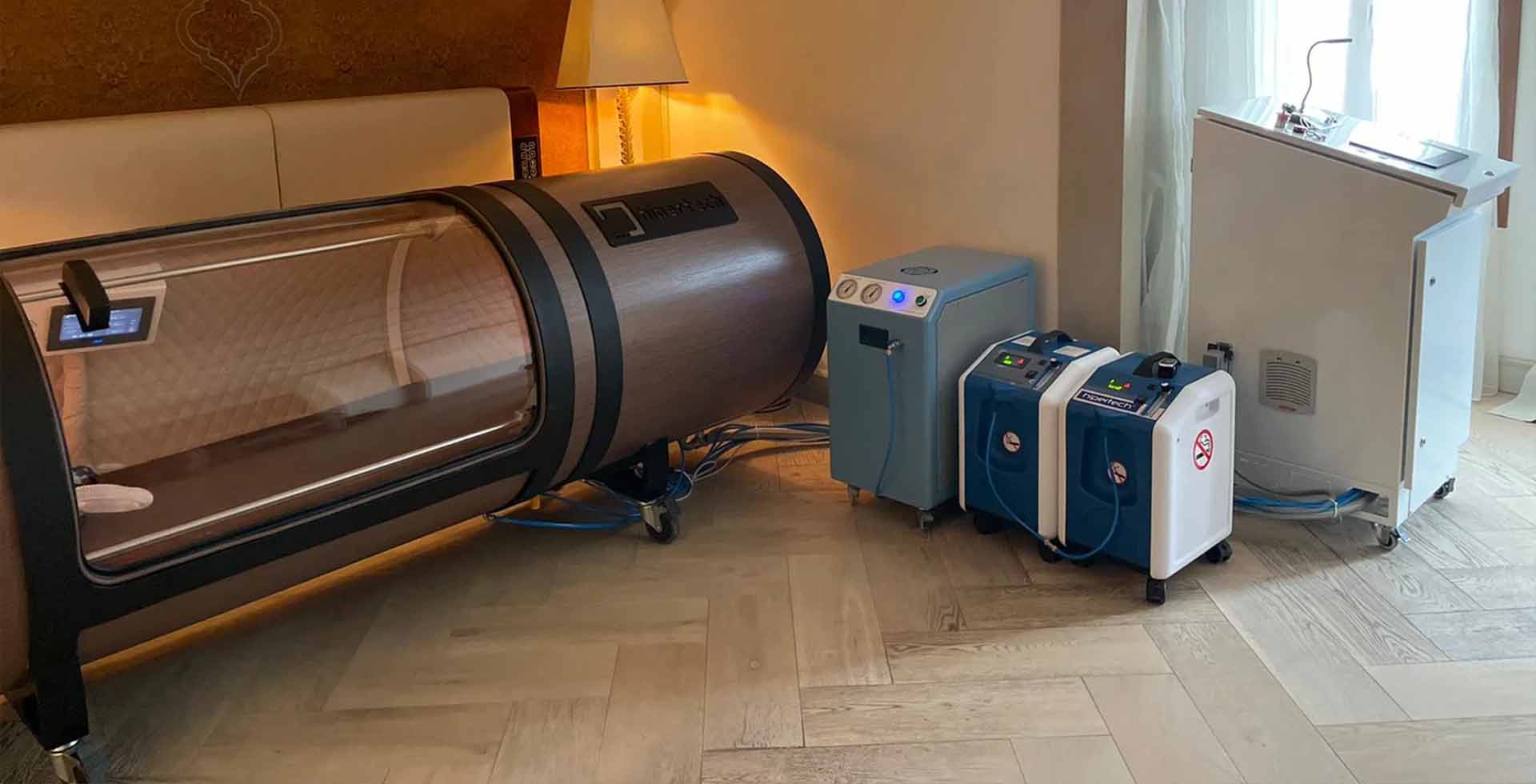
A soft-shell chamber still sets requirements on the room: a clear floor area of the footprint plus roughly 700 mm all round, 2.4 m clear ceiling height, a flat snag-free floor with no thresholds, a conditioned space, continuous fresh air, a dedicated circuit and the compressor sited outside the room.
A portable soft-shell chamber is sold as an object that needs nothing but a floor, which is why so many end up in rooms that fight them. It is lighter and it does not need a crane, but it still sets a list of requirements on the space around it.

| What the room provides | Portable / soft-shell chamber | Fixed hard-shell chamber | Why it matters here |
|---|---|---|---|
| Clear floor area | A footprint plus roughly 700 mm all round for entry, assistance and servicing | The chamber footprint plus a service side and a seated operator position | Soft-shell chambers are entered from the side and need the zip run kept clear |
| Ceiling height | 2.4 m clear, more where the unit is inflated from a folded state | Set by the vessel and its lifting points | A low soffit or a ceiling fan over the unit is a common late discovery |
| Floor | A flat, level, snag-free surface with no thresholds under the shell | A slab checked for the point loads of a rigid vessel | Soft shells are punctured by what is under them, not by what is around them |
| Ambient temperature and humidity | A conditioned room; the compressor and the occupant both add heat | The same, plus heat rejection from a larger plant | In this climate an unconditioned room defeats the session before the pressure does |
| Ventilation | Continuous fresh air to the room, not just to the chamber | Designed air changes with the oxygen plant handled separately | Oxygen-enriched air must not be allowed to accumulate in an enclosed room |
| Power | A dedicated, correctly rated circuit for the compressor and the concentrator | A designed supply coordinated with the utility | Compressors on a shared circuit trip the room mid-session |
| Acoustics | The compressor sited outside the room, or in an acoustically treated enclosure | Plant in a separate, accessible plant space | Compressor noise is the single most common complaint after handover |
| Access route | Standard doorways | Door widths, lift capacity and turning circles surveyed before ordering | A rigid vessel that cannot reach its room is an expensive object in a corridor |
The pattern is consistent: a soft-shell chamber transfers its demands to the room’s services and finishes, and a hard-shell chamber transfers them to the structure and the access route. Both are room design problems before they are equipment problems, which is the same logic that governs the plant behind a infrared sauna cabin or a chilled cold plunge pool in the same circuit.
Buying a hyperbaric chamber in the UAE — the specification questions that decide the room
The room is decided by 9 specification questions asked before an order is placed: working pressure in ATA, shipping and operating weight, external dimensions against the smallest opening, the air source, concentrator or bulk oxygen, heat rejection in kW, noise at the operator position, the UAE service interval, and the documentation shipped.
We do not manufacture chambers. We design and build the rooms that house them, which means we spend a lot of time reading other people’s specification sheets on behalf of clients. These are the questions worth asking a supplier before an order is placed, and what each answer changes about the build.

- What is the working pressure rating, in ATA? It sets the vessel class, the certification route and, in turn, which approvals the intended use triggers.
- What is the shipping weight and the operating weight? Operating weight includes occupants and any water or ballast. The structural check is run against the operating figure.
- What are the external dimensions with the door open, and what is the smallest opening the unit can pass through? This is the access survey in one question, and it is the one most often skipped.
- Where does the air come from — an integral compressor, a remote compressor, or a building supply? A remote compressor moves the noise and the heat out of the room and changes the plant space requirement completely.
- Concentrator or bulk oxygen? A concentrator is an appliance. Bulk oxygen storage is a Civil Defence conversation, a fire-rated store and a route, and it should be settled at concept stage, not at fit-out.
- What is the heat rejection into the room, in kW? Without this figure the room’s cooling cannot be sized, and in this climate an under-cooled chamber room is unusable in summer.
- What are the noise levels at the operator position and at one metre from the compressor? These numbers set the acoustic build-up of the partitions.
- What is the service interval, and who performs it in the UAE? A vessel with no local service presence is a maintenance problem waiting for its first year.
- What documentation ships with it? Certification, O&M manual, commissioning records and warranty terms. If they are not listed in the quotation, they are not in the price.
Whether a client buys a hard-shell chamber for a clinic or a portable soft-shell unit for a private wellness room, the design work is the same: establish the answers above, then draw the room, the plant space, the access route and the services around them before anything is ordered. That is the order in which a hyperbaric chamber suite is delivered on programme.
What drives the cost of a hyperbaric oxygen chamber in Dubai?
The chamber is 50 to 70 percent of the finished project; room engineering, oxygen plant and approvals carry the rest. On a clinical multiplace suite that puts the whole job at roughly 1.4 to 1.7 times the vessel price. The drivers, in order, are chamber type and pressure rating, oxygen source, room engineering and approvals.
Cost is driven by chamber type and pressure rating, the oxygen source, the room engineering around it, and the approvals the intended use triggers. We price each project against its own drawings rather than a rate card. Soft-shell wellness chambers sit well below clinical systems, while clinical hard-shell systems cost considerably more once the chamber, oxygen plant, room engineering and approvals are included. The chamber itself is often only 50 to 70 percent of the finished project cost.
What additional costs should you budget for?
- Room engineering, finishes, and acoustic isolation
- Oxygen plant, storage, and Civil Defence compliance
- DEWA electrical and dedicated circuits
- DHA facility licensing (clinical use): professional and authority fees vary
- Crane lift or access modification
For a clinical multiplace suite, budget total project cost at roughly 1.4 to 1.7 times the chamber price, because oxygen engineering, fire safety, and room construction carry substantial weight in a compliant Dubai build.
How do you integrate an HBOT chamber into a luxury wellness or contrast-therapy circuit?
Oxygen is one station in a sequence, not a room on its own. At residential scale the whole circuit sits in about 30 m², holding a soft-shell monoplace chamber, a compact infrared cabin, a plunge at 6 to 8 °C and a seated recovery position, with compressor and chiller outside the conditioned envelope.
The most effective Dubai wellness facilities position HBOT as one station within a sequenced circuit rather than a standalone room. A typical longevity or recovery circuit moves the user through heat (sauna or infrared), cold (cold plunge), and oxygen (HBOT), each phase complementing the others. Designing these together, with shared changing, relaxation, and hydration zones, is what turns a collection of devices into a coherent luxury experience.
There is a practical engineering logic to integration as well. Grouping the high-load, climate-sensitive equipment, the chamber, the compressors, the cold-therapy plant, into a coordinated services strategy keeps electrical, ventilation, and acoustic demands contained and serviceable. This is the same systems-level thinking we apply to every full wellness suite, and it is why a spa developer approach outperforms buying equipment piecemeal.
At residential scale the same logic produces a compact recovery room rather than a clinic. A typical private brief is a single space of roughly 30 m² carrying a soft-shell monoplace chamber, a compact infrared cabin, a plunge held at 6–8 °C and a seated recovery area with warm, dimmable lighting. What makes that work is not the equipment list but the sequencing and the services: the compressor and the chiller sited outside the room, one conditioned envelope, and short enough distances between the three stages that the circuit is completed rather than abandoned halfway.
For clinics and recovery centers, the same integrated approach applies at larger scale. We have designed commercial spa and clinic wellness floors where a multiplace HBOT suite anchors a circuit that includes saunas, cold therapy, and treatment rooms, engineered as one facility from the shell stage rather than retrofitted device by device.
What are the safety considerations and contraindications for HBOT?
HBOT needs medical screening and supervision. The absolute contraindication is an untreated pneumothorax; relative ones include certain chemotherapy drugs, recent ear or chest surgery, uncontrolled fever, specific lung conditions and severe claustrophobia. Ear and sinus barotrauma are the common side effects, and oxygen toxicity is one reason clinical therapy at 2.0 to 3.0 ATA runs under licensed supervision.
HBOT is generally safe when properly screened and supervised, but it carries real contraindications and risks that demand medical oversight, especially at clinical pressures. The most important absolute contraindication is an untreated pneumothorax (collapsed lung). Relative contraindications include certain chemotherapy drugs, recent ear or chest surgery, uncontrolled high fever, specific lung conditions, and severe claustrophobia. Anyone with a medical condition should be cleared by a physician before any HBOT session.
The most common side effects are ear and sinus barotrauma from pressure changes, temporary short-sightedness that usually resolves after treatment stops, and claustrophobia inside the chamber. At higher pressures and oxygen concentrations, oxygen toxicity becomes a genuine risk, which is one of the central reasons clinical-grade HBOT must operate under DHA-licensed medical supervision rather than as an unsupervised consumer device. For residential wellness installations, we always recommend physician screening and clear operating protocols, regardless of chamber type.
Frequently asked questions about hyperbaric oxygen chambers in Dubai
The 8 questions below are the ones asked before a Dubai chamber is ordered: villa and apartment installation, DHA licensing, soft-shell against hard-shell pressure ratings, session length of 60 to 90 minutes, the anti-aging evidence, room and access dimensions, who builds the room, and circuit integration.
Can you install a hyperbaric oxygen chamber in a Dubai villa or apartment?
Yes. Soft-shell and compact monoplace chambers are installed in Dubai villas and penthouses as private wellness amenities, needing a dedicated electrical circuit, a climate-controlled room, and owners’ association approval. Clinical-grade high-pressure systems are better suited to DHA-licensed facilities.
Is a licence required to operate an HBOT chamber in Dubai?
A licence is required to offer HBOT as a paid medical or therapeutic service, through Dubai Health Authority (DHA) facility licensing. A private chamber used as a personal wellness amenity in your own home is treated differently, but oxygen storage and electrical work must still meet Dubai Civil Defence and DEWA requirements.
What is the difference between a soft-shell and hard-shell hyperbaric chamber?
A soft-shell chamber operates at mild pressures of 1.3 to 1.5 ATA for general wellness, while a hard-shell chamber reaches clinical pressures of 2.0 to 3.0 ATA with 100 percent oxygen. Most published medical benefits come from hard-shell therapy at 2.0 ATA and above.
How long is a typical HBOT session?
A typical session lasts 60 to 90 minutes, not including the gradual pressurisation and depressurisation phases. Wellness and longevity protocols often involve repeated sessions over several weeks, while medical protocols are defined by the treating physician.
Is hyperbaric oxygen therapy proven for anti-aging?
The evidence is promising but early. A 2020 trial reported increased telomere length and reduced cell senescence after a 60-session protocol, but anti-aging use remains off-label rather than a regulator-approved indication. It should be approached as emerging wellness science, not established medicine.
How much space does a home hyperbaric chamber need?
A monoplace chamber needs a room of at least 2.5 m by 2.5 m with clearance for access and servicing. Multiplace chambers need roughly 4 m by 6 m plus a separate plant room. Door, lift, and corridor access for the rigid chamber is usually the tightest constraint.
Does Sauna Dekor manufacture hyperbaric chambers?
No. We are a luxury wellness facility designer and integrator. We design and build the rooms that house hyperbaric chambers, engineer the electrical, ventilation, and oxygen-safety services, and integrate the chamber into a wider wellness or contrast-therapy circuit alongside saunas, cold plunges, and treatment rooms.
Can an HBOT chamber be combined with a sauna and cold plunge?
Yes, and this is the most popular configuration for longevity and recovery facilities in Dubai. Oxygen, heat, and cold are sequenced into a single circuit with shared relaxation and changing zones, designed and engineered together for both experience and serviceability.
Sources
The 3 sources below are the documents this page rests on: the 2020 Hachmo prospective trial on telomere length in Aging, the Undersea and Hyperbaric Medical Society list of approved indications, and the US Food and Drug Administration notice on hyperbaric oxygen therapy claims.
- Hachmo, Y., Hadanny, A., Abu Hamed, R., et al. (2020). Hyperbaric oxygen therapy increases telomere length and decreases immunosenescence in isolated blood cells: a prospective trial. Aging, 12(22), 22445-22456. PMC
- Undersea and Hyperbaric Medical Society (UHMS). Hyperbaric Oxygen Therapy Indications. uhms.org
- US Food and Drug Administration (FDA). Hyperbaric Oxygen Therapy: Get the Facts. fda.gov
Ready to design a hyperbaric oxygen suite in Dubai? Whether you are planning a soft-shell chamber for a Palm Jumeirah wellness room, a clinical multiplace suite for a Jumeirah anti-aging clinic, or a full longevity circuit combining oxygen, heat, and cold, our Dubai team brings 40 years of wellness facility engineering. Hotel and resort references include Hilton (Hilton Bomonti Istanbul, 2023) and Ritz-Carlton (Ritz-Carlton Istanbul, 2024); developer and contractor clients include Emirates Engineering. Request a free consultation and we will provide an access survey, room and oxygen engineering, DHA and Civil Defence coordination, a costed proposal, and a design that fits your space and brand.


