

Last updated: September 2026
Short answer: Sauna heater sizing is two calculations that disagree with each other. The first converts cabin volume into kilowatts and answers how fast the air gets hot. The second sets the mass of stone on the heater and answers how the room behaves once it is hot. Manufacturers publish both, in the same table, and they do not scale together: on EOS’s own data a 9.0 kW cabinet heater carries 15 kg of stone while a 30 kW commercial unit carries 120 kg, which is 1.7 kg per kW against 4.0 kg per kW.
That gap is the whole subject. Almost every disappointing sauna we are asked to look at was sized correctly by the first calculation and wrongly by the second: the right kilowatts, too little stone, and a room that reaches temperature quickly and then cannot hold it through a bench full of people. This guide works through the volume calculation, the surface corrections that quietly enlarge it, what stone mass actually buys, how the two rules pull apart, and what the electrical supply has to be by the time the answer is fixed. We build sauna cabins as a turnkey contractor, so the heater choice and the cabin that has to live with it are the same decision for us.
What is sauna heater sizing, and which two rules does it contain?
Sauna heater sizing is the process of turning a cabin into 2 numbers: an electrical output in kilowatts and a stone charge in kilograms. The first is fixed by volume and by the surfaces enclosing it. The second is fixed by how the room will be used. On EOS’s published range those 2 numbers move independently across at least 4 heater families.
Most people only meet the first number, because it is the one on the order. Ask a supplier for a heater for a 10 m³ cabin and you will be given a kilowatt figure within seconds. Ask what stone charge that heater carries and how long it holds heat after the door opens, and the conversation slows down, because that answer depends on what happens in the room rather than on its dimensions.

Both numbers are published by the people who make the equipment, and they are published together. The mistake is not that the data is hidden. The mistake is reading the volume column, stopping there, and treating the stone column as a packaging detail rather than as the second half of the specification.
How does the kW per cubic metre rule actually work?
It works backwards from a table, not forwards from a formula. Manufacturers publish a volume band against each output and expect you to land inside it. EOS lists its 46.U series as 6.0 kW for 6 to 8 m³, 7.5 kW for 7 to 10 m³, 9.0 kW for 9 to 14 m³ and 12.0 kW for 14 to 18 m³.
Notice what those bands do. They overlap. A 9 m³ cabin is inside the band for 7.5 kW and inside the band for 9.0 kW, and the table does not tell you which to pick, because the table cannot see your walls. The overlap is where sauna heater sizing stops being arithmetic and starts being a judgement about the specific room, and it is the first place a specification goes soft.
EOS is explicit about that limit on its own heater finder: “The determined power range is only an initial guideline value, which may vary depending on the building materials used in the cabin. For the exact determination of the power range, please speak to your sauna cabin manufacturer.” That sentence is doing more work than it looks. It hands the decision from the appliance maker to whoever builds the box.
Is 1 kW per cubic metre a rule, or a ceiling?
A ceiling. Divide the published outputs by the published volumes and 1 kW per m³ turns out to be the top edge of the band, reached only at the small end. EOS’s 7.5 kW model covers 7 to 10 m³, which is 1.07 down to 0.75 kW per m³; the 30 kW commercial unit covers 45 to 65 m³, which is 0.67 down to 0.46.
Run the whole EOS set and the trend is one-directional. The 46.U at 6.0 kW gives 1.00 to 0.75 kW per m³. The Herkules S25 at 9.0 kW covers 10 to 14 m³, so 0.90 to 0.64. The Herkules XL S120 HD at 18.0 kW covers 24 to 35 m³, so 0.75 to 0.51. Bigger rooms are consistently given less power per cubic metre, not more, which is the opposite of what most sauna heater sizing rules of thumb imply.
| EOS heater | Output | Published volume | kW per m³ | Stone charge | kg per kW |
|---|---|---|---|---|---|
| 46.U Compact | 6.0 kW | 6–8 m³ | 1.00–0.75 | 10 kg | 1.7 |
| 46.U | 9.0 kW | 9–14 m³ | 1.00–0.64 | 15 kg | 1.7 |
| Herkules S25 | 9.0 kW | 10–14 m³ | 0.90–0.64 | 25 kg | 2.8 |
| Herkules XL S120 HD | 18.0 kW | 24–35 m³ | 0.75–0.51 | 120 kg | 6.7 |
| Herkules XL S120 HD | 30.0 kW | 45–65 m³ | 0.67–0.46 | 120 kg | 4.0 |
The kW per m³ and kg per kW columns are ours, divided out of the manufacturer’s published figures rather than taken from them. They are arithmetic, not a claim. What the arithmetic shows is that the 2 halves of sauna heater sizing move in opposite directions as rooms get larger, and that is not an accident of one brand’s catalogue.
How do you measure the cabin volume that goes into the calculation?
Internal finished dimensions, floor to ceiling, including the volume under the benches. A 2.0 by 2.0 m cabin with a 2.1 m ceiling is 8.4 m³, not 8.0, and not the 6.5 m³ you get if you subtract the bench boxes. Every published volume band used in sauna heater sizing assumes the gross internal figure.
Two errors recur. The first is using structural dimensions instead of finished ones, which on a 2 m wide cabin with battens, insulation and cladding on both faces can cost 200 mm of width. The second is measuring to a suspended ceiling that is not yet drawn, then building to the slab, which adds several hundred millimetres of height that nobody accounted for.
Height matters more than width here because the hot layer sits at the top. A cabin with a 2.4 m ceiling has the same footprint as one at 2.0 m and roughly 20% more volume, and the extra volume is all in the zone that has to be hottest. When the ceiling is above about 2.2 m, sauna heater sizing should be checked twice before the order goes out.
How much does a glazed front add to sauna heater sizing?
Enough that every manufacturer asks about it before it asks anything else. Harvia’s sauna calculator takes room width, height and depth, then asks 3 further questions: whether the build is log, whether there is a glass door, and how many square metres of non-insulated wall there are. Glazing is 1 of only 3 corrections it collects.
Harvia states the reason plainly: “The volume and structures of the sauna affect the selection of heater power. The power requirement increases if there are window surfaces or heat-storing surfaces such as brick, concrete or massive logs in the sauna.” Glass is a window surface and a heat-storing surface at the same time, which is why a fully glazed front is the single largest correction most cabins carry.

In practice we treat a glazed elevation as a surface that must be paid for twice. It loses heat faster than an insulated wall while the room is warming, and it stores heat in the frame and the panel once the room is hot, so the cabin is slower to reach temperature and slower to recover after the door opens. Handling that with kilowatts alone produces a heater that overshoots at the bench.
What do stone, brick and concrete surfaces do to the answer?
They add thermal mass to the room envelope, which behaves exactly like adding volume. Harvia’s own wording puts brick, concrete and massive logs in the same sentence as window surfaces, as things that increase the power requirement. A single split-face stone feature wall of 4 or 5 m² is a significant sauna heater sizing correction in a cabin of 10 m³.
The physics is the same as for the stones on the heater, only in the wrong place. Rock has a specific heat capacity of roughly 0.84 kJ per kg per kelvin, so every kilogram of stone on the wall has to be dragged up to working temperature before the air will settle. Unlike the heater’s stones, that mass gives nothing back into the room as steam.
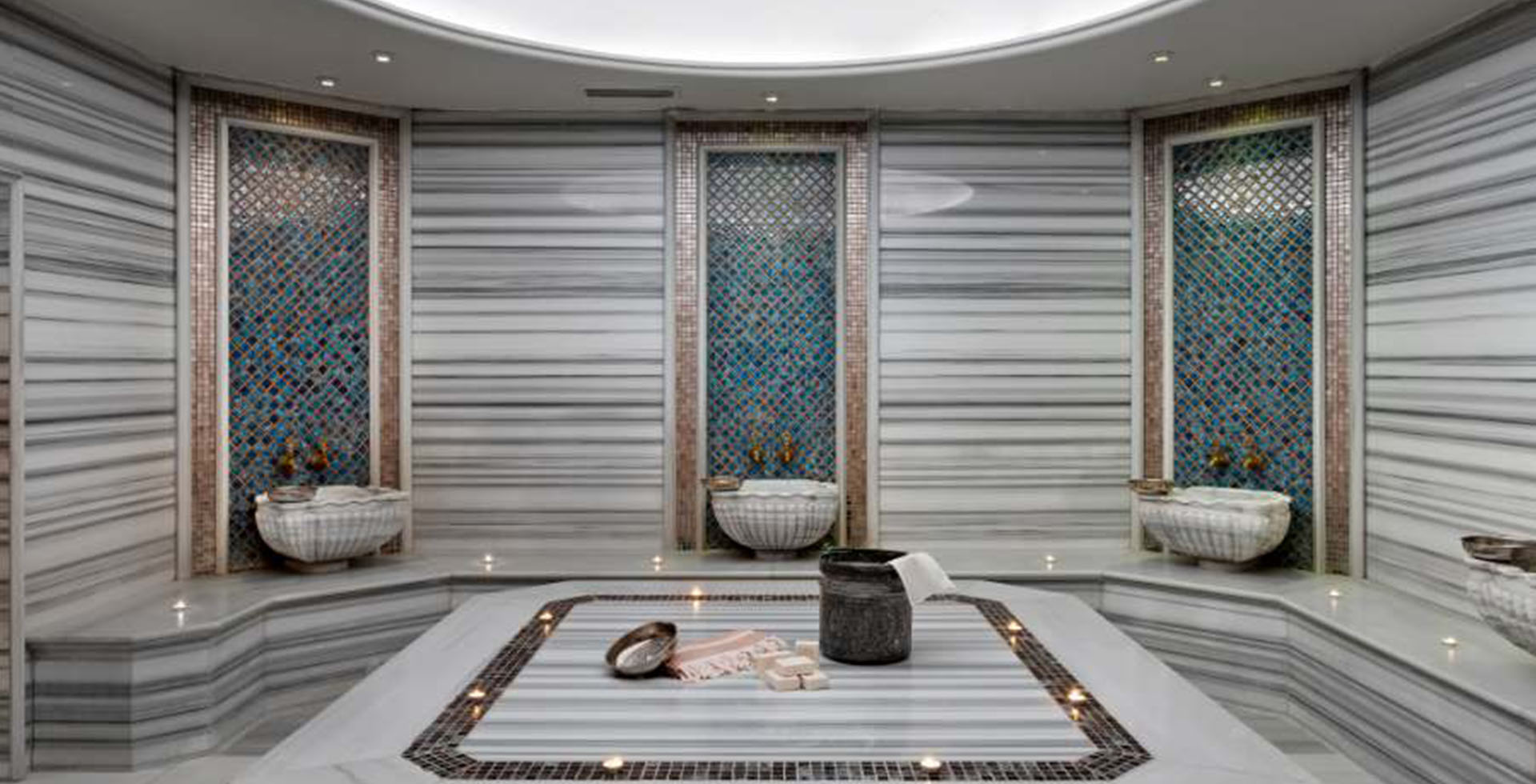
Designers reach for stone and concrete inside saunas constantly, and we are not arguing against it. The same feature walls appear in the Turkish hammam rooms we build, where heated masonry is the entire point. In a sauna it simply has to be declared before the heater is chosen, not discovered after the first commissioning run.
Why is an uninsulated wall counted as extra volume instead of extra loss?
Because the correction has to survive being used by non-engineers, and volume is the only unit the rest of the table is already in. Harvia asks for non-insulated wall area in m² and folds it into the same calculation that produced the volume figure, so 1 output column can carry both.
It is a simplification and it is worth knowing that it is one. A genuine heat-loss calculation would treat conduction through the envelope and the thermal mass of the envelope separately, because they act on different timescales. Folding both into an effective volume gives a single conservative answer instead of 2 precise ones, which is the right trade for a catalogue.
The failure mode is asymmetric, and that is the point. Under-sizing gives a cabin that never reaches its setpoint with a full bench, which is unfixable without replacing the heater and possibly the supply. Over-sizing by one step gives a cabin that cycles more often. Sauna heater sizing corrections are deliberately built to fail in the second direction.
What does the stone charge do that kilowatts cannot?
It stores energy at a temperature high enough to flash water instantly, and it releases that energy in seconds rather than minutes. A 25 kg charge on a 9 kW heater holds roughly 6 times more usable thermal mass than the air in a 12 m³ cabin, and it is the only part of the system that can respond to a ladle of water.
Kilowatts are a rate. Stone mass is a reservoir. An element can deliver its rated output continuously, but it cannot deliver 10 times that output for 20 seconds, which is precisely what happens when water hits the charge and the room needs to recover. Without mass, the element chases the thermostat and the bench feels the dip.
This is why the same 9.0 kW output appears on 2 different EOS heaters with 15 kg and 25 kg of stone, covering almost the same volume band. They are not 2 versions of the same product. They are 2 different sauna heater sizing answers to the question of what the room is for, sold at the same electrical rating.

How much energy does the stone charge absorb before the room is usable?
Enough to account for a measurable share of the heat-up. Using a specific heat capacity of 0.84 kJ per kg per kelvin for rock, a 25 kg charge absorbs 25 × 0.84 × 100 = 2,100 kJ for every 100 K of temperature rise. That is 0.58 kWh per 100 K, and around 1.75 kWh for a 300 K rise.
Put that against the heater. A 9 kW element delivers 9 kWh in an hour, so 1.75 kWh is about 12 minutes of its full output going into stone alone, before any of it reaches the air, the timber or the losses. Scale to the 120 kg charge on the commercial unit and the same 300 K rise takes 8.4 kWh, which is roughly 17 minutes of a 30 kW heater running flat out.
Those figures are arithmetic from a published material constant, not measurements of a specific cabin, and the real number in any room is higher because the stones do not all reach the same temperature. They are still the cleanest way to see why a heavy charge cannot be treated as an accessory. It is a load, and it is on the critical path of every heat-up.
Why do the kilowatt rule and the stone mass rule pull in opposite directions?
Because they optimise for different moments. Kilowatts optimise for the first 45 minutes, when nobody is in the room. Stone mass optimises for the next 3 hours, when people are. Across the EOS range, kW per m³ falls from about 1.00 to 0.46 as rooms grow, while stone per kW rises from 1.7 kg to 4.0 kg.
Read that as a design statement rather than a coincidence. A domestic cabin is used once or twice, by 2 people, with the door opened rarely; it needs to get hot fast and does not need a reservoir. A hotel sauna runs 14 hours with the door opening every few minutes; it needs a reservoir far more than it needs a fast start, because it never gets to start twice.
The conflict becomes a problem when a room is specified on one logic and used on the other. A domestic-pattern heater in a shared cabin is the single most common thing we are called to look at: correct kilowatts, correct volume band, 15 kg of stone, and a room that cannot hold 80 °C once 4 people and an open door are in the equation.
How long should a sauna take to heat up, and what sets that time?
The only figure worth quoting is a measured one. Harvia ran a 10 m³ sauna and reported the temperature after 1 hour: around 70 °C with new, loosely laid stones and around 60 °C with new, tightly stacked ones. Same cabin, same hour, same heater, 10 degrees apart, with no sauna heater sizing decision involved at all.
That measurement is more useful than any rule of thumb because it isolates a single variable. Nothing about the cabin, the output or the volume changed between the 2 runs. The only difference was how the charge was laid, and it moved the 1-hour temperature by an amount that most people would blame on the heater being undersized.
It also sets the honest limit on what anyone can promise. We do not quote a heat-up time for a cabin we have not built, because the answer depends on the stone charge, how it is laid, the glazing, the wall mass and the air path, and 4 of those 5 are decided after the heater is ordered. What we can promise is that all 5 are settled in one drawing before the order goes out.
How much difference does the way the stones are laid make?
More than the difference between 2 heater models, and it costs nothing. In the same Harvia test, the maximum element temperature was about 580 °C with new, loosely laid stones, 640 °C with old, loosely laid stones and 680 °C with old, tightly stacked ones — a 100 °C spread driven entirely by packing and age.
Element temperature is service life. An element running 100 °C hotter than it needs to is being asked to do the same job under worse conditions, and the reason it is hotter is that the heat cannot get away from it. Tightly stacked stones block the convection path that is supposed to carry energy off the element and into the room.
So the charge has 2 jobs that constrain each other: store energy, and let air through. That is why a stone charge is specified by mass and laid by hand, largest stones at the bottom, no stone wedged against an element, gaps left deliberately. It is also why an annual check matters, and why no sauna heater sizing exercise survives a charge that is never relaid: the Harvia test had old stones losing 10 degrees of room temperature against new ones.
What electrical supply does the heater you have chosen need?
Three-phase, on everything above the smallest domestic models. EOS specifies 400 V 3N~ 50/60 Hz across the 46.U, Herkules S25 and Herkules XL S120 HD ranges alike, with control-unit fuse protection of 3 × 16 A on the mid-range units and power unit protection rising to 3 × 63 A on the 30 kW machine.
The arithmetic behind those fuses is worth doing once. A 9 kW load on a 400 V three-phase supply draws 9,000 ÷ (1.732 × 400) = 13.0 A per phase, which is why a 16 A protective device appears. A 30 kW load draws 30,000 ÷ (1.732 × 400) = 43.3 A per phase, which is why the same manufacturer’s table jumps to 63 A for that model.
This is the part of sauna heater sizing that cannot be corrected later without opening walls. The cable route, the cross-section, the isolator position and the protective device all follow from the output, and the output follows from a volume figure that is often still being argued about when the electrical first fix is programmed. On our own projects the heater schedule is issued to the electrical contractor before the cabin is ordered, not after.
What changes when the sauna is commercial rather than domestic?
The duty cycle, and everything that follows from it. A domestic cabin might run 4 hours a week; a hotel sauna runs 14 hours a day, every day. EOS reflects that by publishing separate heater families for small-scale and large-scale commercial projects, with the 120 kg charge appearing only in the latter.
The visible consequences are stone mass, element redundancy and controls. The less visible one is that a commercial room never cools down, so the envelope is at working temperature permanently and the heater is only making up losses and recovery. That is exactly the condition in which a low kW per m³ figure with a heavy charge outperforms a high one with a light charge.
It also changes who carries the risk. In a hotel the heater is part of a facility with an operating programme, and the sizing has to match that programme rather than the room. This is the point at which sauna heater sizing stops being a product question and becomes part of turnkey spa contracting, alongside the cabin, the ventilation and the electrical design.
How does ventilation change the sizing answer?
It sets a floor under the heater that most volume calculations ignore. EOS publishes minimum inlet and outlet openings alongside each output: 35 × 4 cm up to 35 × 7 cm across the 46.U range, and 50 × 6 cm up to 50 × 10 cm on the 30 kW unit. Those are free areas the cabin has to provide.
Air moving through those openings carries heat out of the room continuously. A cabin built with the openings the manufacturer requires loses more energy than one that is sealed, and that loss is a permanent part of the load rather than a start-up cost. Under-sizing the heater and then choking the vents to compensate is a trade we see attempted regularly and it fails in both directions.
The openings also decide where the heat goes. An inlet low behind the heater and an outlet diagonally opposite under the top bench produces a circulation that puts the hottest air where people sit. The same heater with the outlet next to the door heats the corridor. Neither arrangement changes the kilowatt figure that sauna heater sizing produced, and only 1 of them produces a sauna.
Which standard covers the heater itself, and whose certificate is it?
The product standard is EN 60335-2-53, and the certificate belongs to the manufacturer of the appliance, never to the contractor who installs it. The current British adoption is BS EN 60335-2-53:2011+A11:2023, a 42-page document published on 30 June 2023 that the appliance manufacturer declares against, titled “Household and similar electrical appliances — Safety — Particular requirements for sauna heating appliances and infrared cabins”.
You can see the ownership directly in the paperwork. EOS Saunatechnik GmbH of Driedorf publishes an EU declaration of conformity for its 46.U sauna heating appliance which lists DIN EN 60335-1, DIN EN 60335-2-53 and DIN EN 62233 as the standards applied, cites the EMC and Low Voltage Directives, and states in terms that the declaration “is submitted on behalf of the manufacturer/importer”. It is signed by that manufacturer’s head of development, and the certification it carries belongs to the manufacturer.
We say this plainly because it is the most common piece of confusion in a spa tender. A contractor who lists the heater’s compliance marks on its own letterhead is claiming something it does not hold. Our certificate is TS EN ISO 9001:2015; the appliance certificates belong to EOS, Harvia, Sentiotec and their peers, and we quote them as theirs. Sauna heater sizing is our responsibility; certifying the appliance is not.
What are the 6 most common sauna heater sizing mistakes?
Six, in the order we meet them. Using structural rather than finished internal dimensions. Ignoring the glazed elevation. Ignoring interior masonry. Reading only the volume column. Specifying a domestic stone charge for a shared room. Fixing the electrical supply before the output is final. Every one of the 6 sauna heater sizing errors is free to avoid at drawing stage.
- Structural dimensions instead of finished ones. Battens, insulation and cladding on both faces can take 200 mm off a 2 m width, and the volume band is defined on the finished internal box.
- The glazed elevation left out. Manufacturers ask about glazing before they ask about anything else; a fully glazed front is usually the largest single correction a cabin carries.
- Interior masonry left out. A 4 or 5 m² feature wall of split-face stone inside a 10 m³ cabin is thermal mass the volume figure cannot see.
- Reading the volume column only. The stone column sits beside it in the same table and answers a different question, and 15 kg against 25 kg at the same 9.0 kW is not a packaging difference.
- A domestic charge in a shared room. The light-charge heater is correct for a cabin used twice a week and wrong for one with a door opening every few minutes.
- Electrical first fix ahead of the final output. The cable, the isolator and the protective device follow the kilowatts, and 43.3 A per phase is not a change you make after the walls close.
None of these is exotic and none of them is a manufacturer’s fault. Every figure needed to avoid them is published, in English, on the pages listed at the end of this article. What the published data cannot do is measure your cabin, and that is the part that has to happen on a drawing before anything is ordered.
If you are working on a Gulf project where the cabin sits inside a conditioned space and the plant room is already crowded, our spa contracting work in Dubai takes the heater schedule, the ventilation openings and the electrical supply as one package. You can see the rest of the rooms it has to sit alongside in our sauna, hammam and steam room product range, and if the cabin is being drawn now, send your sauna drawings to our design office before the heater is ordered.

Who is writing this
Sauna Dekor has been building wellness and thermal facilities since 1987 and is now in its 40th year, manufacturing in its own Istanbul facility with a team of 19, working under TS EN ISO 9001:2015, with projects delivered in more than 35 countries. On saunas we work turnkey: the cabin, the timber, the benches, the ventilation, the glazing, the electrical coordination and the commissioning.
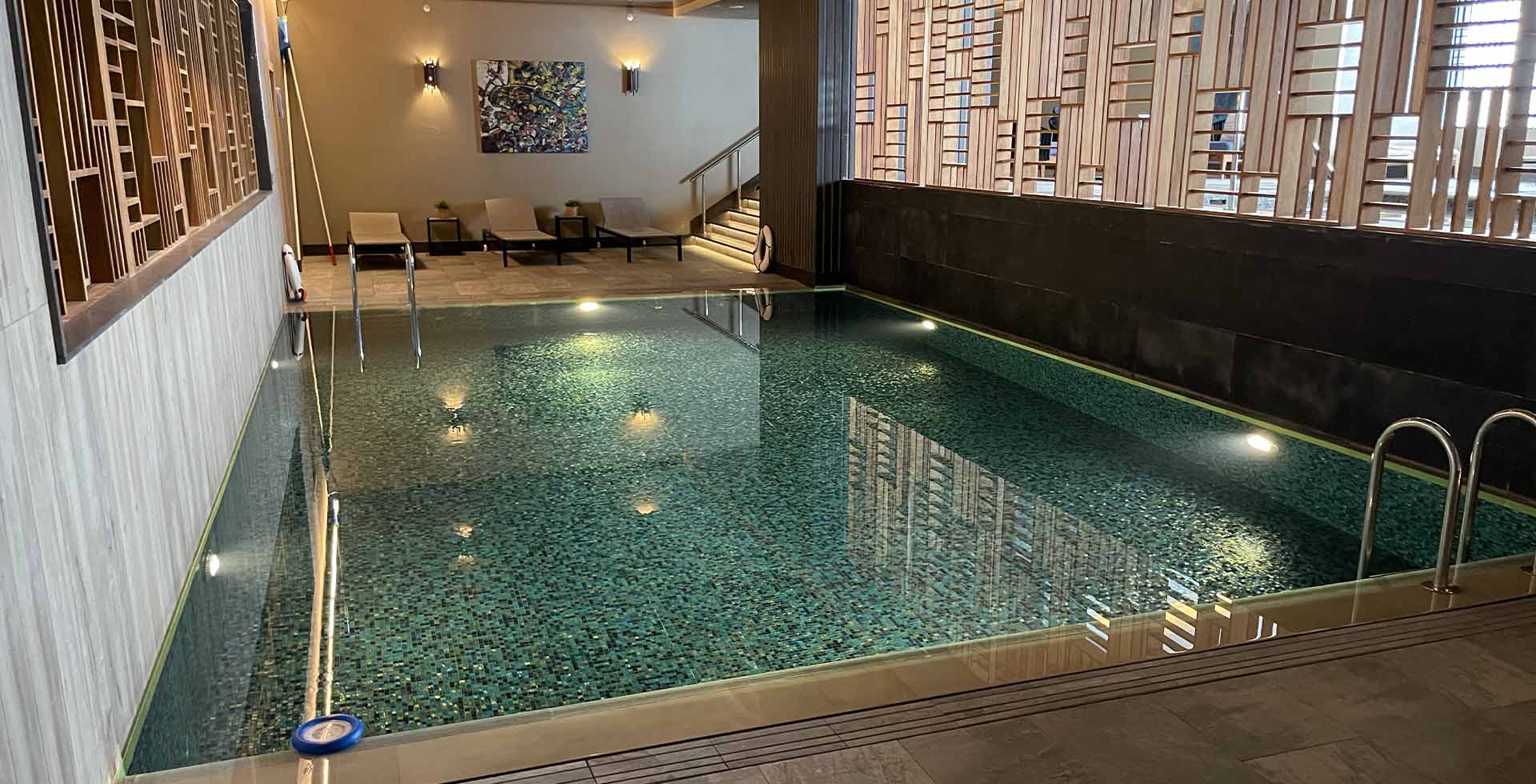
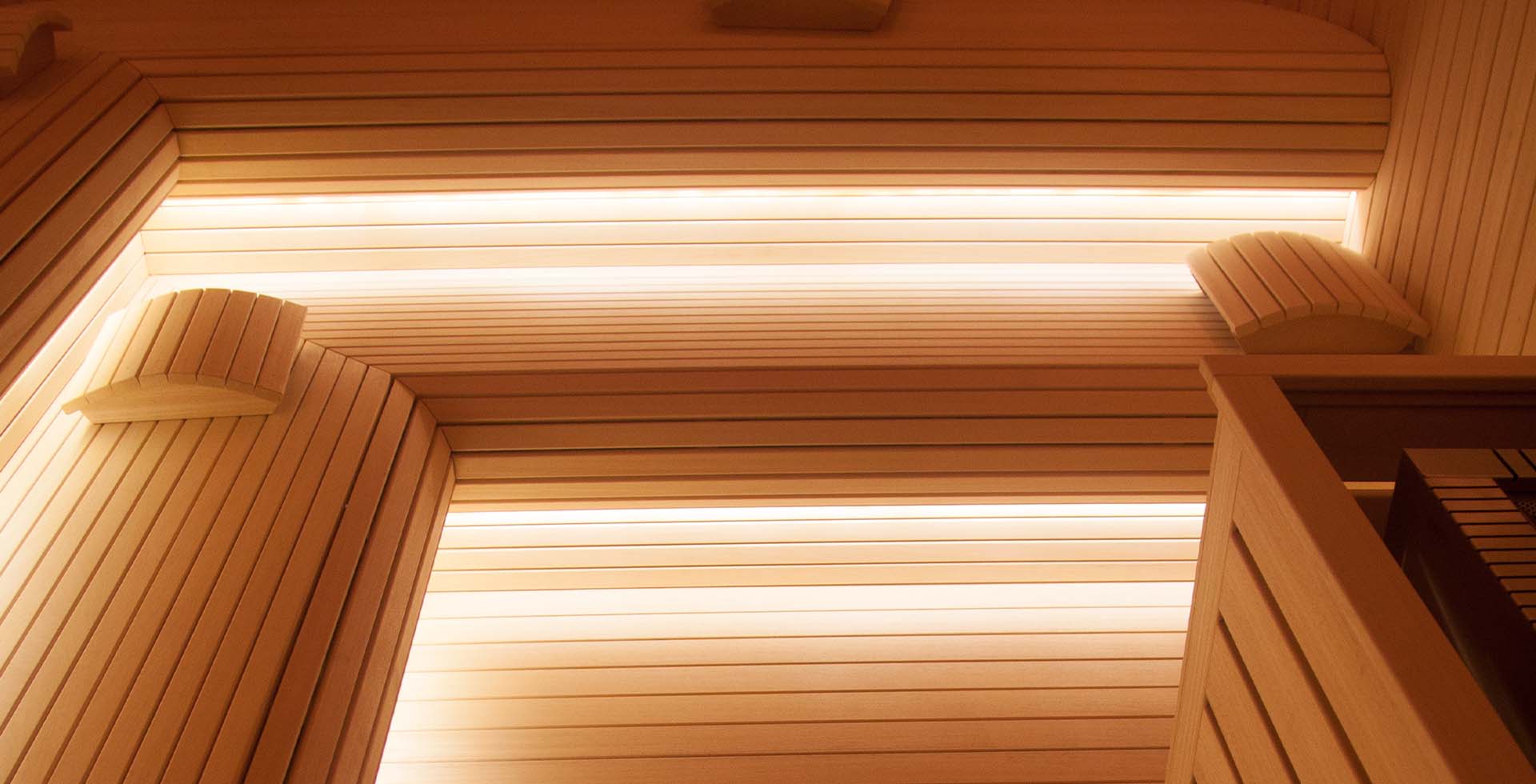
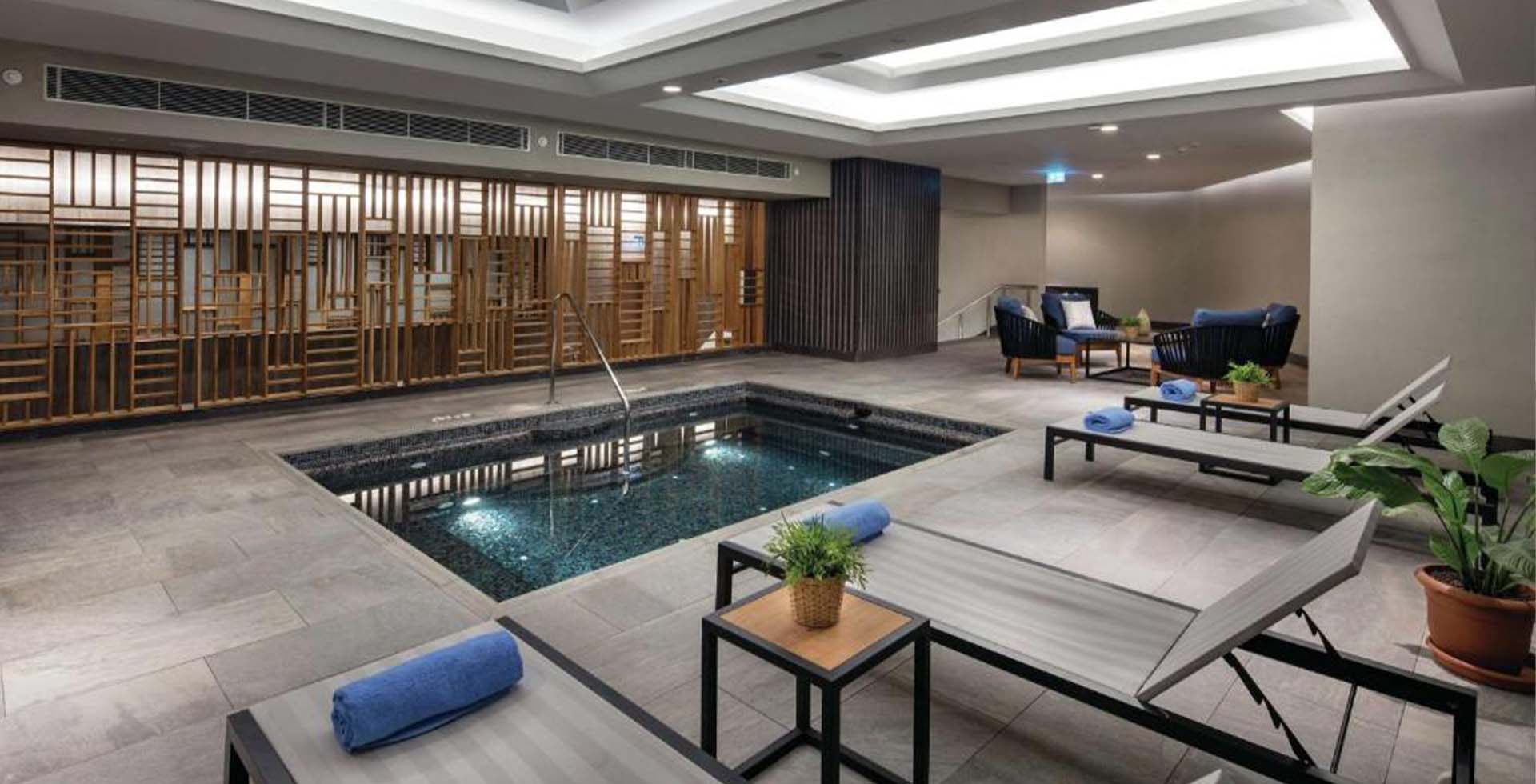
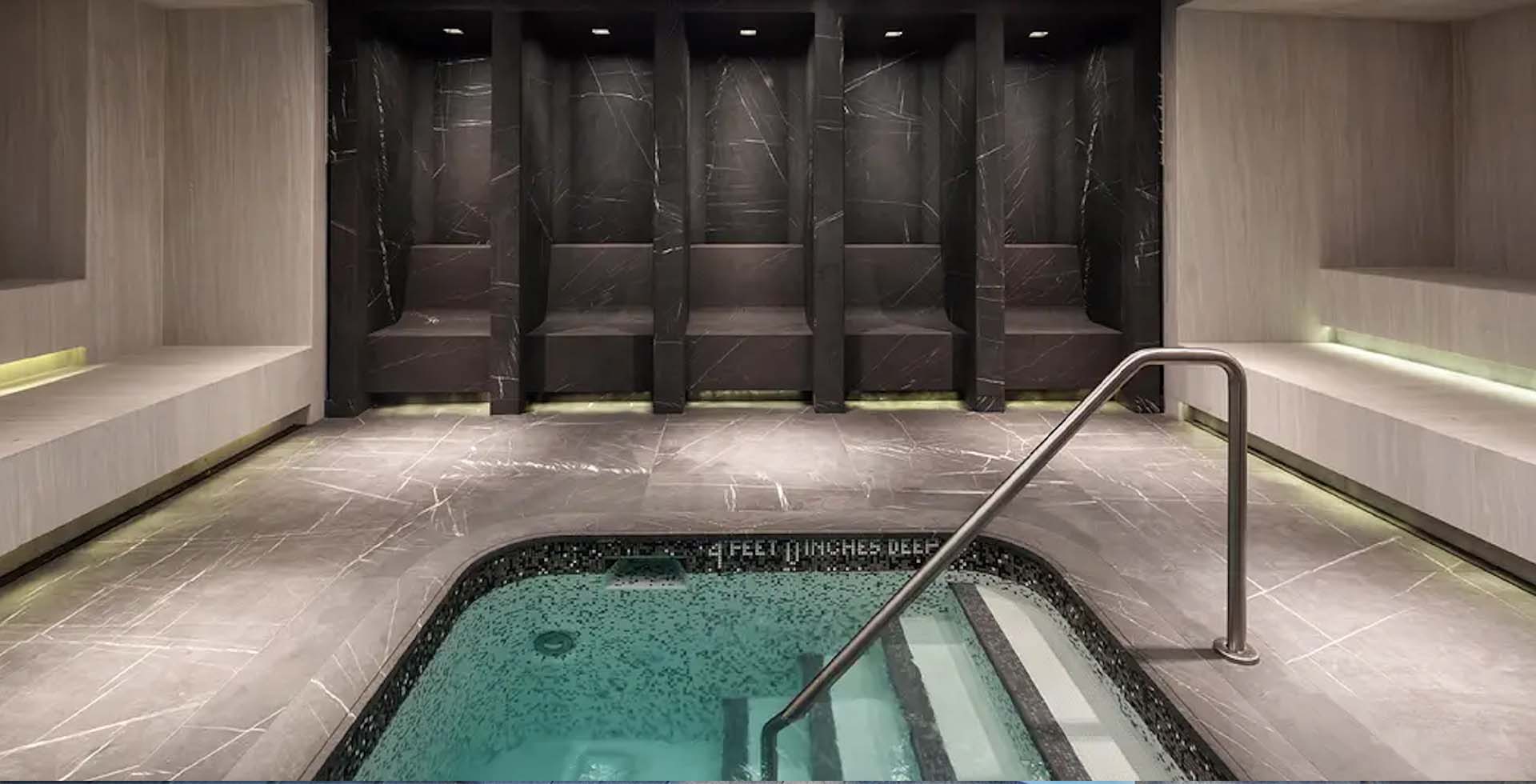
What we do not make is equally clear. The heaters, the control panels, the sensors and the stone are not our products; they come from equipment manufacturers such as EOS, Harvia and Sentiotec, and any certification on that equipment belongs to its manufacturer rather than to us. The TS EN ISO 9001:2015 certificate is ours; the appliance certificates are theirs. The cabins photographed above are delivered private villa projects in Doha, Dubai and Riyadh.
Frequently asked questions about sauna heater sizing
Can I just use 1 kW per cubic metre for sauna heater sizing?
Only as an upper bound for a small, well-insulated cabin. Divide EOS’s published bands and the figure runs from about 1.07 kW per m³ at the small end to 0.46 at the large end, so a flat 1 kW per m³ oversizes big rooms badly and is the weakest sauna heater sizing shortcut in circulation.
Is more stone always better?
No. A heavy charge lengthens heat-up and needs a heater built to carry it, so it earns its place only where the door opens often. For a cabin used twice a week, a 10 to 15 kg charge reaches temperature sooner and wastes less energy.
Does a glass door alone change the heater size?
Often not by a whole step, but it is asked about separately for a reason. Harvia’s calculator collects the glass door as its own input alongside log construction and non-insulated wall area, which are the only 2 other corrections it takes.
Can a 9 kW heater run on a single-phase supply?
Not on the units quoted here. EOS specifies 400 V 3N~ for the 46.U and Herkules ranges, and a 9 kW load on a single 230 V phase would draw about 39 A, which is beyond an ordinary final circuit in most installations.
How often should sauna stones be replaced?
Harvia recommends checking them every year, and its own test showed old stones running about 10 °C cooler in the room and 60 °C hotter at the element than new ones. On commercial rooms we relay the charge at every planned service.
Who decides the final output, the heater supplier or the cabin builder?
The cabin builder, and EOS says so on its own heater finder. The published band is an initial guideline value that varies with the materials used in the cabin, and the manufacturer directs you to the sauna cabin maker for the exact determination.
Sources
- EOS 46.U series technical data — outputs 6.0, 7.5, 9.0 and 12.0 kW against cabin volumes of 6–8, 7–10, 9–14 and 14–18 m³; stone charge 10 kg (Compact) and 15 kg; 400 V 3N~ 50/60 Hz; minimum air openings 35 × 4 cm to 35 × 7 cm.
- EOS Herkules S25 series technical data — 7.5 kW for 8–12 m³ and 9.0 kW for 10–14 m³, both with a 25 kg stone charge, 400 V 3N~, fuse protection 3 × 16 A.
- EOS Herkules XL S120 HD series technical data — 18.0, 24.0 and 30.0 kW for 24–35, 35–45 and 45–65 m³; 120 kg of stone in 2 stores of 60 kg; power unit fuse protection 3 × 16 A, 3 × 35 A and 3 × 63 A.
- EOS heater finder, power range — the statement that the determined power range is only an initial guideline value which may vary with the building materials used in the cabin.
- Harvia sauna calculator — the inputs it collects (room dimensions, log construction, glass door, non-insulated wall area) and the statement that power requirement increases with window surfaces or heat-storing surfaces such as brick, concrete or massive logs.
- Harvia, “Changing sauna stones makes the sauna heat up faster – saving energy & time” — the measured 10 m³ comparison: about 70 °C after 1 hour with loosely laid stones against about 60 °C tightly stacked, and element maxima of 580, 640 and 680 °C.
- BS EN 60335-2-53:2011+A11:2023, the product standard the appliance manufacturer declares against — “Household and similar electrical appliances — Safety — Particular requirements for sauna heating appliances and infrared cabins”, published 30 June 2023, 42 pages.
- EOS Saunatechnik GmbH, EU declaration of conformity for the 46.U / 46.U Compact sauna heating appliance — listing DIN EN 60335-1, DIN EN 60335-2-53 and DIN EN 62233, submitted on behalf of the manufacturer and signed by its head of development.
- Engineering ToolBox, “Solids – Specific Heats” — specific heat capacity of stone and basalt rock at 0.84 kJ/(kg·K) and granite at 0.79, the constant used in the stone charge arithmetic above.


