


Last updated: May 2026
Scandinavian lakeside properties are where the longevity case for an outdoor sauna is easiest to read. Wood-burning cabins built at the water’s edge in the 1960s are still standing after six decades of some of the harshest weather in Europe, and what kept them standing is not the timber species alone. It is the construction principles: a ventilated build-up that lets the structure dry, a roof that sheds water clear of the walls, and a foundation that keeps the timber off the ground. A new guest sauna designed on the same principles — thermowood cladding, a sloping turf roof, a cold plunge dock cut into the lake — is built to the same expectation rather than to a warranty period.
That story captures what most outdoor sauna buyers underestimate: a well-built outdoor sauna is a 50 to 80-year asset, not a five-year garden purchase. The decisions you make on type, material, foundation, and heater will dictate whether your sauna becomes a generational fixture or needs replacing before the next decade is out.
This outdoor sauna guide walks through every meaningful choice. We cover the four main outdoor sauna types, the materials that survive different climates, the prefab versus custom-built decision, electrical and ventilation requirements, foundation work, heater selection, and a full 2026 cost breakdown. Drawing on 40 years of building wellness facilities at Sauna Dekor, our team has compiled the technical detail that brochures gloss over.
Thinking about a custom outdoor sauna for your home, lakehouse, or hotel grounds? Explore our custom sauna range or request a free consultation with our design team.
What is an outdoor sauna and why install one outside?
An outdoor sauna is a freestanding sauna cabin designed to be used and weather-sealed for exterior installation, typically in a garden, lakeside, rooftop, or hotel grounds setting. The category covers four common forms: barrel, cabin, modern cube, and panoramic. Outdoor saunas offer three advantages over indoor units: better access to fresh air and contrast with cold immersion, less moisture stress on a residence, and a destination-style ritual that indoor saunas rarely match.
The connection between heat exposure and cold immersion is at the heart of the Nordic tradition. Stepping from a 90 °C sauna into a 5 °C plunge or snowbank produces measurable cardiovascular and recovery effects that have been documented in evidence reviews (Laukkanen et al., 2018). An outdoor sauna sited next to a cold plunge pool is the most direct way to recreate that protocol at home.
What are the main types of outdoor saunas?
Outdoor saunas fall into four main types: barrel saunas, traditional cabin saunas, modern cube saunas, and panoramic saunas. Each has distinct construction, aesthetics, and price brackets. Barrel saunas are the most economical and quickest to install. Traditional cabin saunas are the most authentic. Modern cube and panoramic saunas are designed-led, premium options favoured by architects and luxury hotels.
Barrel saunas
Barrel saunas use a curved cylindrical shape, with timber slats clamped by steel bands. The shape reduces internal volume, which means faster heat-up (typically 30 to 45 minutes) and lower running cost. What separates a cheap barrel from a durable one is the stave timber: kiln-dried softwood moves with the seasons and opens gaps at the steel bands, while heat-treated thermowood holds its profile. Best suited for compact gardens, rental properties, and buyers who prioritise speed over architectural ambition.
Traditional cabin saunas
Cabin saunas are the form most people picture when they think “outdoor sauna.” Rectangular, with pitched or shed roofs, log or panelled walls, and a recognisable Finnish silhouette. The budget on a cabin is set by footprint, roof construction and cladding grade rather than by the silhouette. A prefab cabin arrives as a fixed kit of parts; a custom cabin is drawn to the site and can carry a changing lobby, a covered porch or a guesthouse-scale footprint.
Modern cube saunas
Modern cube saunas combine flat-roof construction, large glass panels, and minimalist timber cladding (often charred Japanese-style or thermowood). They are designed to look like a contemporary garden building rather than a traditional sauna. Glazed area and cladding treatment are what move the budget in this form: charring, thermowood and concealed fixings are all labour-intensive finishes. Popular with architects and design-led homeowners.
Panoramic saunas
Panoramic saunas feature a full-height glass front (sometimes a full glass wall or three-sided glass) facing a view: a lake, a forest, a mountain ridge, or a hotel garden. Construction requires laminated heat-resistant glass and specialised glazing, which is the single largest cost driver in this form: the glass itself, the frame that carries it, the thermal detailing at the perimeter, and the lifting equipment needed to set a large pane on site. Panoramic builds are the most-requested form for luxury hotel projects.
What materials work best for outdoor saunas in different climates?
The most durable outdoor sauna materials are thermowood (heat-treated spruce or pine), Western Red Cedar, and Nordic Spruce. Thermowood is the strongest choice for harsh climates because the heat treatment removes resins and stabilises the cell structure, giving 25 to 30 years of weather resistance with minimal maintenance. Cedar performs well in temperate climates with natural rot resistance. Canadian Hemlock and untreated softwoods are best reserved for sheltered interiors.
Thermowood: the standard for harsh climates
Thermowood is spruce or pine treated to 180 to 230 °C in a controlled oxygen-free chamber, following the international ThermoWood standard (International ThermoWood Association). The process reduces moisture content to 4 to 6 %, removes sugars and resins, and produces a stable, durable, biocidal material. For outdoor saunas in Norway, Canada, the Alpine region, and northern US states, thermowood is the most reliable choice for both cladding and interior benches.
Cedar: classic and aromatic
Western Red Cedar contains natural tannins and oils that resist rot, insects, and fungal decay. The aroma is iconic in sauna culture. Cedar is well-suited to temperate climates (UK, central Europe, US Pacific Northwest, mid-Atlantic states) and handles moderate freeze-thaw cycles. Cost is 30 to 50 % higher than Nordic Spruce. Cedar requires annual brushing and occasional re-sealing but ages to a silver-grey patina that many owners prefer to the original red.
Nordic Spruce: cost-effective and authentic
Nordic Spruce is the timber used in most traditional Finnish saunas. It is dense, light-coloured, and handles internal heat very well. For outdoor use, spruce cladding should be treated or paired with a rain screen to extend lifespan. Untreated spruce in wet climates typically needs replacement every 12 to 15 years; treated spruce extends that to 25 years.
Canadian Hemlock and others
Canadian Hemlock is widely used in pre-fab indoor saunas because of its consistent grain and low resin content, but it is less weatherproof outdoors. Abachi and African Mahogany are specialty timbers used in luxury custom builds for benches and visible interior surfaces, not exterior cladding.
A material comparison for outdoor use:
| Material | Best climate | Maintenance | Outdoor lifespan | Cost level |
|---|---|---|---|---|
| Thermowood | Harsh, cold, wet | Low (every 5 years) | 25–30 years | High |
| Western Red Cedar | Temperate | Medium (annual) | 20–25 years | High |
| Nordic Spruce (treated) | Temperate to cool | Medium | 18–25 years | Mid |
| Nordic Spruce (untreated) | Sheltered, dry | High | 10–15 years | Low |
| Canadian Hemlock | Indoor / sheltered porch | Medium | 12–18 years outdoors | Mid |
Planning an outdoor build in a demanding climate? Our team specifies thermowood and engineered timber assemblies designed for the specific weather profile of your site. Get a custom quote for your project.

How do prefab and custom-built outdoor saunas compare?
Prefab outdoor saunas offer faster delivery, lower cost, and predictable specifications, while custom-built outdoor saunas offer dimensional freedom, longer lifespan, better materials, and integration with the surrounding architecture. Prefab kits carry 4 to 8-week lead times. Custom builds carry 10 to 20-week lead times, because the drawings, the joinery and the glazing are made for one site and one set of dimensions. The right choice depends on space, design intent, and intended lifespan.
A direct comparison:
| Feature | Prefab outdoor sauna | Custom-built outdoor sauna |
|---|---|---|
| What sets the budget | Model and options chosen from a fixed catalogue | Footprint, timber grade, glazing area and foundation design |
| Lead time | 4 to 8 weeks | 10 to 20 weeks |
| Sizing | Standard (2 to 6 person) | Any dimension |
| Material range | 1 to 2 standard timbers | Full range incl. thermowood |
| Foundation | Pad or piers | Engineered footings |
| Lifespan | 12 to 20 years | 30 to 80 years |
| Resale impact | Modest | Significant home-value uplift |
The mid-2024 wave of low-cost imported barrel saunas illustrates the trade-off. We were called to assess three failed installations in the UK alone over the autumn of 2025; each had been advertised as “premium” but used kiln-dried (not heat-treated) softwood that warped within two winters. The lesson is consistent across decades of outdoor builds: material specification matters more than headline price.
For a homeowner with a regular-shaped garden, no specific design constraints, and a 10 to 15-year horizon, a quality prefab cabin can be excellent value. For a heritage property, a luxury garden, a lakeside lodge, or any project where the sauna is intended to be a permanent architectural element, custom-built is almost always the right call.
What are the electrical, ventilation, and foundation requirements?
Outdoor saunas typically require a dedicated 30 to 60 amp electrical circuit, passive vertical ventilation, and a solid level foundation rated for the unit’s weight plus snow and live loads. Electrical work must be carried out by a qualified electrician with weatherproof outdoor-rated conduit. Foundations vary by build: a barrel sauna can sit on a gravel pad, while a custom cabin in a freeze-thaw climate needs engineered concrete footings below the frost line.
Electrical specification
Most outdoor saunas with electric heaters draw between 6 kW and 12 kW, requiring a dedicated circuit at 30 to 60 amps depending on heater size and cabin volume. A 4-person prefab cabin with a 6 kW heater typically needs a 32 amp circuit; a 6 to 8-person custom cabin with a 9 kW heater typically needs a 40 amp circuit. Always confirm the heater’s exact specification with your electrician before purchase.
Wiring must be run in weatherproof conduit. The consumer unit at the house must have spare capacity. In older properties the consumer unit and the incoming supply often have to be upgraded before the sauna circuit can be added, and that work is the most common unplanned item in an outdoor sauna budget.
Ventilation
Outdoor saunas typically use passive ventilation: a low inlet near the heater and a higher outlet on the opposite wall. This drives a natural convection loop that brings fresh air in and exhausts spent air. Cabin design must accommodate this airflow without compromising weather sealing. Custom panoramic and cube saunas sometimes require small mechanical extraction to maintain air quality during commercial-frequency use.
Foundation work
Foundation requirements vary by sauna weight and local climate:
- Light prefab barrel saunas (under 800 kg): a 100mm compacted gravel pad over a level subgrade is usually sufficient.
- Mid-sized prefab cabins (800 to 1,500 kg): concrete pavers or a 150mm reinforced concrete pad.
- Custom cabin saunas (1,500 to 4,000 kg): engineered concrete footings below frost line, typically 600 to 1,200mm deep depending on local frost depth.
- Panoramic and glass-walled saunas: structurally engineered concrete with anchor bolts pre-set for the steel-and-timber frame.
In freeze-thaw climates (UK, northern Europe, Canada, northern US), inadequate foundation work is the single most common cause of premature failure. A sauna built on an inadequate pad will move with the seasons; doors stop closing properly, glass panels crack, and the building envelope fails.
Should you choose a wood-burning or electric heater?
Wood-burning sauna heaters deliver a more authentic experience, work off-grid, and are the traditional Finnish choice; electric heaters are more convenient, easier to control, and the standard in residential and most commercial settings. For lakeside, rural, or off-grid properties, wood-burning is often the better fit. For urban gardens, residential settings, and most hotel installations, electric is the practical default.
Wood-burning heaters
Wood-burning heaters use a flue stack and burn split hardwood at a typical operating output of 15 to 20 kW. They produce a more intense, dynamic heat with löyly (steam from water thrown on the stones) that many traditionalists prefer. Installation requires a fire-rated wall penetration for the flue, a non-combustible floor under the stove, and clearance from combustible materials.
Pros: authentic, atmospheric, off-grid capable, no electrical demand.
Cons: requires wood storage, manual fire management (45 to 60 minute heat-up), restricted in some urban areas due to wood-smoke regulations, fire insurance considerations.
Electric heaters
Electric heaters range from 4.5 kW (1 to 2-person cabin) to 12 kW (6 to 8-person commercial cabin). Heat-up time is typically 30 to 45 minutes, with precise digital temperature control. Modern controllers allow remote start via Wi-Fi, allowing you to pre-heat the sauna while you finish work or drive home.
Pros: convenient, controllable, no wood storage, broadly permitted, integrates with smart-home systems.
Cons: requires dedicated electrical supply, depends on grid, lacks the smoke-and-fire ritual of wood-burning.
In our own design consultations, the split for residential clients is roughly 70 % electric, 30 % wood-burning. For hotel projects, electric is closer to 90 % of installations because of regulatory and operational simplicity.

How much does an outdoor sauna cost in 2026?
Outdoor sauna costs in 2026 range from $3,000 for a basic prefab barrel sauna to over $60,000 for a custom-built panoramic cabin with glass walls and integrated cold plunge. The four typical price bands are: $3,000 to $8,000 for entry-level prefab barrel or cabin saunas, $8,000 to $20,000 for mid-range prefab cabins, $20,000 to $40,000 for custom-built cabin and cube designs, and $40,000 to $60,000+ for panoramic, oversized, or full-spec hotel installations.
Additional costs to budget:
- Foundation and groundworks: $1,000 to $8,000 depending on size and climate
- Electrical supply and circuit: $500 to $4,000
- Heater (if not included): $800 to $3,500 for residential, up to $6,500 for commercial
- Cold plunge or contrast bath: $4,000 to $25,000
- Delivery and crane lift: $500 to $3,500 depending on access
- Permits and planning: $200 to $2,500 depending on jurisdiction
For a typical custom build in a temperate climate, a useful planning figure is 1.25 to 1.4 times the cabin price for the full delivered-and-installed cost. A $30,000 cabin should be budgeted at approximately $38,000 to $42,000 total project cost.
Site constraints, not the cabin, are what move an outdoor sauna budget. A 1930s villa with a south-facing garden can present a sloping lawn, a heritage stone wall, and a planning constraint that limits the visible roofline all at once; the answer is a 12 m² thermowood cube with a partially submerged foundation and a copper-clad shed roof to satisfy the heritage rules. A brief of that kind routinely lands above the figure the owner first had in mind, and the decision that follows is the real one — whether the difference between a 12-year and a 50-year asset is worth it.
Why do high-net-worth homeowners and luxury hotels choose custom-built outdoor saunas?
The four reasons custom-built outdoor saunas dominate the luxury segment are: dimensional and design flexibility for specific sites, material quality (thermowood, premium timbers, engineered glazing), lifespan that aligns with the property’s intended hold period, and integration with the surrounding architecture and landscape. At the top of the residential market the deciding factor is rarely the price of the cabin itself; it is whether the finished sauna reads as part of the house, and whether it will still read that way in twenty years.
Hotels and resorts add a fifth reason: brand consistency. A boutique hotel with a defined design language cannot drop a generic prefab into its garden and call it a feature. The sauna must look as though it was designed for the property, by the same hand that designed the rest of the experience. That is design and manufacturing work, not catalogue selection.
We have delivered outdoor sauna installations for hotels in the Hilton, Ritz-Carlton, and Emirates portfolios, and for private residences from a lakeside dacha outside Helsinki to a rooftop in central Istanbul. The pattern across these projects is consistent: clients specify custom because they want the sauna to be an architectural element of the property, not an accessory.
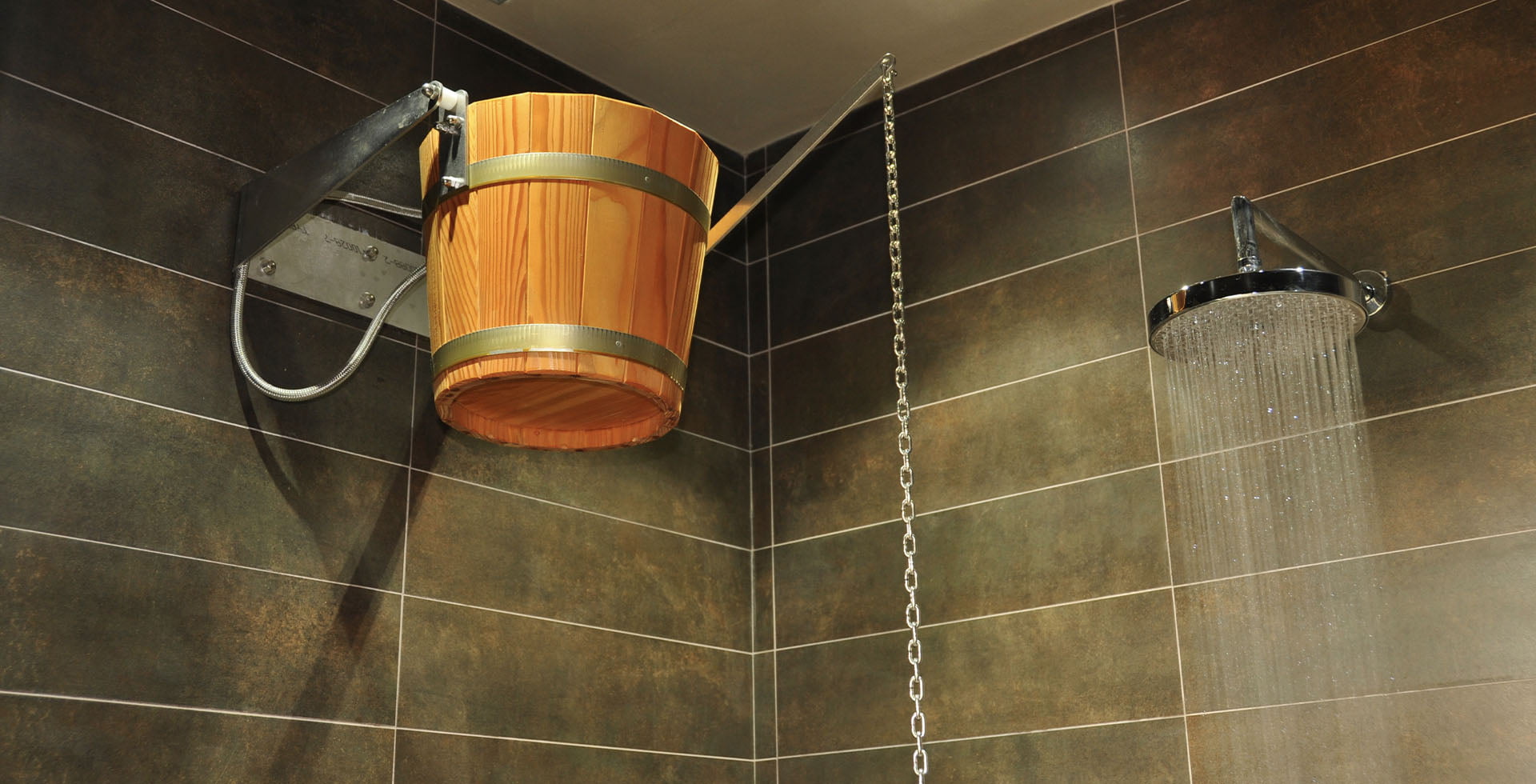
For homeowners planning a private spa or hoteliers planning a commercial spa facility, the outdoor sauna often anchors a wider wellness landscape that includes a cold plunge, an experience shower, and sometimes an infrared sauna or bio sauna inside the main building for daily use. A traditional Finnish sauna outside, paired with a gentler indoor option, is the layout we recommend most often for serious residential clients.
Frequently asked questions about outdoor saunas
Do you need planning permission for an outdoor sauna?
In most of the UK, outdoor saunas under 2.5 m in height and within permitted-development limits do not require planning permission. Larger or panoramic builds, listed buildings, conservation areas, and many US municipalities do require permits. Always check local rules before ordering. Permit fees are set by the local authority and vary widely by jurisdiction.
How long does an outdoor sauna last?
A quality prefab cabin lasts 12 to 20 years with regular maintenance. A custom-built thermowood or cedar sauna with engineered footings lasts 30 to 50 years; the best-built lakeside cabins in Finland and Norway are routinely 60 to 80 years old and still in daily use.
Can you use an outdoor sauna in winter?
Outdoor saunas are designed for year-round use and are most rewarding in winter. The contrast between a 90 °C cabin and a sub-zero outdoor air or snow plunge is the classic Nordic experience. Insulation and vapour barriers must be specified correctly for the climate.
How long does it take to install an outdoor sauna?
A prefab barrel sauna can be assembled in a single day once the pad is laid. A prefab cabin takes two to four days. A custom-built sauna with engineered footings, full electrical, and integrated cold plunge typically takes three to eight weeks on site, depending on size and complexity.
Is a wood-burning outdoor sauna allowed in urban areas?
Many urban areas restrict new wood-burning installations due to air quality regulations. London, for example, has Smoke Control Areas where only approved appliances may be used. Always check local rules. In most urban gardens, electric is the practical choice.
How much space do you need around an outdoor sauna?
Minimum clearance is 600 mm from any combustible structure (boundary fence, garden building) and 1.5 m clear access at the door. For wood-burning units, flue clearance from buildings is typically 2.4 m. For best use, allow 2 to 4 m of clear deck or terrace for sitting, transitioning, and cold plunge access.
Can an outdoor sauna increase home value?
Yes, particularly in markets where wellness amenities are valued. Estate agents in the UK and the US consistently treat a quality custom outdoor sauna as a value-adding feature, and the effect is strongest in lakeside, rural, and luxury markets. Prefab kits tend not to add measurable resale value.
What is the difference between an outdoor sauna and an indoor sauna?
The cabin construction differs significantly. Outdoor saunas are weather-sealed, use exterior-rated cladding (thermowood, cedar, treated spruce), have insulated walls and roofs to manage temperature differentials, and are built on foundations that handle ground movement. Indoor saunas are unsealed cabins designed for a controlled interior environment.
Sources
- Hannuksela, M.L., & Ellahham, S. (2001). Benefits and risks of sauna bathing. American Journal of Medicine, 110(2), 118-126. PubMed
- Laukkanen, J. A., Laukkanen, T., & Kunutsor, S. K. (2018). Cardiovascular and Other Health Benefits of Sauna Bathing: A Review of the Evidence. Mayo Clinic Proceedings, 93(8), 1111-1121. Full text
- International ThermoWood Association. (n. d.). ThermoWood Handbook and Product Standards. thermowood.fi
Ready to design your outdoor sauna? Whether you are planning a single home installation in a UK garden, a lakeside lodge in Scandinavia, or a panoramic guest sauna for a luxury hotel, our team has 40 years of manufacturing experience and a track record with Hilton, Ritz-Carlton, and Emirates. Request a free consultation and we will provide detailed project costs, timber samples, and design options for your specific site and climate.


Permalink