


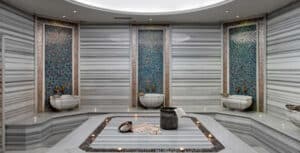


Spa Interior Design: Layout Planning, Materials, Lighting and Wet Area Integration


Last updated: April 2026
Most spa interior design failures are not construction failures. They are planning failures, and they follow a pattern anyone who has walked a few underperforming hotel spas will recognise. The facility is procured room by room: the Finnish sauna from one supplier, the steam room from a second, the hammam from a third. Each room is built competently on its own terms. Then the sauna’s heat load lands in a corridor that was never sized to take it. The steam room shares a wall with an electrical cupboard, and the tanking stops at the tile line rather than continuing behind and above it. The hammam is given an extract rate calculated for a bathroom rather than for a room held near 100 per cent relative humidity, and the ceiling grows mould long before the finishes are due for renewal. What follows is remedial work on a spa that is only a few years old: re-tanking, re-routing ventilation, and stripping and rebuilding finishes that should still have had a decade of service in them.
Every one of those failures is a design failure rather than a construction failure. Nobody designed the spa as a single integrated facility: one ventilation strategy, one waterproofing line, one drainage scheme, one thermal sequence. That is the difference between fitting out rooms and doing spa interior design.
The global spa industry generated $157 billion in revenue in 2024, with the broader wellness economy reaching $6.8 trillion (Global Wellness Institute, 2025). U.S. spa revenue alone hit a record $22.5 billion in 2024, with revenue per visit climbing to $120.30 (ISPA, 2025). Hotels, resorts, and high-net-worth homeowners are investing more in wellness facilities than ever before. But the facilities that succeed are not the ones with the most expensive finishes; they are the ones where layout, materials, lighting, and thermal zoning work together from the first sketch.
This guide covers how to design a spa that works, whether you are planning a hotel spa design for a commercial property or a luxury spa design for a private residence. From wellness facility design principles to wet area design details, every recommendation here comes from Sauna Dekor’s 40 years of project experience.
What makes a good spa layout?
A good spa layout follows the guest’s journey from arrival to departure in a logical thermal progression: cool to warm to hot, then back to cool, then rest. Every successful spa, from a 50 m² home wellness suite to a 2,000 m² resort facility, follows this principle. The specific rooms change, but the sequence does not.
The most common mistake in spa interior design is treating each room as a standalone installation. A sauna here, a steam room there, a cold plunge in the corner. That approach produces a collection of rooms, not a spa. Guests should move through the facility in a natural flow without backtracking through reception or crossing cold corridors in a towel.
The thermal journey principle
The classic spa circuit follows a rhythm that mirrors centuries-old bathing traditions from Roman thermae to Ottoman hammams:
- Arrival and transition — changing rooms, showers, and a relaxation area where guests acclimatise and leave the outside world behind.
- Gentle warming — a bio sauna, tepidarium, or warm footbath that raises core body temperature gradually.
- Intense heat — a Finnish sauna at 80-100 °C, a steam room at 40-45 °C with 100 % humidity, or a hammam with its heated stone surfaces and scrub ritual.
- Cold contrast — a cold plunge pool at 4-15 °C, an ice fountain, or experience showers. This is where the cardiovascular benefit peaks.
- Rest and recovery — heated loungers, a quiet room, or a garden terrace. This is where the parasympathetic response completes and guests feel the full effect.
When our team plans a spa layout, we map this journey first, then fit the rooms around it. Not the other way around.
How much space does a spa need?
Space requirements vary enormously by ambition and context, but these benchmarks help at the briefing stage:
- Compact home spa (two to four people): 15-30 m². Enough for a sauna, a shower, and a rest area. Add a cold plunge if the layout allows.
- Boutique hotel spa (20-50 guests per day): 150-300 m². A full thermal circuit with sauna, steam room, cold plunge, relaxation area, and one or two treatment rooms.
- Resort spa (100+ guests per day): 500-2,000 m². Multiple thermal experiences, a hammam, a pool, treatment rooms, a fitness area, and support spaces (laundry, storage, staff areas).
A narrow, L-shaped footprint with only two exterior walls — a former restaurant converted into a spa of around 220 m², for instance — reads on plan as the worst possible shape and is frequently the best one. Mapping the thermal journey along the L gives changing rooms at the entrance, a bio sauna and steam room along the first arm, a hammam and cold plunge at the turn, and heated loungers along the second arm facing the view. The constraint that looks like the problem is what creates a natural one-way flow, which an open rectangle has to invent artificially.
What materials work best in spa interior design?
Five materials cover most of a spa: marble or limestone for heated hammam platforms, large-format porcelain of at least 10 mm for steam rooms and pool surrounds, ayous for sauna benches that stay touchable at 100 °C, tadelakt lime plaster for hammam walls, and teak for benches and locker rooms.
Material selection in a spa is not primarily an aesthetic decision. It is an engineering decision. Every surface in a wet wellness environment must resist sustained heat, humidity, water, and chemical cleaning agents without degrading, staining, or becoming slippery. Choosing the wrong spa materials is the most expensive mistake in spa design.
Stone and marble
Natural stone is the default surface for hammams, steam rooms, and pool surrounds. Marble, travertine, and limestone are all suitable, but each has different porosity, slip resistance, and thermal conductivity. Marble absorbs and radiates heat beautifully on a hammam’s gobek tashi, but it is porous and stains if not sealed properly. Travertine offers a warmer, more textured surface with better grip underfoot.
For heated surfaces where bathers lie or sit, thermal conductivity matters. A marble slab heated to 40 °C feels warm and inviting; a granite slab at the same temperature feels noticeably cooler because granite conducts heat away from the skin faster. Our team specifies marble or limestone for heated platforms and reserves granite for flooring and structural elements.
Timber
Timber is essential for sauna interiors but must be selected carefully. We build saunas in ayous and pine, with aspen and alder on request; bench timbers are chosen for their low resin content, low thermal conductivity (so benches do not burn the skin at 100 °C), and resistance to warping under repeated heat cycles. Pine and other resinous softwoods are not suitable; they bleed sap at high temperatures.
In spa areas outside the sauna cabin, teak and iroko are popular for benches, locker room details, and accent walls. Both are naturally water-resistant and age gracefully in humid environments.
Tile and mosaic
Ceramic and porcelain tiles remain the workhorse material for steam rooms, shower areas, and pool surrounds. Large-format porcelain (minimum 10 mm thickness) with a matt, textured finish provides the best combination of durability, slip resistance, and ease of cleaning. Mosaic tiles allow curved surfaces and intricate designs, particularly in hammams and steam rooms where walls meet domed ceilings.
Tadelakt
Tadelakt is a traditional Moroccan lime plaster that is naturally waterproof, antibacterial, and extraordinarily beautiful. It is the signature finish for Moroccan hammams and is increasingly specified in contemporary spa design for its seamless, organic aesthetic. Applying tadelakt requires a specialist plasterer; it cannot be installed by a general tiler.
Engineered surfaces
Solid-surface materials (such as Corian), sintered stone, and large-format porcelain slabs offer practical advantages for modern spa design: seamless joins, uniform colour, and zero porosity. They lack the warmth and character of natural stone but are easier to maintain and less prone to staining.
| Material | Best use | Heat tolerance | Slip resistance | Maintenance |
|---|---|---|---|---|
| Marble | Hammam platforms, accent walls | Excellent (radiates heat evenly) | Low (must be honed, not polished) | Medium (requires sealing) |
| Porcelain tile | Steam rooms, showers, pool surrounds | Excellent | High (textured finish) | Low |
| Ayous and pine | Sauna interiors | Excellent (low thermal conductivity) | N/A (bench surfaces) | Low (sand annually) |
| Tadelakt | Hammam walls, feature walls | Good | Medium | Low (self-healing plaster) |
| Teak | Benches, locker rooms, accents | Good | Medium | Low (oils naturally) |
Planning a spa and need help with material specifications? Our spa developer team provides full material consultation as part of every project. Request a free consultation.
How should you design lighting for a spa?
Spa lighting sits between 2,200 K and 2,700 K, warm white to amber. Relaxation areas run at 2,200–2,400 K and only 50 to 100 lux; sauna and steam rooms at 2,400–2,700 K. Build it in three layers — ambient, accent, task — and keep every bulb out of a reclining guest’s sight line.
Lighting is the single most underrated element in spa interior design. The wrong lighting ruins the atmosphere of even the most beautifully built facility. Bright, cool-toned overhead lighting, the default in most commercial fit-outs, creates a clinical feel that contradicts everything a spa is trying to achieve.
Colour temperature and intensity
Spa lighting should sit between 2,200 K and 2,700 K (warm white to amber). This range mimics candlelight and firelight, activates the parasympathetic nervous system, and supports the body’s circadian rhythm rather than fighting it. A 2024 framework for human-centric lighting design published in Buildings confirms that warm light in the 1,500-3,000 K range promotes relaxation and preparation for rest, while light above 5,500 K encourages alertness, the opposite of what a spa guest needs (Jalali et al., 2024).
In practical terms:
– Relaxation areas: 2,200-2,400 K at low intensity (50-100 lux). Recessed cove lighting, backlit panels, or indirect wall washing.
– Sauna and steam room: 2,400-2,700 K. Fibre-optic starlight ceilings in saunas are popular and practical (no electrical components inside the hot cabin). Steam rooms use waterproof LED strips behind frosted glass.
– Hammam: The traditional approach uses natural light filtered through small star-shaped openings (elephant eyes) in the dome. Modern hammams replicate this with fibre-optic points set into the ceiling.
– Treatment rooms: Dimmable from 2,400 K (treatment mode) to 3,000 K (cleaning and preparation mode).
– Changing rooms and corridors: 2,700-3,000 K. Warm but bright enough for safety and wayfinding.
Layered lighting design
A well-designed spa uses three layers of light:
- Ambient: The base layer. Indirect cove lighting, backlit niches, or concealed LED strips that wash walls and ceilings with warm, even light.
- Accent: Directional spots highlighting texture, a stone feature wall, a water feature, or a piece of art. Accent lighting creates depth and visual interest.
- Task: Functional light where needed (mirrors in changing rooms, therapist work lights in treatment rooms, safety lighting at step edges near pools).
The key principle is that no light source should be directly visible to a reclining guest. If you can see the bulb, the lighting design has failed.
How do you integrate wet areas with saunas, steam rooms, and pools?
Integration is a mechanical problem, not a layout problem. A Finnish sauna needs six to eight complete air changes per hour; a steam room sits at 100 % humidity behind a tanked envelope and exhausts through a condensation trap, never into the general HVAC. The corridor between a 90 °C sauna and a 10 °C plunge crosses an 80-degree gradient.
Wet area integration is where spa interior design becomes a technical discipline. A sauna, a steam room, a hammam, and a cold plunge pool each produce different levels of heat, humidity, and water, and each has different structural, waterproofing, and ventilation requirements. When they share walls, floors, or mechanical systems, the interfaces must be designed with precision.
Waterproofing
Waterproofing is the single most critical technical element in any spa. A steam room at 100 % humidity generates litres of condensation per hour. A cold plunge pool holds thousands of litres of water. A hammam’s floor is regularly flooded during the washing ritual. If any of this moisture reaches the building structure, the damage is progressive, expensive, and often invisible until it is severe.
Our team specifies tanked waterproofing systems for all wet areas: a continuous membrane applied to floors, walls, and ceilings before any finish material is installed. Joints, penetrations, and transitions between rooms are the weak points; they require reinforcement strips and compatible sealants. We have seen spas fail within two years because the waterproofing was specified by the tiler rather than the spa designer.
Ventilation and humidity management
Each thermal room has different ventilation needs:
- Finnish sauna: Fresh air intake near the heater (low), exhaust vent on the opposite wall (high). Six to eight complete air changes per hour.
- Steam room: Sealed envelope with a dedicated steam generator. Exhaust via a condensation trap, not into the general HVAC system. Separate dehumidification for the surrounding corridor.
- Hammam: Continuous low-level ventilation through the dome’s traditional openings or a mechanical equivalent. The hypocaust heating system beneath the marble floors also drives air circulation.
- Cold plunge pool: Dehumidification to prevent condensation on surrounding surfaces, especially if the pool is adjacent to a heated room.
The corridor between a 90 °C sauna and a 10 °C cold plunge pool experiences a temperature gradient of 80 degrees across a few metres. Without proper vapour barriers and transition zones, condensation forms on cold surfaces, drips onto guests, and eventually degrades finishes and structure.
Acoustic separation
Spa guests expect quiet. But a sauna heater hums, a steam generator pulses, a cold plunge chiller runs continuously, and pool filtration pumps cycle on and off. All mechanical equipment should be located in a separate plant room with acoustic insulation. Water pipes should be isolated with rubber mountings to prevent vibration transfer through walls and floors.
In a new-build townhouse basement spa, the pool filtration room is routinely drawn directly below the master bedroom, because on plan that is the space left over. It has to move. Relocating it to the far end of the basement, mounting the pumps on acoustic isolators and running the pipework through a dedicated service corridor is what allows the spa to run around the clock without the household hearing it. Solving this on the drawing costs nothing; solving it after commissioning means opening finished ceilings.
How to design a spa, step by step
Designing a spa is a sequence, and most of the expensive mistakes come from taking the steps out of order — usually by choosing finishes before the services are settled. This is the order we work in, whether the project is a hotel floor or a villa wellness suite.

- Establish the operating brief before the plan. Who uses the spa, how many at once, at what hours, and is it a guest amenity, a membership business, or a private facility? Occupancy per hour is the number that drives room sizes, ventilation and plant. A plan drawn before this is a drawing, not a design.
- Survey the shell. Slab-to-slab height, available floor build-up for falls and tanking, drainage inverts, structural capacity for wet loads, plant space and its access route, and the incoming services. These constraints set what is possible; everything after this is a choice within them.
- Design the journey, then the rooms. Arrival, changing, shower, heat, cold, wash, rest — and back. The route is drawn first, and rooms are placed along it in temperature order so that no guest has to cross a cold zone wet or a hot zone dressed. The sequencing logic is set out in our notes on the thermal suite.
- Set the room schedule with its numbers. Each room gets its design temperature, humidity, occupancy, bench or platform sizes, and its ventilation rate — the Finnish sauna at 80–90 °C and 10–20 % relative humidity, the steam room near saturation, the hammam at 40–45 °C with a heated platform. The schedule is the specification; the mood board is not.
- Coordinate MEP against the schedule. Ventilation and dehumidification, hot and chilled water, drainage falls and gullies, electrical loads, controls and sensor positions. This is where a spa is won, and it happens while the walls are still lines.
- Resolve waterproofing and structure. Tanking to walls and floor, upstands at every threshold, sealed penetrations, and structural sign-off for filled pools. Nothing after this stage can fix it.
- Select finishes against duty, not against the photograph. Stone, tile, mosaic, tadelakt and timber all behave differently under a commercial turnover. The finish is chosen after the room is known, because a surface that fails in a wet room takes the room apart with it.
- Detail the back of house. Plant access without crossing the guest route, linen and chemical storage, staff circulation, and the cleaning route. A spa that cannot be cleaned in the hours available is redesigned within two years.
- Commission against the schedule. Hold each room at its design temperature and humidity under load, verify the sensors read what the room actually does, prove the drainage, and hand over an O&M file the operator can use.
Steps two, five and six are the ones clients most often want to defer, and they are the three that cannot be revisited later. Steps seven and eight are the ones that get all the attention.
Spa design and construction — where design stops and the build starts
“Spa design and construction” is usually two or three contracts pretending to be one, and the joints between them are where projects lose time. There are three common structures.

| Structure | Who holds what | Where it works | Where it fails |
|---|---|---|---|
| Design and build under one contract | One party holds the room schedule, manufacture, installation and commissioning | Wet thermal rooms, where the design decisions and the manufacturing tolerances are the same decisions | Rarely — but it needs the main contractor’s programme to be honest about wet-area sequencing |
| Designer plus separate specialist trades | An interior designer sets the look; individual suppliers build a sauna, a steam room and a hammam | Small, dry, low-risk rooms | The junctions between rooms: shared walls, shared drainage, shared plant. Nobody owns the gap, and the gap is where water goes |
| Specialist as subconsultant to the architect | The architect holds the building; the spa specialist holds the room schedule and the MEP requirements feeding it | Hotel and resort floors, where the spa is one part of a larger programme | When the specialist is brought in after the shell is set and the floor build-up no longer allows the falls |
The practical test is simple: ask who is accountable for the room holding its design temperature and humidity on handover day. If more than one party can point at another, the specification has a hole in it. We manufacture in Istanbul and install with our own supervision precisely so that the room schedule, the manufacture and the commissioning sit with the same people — the approach set out on our spa contractor and spa developer page, and applied at floor scale in commercial spa projects. When the same scope is tendered by a developer or a main contractor rather than designed from scratch, the package boundaries are set out on our spa fit out contractor page for Dubai and Abu Dhabi.
What common mistakes should you avoid in spa interior design?
Five mistakes recur across 40 years of spa builds. The costliest is designing rooms instead of a journey. Second is ignoring back of house: plant, storage, laundry and staff changing need 20 to 30 % of total spa area, so a scheme that gives 100 % of the floor plate to guests has nowhere to put the steam generator.
We have seen every one of them at least twice. These are the ones that cost the most to fix.
Designing rooms instead of journeys
The most expensive error. Each room works individually, but the guest experience feels disjointed because there is no logical flow between them. Always design the journey first, then the rooms.
Ignoring the back of house
A spa needs plant rooms, storage, laundry, staff changing, and chemical storage. These support spaces typically require 20-30 % of the total spa area. Architects who allocate 100 % of the budget to guest-facing areas discover too late that there is nowhere to put the boiler, the steam generator, or the pool filtration equipment.
Specifying residential materials for commercial use
Materials that work in a home bathroom fail in a commercial spa. Unsealed natural stone stains within weeks. Timber benches without proper drainage rot. Glass mosaic tiles with organic adhesive delaminate in steam rooms. Always specify materials rated for continuous wet and thermal use.
Underestimating ventilation
A beautiful steam room with inadequate ventilation becomes a mould incubator. A sauna without fresh air intake becomes an unpleasant, oxygen-depleted box. Ventilation is not optional; it is as fundamental as the walls.
Choosing finishes before function
Selecting the marble before confirming the waterproofing system, the heating method, or the room dimensions leads to costly rework. Function first, finishes second. Always.
Who manufactures and installs these rooms
Sauna Dekor has manufactured sauna, hammam and steam room interiors in Istanbul since 1987 — our 40th year — with 19 staff and delivery in more than 35 countries. Production is quality-managed under TS EN ISO 9001:2015, certificate no. 202025106, issued by EKOL Belgelendirme. We design, manufacture and install; we do not operate spas, sell treatments or run booking services.
Frequently asked questions about spa interior design
How much does it cost to design and build a hotel spa?
Costs depend on size, complexity, and finish level. A 200 m² boutique hotel spa with a sauna, steam room, cold plunge, and two treatment rooms requires a different investment than a 1,000 m² resort facility. The best starting point is a free consultation with our team, who can scope your project and provide a detailed estimate.
How do you design a spa from scratch?
Establish the operating brief and occupancy first, then survey the shell for height, floor build-up, drainage inverts and structural capacity. Draw the guest journey, then place the rooms along it in temperature order. Write a room schedule with design temperature, humidity, occupancy and ventilation rate for each room, coordinate MEP against it, resolve waterproofing and structure, and only then select finishes. Commission each room against its schedule under load.
What is the difference between spa design and spa construction?
Design sets the room schedule — the temperatures, humidities, sizes and services each room needs. Construction delivers it. The risk sits at the junction between them, so the useful question is who is accountable for a room holding its design conditions on handover day. Where the room schedule, the manufacture and the commissioning sit with different parties, the gaps between them are where wet-area problems appear.
Can you add a spa to an existing building?
Yes. We regularly retrofit spas into hotel basements, converted outbuildings, and residential properties. The key constraints are structural load-bearing capacity (for pools), ceiling height (minimum 2.3 m for saunas), and access to electrical and water services. A feasibility assessment is always the first step.
How long does it take to build a commercial spa?
From design sign-off to handover, a typical 200-400 m² hotel spa takes four to eight months. Larger resort facilities may take 12-18 months. Our team manages the full timeline from manufacturing through installation.
Do you need an architect to design a spa?
For a commercial spa, yes. Building regulations, fire safety, accessibility, and structural engineering all require professional sign-off. For a residential spa, an architect is recommended but not always required. Sauna Dekor’s spa developer service includes design consultation that works alongside your architect or independently.
What is the ideal temperature for a spa relaxation area?
A relaxation area should be held at 22-25 °C with low humidity. Heated loungers set to 38-40 °C add a therapeutic element. The space should feel noticeably warmer than a standard room but cooler than any of the thermal experiences, allowing the body to return to baseline gradually.
Should a spa have natural light?
Where possible, yes. Natural light in relaxation areas and pool halls improves guest wellbeing and reduces energy costs. However, thermal rooms (saunas, steam rooms, hammams) traditionally use dim, controlled lighting. A good spa design uses natural light strategically, not uniformly.
What experience showers should a spa include?
At minimum: pre-cleansing showers before thermal areas, cool-down showers between hot and cold experiences, and rinse showers after the salt room or hammam. Experience showers with variable temperature, pressure and fragrance are the detail guests remember.
Ready to design your spa? Sauna Dekor’s team handles everything from concept to installation for hotels, residences, and wellness centres worldwide. Start your project with a free consultation.
Sources
- Global Wellness Institute. (2025). The Global Wellness Economy Hits a Record $6.8 Trillion. Full text
- International SPA Association. (2025). ISPA Big Five Statistics: U.S. Spa Industry Study. Press release
- Jalali, M. S., Jones, J. R., Tural, E., & Gibbons, R. B. (2024). Human-Centric Lighting Design: A Framework for Supporting Healthy Circadian Rhythm Grounded in Established Knowledge in Interior Spaces. Buildings, 14(4), 1125. Full text
- Terrapin Bright Green. (2015). The Economics of Biophilia: Why Designing with Nature in Mind Makes Financial Sense. 2nd edition. Full text
- Laukkanen, J. A., Laukkanen, T., & Kunutsor, S. K. (2018). Cardiovascular and Other Health Benefits of Sauna Bathing: A Review of the Evidence. Mayo Clinic Proceedings, 93(8), 1111-1121. Full text


