




Sauna Dekor Spa Solutions engineering team, Istanbul · project and press enquiries: Alican Aykaç, Managing Partner

Last updated: May 2026
A resort spa that is profitable but flat is the usual starting point for this conversation. Read across a decade of P&L data and the shape repeats: treatment revenue that tracks occupancy and nothing that lifts it, because there is nothing to sell the guest who was never going to book a treatment. A thermal suite — sauna, steam room, hammam and cold plunge — changes that shape, and the metric that moves first is treatment revenue per occupied room rather than total spa revenue.
If you are a hotel owner, asset manager, GM, or development director, the question of hotel spa ROI is rarely simple. The capital outlay is meaningful, the operating model differs from rooms or F&B, and the benchmarks are scattered across industry reports that often disagree. We have spent 40 years installing spa facilities for hotel operators and independent spa operators. Hotel references include Hilton (Hilton Istanbul Maslak, 2017) and Ritz-Carlton (Ritz-Carlton Istanbul, 2013). Developer and contractor clients include Emirates Engineering. The numbers in this guide come from real projects, real cost lines, and real revenue uplifts.
This guide walks through how to calculate hotel spa ROI honestly, the SpaRevPAR benchmark you should use, capital investment ranges by spa size, operating margins to expect, and how each thermal facility category contributes to profitability. Considering a new build, refit, or expansion? Explore our commercial spa development services or request a free consultation with our hospitality team.
What is the average ROI on a hotel spa investment?
A well-designed hotel spa typically delivers a payback period of 3 to 6 years, contributes 6 to 14 % of total hotel revenue, and runs operating margins of 28 to 42 % depending on segment, location, and labour cost structure. Resort properties at the upper end of luxury segments often outperform these ranges; mid-scale urban hotels usually sit at the lower end.
How does spa revenue contribution vary by hotel segment?
Hotel spa contribution to total revenue varies widely by segment. According to the Global Wellness Institute’s industry research, the global wellness economy reached USD 6.3 trillion in 2023, with hospitality wellness one of the fastest-growing sub-sectors. In our project portfolio, luxury resort spas contribute 10–14 % of total hotel revenue, urban luxury hotels 7–10 %, upscale properties 5–8 %, and upscale-select-service hotels 3–6 %.
What does the recent ISPA data show?
The International Spa Association’s U.S. Spa Industry Study tracks revenue per spa, treatment volumes, and operating cost structures across thousands of facilities annually. Hotel and resort spas consistently report higher revenue-per-square-metre and stronger margins than day spas, driven by captive guest demand and higher average treatment prices. The 2024 study showed continued growth in thermal-experience and wellness-treatment revenue lines.
How do you calculate hotel spa revenue and payback period?
Hotel spa ROI calculations rest on five inputs: capital investment, operating margin, treatment revenue, retail revenue, and incremental room revenue from a wellness positioning. Payback period in years equals total capital invested divided by annual EBITDA contribution. Most luxury hotel spas reach payback in 3 to 6 years; properly designed thermal-only spaces can pay back in 18 to 36 months.
What is the basic ROI formula?
Use this structure for first-pass modelling:
- Annual Spa Revenue = (Treatment Revenue) + (Retail Revenue) + (Day-Pass Revenue) + (Membership Revenue)
- Annual Spa EBITDA = Annual Spa Revenue × Operating Margin %
- Payback (years) = Total Capital Investment ÷ (Annual Spa EBITDA + Incremental Hotel Revenue)
- 5-Year ROI % = ((5 × Annual EBITDA) – Capital Investment) ÷ Capital Investment × 100
Capital investment includes design, manufacturing, freight, installation, and furniture, fixtures, and equipment (FFE). Incremental hotel revenue is the lift in room nights and room rate driven by the spa’s existence.
How do you measure incremental room revenue?
The cleanest measurement is to compare RevPAR before and after a spa opens, controlling for market and seasonality. In our hospitality projects, properties that add a complete thermal suite typically see RevPAR uplift of 4–9 % within 18 months, attributable to higher occupancy in wellness-aware demand segments and modest ADR gains. STR-style competitive set indexing provides a fair benchmark.
How to build the ROI model for your own property
We do not publish a model with our own numbers in it, because a spa ROI model that is not built on your property’s occupancy, ADR and labour cost is a decoration rather than a decision tool. Build it in this order instead, for a 100-key luxury urban hotel adding a 350 m² spa with thermal suite, three treatment rooms and reception:
- Capital investment, itemised. Design, manufacturing, freight, installation, FFE and signage as separate lines, so each one can be tested against the revenue it is meant to produce. Civil works, landlord shell and operator pre-opening costs sit outside the fit-out line and are frequently forgotten at feasibility stage.
- Year-one spa revenue, built bottom up. Treatment rooms multiplied by realistic utilisation and your own achievable treatment price, plus thermal-circuit and day-pass revenue, plus retail. Not a percentage of a benchmark.
- Operating margin from your own cost base. Therapist payroll is the dominant line and it is local; a margin assumed from a published benchmark is the single most common reason a spa model misses.
- Incremental room revenue. The RevPAR uplift attributable to the spa, measured against a competitive set rather than against your own prior year, so market movement is not credited to the spa.
- Payback and multi-year return. These two are outputs, not inputs. If they are the first numbers in your model, the model was written backwards.
Run that structure against your actual figures and the answer is defensible in an investment committee. Run someone else’s published example and it is not.
Designing a new hotel spa or planning a refit? Our spa developer services handle feasibility, programming, design, manufacturing, and installation under a single contract. Get a custom quote from Sauna Dekor for a tailored ROI model on your property.
What is SpaRevPAR and how do you benchmark it?
SpaRevPAR (spa revenue per available room) is the industry’s cleanest spa benchmark, defined as total spa revenue divided by total available room nights for the period. It strips out hotel size and lets you compare a 100-key property against a 500-key resort fairly. Strong luxury hotels achieve EUR 18–35 SpaRevPAR; resort properties with full wellness programming reach EUR 40–80.
Why SpaRevPAR matters more than total spa revenue
Total spa revenue rewards bigger hotels. SpaRevPAR rewards better hotels. A 200-key urban hotel generating EUR 1.4 million in spa revenue has a SpaRevPAR of approximately EUR 19, which is solid but not exceptional. A 100-key boutique generating EUR 1.0 million has a SpaRevPAR of EUR 27, which signals a much higher-performing facility relative to its size.
What benchmarks should you target?
For new builds and major refits, our team uses these planning benchmarks:
| Hotel Segment | Target SpaRevPAR (EUR) | Spa Revenue % of Total |
|---|---|---|
| Urban Luxury (5-star) | 22–35 | 7–10 % |
| Resort Luxury | 40–80 | 10–14 % |
| Urban Upscale (4-star) | 12–22 | 5–8 % |
| Resort Upscale | 18–35 | 7–11 % |
| Upper-Upscale Select | 8–14 | 3–6 % |
The HVS hotel research library publishes regional spa performance benchmarks that can refine these ranges by city.
How does occupancy affect SpaRevPAR?
SpaRevPAR is denominated in available rooms, not occupied rooms, which means low-occupancy properties look weaker on this metric. The cleaner secondary metric is treatment revenue per occupied room (TROR), which removes occupancy noise and captures how well your spa converts guests who are actually on-property. A target TROR for a luxury hotel sits around EUR 28–55.
What determines what a hotel spa costs to build?
Hotel spa capital cost scales with floor area only loosely: two spas of the same size can differ by a multiple, and the specification and the building set the difference. Sauna Dekor plans against four size bands, a compact thermal suite at 80–150 m², mid-size at 200–400 m², a full hotel spa at 500–900 m² and a flagship above 1,000 m².
We quote every project itemised rather than publish a per-square-metre rate, because a rate per m² hides exactly the decisions that move the budget.
What does the scope actually cover?
| Spa Size | Floor Area | What sets the budget at this scale | Typical Properties |
|---|---|---|---|
| Compact thermal suite | 80–150 m² | Equipment and wet-room construction dominate; there is no back-of-house to absorb cost, so every square metre is guest-facing and finished to guest standard. | Boutique hotels, urban 4-star |
| Mid-size hotel spa | 200–400 m² | Treatment-room count and thermal-circuit complexity start to compete for the same budget. This is the scale where under-sizing the thermal suite to add one more room built to our massage room design does the most damage. | Urban 5-star, smaller resorts |
| Full hotel spa | 500–900 m² | MEP leads: dehumidification, drainage, plant space and power. Hydrotherapy elements such as vitality pools and experience showers carry plant that has to be located and served. | Luxury resorts, 200+ key urban |
| Flagship destination spa | 1,000 m²+ | Structure and services decide feasibility before finishes are chosen. Slab capacity, ceiling voids, plant rooms and circulation are fixed early and are the expensive things to change late. | Wellness resorts, mega-properties |
Our fit-out scope covers design, manufacturing, freight, installation, FFE and signage. It excludes civil works, landlord shell costs and operator pre-opening expenses, and those three are the items most often missing from a first feasibility budget.
What drives the cost variation?
Five factors drive variation within each band: finish quality (marble vs porcelain, custom timber vs standard), thermal-suite complexity (single sauna vs full hammam-and-snow-room circuit), treatment-room count, hydrotherapy elements (vitality pool, experience showers), and back-of-house complexity. Our team itemises every cost line in our quotations, so investment decisions can be evaluated component by component.
What about ongoing maintenance and refit cycles?
Plan for a major refit every 8–12 years. Annual maintenance and small replacements typically run 1.5–3 % of capital investment per year for thermal facilities, and 3–5 % per year for treatment-room finishes and FFE that see harder daily wear. We provide a 24-month warranty on workmanship and manufacturing; 24-month manufacturer’s warranty on electrical and mechanical equipment; 5-year warranty on structure and waterproofing. We also quote optional service-and-maintenance contracts at handover.
What operating margins should you expect from a hotel spa?
Hotel spa operating margins typically run 28–42 %, well below F&B but well above the rooms division. The biggest cost driver is labour, often 50–60 % of spa revenue, followed by retail cost of goods, treatment products, energy, and laundry. Thermal-only spas without treatment rooms can run margins above 50 % because the labour load is much lower.
Where does margin come from in a treatment-led spa?
In a treatment-led spa, treatment revenue typically generates 40–55 % gross margin after therapist labour and product cost. Retail typically runs 35–55 % gross margin. Memberships and day passes are the highest-margin revenue lines at 70 %+ when underwritten by existing fixed-cost staffing. Energy costs for thermal facilities, heaters, generators, ventilation, run 6–12 % of spa revenue depending on local utility rates.
Where does margin come from in a thermal-led spa?
A thermal-only spa, sauna, steam room, custom hammam design, and cold plunge pool, with limited treatment offering and minimal staffing, can run operating margins of 50–65 %. The model is better suited to wellness hotels and properties that bundle thermal access into the room rate or sell day passes. Throughput, not treatment intensity, drives revenue.
How does labour structure affect margin?
Hotel spa labour structure typically combines fixed-cost reception and supervisory staff with variable-cost commission-based therapists. Properties that compensate therapists on a tip-only or low-base-plus-commission model achieve higher margins; properties on full-salary structures achieve lower margins but tend to retain talent longer. Our hospitality clients ask us to design facilities that can flex between these models without major rework.
How do saunas, steam rooms, hammams, and cold plunge pools each contribute to spa profitability?
Saunas and steam rooms contribute primarily through guest-attraction and member-retention rather than direct revenue, while hammams generate high-margin treatment revenue and cold plunge pools amplify utilisation across the whole thermal circuit. A complete thermal suite typically multiplies treatment revenue by 18–32 % compared to a treatment-only spa with no thermal experience.
How do saunas contribute to revenue?
Custom saunas generate revenue indirectly through three mechanisms: room-rate uplift in wellness-positioned packages, day-pass attraction from local market, and longer guest stays in the spa (which increases treatment add-ons and retail purchases). In luxury properties the sauna also carries a direct day-pass or spa-access charge, priced by the operator against its own market.
How do steam rooms compare?
Custom steam rooms sit alongside saunas in the thermal circuit and split guest preference roughly evenly. Most luxury hotels installing one will install both, because guest preferences are personal and offering only one limits utilisation. Steam rooms additionally pair naturally with body-treatment up-sells (scrubs, exfoliations) that lift average treatment value by 18–35 %.
Why hammams have the highest direct ROI
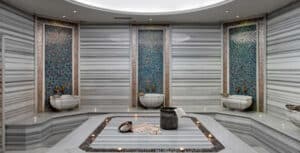
Of all thermal facilities, hammams generate the highest direct revenue, because the experience itself is sold as a treatment rather than a free amenity. A 60-minute hammam ritual is sold at treatment prices rather than amenity prices, and because the consumables are minimal and the room does the work, it runs a high gross margin. A property that installs a traditional Turkish bath or Moroccan bath typically sees this revenue line grow into 15–25 % of total spa revenue within 24 months.
How do cold plunge pools amplify the whole circuit?
A cold plunge pool is the lowest-cost thermal element to add and the one that most increases circuit utilisation. Spas that offer a contrast cycle (sauna, cold plunge, steam, rest) report sessions that are 30–60 % longer than spas without cold immersion. Longer sessions correlate with more retail purchases, more day-pass return visits, and stronger member retention.
What are the biggest mistakes hotel owners make when investing in a spa?
The three most expensive mistakes are under-sizing the thermal suite, choosing the wrong manufacturer-installer split, and skipping cold therapy. Hotels typically give thermal facilities only 15–25 % of spa floor area when 30–35 % generates better total revenue, and multi-vendor briefs run 30–48 weeks against 12–20 weeks for a single-source manufacturer-installer.
Each of them costs more over the first five operating years than getting it right would have cost at design stage, and the loss shows up in two places at once: revenue that never arrives, and rework in a finished wet area.
Why under-sizing the thermal suite hurts ROI
Hotels often allocate 40–55 % of spa floor area to treatment rooms and only 15–25 % to thermal facilities, when the data points to a 30–35 % thermal allocation generating better total revenue. The reason: thermal suites multiply treatment-room utilisation. Rebuilding an undersized thermal suite after opening is recurring work for our team, and it always costs more than building it correctly the first time: the demolition, the temporary closure and the reinstatement are all additional to the room itself.
Why splitting manufacturing and installation is expensive
Multiple-vendor projects, where one company supplies equipment and another installs it, almost always cost more in coordination time, defect resolution, and missed deadlines. As a single-source manufacturer with our own installation teams, we have delivered hotel projects in 12–20 weeks where multi-vendor briefs ran 30–48 weeks. Our commercial spa development team prices design, build, freight, install, and commissioning under one contract with one warranty.
Why skipping cold therapy is a false saving
Cold plunge pools, ice fountains, and shock buckets are the lowest-cost thermal elements and the highest-impact on guest experience. Hotels that defer them to “phase 2” usually see lower-than-projected spa revenue in years 1–3 and end up paying double the original cost when they retrofit. Build the contrast circuit on day one.
A real example of expensive scope cuts
The hammam is the item most often cut when a construction budget tightens, and it is the item most often added back after opening. Retrofitting it costs substantially more than building it in sequence, because the wet-zone tanking has to be opened, the plant re-balanced, and the spa closed for part of the works — usually during a period the property would rather be trading. Sequenced design always beats retrofit on hotel spa projects.
Why hotel spa ROI is more achievable than most owners assume
Hotel spas are no longer a luxury cost line that owners tolerate to compete with neighbours. They are increasingly a primary revenue and brand-positioning lever, with payback periods that compete favourably with most other hotel capital projects. Done well, a spa contributes 6–14 % of total hotel revenue, supports 4–9 % RevPAR uplift, and pays back capital in 3–6 years.
The owners and asset managers who get the strongest returns share three habits. First, they design the thermal suite generously and the treatment-room count tightly, then expand treatment capacity as demand proves itself. Second, they run a single-source contract for design, manufacturing, and installation, which eliminates coordination cost. Third, they treat the spa as a yield-managed revenue line, not a fixed amenity, with day passes, memberships, and dynamic packages.
Ready to model the ROI on your property? Our hospitality team has 40 years of installations across luxury and upper-upscale segments. We will walk your property, model your spa P&L, and quote a complete design-build solution. Request a free consultation and we will return a tailored ROI model within 14 days.
Frequently asked questions about hotel spa ROI
How long does a typical hotel spa take to design and build?
A new-build hotel spa runs 14–28 weeks from concept to commissioning when handled by a single-source manufacturer-installer. Multi-vendor projects often run 30–48 weeks because of coordination friction. Refits and expansions to existing facilities usually run 8–18 weeks depending on phasing and operational impact.
Should we operate the spa internally or outsource to a brand operator?
Internal operation captures more margin but requires spa management expertise; brand operators (e. g., ESPA, Six Senses Spas, Mandarin Oriental Spa) bring instant brand equity and operating systems but typically take 8–14 % of spa revenue as a management fee. The decision depends on your owner’s spa expertise, brand positioning, and risk tolerance.
How important are membership and day-pass revenue to ROI?
Very important in urban properties and underused in resort properties. Memberships and day passes can lift a hotel spa from 65 % occupancy of capacity to 85 %+ on shoulder days, materially improving SpaRevPAR. Resort properties with strong leisure occupancy typically focus on guest-and-package revenue instead.
What energy cost should we budget for a thermal spa?
Plan for 6–12 % of spa revenue going to energy in commercial operations, depending on local utility rates and facility size. A well-insulated thermal suite, programmable controls, occupancy sensors, and heat recovery on ventilation can reduce energy load by 18–28 %. Our design specifications include energy-efficiency features as standard.
How does spa revenue contribute to hotel valuation at sale?
Hotel valuations capitalise EBITDA at multiples that depend on segment and location. Strong spa contribution improves both EBITDA margin and revenue diversification, which often supports a higher valuation multiple at sale. In recent transactions in our portfolio markets, spa-rich properties have traded at 0.5–1.0× higher EBITDA multiples than otherwise-comparable properties.
Can an existing hotel retrofit a spa profitably?
Yes, particularly if existing back-of-house space (under-used meeting rooms, basement areas, lobby-floor retail) can be repurposed. Retrofit projects carry a cost premium per square metre over new builds because of structural and MEP constraints — the slab has to take the loads, the risers have to reach the wet rooms, and the plant has to fit into space that was never planned for it — but ROI can still be strong if the property has a wellness-positioned brand or strong feeder demand for spa services.
What is the right capacity ratio of treatment rooms to keys?
For luxury urban hotels, plan one treatment room per 25–35 keys. For resorts, plan one treatment room per 18–25 keys. Properties with destination-spa positioning may go as low as one room per 10–15 keys. Adding a fitness centre and recovery area alongside the spa improves utilisation across both.
Sources
- Global Wellness Institute. (2024). The Global Wellness Economy: Country Rankings. GWI Industry Research
- International Spa Association. (2024). U.S. Spa Industry Study. ISPA Research
- HVS. Hotel Research and Industry Reports. HVS Articles
- Horwath HTL. European Hotel Industry Reports. Horwath HTL
- Cornell University School of Hotel Administration. Center for Hospitality Research. CHR


