


Last updated: April 2026
In the spring of 2024, a Boston-based architect named Rachel visited Istanbul for the first time. Two days into her trip she stepped into a 16th-century hammam in the old city, expecting “a nicer kind of steam room”. Ninety minutes later she walked out, in her own words, “rearranged from the inside out”. Six months on, her practice in Massachusetts had commissioned its first private Turkish bath for a client’s home in Brookline, and our team in Istanbul was on the design call.
That reaction is not unusual. A Turkish bath is not a steam room with marble walls. It is a centuries-old bathing ritual built around radiant heat, slow time, and human touch, and it delivers a sensory and physiological experience that no sauna or steam cabin can quite reproduce. In this guide, we explain what a Turkish bath actually is, where it comes from, what happens inside one, and how it compares to the Finnish sauna and the modern steam room.
Thinking about a custom hammam for a hotel, spa, or private residence? Explore our hammam range or request a free consultation with our design team, we have built authentic Turkish baths for clients from Istanbul to Dubai to the United States since 1987.
What is a Turkish bath in simple terms?
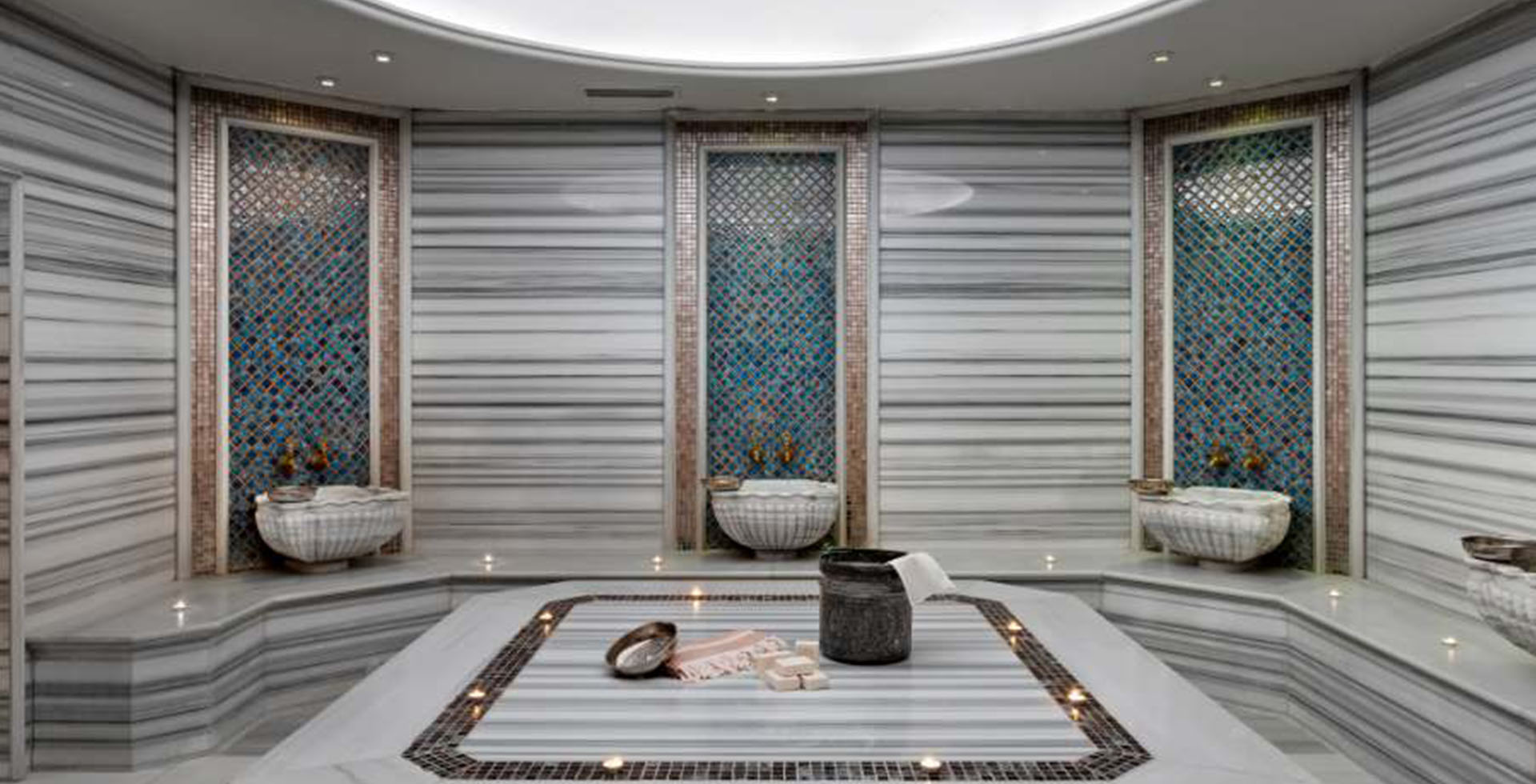
A Turkish bath, known in Turkish as a hamam (pronounced hah-MAHM), is a public or private bathhouse built around a heated marble platform called the göbek taşı. Bathers lie on the warm stone in a humid, domed chamber heated to around 40–45 °C (104–113 °F), then receive a vigorous exfoliation with a coarse mitt called a kese and a soap-foam massage. It is part bathing, part therapy, and part social ritual.
Unlike a Finnish sauna, the air is humid rather than dry. Unlike a modern steam room, the heat is delivered mainly through the marble itself, not through steam clouds. And unlike either, the experience is not something you do alone, traditionally, a tellak (male attendant) or natır (female attendant) performs the scrub and wash for you.
Where does the word “hammam” come from?
The word hammam (also spelled hamam in Turkish, hammām in Arabic) comes from the Arabic root ḥamma, meaning “to heat”. It entered Turkish through Ottoman Arabic and spread across the Islamic world along with the bathing tradition itself. In English we tend to write “hammam” rather than “hamam”, both are correct, but Sauna Dekor uses “hammam” in international content for clarity.
Where does the Turkish bath come from?
The Turkish bath is the Ottoman evolution of two older bathing traditions: the Roman thermae and the Byzantine balneum. When the Ottomans took Constantinople in 1453, they inherited a city already laced with Byzantine bathhouses. Over the following two centuries, Ottoman architects, most famously Mimar Sinan in the 16th century, adapted those buildings into the layout we still recognise today: a domed hot room with a central heated marble platform, smaller side chambers for washing, and a cool entrance hall for resting.
By the 17th century, Istanbul alone had more than 150 public hammams, and the bathhouse was a central institution of city life. It served as a place to wash, of course, but also as a venue for weddings, business deals, gossip, religious purification before prayer, and the celebration of births. Many of those original Sinan-era hammams are still operating today, including Çemberlitaş Hamamı (1584) and Cağaloğlu Hamamı (1741), both of which our team has studied closely as references for restoration and new-build projects.
How is a Roman bath different from a Turkish bath?
A Roman bath followed a sequence of rooms at progressively hotter temperatures, frigidarium (cold), tepidarium (warm), caldarium (hot), and the bather moved through them. A Turkish bath retains this progression but centres the experience on the göbek taşı, the heated marble belly stone, where the bather lies still for an extended period before being scrubbed and washed. The Ottomans also introduced the soap-foam massage, which has no direct Roman equivalent.
What happens inside a Turkish bath?
A traditional hammam visit follows a clear ritual that lasts between 60 and 90 minutes and unfolds in three temperature zones. The bather first warms up in the sıcaklık (the hot, domed marble room) for 15–20 minutes on the heated stone, opening pores and softening the skin. Then comes the kese exfoliation and a soap-foam wash, followed by a cool rinse and a long rest in the entrance hall with tea or sherbet. It is unhurried by design, the slowness is the point.
The three rooms of a traditional hammam
Authentic Ottoman hammams are built around three temperature zones, each with a specific architectural and physiological purpose:
- Soğukluk (cold room), the entrance and changing area, usually around 20–25 °C. Bathers undress, wrap in a cotton peştemal, and acclimatise.
- Ilıklık (warm room), a transitional chamber at roughly 30–35 °C, used to ease the body into heat and prevent thermal shock.
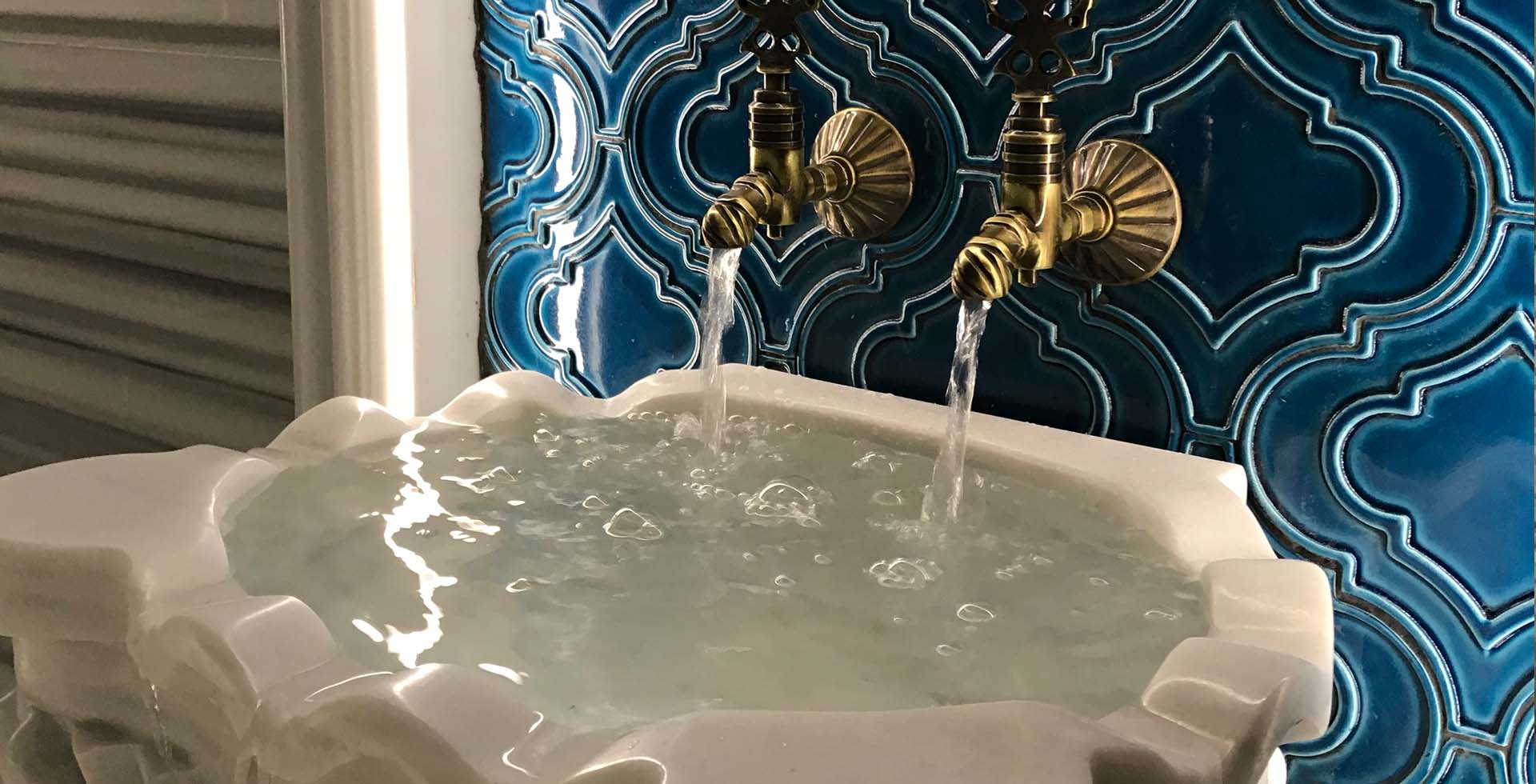
- Sıcaklık (hot room), the heart of the hammam, with the göbek taşı in the centre, heated to 40–45 °C and saturated with humidity from the marble basins around the walls.
Each zone has its own dome, its own light wells (the small star-shaped elephant eyes cut into the roof), and its own acoustic character. Designing these rooms in proportion to one another is one of the most technically demanding parts of building a new hammam, and something our team specifies on every custom Turkish bath project.
What is the göbek taşı and why does it matter?
The göbek taşı, literally “belly stone”, is the large heated marble platform at the centre of the hot room. It is heated from below by a hypocaust system, the same underfloor heating principle the Romans used, and reaches a surface temperature of around 38–42 °C. Bathers lie directly on the stone, and the radiant heat penetrates muscle and joint tissue more deeply than the convective heat of a steam cloud or sauna air. The göbek taşı is the single most important element of an authentic Turkish bath, and it is what most modern “steam room hammam” hybrids get wrong.
What does a kese scrub feel like?
The kese is a coarse-weave silk or goat-hair mitt used to exfoliate dead skin after the bather has spent 15–20 minutes warming on the stone. The attendant works systematically across the body, and the result is visually dramatic, long grey ribbons of dead skin lifting away. It is firm but not painful, and most first-time bathers describe their skin afterwards as feeling “lighter” and noticeably smoother for several days.
What are the health benefits of a Turkish bath?
Regular use of a Turkish bath delivers most of the cardiovascular and recovery benefits associated with sauna bathing, with two additional advantages: deep mechanical exfoliation and a meaningful reduction in stress hormones from the slow ritual itself. A comprehensive review in Mayo Clinic Proceedings found that frequent thermal bathing improves endothelial function, lowers blood pressure over time, and reduces all-cause mortality in a dose-dependent way (Laukkanen et al., 2018).
Does a Turkish bath improve skin health?
Yes, and this is the benefit most users notice first. The combination of humid heat, which softens the stratum corneum, followed by mechanical kese exfoliation, removes far more dead skin than washing alone. Clinical research published in the Journal of the European Academy of Dermatology and Venereology has documented that repeated warm-water bathing improves skin barrier function and hydration in healthy adults. Most clients report visibly smoother skin for 5–7 days after a single session and longer-lasting improvements with weekly use.
Is a Turkish bath good for muscle recovery?
Yes. Passive heat exposure increases peripheral blood flow, helps clear metabolic waste from working muscles, and reduces delayed-onset muscle soreness after exercise. Research published in the Journal of Science and Medicine in Sport has shown that post-exercise heat exposure can accelerate recovery markers compared with passive rest (Mero et al., 2015). The added soap-foam massage, performed at the end of the ritual, provides a mechanical recovery component that pure heat exposure does not.
Does a Turkish bath reduce stress?
Yes, and arguably more effectively than a sauna. The 60–90 minute ritual format, the warm marble surface, the dim humid light, and the human touch component all activate the parasympathetic nervous system. Studies on Watsu and warm-water immersion therapies have linked similar protocols to measurable reductions in cortisol and improvements in heart-rate variability. Anecdotally, this is the benefit our hotel clients hear about most often from their spa guests.
Ready to bring this experience to your own property? Our team has designed and installed authentic hammams for hotel and resort spa projects across three continents. Get a custom quote →
How is a Turkish bath different from a steam room?
A Turkish bath uses radiant heat from a heated marble platform in a humid, domed chamber, while a steam room uses convective heat from a steam generator that fills a sealed cabin with 100 % humidity vapour. The temperatures, the architecture, the bathing ritual, and the physiological effect are all distinct. A steam room is a 15-minute solo experience; a Turkish bath is a 60–90 minute attended ritual.
Turkish bath vs steam room comparison
| Feature | Turkish Bath (Hammam) | Steam Room |
|---|---|---|
| Air temperature | 40–45 °C (104–113 °F) | 40–45 °C (104–113 °F) |
| Humidity | 60–80 % | 100 % |
| Heat source | Heated marble platform (radiant) | Steam generator (convective) |
| Typical session | 60–90 minutes | 10–20 minutes |
| Architecture | Domed marble room with göbek taşı | Sealed tiled cabin |
| Attendant | Yes, kese and foam wash | No |
| Origin | Ottoman / Roman | Modern wellness adaptation |
A well-designed custom steam room and a well-designed Turkish bath are not interchangeable, they serve different bathing rituals and different guests. The most successful hotel spas we have built install both.
How is a Turkish bath different from a Finnish sauna?
A Finnish sauna uses dry, very hot air at 80–100 °C (176–212 °F) with humidity below 20 %, while a Turkish bath uses humid, much cooler air at 40–45 °C with humidity above 60 %. The Finnish sauna is built around intense, short heat exposure followed by a cold plunge; the Turkish bath is built around prolonged moderate heat followed by a hands-on cleansing ritual. They are best understood as complementary practices, not substitutes.
Turkish bath vs Finnish sauna comparison
| Feature | Turkish Bath | Finnish Sauna |
|---|---|---|
| Temperature | 40–45 °C | 80–100 °C |
| Humidity | 60–80 % | 10–20 % |
| Session length | 60–90 min (full ritual) | 8–15 min per round |
| Primary heat | Radiant from marble | Convective from heated stones |
| Cold contrast | Cool rinse | Cold plunge or snow |
| Material | Marble, stone, mosaic | Timber (Hemlock, Spruce, Cedar) |
| Social character | Attended ritual | Self-directed, often communal |
For commercial spas designing recovery zones for high-end guests, our team typically recommends pairing both, a traditional Finnish sauna for cardiovascular conditioning and a custom hammam for skin care, recovery, and the social ritual layer.
How does a Turkish bath compare to a Moroccan bath?
A Moroccan bath, or hammam maghribi, shares the same Arab-Islamic bathing roots as the Turkish hammam but differs in its products and choreography. Moroccan baths use savon noir (black olive-oil soap) applied to the skin and left to soften it for 10–15 minutes before exfoliation, whereas Turkish baths use a soap-foam wash after the kese scrub. Moroccan rooms also tend to be smaller and steamier, without the central göbek taşı that defines an Ottoman hammam.
Both rituals are wonderful, and both have a place in a modern spa programme. Our Moroccan bath designs draw on traditional Marrakech and Fes layouts, while our Turkish bath projects follow the Ottoman tradition with the heated marble platform at the centre.
How often should you use a Turkish bath?
For most healthy adults, one to two Turkish bath sessions per week is enough to see meaningful benefits to skin, recovery, and stress levels. The exfoliation step is too aggressive to repeat daily, the skin barrier needs time to reset between kese sessions. Our hospitality clients typically see guests booking a hammam ritual once per stay as a “signature treatment”, which is part of why a hammam tends to deliver a higher revenue per square metre than a standard treatment room.
Who should avoid a Turkish bath?
People with uncontrolled high blood pressure, recent cardiovascular events, pregnancy in the third trimester, or active skin conditions such as eczema or sunburn should consult a doctor before using a hammam. The heat itself is moderate, significantly cooler than a Finnish sauna, but the duration is longer, and the kese scrub is not appropriate on inflamed or broken skin.
What does it cost to build a Turkish bath?
A custom-built Turkish bath for a private residence typically starts at around 60,000 USD for a compact 6–8 m² installation and rises into the mid six figures for larger commercial hammams with full marble cladding, multiple domes, and integrated washing fountains. The major cost drivers are the marble selection (Marmara, Carrara, onyx), the dome construction, the hypocaust heating system for the göbek taşı, and the tilework or mosaic finishes.
Because every project is custom-built, our team always begins with a free design consultation to understand the space, the intended use, and the budget envelope before producing a quote.
A note on authenticity
When a Florence-based interior designer named Andrea contacted our team in 2025 about restoring a 19th-century bathhouse on the Tuscan coast, his first question was simply “can you build it the way it was built”. Our answer was yes, because Sauna Dekor was founded in Istanbul in 1987 specifically to manufacture authentic Turkish wellness facilities, and because the hammam tradition is the one product category where our 38 years of heritage matters most. A modern steam room with marble walls is not a hammam. The proportions, the göbek taşı heating, the dome acoustics, and the bathing ritual are all part of what makes an authentic Turkish bath work.
Frequently asked questions about Turkish baths
What is the difference between a hammam and a Turkish bath?
There is no difference, hammam is simply the Turkish (and Arabic) word for the bathing institution that English-speakers call a Turkish bath. The same building, the same ritual, and the same architecture are referred to by both names depending on the language being used.
Do you wear clothes in a Turkish bath?
In a traditional hammam, bathers wrap themselves in a cotton peştemal (a thin striped towel) and remove it only during the wash. Modern hotel hammams in international markets typically ask guests to wear swimwear under the peştemal, particularly in mixed-gender settings. Sauna Dekor designs both single-gender and mixed-gender layouts depending on the client’s market.
How long should you stay in a Turkish bath?
A complete Turkish bath ritual lasts between 60 and 90 minutes, including warming on the göbek taşı, the kese scrub, the foam wash, the rinse, and the rest period. The actual time on the heated marble is around 15–20 minutes, comparable to a long sauna session, but the full ritual is much longer because it includes the cleansing and rest stages.
Is a Turkish bath safe for people with high blood pressure?
Regular thermal bathing has been associated with lower blood pressure over time, but heat causes acute vasodilation that can briefly destabilise an already-fragile cardiovascular system. Anyone with diagnosed hypertension or heart disease should consult their doctor before beginning regular hammam use.
Can you build a Turkish bath at home?
Yes. A compact private hammam can fit into a residential footprint of 6–8 m² with sufficient ceiling height for a small dome and the structural capacity to support a marble göbek taşı. Our team has built private Turkish baths in homes from Istanbul to Boston to the UAE, and we handle design, manufacture, delivery, and installation as a single source.
Why is the marble in a Turkish bath always white?
Tradition, light, and acoustics. White Marmara marble was used in Ottoman hammams because it was quarried locally, because it reflects the soft daylight from the dome’s elephant-eye windows, and because it produces the gentle sound diffusion that gives a hammam its characteristic acoustic warmth. Modern hammams sometimes use coloured marble or onyx accents, but the göbek taşı itself is almost always white.
How is a Turkish bath heated?
Traditional hammams used a hypocaust, a wood-fired furnace that channelled hot gases through ducts under the marble floor and göbek taşı. Modern installations use electric or gas-fired systems that achieve the same radiant heating effect with much greater efficiency and precise temperature control. Our team specifies and installs both heating systems on every hammam project.
Bring an authentic Turkish bath to your project
A Turkish bath is one of the few wellness experiences that has not been improved on in 600 years. The combination of radiant marble heat, humid air, mechanical exfoliation, and ritual slowness produces a result no steam cabin or sauna can match, and for hotels, resorts, and private clients, it remains one of the most memorable and revenue-generating wellness installations on the market.
Sauna Dekor has been designing and manufacturing authentic Turkish baths since 1987, with completed projects for Hilton, Ritz-Carlton, Emirates, and private clients across Europe, the Middle East, and the Americas. Every hammam we build is custom-designed to the space, the brief, and the cultural context, and every project is delivered by a single team from concept to installation.
Request a free consultation with our hammam design team, or explore our hammam range to see what is possible.
Sources
- Laukkanen, J. A., Laukkanen, T., & Kunutsor, S. K. (2018). Cardiovascular and Other Health Benefits of Sauna Bathing: A Review of the Evidence. Mayo Clinic Proceedings, 93(8), 1111–1121. Full text
- Research on warm-water bathing and skin barrier function. Journal of the European Academy of Dermatology and Venereology.
- Mero, A., Tornberg, J., Mäntykoski, M., & Puurtinen, R. (2015). Effects of far-infrared sauna bathing on recovery from strength and endurance training sessions in men. SpringerPlus, 4, 321. Full text
