

Last updated: April 2026
A Moroccan bath — حمام مغربي (ḥammām maghribī) — is the Moroccan form of the hammam: a steam-and-scrub ritual built around black soap, a kessa glove and rhassoul clay, performed lying on a heated stone bench rather than sitting in a steam cabin.
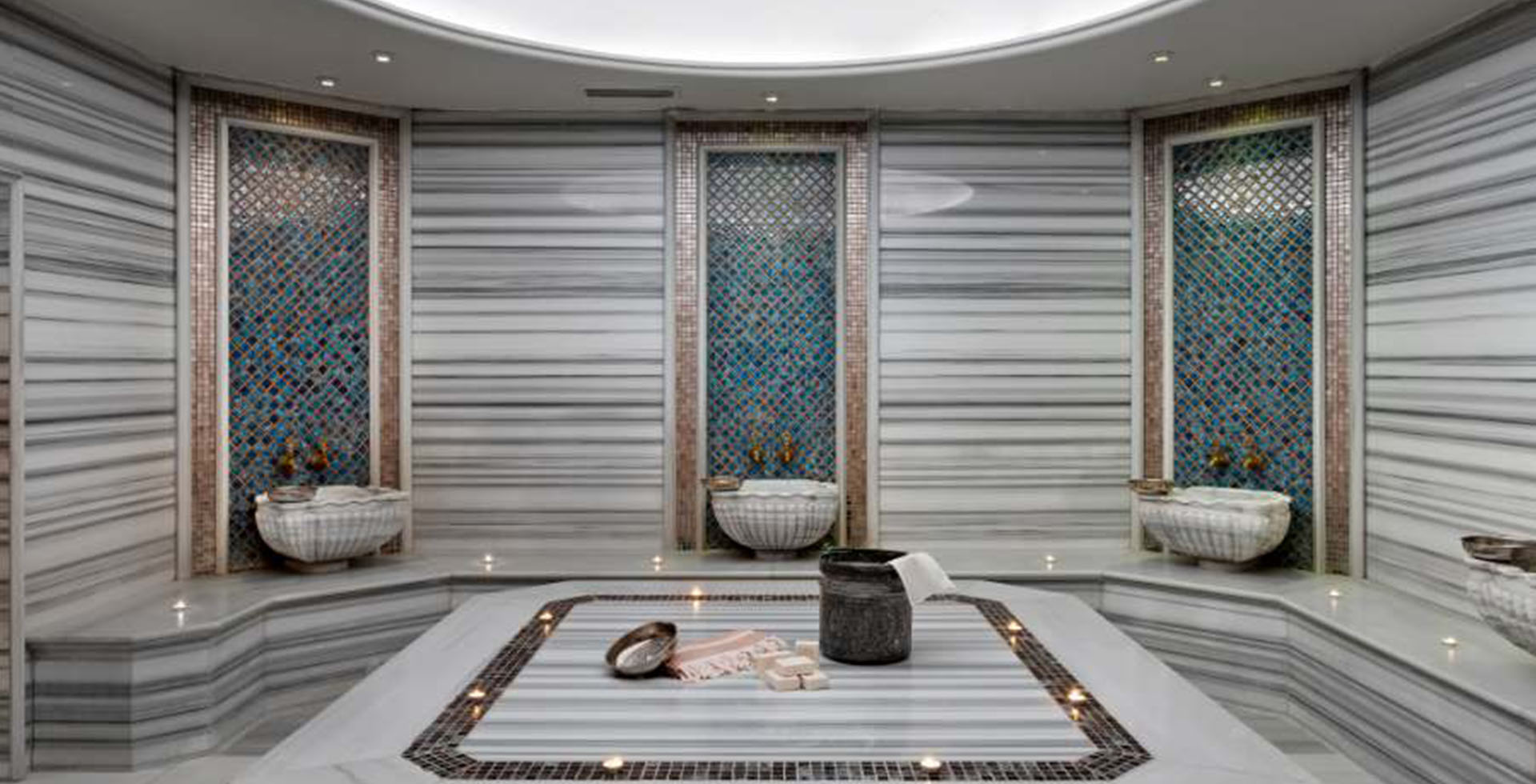
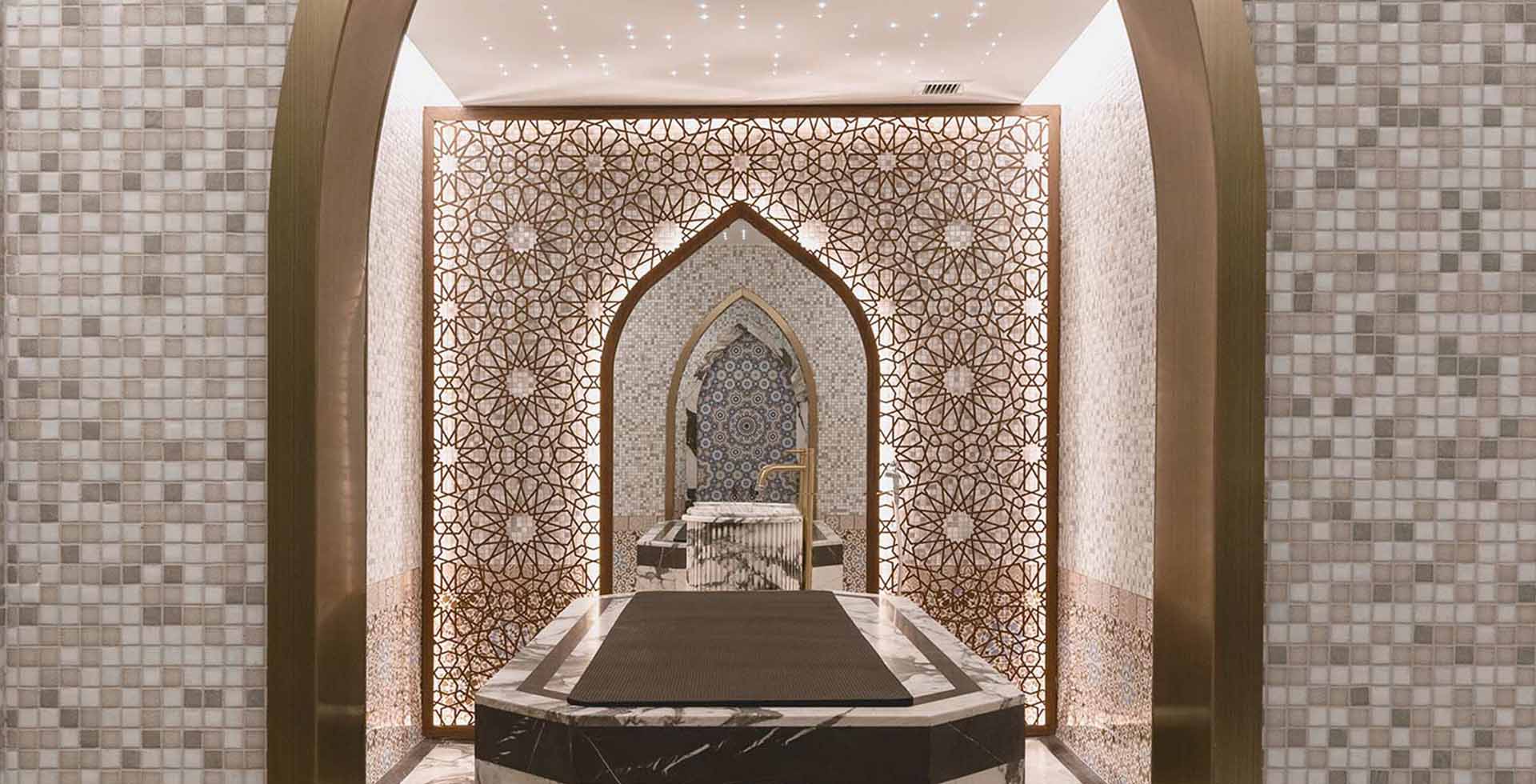
A brief our team is asked to review regularly is a half-built hotel spa wing — treatment rooms, a Finnish sauna, a plunge pool, and a “hammam” that is, in practice, a tiled steam room with a marble bench. What guests ask for is the ritual: the black soap, the glove, the full sequence. A tiled bench cannot deliver any of it, because the ritual depends on a heated stone surface the bather lies on and a washing station the attendant works from. Correcting it means gutting the room and rebuilding it as an authentic Moroccan bath, with traditional tadelakt walls, heated stone benches, and a proper washing station.
| العربية | English | What it is |
|---|---|---|
| حمام مغربي | Moroccan bath | The Moroccan form of the hammam ritual |
| كيسة | kessa glove | Coarse exfoliating mitt used for the scrub |
| غاسول | rhassoul / ghassoul | Mineral clay wash applied after the scrub |
| صابون بلدي | black soap (beldi) | Olive-based soap applied before the scrub |
| حمام بخار | steam room | A steam cabin — not a hammam |
| ساونا / سونا | sauna | Dry-heat cabin; both spellings are in use |
That is the difference between a steam room labelled “hammam” and an actual Moroccan bath. The ritual, the products, and the architecture are specific; and guests can tell. If you’ve searched “Moroccan bath” looking for a clear explanation of what this experience actually involves, this guide covers everything: history, step-by-step ritual, health benefits, and how a Moroccan hammam differs from a Turkish bath and a modern steam room.
Considering a Moroccan bath for your hotel, wellness centre, or home? Explore our Moroccan bath designs or request a free consultation with our hammam specialists, Sauna Dekor has been manufacturing authentic hammams since 1987.
What is a Moroccan bath?
A Moroccan bath, or hammam maghribi, is a bathing ritual run at 40–45 °C (104–113 °F) with high humidity: steam, savon noir black olive-oil soap, a vigorous kessa-mitt scrub, then a ghassoul (rhassoul) clay mask, in that order. One session lasts 45–90 minutes. Unlike a Turkish bath it has no göbek taşı; bathers sit on low benches or the heated floor.
The humidity is generated by pouring hot water over heated stone surfaces, and the ritual leaves the skin visibly smoother and deeply clean.
The Moroccan bath shares its roots with the broader Islamic hammam tradition but has its own distinct products, choreography, and aesthetic. Where a Turkish bath centres on the heated göbek taşı marble platform, a Moroccan bath centres on its signature products: the black soap, the kessa mitt, and the clay.
Where does the Moroccan bath tradition come from?
The Moroccan hammam traces its origins to the Roman bathhouses of North Africa, which were adapted by Arab and Berber communities after the 7th-century Islamic expansion. By the 12th century, the hammam was a fixture of Moroccan urban life, Marrakech, Fes, and Meknes each had dozens of public bathhouses serving every neighbourhood. The ritual evolved around locally available materials: olive-oil soap from the groves of the Rif and Souss regions, argan oil from the southwest, and ghassoul clay mined from the Atlas Mountains.
Today, the public neighbourhood hammam remains part of daily life in Morocco. It is where families bathe, socialise, and mark occasions, a bride-to-be’s pre-wedding hammam, for example, is a celebrated tradition. Sauna Dekor’s Moroccan bath design and build draw directly on the layouts and finishes of the traditional bathhouses in Marrakech and Fes.
What happens during a Moroccan bath ritual?
The ritual follows a fixed sequence — steam, savon noir, kessa scrub, ghassoul clay, rinse — and takes 45 to 90 minutes end to end. The bather sits in the warm, steamy room for 10–15 minutes first, to open the pores and soften the skin. Warm and cool rinses close each stage, and skipping a stage weakens the result.
Step 1: Warming and steaming (10–15 minutes)
The bather enters the heated room, typically finished in tadelakt (polished lime plaster) or stone, and sits on a low bench or directly on the warm floor. Hot water from copper buckets is poured over the body while the room’s steam softens the outer layer of skin. The temperature stays around 40–45 °C, considerably gentler than a Finnish sauna’s 80–100 °C.
Step 2: Savon noir application (5–10 minutes)
Savon noir, or black soap, is a dark, paste-like soap made from crushed olives and olive oil. The attendant (or the bather, in a home setting) spreads it over the entire body in a thick layer and leaves it to sit for five to ten minutes. The soap’s natural oils soften the stratum corneum, the outermost layer of dead skin, far more effectively than a standard shower gel.
Step 3: Kessa exfoliation (10–15 minutes)
This is the defining step of the Moroccan bath. The attendant uses a kessa, a coarse-textured woven mitt, to scrub the body in long, firm strokes. The combination of steam-softened skin and the black soap produces dramatic results: visible rolls of dead skin lift away with each pass. The kessa is rougher than a loofah but gentler than a pumice stone, and the technique requires firm, even pressure that a trained attendant can maintain for 15 minutes without bruising the skin.
Step 4: Ghassoul clay mask (5–10 minutes)
After rinsing off the soap and dead skin, a ghassoul (also called rhassoul) clay mask is applied to the body and sometimes the hair. Ghassoul is a mineral-rich clay mined exclusively from deposits in the Atlas Mountains of Morocco. It absorbs excess oil, tightens pores, and adds minerals back into freshly exfoliated skin. Clinical research on ghassoul clay has documented its ability to improve skin elasticity and reduce sebum without stripping natural moisture, properties that synthetic products struggle to replicate.
Step 5: Rinse and rest (10–15 minutes)
The bather rinses with alternating warm and cool water, often poured from traditional copper buckets. A final application of argan oil is common, the oil absorbs quickly into clean, exfoliated skin and provides deep hydration. Then comes rest: tea, conversation, and a period of stillness that is as much a part of the ritual as the scrub itself.
What are the health benefits of a Moroccan bath?
A Moroccan bath combines three evidence-supported wellness mechanisms, passive heat exposure, deep mechanical exfoliation, and natural topical treatments, into a single ritual. The cardiovascular benefits of regular thermal bathing are well documented: a comprehensive review in Mayo Clinic Proceedings found that frequent heat exposure improves endothelial function, reduces arterial stiffness, and lowers blood pressure over time (Laukkanen et al., 2018). The Moroccan bath adds skin-specific benefits on top of those systemic effects.
Does a Moroccan bath improve your skin?
Yes, and more measurably than most spa treatments. The three-step combination of black soap softening, kessa exfoliation, and ghassoul clay remineralisation removes dead skin, unclogs pores, and restores moisture balance in a single session. Most clients report that their skin feels noticeably smoother for five to seven days after a Moroccan bath. With weekly use, the cumulative effect on skin texture, tone, and clarity becomes significant.
Research published in Applied Clay Science has confirmed that ghassoul clay has strong adsorptive properties that remove impurities from the skin without disrupting the lipid barrier, a combination that most chemical exfoliants and scrubs cannot achieve simultaneously.
Is a Moroccan bath good for stress and relaxation?
Yes. The ritual’s slow pace, the warmth of the room, and the human touch of the attendant’s scrub all activate the parasympathetic nervous system. In Moroccan culture, the hammam is explicitly understood as a place of rest, not exercise. The 45–90 minute session forces a break from stimulation that most modern wellness experiences, including short sauna sessions, do not.
The distinction fits in one line: a sauna warms you, a Moroccan bath takes care of you. Passive heat versus attended ritual is what an operator is really choosing between, and it is why a Moroccan bath needs a treatment protocol and trained staff, not only a finished room.
Want to offer this experience to your guests? Our team designs and builds Moroccan baths for hotels, resorts, and commercial spas worldwide. Get a custom quote.
Does a Moroccan bath help with muscle and joint pain?
The combination of sustained humid heat and manual exfoliation increases peripheral blood flow and helps clear metabolic waste from muscle tissue. While the Moroccan bath is gentler than a Finnish sauna (40–45 °C versus 80–100 °C), the longer exposure time, often 45 minutes or more in the warm room, compensates with a deeper, slower heat penetration. For clients with chronic tension or mild joint stiffness, weekly Moroccan bath sessions often provide more sustained relief than a 15-minute sauna round.
How is a Moroccan bath different from a Turkish bath?
Both are hammams, but the centrepiece differs. A Turkish bath is built around the göbek taşı, a heated marble platform where bathers lie flat for a long warm-up before a kese scrub and foam wash, and runs 60–90 minutes. A Moroccan bath has no göbek taşı: it runs 45–90 minutes around savon noir and ghassoul clay, with bathers seated on low benches or the heated floor.
Moroccan bath vs Turkish bath comparison
| Feature | Moroccan Bath | Turkish Bath |
|---|---|---|
| Centrepiece | Savon noir + ghassoul clay ritual | Göbek taşı (heated marble platform) |
| Soap | Black olive-oil soap (savon noir) | Foam wash with olive soap |
| Exfoliation mitt | Kessa (coarser weave) | Kese (silk or goat-hair) |
| Clay treatment | Ghassoul clay mask (standard) | Not traditional |
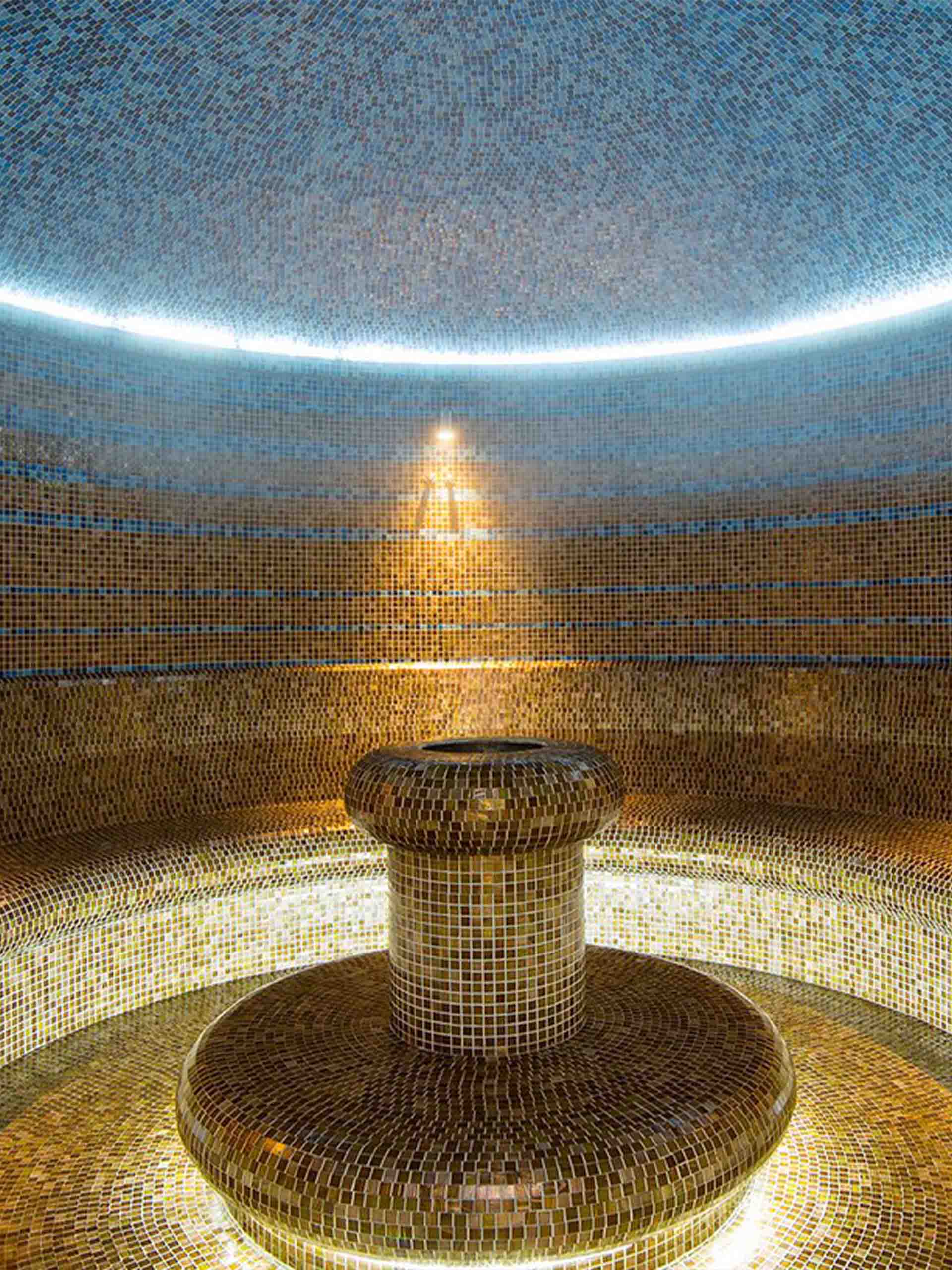
| Architecture | Tadelakt walls, low benches, copper basins | Domed marble room, central platform |
| Session length | 45–90 minutes | 60–90 minutes |
| Temperature | 40–45 °C | 40–45 °C |
| Finishing product | Argan oil | Not traditional |
Both are extraordinary bathing experiences, and both have a strong place in a modern spa programme. For commercial projects, our team often recommends installing both a custom Turkish bath and a Moroccan bath as distinct treatment offerings. For residential clients, the choice usually comes down to personal preference and the ritual they find most appealing.
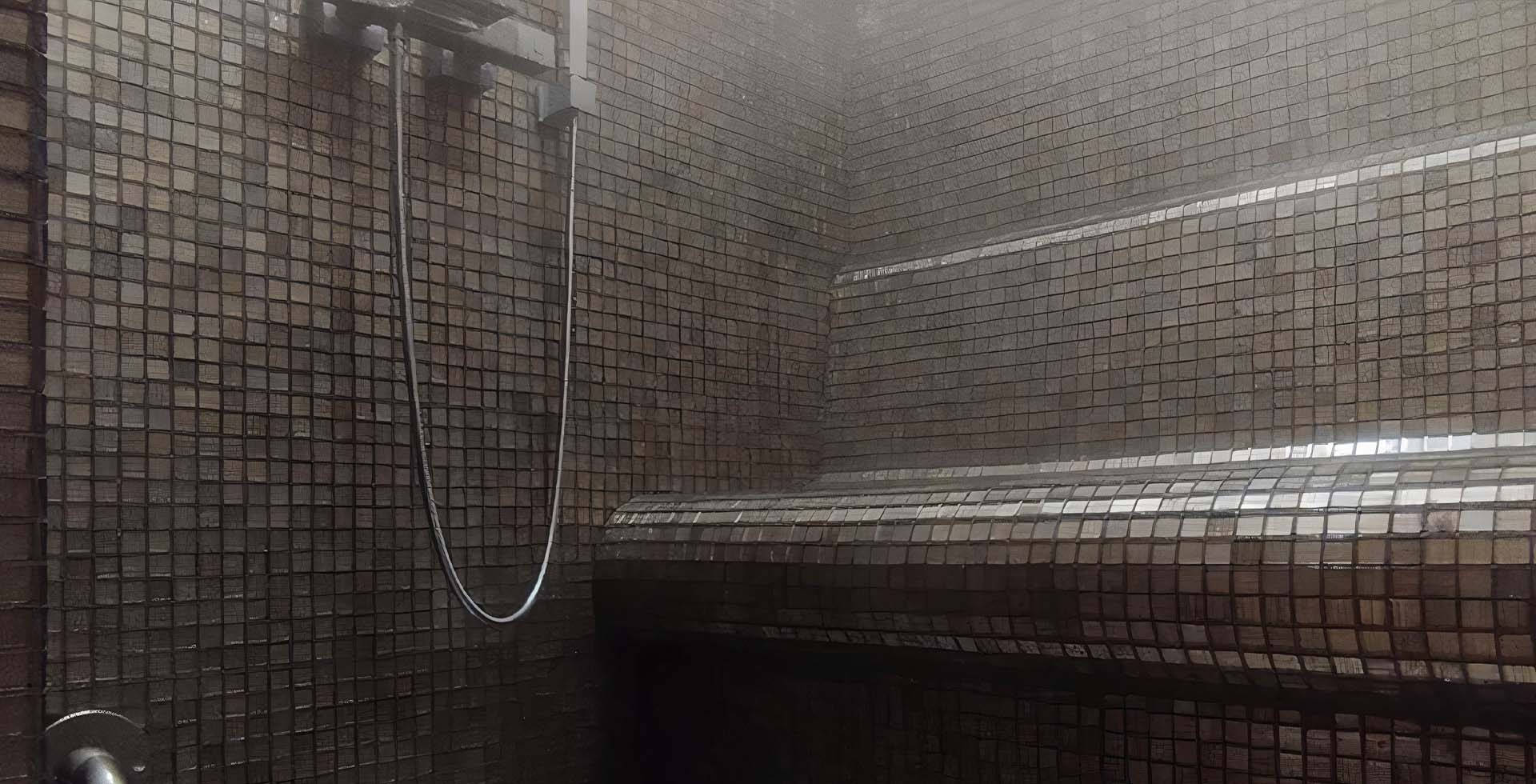
How is a Moroccan bath different from a steam room?
A modern steam room is a sealed, tiled cabin that fills with 100 % humidity vapour from an electric steam generator. Bathers sit inside for 10–20 minutes, perspire, and leave. There is no attendant, no exfoliation, no soap or clay, and no ritual sequence. A Moroccan bath uses humid heat as just the first step in a multi-stage cleansing process that lasts three to four times longer and involves direct physical contact.
Moroccan bath vs steam room comparison
| Feature | Moroccan Bath | Steam Room |
|---|---|---|
| Temperature | 40–45 °C (104–113 °F) | 40–45 °C (104–113 °F) |
| Humidity | 60–80 % | 100 % |
| Heat source | Heated stone surfaces + hot water | Electric steam generator |
| Session length | 45–90 minutes | 10–20 minutes |
| Exfoliation | Yes (kessa + savon noir) | No |
| Clay treatment | Yes (ghassoul) | No |
| Attendant | Yes (traditional) | No |
| Architecture | Tadelakt, stone, copper fittings | Sealed tiled cabin |
A custom steam room is an excellent addition to any spa or home wellness area, but it serves a different purpose. Steam rooms offer quick cardiovascular recovery; Moroccan baths offer a complete skin-care and relaxation ritual.
How often should you have a Moroccan bath?
For most healthy adults, 1 Moroccan bath per week is the right frequency. The kessa exfoliation is thorough enough that the skin needs 5 to 7 days to regenerate its outer layer before the next session. In Morocco a weekly hammam visit, usually on a fixed day, has been the standard pattern for centuries.
For hotel guests, a single Moroccan bath session during their stay is the typical booking pattern. Our commercial clients find that the Moroccan bath consistently commands a higher per-treatment price than a standard massage or facial, and guests rate it among the most memorable parts of their stay.
What does it cost to build a Moroccan bath?
A compact residential Moroccan bath, roughly 6–8 m² with tadelakt finishes, heated flooring, a built-in bench, and proper drainage, typically starts at around 50,000 USD. Larger commercial installations for hotels and spas range from 80,000 to well over 200,000 USD depending on the number of treatment stations, the stone and plaster finishes, and the integration with adjacent wet areas.
The most significant cost variables are the wall finish (hand-applied tadelakt is labour-intensive but authentic), the heating system, the drainage engineering, and any imported copper fittings or mosaic tilework. Our team handles design, manufacture, delivery, and installation as a single-source partner, which simplifies coordination and keeps costs predictable.
Because every Moroccan bath we build is custom-designed, we always start with a free consultation to understand the project scope before quoting.
Frequently asked questions about Moroccan baths
What is savon noir made from?
Savon noir, or Moroccan black soap, is made from crushed olives and olive oil. The olives are macerated in salt and potassium hydroxide (lye) until they form a dark, paste-like soap. High-quality savon noir contains no synthetic fragrances or preservatives. It has been used in Moroccan hammams for centuries.
Is a Moroccan bath the same as a hammam?
A Moroccan bath is one type of hammam. The word hammam simply means “bathhouse” in Arabic, and different regions have their own hammam traditions. A Moroccan bath uses savon noir and ghassoul clay; a Turkish bath uses a heated marble platform and foam wash. Both are hammams, but the rituals are distinct.
Can men use a Moroccan bath?
Yes. In Morocco, public hammams have separate sessions or separate facilities for men and women. In commercial hotel spas and private residential installations, our team designs Moroccan baths for mixed-gender use, single-gender use, or flexible scheduling, depending on the client’s market and cultural context.
Is a Moroccan bath safe during pregnancy?
Heat exposure above 40 °C is generally not recommended during the first trimester. In later stages of pregnancy, shorter sessions at moderate temperatures may be acceptable, but we always advise consulting a doctor first. Many Moroccan spas offer modified, lower-temperature hammam rituals specifically for pregnant clients.
What is tadelakt?
Tadelakt is a traditional Moroccan lime plaster that has been used for centuries to waterproof the interior walls of hammams, cisterns, and riads. It is polished with a smooth river stone and sealed with olive-oil soap, creating a naturally water-resistant, slightly glossy surface that resists mould without synthetic sealants. It is the authentic wall finish for a Moroccan bath.
How is a kessa different from a loofah?
A kessa is a flat, woven mitt with a rough, crepe-like texture designed for full-body exfoliation by an attendant. A loofah is a cylindrical natural sponge used for lighter self-scrubbing in the shower. The kessa removes significantly more dead skin because it is used after the savon noir has softened the skin, and because the attendant applies far more sustained pressure than self-washing allows.
Can I build a Moroccan bath at home?
Yes. A private Moroccan bath can fit into a residential space of 6–8 m² with proper waterproofing, heating, drainage, and ventilation. Our team has built private Moroccan baths in homes across Europe, the Middle East, and the United States. Every project is custom-designed to the space and finished to the client’s specification.
Build an authentic Moroccan bath with Sauna Dekor
A Moroccan bath is one of the few wellness experiences where the products, the ritual, and the architecture work together as a single system. The savon noir opens the skin. The kessa removes what no shower can reach. The ghassoul rebuilds what the scrub has cleared. And the room itself, warm, humid, unhurried, holds the entire sequence together.
Sauna Dekor has been designing and manufacturing hammams since 1987, with completed projects for luxury hotels, private residences, and day spas across three continents. Every Moroccan bath we build is custom-designed from the tadelakt walls to the drainage engineering, manufactured at our Istanbul facility, and installed by our own teams worldwide.
Request a free consultation with our hammam design team, or explore our Moroccan bath range to see recent projects and specifications.
If the question is not the ritual but the room that has to survive it — the floor fall, the central gully, the tanking class and the steam generator — that side is set out in our guide to the morocco bath room itself.
Sources
- Laukkanen, J. A., Laukkanen, T., & Kunutsor, S. K. (2018). Cardiovascular and Other Health Benefits of Sauna Bathing: A Review of the Evidence. Mayo Clinic Proceedings, 93(8), 1111–1121. Full text
- Research on the adsorptive and cleansing properties of ghassoul (rhassoul) clay. Applied Clay Science.


Permalink